Evaluating language technologyL'évaluation des technologies langagières
PrintedImprimé le·aylart.github.io/learn·
CC BY-NC 4.0
Evaluation foundationsFondements de l'évaluation
Written in English. The French version was automatically generated
and I have not revised it.
Rédigé en anglais. La version française a été
générée automatiquement et je ne l'ai pas révisée.
Systematic evaluationL'évaluation systématique
Limits of a first impression
When you try out a language tool, for example a machine translation system, a
spelling checker or a chatbot, the obvious way to judge it is to look at some
of its results and decide whether they seem good. That first impression is
useful, but it is a weak basis for a conclusion:
it relies on the few examples you happened to try;
it depends on your own expertise, so another person can judge the same
results differently, and it does not work for a subject or a language in
which your own expertise is limited;
it cannot be compared with another person’s impression of another tool, or
with your own impression of the same tool a year later.
An evaluation is a more systematic way of judging a tool. The tool is run on
evaluation data chosen in advance and its output is judged by a method that
is stated, so that the result can be checked, repeated and compared.
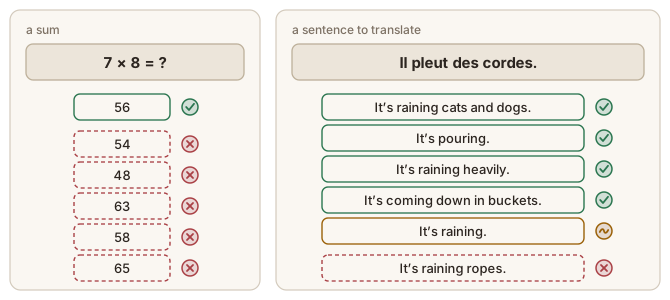
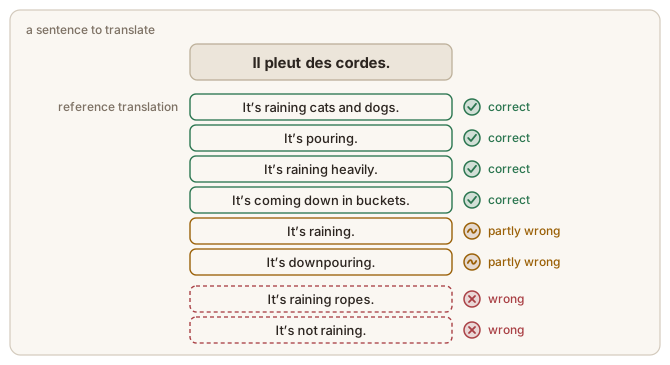
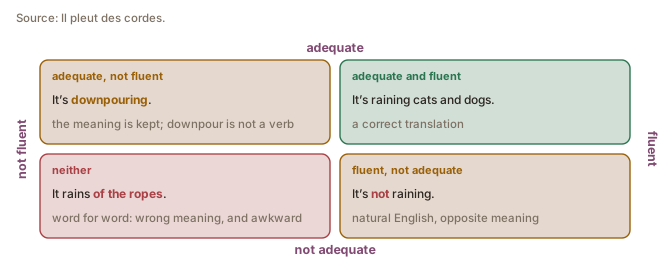
Figure 1. One of the main difficulties in evaluating NLP tasks is that there are often multiple correct answers. Compare, for instance, simple mathematics (1 correct answer, everything else wrong) with translation (multiple correct answers, maybe a few OK answers, some wrong answers).
Writing text, where many outputs would be acceptable
translation, summarization
the output against one or more reference texts, or the output itself, by people (see also the Ways of evaluating page) (voir aussi la page Les façons d'évaluer)
overlap and similarity metrics such as BLEU, chrF, BERTScore and COMET; human ratings
Basile, V., Fell, M., Fornaciari, T., Hovy, D., Paun, S., Plank, B., et al. (2021). We Need to Consider Disagreement in Evaluation. Proceedings of the 1st Workshop on Benchmarking: Past, Present and Future. https://doi.org/10.18653/v1/2021.bppf-1.3
Les limites d’une première impression
Quand vous essayez un outil langagier, par exemple un système de traduction
automatique, un correcteur orthographique ou un agent conversationnel, la
façon la plus évidente de le juger consiste à regarder quelques-uns de ses
résultats et à décider s’ils semblent bons. Cette première impression est
utile, mais c’est une base fragile pour une conclusion :
elle dépend des quelques exemples que vous avez essayés ;
elle dépend de votre propre expertise, de sorte qu’une autre personne peut
juger les mêmes résultats autrement, et elle ne fonctionne pas pour un
sujet ou une langue où votre expertise est limitée ;
elle ne peut pas être comparée à l’impression d’une autre personne sur un
autre outil, ni à votre propre impression du même outil un an plus tard.
Une évaluation est une façon plus systématique de juger un outil. L’outil
fonctionne sur des données d’évaluation choisies à l’avance et sa sortie est
jugée selon une méthode déclarée, de sorte que le résultat peut être
vérifié, répété et comparé.
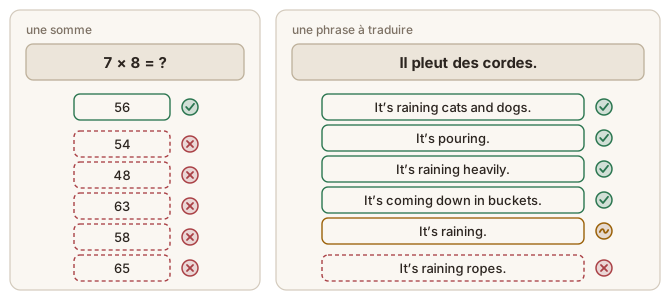
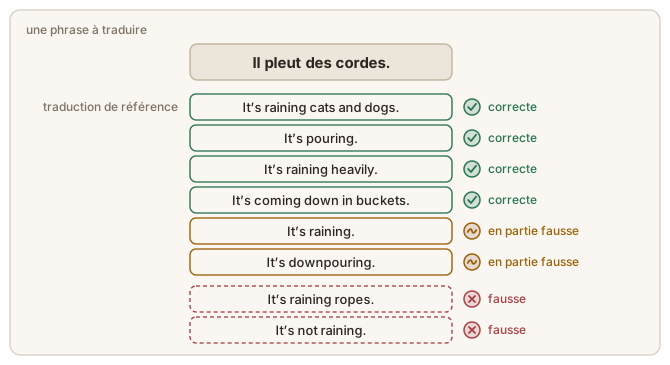
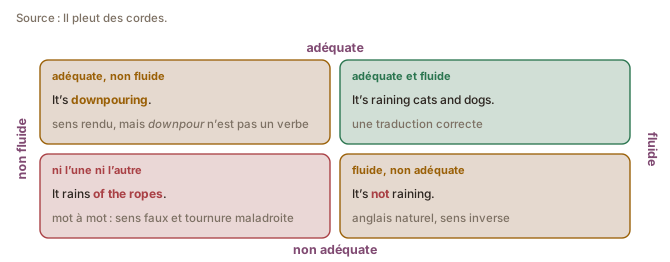
Figure 1. L'une des principales difficultés de l'évaluation des tâches du TAL est qu'il existe souvent plusieurs réponses correctes. Comparez, par exemple, un calcul simple (une seule réponse correcte, toutes les autres fausses) et la traduction (plusieurs réponses correctes, peut-être quelques réponses acceptables, quelques réponses fausses).
Rédiger un texte, quand de nombreuses sorties seraient acceptables
la traduction, le résumé
la sortie, comparée à un ou plusieurs textes de référence, ou la sortie elle-même, par des personnes (see also the Ways of evaluating page) (voir aussi la page Les façons d'évaluer)
des mesures de recoupement et de similarité comme BLEU, chrF, BERTScore et COMET ; des notes attribuées par des personnes
Basile, V., Fell, M., Fornaciari, T., Hovy, D., Paun, S., Plank, B., et al. (2021). We Need to Consider Disagreement in Evaluation. Proceedings of the 1st Workshop on Benchmarking: Past, Present and Future. https://doi.org/10.18653/v1/2021.bppf-1.3
Ways of evaluatingLes façons d'évaluer
Four ways to evaluate
The output of a system can be evaluated in several ways. The first table
below gives four of them, with the kinds of system each is typically used
for. The first way compares the output with answers prepared in advance,
while in the other three, people judge the output itself.
the output is compared with answers that people prepared in advance, and the comparison is counted by a measure
systems that find or label things, such as a spam filter or a term extractor; also translation systems, compared with a human translation
Pairwise comparison
a person sees two outputs for the same input and says which one is better (Jurafsky & Martin, 2026)
systems that produce text, such as translation systems and chatbots
Rating on a scale
a person gives each output a score, for instance from 1 to 5, often for one criterion at a time, such as how fluent a translation is (Jurafsky & Martin, 2026)
a person marks each error in the output, with its category and how serious it is (Freitag et al., 2021)
systems that produce text, above all translation systems
Four ways to evaluate the output of a system.
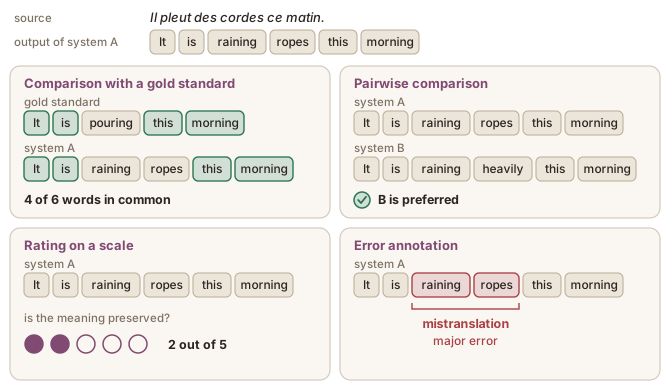
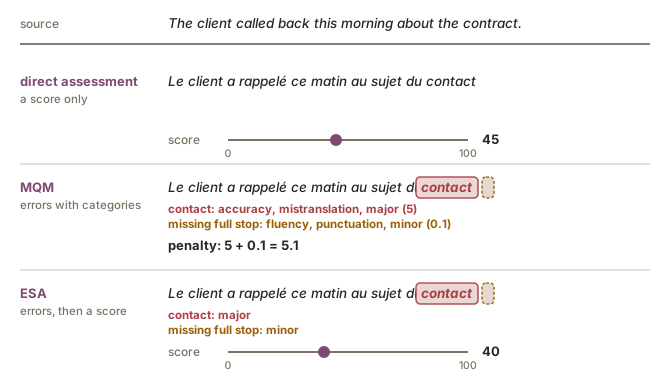
Figure 2figure 2 applies the four ways to one machine translation.
Figure 2. One machine translation evaluated in four ways. The sentences and the judgements are invented.
Each way has its benefits and its costs, which the second table sets out.
Way of evaluating
Benefits
Costs and risks
Comparison with a gold standard
the same evaluation can be repeated, and reused for every new system at no extra cost
the result depends on one gold standard, where other answers could be correct (Basile et al., 2021); a public gold standard can end up in the training data of the systems it tests (Sainz et al., 2023)
Pairwise comparison
an easy judgement to make, which shows directly which of two systems is preferred
it says which output is better, but not how good either is, or why; every new system needs new judgements
Rating on a scale
a quality level for each output, on each criterion
people apply a scale differently, so raters need clear criteria and training (Jurafsky & Martin, 2026)
Error annotation
it shows which errors a system makes and where
slow and expensive, because it takes experts (Kocmi et al., 2024a)
Benefits and costs of the four ways of evaluating.
How the criteria are defined. In two decades of papers on text
generation, the quality criteria had very different names and definitions
from one paper to the next, and reports often left out how the evaluation
was done, so the results are hard to compare (Howcroft et al., 2020).
An extrinsic evaluation is the only way to know whether a system helps with
the task at hand, but it is often very expensive (Jurafsky & Martin, 2026).
Choosing a way of evaluating
The way of evaluating depends on the question and on the available
resources.
The question, for instance:
to find out which of two chatbots or translation systems people prefer, a
pairwise comparison;
to find out whether a translation is good enough to use, and what is wrong
with it, a rating or an error annotation;
to compare many systems, or to follow one system from one version to the
next, a comparison with a gold standard (see also the gold standard page) (voir aussi la page L'étalon de référence).
The resources, for instance:
Time and money. Judgements by people cost more than an automatic
measure, and they have to be paid for again for every new system
(Jurafsky & Martin, 2026).
Expertise. Error annotation takes experts, who are not available for
every language (Kocmi et al., 2024a).
An existing gold standard. Where none exists for the task, the domain
and the language, making one is the first cost of the evaluation.
An evaluation often combines several ways, for instance a score against a
gold standard for every system and an error annotation for the best ones.
Sources
Basile, V., Fell, M., Fornaciari, T., Hovy, D., Paun, S., Plank, B., et al. (2021). We Need to Consider Disagreement in Evaluation. Proceedings of the 1st Workshop on Benchmarking: Past, Present and Future. https://doi.org/10.18653/v1/2021.bppf-1.3
Freitag, M., Foster, G., Grangier, D., Ratnakar, V., Tan, Q., & Macherey, W. (2021). Experts, Errors, and Context: A Large-Scale Study of Human Evaluation for Machine Translation. Transactions of the Association for Computational Linguistics, 9, 1460–1474. https://doi.org/10.1162/tacl_a_00437
Howcroft, D. M., Belz, A., Clinciu, M.-A., Gkatzia, D., Hasan, S. A., Mahamood, S., et al. (2020). Twenty Years of Confusion in Human Evaluation: NLG Needs Evaluation Sheets and Standardised Definitions. Proceedings of the 13th International Conference on Natural Language Generation, 169–182. https://doi.org/10.18653/v1/2020.inlg-1.23
Jurafsky, D., & Martin, J. H. (2026). Speech and Language Processing: An Introduction to Natural Language Processing, Computational Linguistics, and Speech Recognition with Language Models. Online draft, 3rd edition. https://web.stanford.edu/~jurafsky/slp3/
Kocmi, T., Zouhar, V., Avramidis, E., Grundkiewicz, R., Karpinska, M., Popović, M., et al. (2024a). Error Span Annotation: A Balanced Approach for Human Evaluation of Machine Translation. Proceedings of the Ninth Conference on Machine Translation (WMT 2024), 1440–1453. https://doi.org/10.18653/v1/2024.wmt-1.131
Sainz, O., Campos, J., García-Ferrero, I., Etxaniz, J., Lopez de Lacalle, O., & Agirre, E. (2023). NLP Evaluation in Trouble: On the Need to Measure LLM Data Contamination for Each Benchmark. Findings of the Association for Computational Linguistics: EMNLP 2023, 10776–10787. https://doi.org/10.18653/v1/2023.findings-emnlp.722
La sortie d’un système peut être évaluée de plusieurs façons. Le premier
tableau ci-dessous en présente quatre, avec les types de systèmes pour
lesquels chacune est habituellement utilisée. La première façon compare la
sortie avec des réponses préparées à l’avance, tandis que dans les trois
autres, des personnes jugent la sortie elle-même.
la sortie est comparée à des réponses que des personnes ont préparées à l’avance, et la comparaison est chiffrée par une mesure
les systèmes qui trouvent ou étiquettent des éléments, comme un filtre antipourriel ou un extracteur de termes ; aussi les systèmes de traduction, comparés à une traduction humaine
Comparaison par paires
une personne voit deux sorties pour la même entrée et dit laquelle est la meilleure (Jurafsky & Martin, 2026)
les systèmes qui produisent du texte, comme les systèmes de traduction et les agents conversationnels
Notation sur une échelle
une personne attribue une note à chaque sortie, par exemple de 1 à 5, souvent pour un critère à la fois, comme la fluidité d’une traduction (Jurafsky & Martin, 2026)
une personne marque chaque erreur dans la sortie, avec sa catégorie et sa gravité (Freitag et al., 2021)
les systèmes qui produisent du texte, surtout les systèmes de traduction
Quatre façons d'évaluer la sortie d'un système.
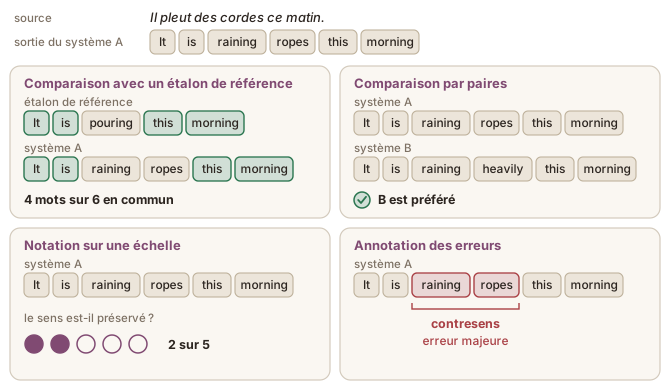
La Figure 2figure 2 applique les quatre façons à une même traduction automatique.
Figure 2. Une même traduction automatique évaluée de quatre façons. Les phrases et les jugements sont inventés.
Chaque façon a ses avantages et ses coûts, que présente le deuxième tableau.
Façon d’évaluer
Avantages
Coûts et risques
Comparaison avec un étalon de référence
la même évaluation peut être répétée, et réutilisée pour chaque nouveau système sans coût supplémentaire
le résultat dépend d’un seul étalon de référence, alors que d’autres réponses pourraient être correctes (Basile et al., 2021) ; un étalon de référence public peut se retrouver dans les données d’entraînement des systèmes qu’il sert à tester (Sainz et al., 2023)
Comparaison par paires
un jugement facile à poser, qui montre directement lequel de deux systèmes est préféré
elle dit quelle sortie est la meilleure, mais pas à quel point chacune est bonne, ni pourquoi ; chaque nouveau système demande de nouveaux jugements
Notation sur une échelle
un niveau de qualité pour chaque sortie, pour chaque critère
les personnes n’appliquent pas une échelle de la même façon, de sorte que les évaluateurs ont besoin de critères clairs et d’une formation (Jurafsky & Martin, 2026)
Annotation des erreurs
elle montre quelles erreurs un système commet et à quel endroit
lente et coûteuse, parce qu’elle demande des spécialistes (Kocmi et al., 2024a)
Comment les critères sont définis. Dans vingt ans d’articles sur la
génération de texte, les critères de qualité avaient des noms et des
définitions très différents d’un article à l’autre, et les comptes rendus
omettaient souvent de dire comment l’évaluation avait été menée, de sorte
que les résultats sont difficiles à comparer (Howcroft et al., 2020).
Une évaluation extrinsèque est la seule façon de savoir si un système aide à
accomplir la tâche visée, mais elle est souvent très coûteuse (Jurafsky &
Martin, 2026).
Choisir une façon d’évaluer
La façon d’évaluer dépend de la question et des ressources disponibles.
La question, par exemple :
pour savoir lequel de deux agents conversationnels ou de deux systèmes de
traduction les gens préfèrent, une comparaison par paires ;
pour savoir si une traduction est assez bonne pour être utilisée, et ce
qui ne va pas, une notation ou une annotation des erreurs ;
pour comparer de nombreux systèmes, ou pour suivre un système d’une
version à la suivante, une comparaison avec un étalon de référence (see also the gold standard page) (voir aussi la page L'étalon de référence).
Les ressources, par exemple :
Le temps et l’argent. Les jugements de personnes coûtent plus cher
qu’une mesure automatique, et il faut les payer de nouveau pour chaque
nouveau système (Jurafsky & Martin, 2026).
L’expertise. L’annotation des erreurs demande des spécialistes, qui ne
sont pas disponibles pour toutes les langues (Kocmi et al., 2024a).
Un étalon de référence existant. Lorsqu’il n’en existe aucun pour la
tâche, le domaine et la langue, en créer un est le premier coût de
l’évaluation.
Une évaluation combine souvent plusieurs façons, par exemple un score par
rapport à un étalon de référence pour chaque système et une annotation des
erreurs pour les meilleurs.
Sources
Basile, V., Fell, M., Fornaciari, T., Hovy, D., Paun, S., Plank, B., et al. (2021). We Need to Consider Disagreement in Evaluation. Proceedings of the 1st Workshop on Benchmarking: Past, Present and Future. https://doi.org/10.18653/v1/2021.bppf-1.3
Freitag, M., Foster, G., Grangier, D., Ratnakar, V., Tan, Q., & Macherey, W. (2021). Experts, Errors, and Context: A Large-Scale Study of Human Evaluation for Machine Translation. Transactions of the Association for Computational Linguistics, 9, 1460–1474. https://doi.org/10.1162/tacl_a_00437
Howcroft, D. M., Belz, A., Clinciu, M.-A., Gkatzia, D., Hasan, S. A., Mahamood, S., et al. (2020). Twenty Years of Confusion in Human Evaluation: NLG Needs Evaluation Sheets and Standardised Definitions. Proceedings of the 13th International Conference on Natural Language Generation, 169–182. https://doi.org/10.18653/v1/2020.inlg-1.23
Jurafsky, D., & Martin, J. H. (2026). Speech and Language Processing: An Introduction to Natural Language Processing, Computational Linguistics, and Speech Recognition with Language Models. Online draft, 3rd edition. https://web.stanford.edu/~jurafsky/slp3/
Kocmi, T., Zouhar, V., Avramidis, E., Grundkiewicz, R., Karpinska, M., Popović, M., et al. (2024a). Error Span Annotation: A Balanced Approach for Human Evaluation of Machine Translation. Proceedings of the Ninth Conference on Machine Translation (WMT 2024), 1440–1453. https://doi.org/10.18653/v1/2024.wmt-1.131
Sainz, O., Campos, J., García-Ferrero, I., Etxaniz, J., Lopez de Lacalle, O., & Agirre, E. (2023). NLP Evaluation in Trouble: On the Need to Measure LLM Data Contamination for Each Benchmark. Findings of the Association for Computational Linguistics: EMNLP 2023, 10776–10787. https://doi.org/10.18653/v1/2023.findings-emnlp.722
The most common way to evaluate an NLP system is to compare its output with a
gold standard (see also the Ways of evaluating page) (voir aussi la page Les façons d'évaluer). The gold
standard states what the output should have been, and it is most often made
of the answers people gave for the same input (Jurafsky & Martin, 2026).
Click the drawing, or a line below, to build it up stage by stage.Cliquez sur le dessin, ou sur une ligne ci-dessous, pour le construire étape par étape.
Figure 3. An evaluation of named entity recognition, the task of finding the names in a text: people mark the names first, and the output of the system is then compared with their answers. The marks are invented.
The general word for the answers that an output is compared with is the
reference. A gold standard is a reference that people produced. For a
translation system, it is a translation made by a person, called a reference
translation.
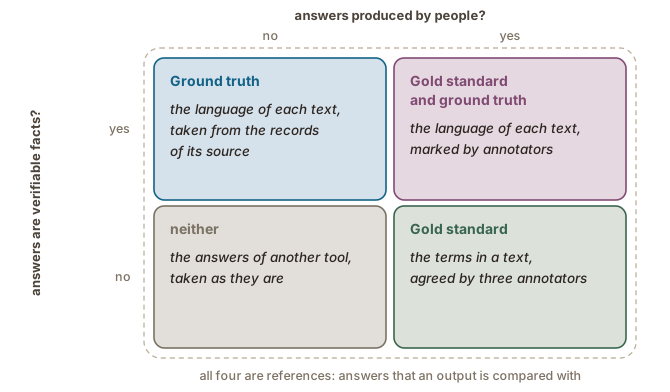
Ground truth is often used as a synonym of gold standard, but the two answer
different questions about a reference
(Figure 4figure 4): a gold standard is produced by people, and a ground truth
consists of verifiable facts. Where the answers depend on judgement, people can
disagree and more than one answer can be correct (Basile et al., 2021), so a
gold standard is then not a ground truth.
Figure 4. Gold standard and ground truth answer two different questions about a reference. The examples are mine.
Limits of a gold standard
Every score computed against a gold standard is a comparison with one
particular set of answers, and that set has limits of its own:
It depends on the guidelines. The people who made it followed written
guidelines and decided the unclear cases, for instance whether names count
as terms or how long a term may be. Had they decided differently, the same
system would score differently on the same
text (see also the Where people disagree about terms page, in the Classical NLP module) (voir aussi la page Les points de désaccord sur les termes, dans le module TAL classique).
For many language tasks, some of these decisions are a matter of judgement
(Basile et al., 2021).
It depends on the annotators. Other people, with other expertise, would
mark some items differently, and any annotator makes mistakes (Artstein &
Poesio, 2008). Comparing the annotators with each other shows how far a gold
standard can be relied
on (see also the Agreement between annotators page) (voir aussi la page L'accord entre annotateurs).
It covers a limited set of texts. A score says how a system does on
texts like those in the gold standard, from one domain, one language and one
type of document, and it says less about other
texts (see also the Interpreting a score page) (voir aussi la page Interpréter un score).
It is costly to extend. A new domain or a new language needs a new gold
standard, annotated by hand again.
It can end up in training data. Once a gold standard is published, the
systems it is meant to evaluate may have been trained on it (Sainz et al.,
2023) (see also the Benchmarks and test sets page) (voir aussi la page Tests de performances et jeux de test).
It lists a limited number of answers. For a system that produces text,
such as a translation system or a chatbot, an output can be good without
resembling any of them, which is one reason why people also judge such
output
directly (see also the Ways of evaluating page) (voir aussi la page Les façons d'évaluer).
Sources
Artstein, R., & Poesio, M. (2008). Inter-coder agreement for computational linguistics. Computational Linguistics, 34(4), 555–596. https://doi.org/10.1162/coli.07-034-R2
Basile, V., Fell, M., Fornaciari, T., Hovy, D., Paun, S., Plank, B., et al. (2021). We Need to Consider Disagreement in Evaluation. Proceedings of the 1st Workshop on Benchmarking: Past, Present and Future. https://doi.org/10.18653/v1/2021.bppf-1.3
Jurafsky, D., & Martin, J. H. (2026). Speech and Language Processing: An Introduction to Natural Language Processing, Computational Linguistics, and Speech Recognition with Language Models. Online draft, 3rd edition. https://web.stanford.edu/~jurafsky/slp3/
Rebholz-Schuhmann, D., Jimeno Yepes, A. J., van Mulligen, E. M., Kang, N., Kors, J., Milward, D., et al. (2010). The CALBC Silver Standard Corpus for Biomedical Named Entities — A Study in Harmonizing the Contributions from Four Independent Named Entity Taggers. Proceedings of the Seventh International Conference on Language Resources and Evaluation (LREC'10). https://aclanthology.org/L10-1609/
Sainz, O., Campos, J., García-Ferrero, I., Etxaniz, J., Lopez de Lacalle, O., & Agirre, E. (2023). NLP Evaluation in Trouble: On the Need to Measure LLM Data Contamination for Each Benchmark. Findings of the Association for Computational Linguistics: EMNLP 2023, 10776–10787. https://doi.org/10.18653/v1/2023.findings-emnlp.722
Tan, Z., Li, D., Wang, S., Beigi, A., Jiang, B., Bhattacharjee, A., et al. (2024). Large Language Models for Data Annotation and Synthesis: A Survey. Proceedings of the 2024 Conference on Empirical Methods in Natural Language Processing, 930–957. https://aclanthology.org/2024.emnlp-main.54/
La sortie et l’étalon de référence
La façon la plus courante d’évaluer un système de TAL est de comparer sa
sortie avec un étalon de référence (angl. gold
standard) (see also the Ways of evaluating page) (voir aussi la page Les façons d'évaluer). L’étalon de
référence indique quelle aurait dû être la sortie, et il est le plus souvent
constitué des réponses que des personnes ont données pour la même entrée
(Jurafsky & Martin, 2026).
Click the drawing, or a line below, to build it up stage by stage.Cliquez sur le dessin, ou sur une ligne ci-dessous, pour le construire étape par étape.
Figure 3. Une évaluation de la reconnaissance d'entités nommées, la tâche qui consiste à trouver les noms dans un texte : des personnes marquent d'abord les noms, puis la sortie du système est comparée à leurs réponses. Les annotations sont inventées.
Étalon de référence, référence et réalité de terrain
Le mot général pour les réponses auxquelles une sortie est comparée est la
référence. Un étalon de référence est une référence que des personnes ont
produite. Pour un système de traduction, c’est une traduction faite par une
personne, appelée traduction de référence.
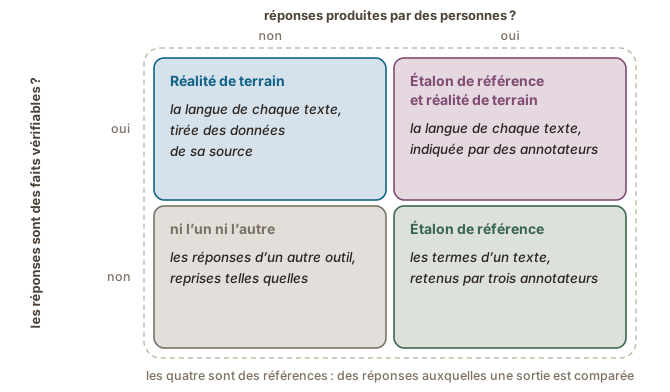
Le terme réalité de terrain (angl. ground truth) est souvent employé comme
synonyme d’étalon de référence, mais les deux répondent à des questions
différentes sur une référence
(Figure 4figure 4) : un étalon de référence est produit par des personnes, et une
réalité de terrain est constituée de faits vérifiables. Lorsque les réponses
dépendent d’un jugement, les personnes peuvent être en désaccord et
plusieurs réponses peuvent être correctes (Basile et al., 2021) : un étalon
de référence n’est alors pas une réalité de terrain.
Figure 4. L'étalon de référence et la réalité de terrain répondent à deux questions différentes sur une référence. Les exemples sont les miens.
Les limites d’un étalon de référence
Chaque score calculé par rapport à un étalon de référence est une comparaison
avec un ensemble de réponses particulier, et cet ensemble a ses propres
limites :
Il dépend des consignes. Les personnes qui l’ont établi ont suivi des
consignes écrites et ont tranché les cas flous, par exemple si les noms
propres comptent comme des termes, ou quelle longueur un terme peut avoir.
Si elles avaient décidé autrement, le même système obtiendrait un autre
score sur le même
texte (see also the Where people disagree about terms page, in the Classical NLP module) (voir aussi la page Les points de désaccord sur les termes, dans le module TAL classique).
Pour beaucoup de tâches langagières, une partie de ces décisions relève du
jugement (Basile et al., 2021).
Il dépend des annotateurs. D’autres personnes, avec une autre
expertise, marqueraient certains éléments autrement, et tout annotateur
fait des erreurs (Artstein & Poesio, 2008). Comparer les annotateurs entre
eux montre à quel point on peut se fier à un étalon de
référence (see also the Agreement between annotators page) (voir aussi la page L'accord entre annotateurs).
Il porte sur un ensemble limité de textes. Un score dit ce que donne un
système sur des textes semblables à ceux de l’étalon de référence, d’un
domaine, d’une langue et d’un type de document, et il en dit moins sur
d’autres textes (see also the Interpreting a score page) (voir aussi la page Interpréter un score).
Il coûte cher à étendre. Un nouveau domaine ou une nouvelle langue
demande un nouvel étalon de référence, annoté de nouveau à la main.
Il peut se retrouver dans les données d’entraînement. Une fois publié,
un étalon de référence peut avoir servi à entraîner les systèmes qu’il doit
évaluer (Sainz et al.,
2023) (see also the Benchmarks and test sets page) (voir aussi la page Tests de performances et jeux de test).
Il énumère un nombre limité de réponses. Pour un système qui produit du
texte, comme un système de traduction ou un agent conversationnel, une
sortie peut être bonne sans ressembler à aucune d’elles, et c’est l’une des
raisons pour lesquelles des personnes jugent aussi de telles sorties
directement (see also the Ways of evaluating page) (voir aussi la page Les façons d'évaluer).
Sources
Artstein, R., & Poesio, M. (2008). Inter-coder agreement for computational linguistics. Computational Linguistics, 34(4), 555–596. https://doi.org/10.1162/coli.07-034-R2
Basile, V., Fell, M., Fornaciari, T., Hovy, D., Paun, S., Plank, B., et al. (2021). We Need to Consider Disagreement in Evaluation. Proceedings of the 1st Workshop on Benchmarking: Past, Present and Future. https://doi.org/10.18653/v1/2021.bppf-1.3
Jurafsky, D., & Martin, J. H. (2026). Speech and Language Processing: An Introduction to Natural Language Processing, Computational Linguistics, and Speech Recognition with Language Models. Online draft, 3rd edition. https://web.stanford.edu/~jurafsky/slp3/
Rebholz-Schuhmann, D., Jimeno Yepes, A. J., van Mulligen, E. M., Kang, N., Kors, J., Milward, D., et al. (2010). The CALBC Silver Standard Corpus for Biomedical Named Entities — A Study in Harmonizing the Contributions from Four Independent Named Entity Taggers. Proceedings of the Seventh International Conference on Language Resources and Evaluation (LREC'10). https://aclanthology.org/L10-1609/
Sainz, O., Campos, J., García-Ferrero, I., Etxaniz, J., Lopez de Lacalle, O., & Agirre, E. (2023). NLP Evaluation in Trouble: On the Need to Measure LLM Data Contamination for Each Benchmark. Findings of the Association for Computational Linguistics: EMNLP 2023, 10776–10787. https://doi.org/10.18653/v1/2023.findings-emnlp.722
Tan, Z., Li, D., Wang, S., Beigi, A., Jiang, B., Bhattacharjee, A., et al. (2024). Large Language Models for Data Annotation and Synthesis: A Survey. Proceedings of the 2024 Conference on Empirical Methods in Natural Language Processing, 930–957. https://aclanthology.org/2024.emnlp-main.54/
Agreement between annotatorsL'accord entre annotateurs
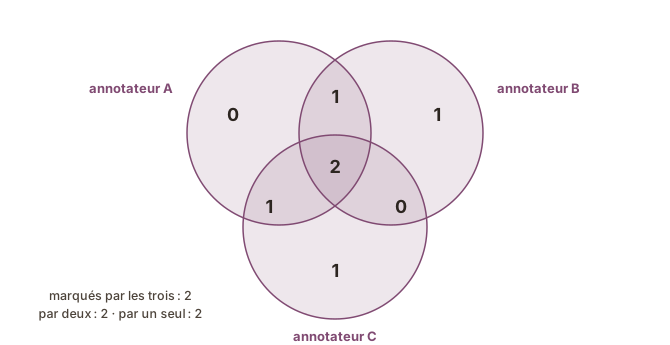
Inter-annotator agreement is a measure of the reliability of a gold standard:
high agreement suggests that the annotators understood the guidelines in the
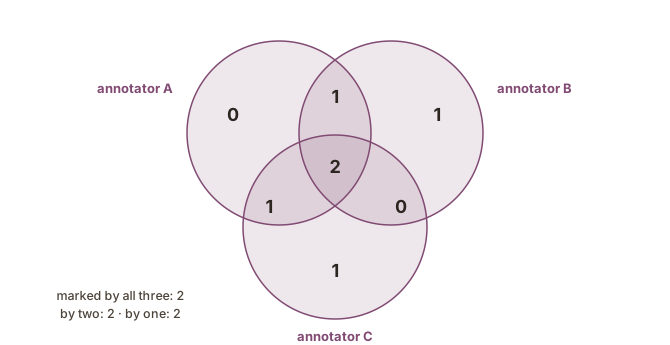
same way (Artstein & Poesio, 2008). In
Figure 5figure 5, three annotators have marked six units between them, and only two
of the six were marked by all three.
Figure 5. Three annotators marking the terms of one short text: the number of units marked by each combination of them. The example is invented.
The simplest measure is the share of items on which the annotators gave the
same answer. Part of any agreement arises by chance, and some measures
correct for it (Artstein & Poesio, 2008). When annotators mark things in
running text, such as terms, their agreement can be measured with the same
scores as a system (Hripcsak & Rothschild, 2005) (see also the Agreement as an F1 score page) (voir aussi la page L'accord mesuré par le score F1).
Low and high agreement
Low agreement is a finding about the task. Either some annotators are
wrong, or the guidelines do not fit the data (Artstein & Poesio, 2008). For
many language tasks there is a third possibility, that more than one answer
is right (Basile et al., 2021).
A task with low agreement is harder to evaluate, and often harder to
automate. The gold standard that a system is scored against is itself
uncertain, and where people do not agree on the answer, a system has no
consistent answer to learn or to reproduce. In a review of published results
in biomedical NLP, Boguslav and Cohen (2017) found that tasks with higher
agreement between annotators also had higher system scores.
High agreement is not proof. Reliability is a precondition for a
gold standard being right, but two people can share the same mistaken idea and
agree completely (Artstein & Poesio, 2008).
Combining several annotators
Most evaluations compare a system with a single gold standard, so the
differences between annotators have to be settled. This step is called
adjudication, and it can be done in several ways, for instance:
Discussion: the annotators compare their results and settle each
difference together.
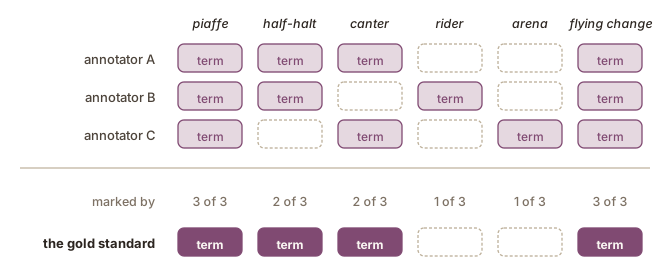
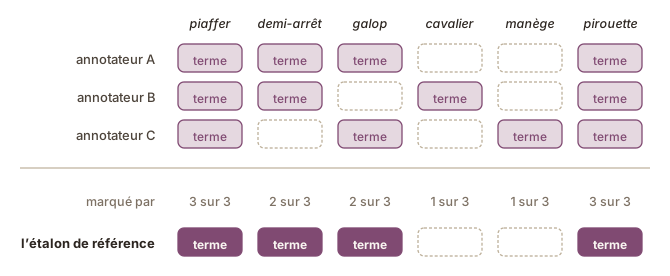
Majority vote: a unit goes into the gold standard when most of the
annotators marked it. Figure 6figure 6 applies it to the three annotators of
Figure 5figure 5.
One person checks: a single experienced annotator makes or reviews
every decision, which keeps the gold standard consistent but makes it one
person’s view.
Figure 6. A majority vote: three annotators mark the terms, and the gold standard keeps the units that at least two of them marked. The example is invented.
Combining the annotations is not the only option. An evaluation can also keep
the annotations of each person and compare a system with all of them, so that
the items on which people disagree are counted as well (Basile et al., 2021).
Agreement and the score of a system
A score against a gold standard cannot be interpreted without the agreement
between the people who made it. When two careful people reach 0.6 against each
other, a system that reaches 0.6 against one of them does about as well as a
second person would (see also the Agreement as an F1 score page) (voir aussi la page L'accord mesuré par le score F1).
The agreement is often assumed to be the upper limit of what a system can
reach, but systems do score above it (Boguslav & Cohen, 2017). A higher score
is not always feasible, and it is not always desirable: a much higher score
can mean that the system reproduces the choices of the particular people who
made the gold standard.
Sources
Artstein, R., & Poesio, M. (2008). Inter-coder agreement for computational linguistics. Computational Linguistics, 34(4), 555–596. https://doi.org/10.1162/coli.07-034-R2
Basile, V., Fell, M., Fornaciari, T., Hovy, D., Paun, S., Plank, B., et al. (2021). We Need to Consider Disagreement in Evaluation. Proceedings of the 1st Workshop on Benchmarking: Past, Present and Future. https://doi.org/10.18653/v1/2021.bppf-1.3
Boguslav, M., & Cohen, K. B. (2017). Inter-Annotator Agreement and the Upper Limit on Machine Performance: Evidence from Biomedical Natural Language Processing. Studies in Health Technology and Informatics, 245, 298–302. https://doi.org/10.3233/978-1-61499-830-3-298
Hripcsak, G., & Rothschild, A. S. (2005). Agreement, the F-measure, and reliability in information retrieval. Journal of the American Medical Informatics Association, 12(3), 296–298. https://doi.org/10.1197/jamia.M1733
Kocmi, T., Zouhar, V., Avramidis, E., Grundkiewicz, R., Karpinska, M., Popović, M., et al. (2024a). Error Span Annotation: A Balanced Approach for Human Evaluation of Machine Translation. Proceedings of the Ninth Conference on Machine Translation (WMT 2024), 1440–1453. https://doi.org/10.18653/v1/2024.wmt-1.131
L’accord inter-annotateurs est une mesure de la fiabilité d’un étalon de
référence : un accord élevé suggère que les annotateurs ont compris les
consignes de la même façon (Artstein & Poesio, 2008). Dans
Figure 5figure 5, trois annotateurs ont marqué six unités à eux trois, et seules deux
des six ont été marquées par les trois.
Figure 5. Trois annotateurs marquent les termes d'un court texte : le nombre d'unités marquées par chaque combinaison d'annotateurs. L'exemple est inventé.
La mesure la plus simple est la proportion d’éléments pour lesquels les
annotateurs ont donné la même réponse. Une partie de tout accord est due au
hasard, et certaines mesures en tiennent compte (Artstein & Poesio, 2008).
Lorsque les annotateurs marquent des éléments dans un texte suivi, comme des
termes, leur accord peut être mesuré avec les mêmes scores qu’un système
(Hripcsak & Rothschild, 2005) (see also the Agreement as an F1 score page) (voir aussi la page L'accord mesuré par le score F1).
Accord faible et accord élevé
Un accord faible est un constat sur la tâche. Soit certains
annotateurs se trompent, soit les consignes ne conviennent pas aux données
(Artstein & Poesio, 2008). Pour beaucoup de tâches langagières, il existe
une troisième possibilité : plusieurs réponses sont correctes (Basile et
al., 2021).
Une tâche où l’accord est faible est plus difficile à évaluer, et
souvent plus difficile à automatiser. L’étalon de référence auquel un
système est comparé est lui-même incertain, et lorsque les personnes ne
s’entendent pas sur la réponse, un système n’a pas de réponse constante à
apprendre ou à reproduire. Dans une analyse de résultats publiés en TAL
biomédical, Boguslav et Cohen (2017) ont constaté que les tâches où
l’accord entre annotateurs était plus élevé obtenaient aussi des scores de
systèmes plus élevés.
Un accord élevé n’est pas une preuve. La fiabilité est une condition
préalable pour qu’un étalon de référence soit juste, mais deux personnes
peuvent partager la même idée fausse et être entièrement d’accord (Artstein
& Poesio, 2008).
Combiner plusieurs annotateurs
La plupart des évaluations comparent un système à un seul étalon de
référence : les différences entre annotateurs doivent donc être tranchées.
Cette étape s’appelle l’arbitrage, et elle peut se faire de plusieurs
façons, par exemple :
La discussion : les annotateurs comparent leurs résultats et tranchent
chaque différence ensemble.
Le vote majoritaire : une unité entre dans l’étalon de référence
lorsque la majorité des annotateurs l’ont marquée. La Figure 6figure 6 l’applique aux trois annotateurs de
Figure 5figure 5.
La vérification par une seule personne : un seul annotateur
expérimenté prend ou révise chaque décision, ce qui garde l’étalon de
référence cohérent, mais en fait le point de vue d’une seule personne.
Figure 6. Un vote majoritaire : trois annotateurs marquent les termes, et l'étalon de référence garde les unités qu'au moins deux d'entre eux ont marquées. L'exemple est inventé.
Combiner les annotations n’est pas la seule possibilité. Une évaluation peut
aussi conserver les annotations de chaque personne et comparer un système à
toutes, de sorte que les éléments sur lesquels les personnes sont en
désaccord sont comptés eux aussi (Basile et al., 2021).
L’accord et le score d’un système
Un score par rapport à un étalon de référence ne peut pas être interprété
sans l’accord entre les personnes qui l’ont établi. Lorsque deux personnes
soigneuses atteignent 0,6 l’une par rapport à l’autre, un système qui
atteint 0,6 par rapport à l’une d’elles fait à peu près aussi bien que le
ferait une deuxième
personne (see also the Agreement as an F1 score page) (voir aussi la page L'accord mesuré par le score F1).
L’accord est souvent considéré comme la limite supérieure de ce qu’un
système peut atteindre, mais des systèmes obtiennent bel et bien des scores
supérieurs (Boguslav & Cohen, 2017). Un score plus élevé n’est pas toujours
réalisable, et il n’est pas toujours souhaitable : un score beaucoup plus
élevé peut signifier que le système reproduit les choix des personnes qui
ont établi l’étalon de référence.
Sources
Artstein, R., & Poesio, M. (2008). Inter-coder agreement for computational linguistics. Computational Linguistics, 34(4), 555–596. https://doi.org/10.1162/coli.07-034-R2
Basile, V., Fell, M., Fornaciari, T., Hovy, D., Paun, S., Plank, B., et al. (2021). We Need to Consider Disagreement in Evaluation. Proceedings of the 1st Workshop on Benchmarking: Past, Present and Future. https://doi.org/10.18653/v1/2021.bppf-1.3
Boguslav, M., & Cohen, K. B. (2017). Inter-Annotator Agreement and the Upper Limit on Machine Performance: Evidence from Biomedical Natural Language Processing. Studies in Health Technology and Informatics, 245, 298–302. https://doi.org/10.3233/978-1-61499-830-3-298
Hripcsak, G., & Rothschild, A. S. (2005). Agreement, the F-measure, and reliability in information retrieval. Journal of the American Medical Informatics Association, 12(3), 296–298. https://doi.org/10.1197/jamia.M1733
Kocmi, T., Zouhar, V., Avramidis, E., Grundkiewicz, R., Karpinska, M., Popović, M., et al. (2024a). Error Span Annotation: A Balanced Approach for Human Evaluation of Machine Translation. Proceedings of the Ninth Conference on Machine Translation (WMT 2024), 1440–1453. https://doi.org/10.18653/v1/2024.wmt-1.131
Benchmarks and test setsTests de performances et jeux de test
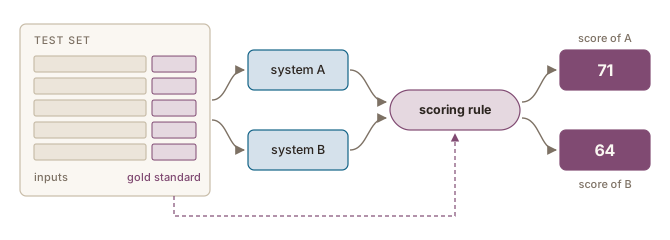
A benchmark fixes all three parts of an
evaluation (see also the Systematic evaluation page) (voir aussi la page L'évaluation systématique), as the table
below and Figure 7figure 7 show.
Part of an evaluation
In a benchmark
Evaluation data
a fixed set of inputs that the systems were not trained on
The three parts of an evaluation, as a benchmark fixes them.
The inputs of a benchmark, together with their answers, are its test set.
A gold standard that you make for your own project is therefore not a
benchmark. It becomes part of one when it is published with its inputs and a
scoring rule, and other people use it to compare their systems.
Figure 7. The parts of a benchmark: one test set, one scoring rule, and a score for each system. The scores are invented.
A test that can be reused
A benchmark can be reused: once it exists, any number of systems, including
systems released later, can be scored on it in exactly the same way. Pairwise
comparisons and ratings by people take new effort for every system, and they
cannot be repeated
identically (see also the Ways of evaluating page) (voir aussi la page Les façons d'évaluer).
Using the same test for every system does not by itself make the comparison
fair: a system may have been trained on the test set, or the test set may
suit one system better than another.
Data contamination
A system that learned from its test set has not been tested, any more than a
student who saw the exam paper the night before. For a model trained on text
collected from the web, such learning is difficult to rule out. A public benchmark is
text on the web, and so are the papers that discuss it, answer keys and forum
threads.
Contamination makes a score too high without making the system better. With
the training data undisclosed, it is hard to measure from outside, and Sainz
et al. (2023) argue that it has to be measured for each benchmark and cannot
be assumed absent (see also the Training data chapter, in the LLM lifecycle module) (voir aussi le chapitre Les données d'entraînement, dans le module Cycle de vie des GML).
Contamination can also happen by hand: pasting a benchmark’s questions into a
chat product that uses its conversations for training sends the test set to
the provider. Balloccu et al. (2024) reviewed studies that evaluated such
products and found that, between them, they had exposed the test items of
hundreds of benchmarks in this way.
Two other things can distort a comparison on the same test set:
A test set closer to one system. A test set whose texts resemble the training
data of one system more than that of another favours that system.
Limits of a benchmark score
Each of the three parts of a benchmark can be flawed, so a score can only be
interpreted by looking at all three. Two parts can be excellent, but a flaw in
the third still affects every score.
The test set: how relevant is it to your task and your texts? A
benchmark measures the particular tasks it contains, not a “general”
ability (Raji et al., 2021). A high score on general knowledge or on coding
says little about how a system will do on a legal text in
French (see also the LLM leaderboards chapter, in the Using LLMs module) (voir aussi le chapitre Les classements de GML, dans le module Utiliser les GML).
The gold standard: how reliable is it? The answers are only as reliable
as the agreement between the people who produced
them (see also the Agreement between annotators page) (voir aussi la page L'accord entre annotateurs).
The scoring rule: what is it able to measure? An automatic score can go
up without the outputs getting better: for translation, relying on BLEU
alone led to bad decisions about which system to deploy (Kocmi et al.,
2021) (see also the Ways of evaluating page) (voir aussi la page Les façons d'évaluer).
Sources
Balloccu, S., Schmidtová, P., Lango, M., & Dušek, O. (2024). Leak, Cheat, Repeat: Data Contamination and Evaluation Malpractices in Closed-Source LLMs. Proceedings of the 18th Conference of the European Chapter of the Association for Computational Linguistics (Volume 1: Long Papers), 67–93. https://doi.org/10.18653/v1/2024.eacl-long.5
Jurafsky, D., & Martin, J. H. (2026). Speech and Language Processing: An Introduction to Natural Language Processing, Computational Linguistics, and Speech Recognition with Language Models. Online draft, 3rd edition. https://web.stanford.edu/~jurafsky/slp3/
Kocmi, T., Federmann, C., Grundkiewicz, R., Junczys-Dowmunt, M., Matsushita, H., & Menezes, A. (2021). To Ship or Not to Ship: An Extensive Evaluation of Automatic Metrics for Machine Translation. Proceedings of the Sixth Conference on Machine Translation (WMT 2021), 478–494. https://aclanthology.org/2021.wmt-1.57/
Sainz, O., Campos, J., García-Ferrero, I., Etxaniz, J., Lopez de Lacalle, O., & Agirre, E. (2023). NLP Evaluation in Trouble: On the Need to Measure LLM Data Contamination for Each Benchmark. Findings of the Association for Computational Linguistics: EMNLP 2023, 10776–10787. https://doi.org/10.18653/v1/2023.findings-emnlp.722
Étalon de référence, jeu de test et test de performances
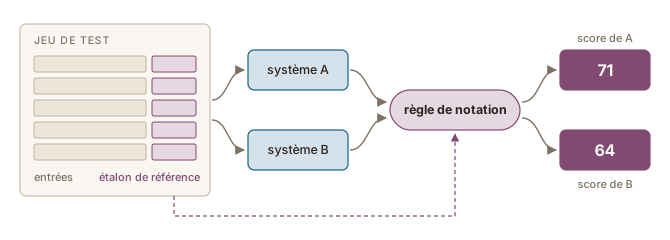
Un test de performances fixe les trois parties d’une
évaluation (see also the Systematic evaluation page) (voir aussi la page L'évaluation systématique), comme le
montrent le tableau ci-dessous et Figure 7figure 7.
Partie d’une évaluation
Dans un test de performances
Données d’évaluation
un ensemble fixe d’entrées qui n’ont pas servi à entraîner les systèmes
une règle de notation, la même pour tous les systèmes
Les trois parties d'une évaluation, telles qu'un test de performances les fixe.
Les entrées d’un test de performances, avec leurs réponses, constituent son
jeu de test.
Un étalon de référence que vous créez pour votre propre projet n’est donc
pas un test de performances. Il en devient une partie lorsqu’il est publié
avec ses entrées et une règle de notation, et que d’autres personnes
l’utilisent pour comparer leurs systèmes.
Figure 7. Les parties d'un test de performances : un jeu de test, une règle de notation et un score pour chaque système. Les scores sont inventés.
Un test réutilisable
Un test de performances peut être réutilisé : une fois qu’il existe, autant
de systèmes qu’on le souhaite, y compris des systèmes publiés plus tard,
peuvent y obtenir un score exactement de la même façon. Les comparaisons par
paires et les notations par des personnes demandent un nouvel effort pour
chaque système, et elles ne peuvent pas être répétées à
l’identique (see also the Ways of evaluating page) (voir aussi la page Les façons d'évaluer).
Utiliser le même test pour tous les systèmes ne suffit pas à rendre la
comparaison équitable : un système peut avoir été entraîné sur le jeu de
test, ou le jeu de test peut convenir mieux à un système qu’à un autre.
La contamination des données
Un système qui a appris à partir de son jeu de test n’a pas été testé, pas
plus qu’un étudiant qui a vu le questionnaire de l’examen la veille. Pour un
modèle entraîné sur du texte recueilli sur le web, un tel apprentissage est
difficile à exclure. Un test de performances public est du texte sur le web,
tout comme les articles qui en discutent, les corrigés et les fils de
discussion.
La contamination rend un score trop élevé sans rendre le système meilleur.
Comme les données d’entraînement ne sont pas divulguées, elle est difficile
à mesurer de l’extérieur, et Sainz et al. (2023) soutiennent qu’elle doit
être mesurée pour chaque test de performances et qu’on ne peut pas la
supposer absente (see also the Training data chapter, in the LLM lifecycle module) (voir aussi le chapitre Les données d'entraînement, dans le module Cycle de vie des GML).
La contamination peut aussi se produire à la main : coller les questions
d’un test de performances dans un agent conversationnel dont les
conversations servent à l’entraînement transmet le jeu de test au fournisseur.
Balloccu et al. (2024) ont passé en revue des études qui évaluaient de tels
produits et ont constaté qu’à elles toutes, elles avaient ainsi exposé les
éléments de test de centaines de tests de performances.
Deux autres facteurs peuvent fausser une comparaison sur le même jeu de
test :
Un jeu de test plus proche d’un système. Un jeu de test dont les
textes ressemblent davantage aux données d’entraînement d’un système qu’à
celles d’un autre favorise ce système.
Les limites d’un score à un test de performances
Chacune des trois parties d’un test de performances peut avoir des défauts :
un score ne peut donc être interprété qu’en examinant les trois. Deux
parties peuvent être excellentes, mais un défaut dans la troisième affecte
tout de même tous les scores.
Le jeu de test : est-il pertinent pour votre tâche et vos textes ? Un
test de performances mesure les tâches particulières qu’il contient, et
non une capacité « générale » (Raji et al., 2021). Un score élevé en
culture générale ou en programmation en dit peu sur ce qu’un système fera
d’un texte juridique en
français (see also the LLM leaderboards chapter, in the Using LLMs module) (voir aussi le chapitre Les classements de GML, dans le module Utiliser les GML).
L’étalon de référence : est-il fiable ? Les réponses ne sont pas plus
fiables que l’accord entre les personnes qui les ont
produites (see also the Agreement between annotators page) (voir aussi la page L'accord entre annotateurs).
La règle de notation : que peut-elle mesurer ? Un score automatique
peut augmenter sans que les sorties s’améliorent : en traduction, se fier
uniquement à BLEU a mené à de mauvaises décisions sur le système à
déployer (Kocmi et al.,
2021) (see also the Ways of evaluating page) (voir aussi la page Les façons d'évaluer).
Sources
Balloccu, S., Schmidtová, P., Lango, M., & Dušek, O. (2024). Leak, Cheat, Repeat: Data Contamination and Evaluation Malpractices in Closed-Source LLMs. Proceedings of the 18th Conference of the European Chapter of the Association for Computational Linguistics (Volume 1: Long Papers), 67–93. https://doi.org/10.18653/v1/2024.eacl-long.5
Jurafsky, D., & Martin, J. H. (2026). Speech and Language Processing: An Introduction to Natural Language Processing, Computational Linguistics, and Speech Recognition with Language Models. Online draft, 3rd edition. https://web.stanford.edu/~jurafsky/slp3/
Kocmi, T., Federmann, C., Grundkiewicz, R., Junczys-Dowmunt, M., Matsushita, H., & Menezes, A. (2021). To Ship or Not to Ship: An Extensive Evaluation of Automatic Metrics for Machine Translation. Proceedings of the Sixth Conference on Machine Translation (WMT 2021), 478–494. https://aclanthology.org/2021.wmt-1.57/
Sainz, O., Campos, J., García-Ferrero, I., Etxaniz, J., Lopez de Lacalle, O., & Agirre, E. (2023). NLP Evaluation in Trouble: On the Need to Measure LLM Data Contamination for Each Benchmark. Findings of the Association for Computational Linguistics: EMNLP 2023, 10776–10787. https://doi.org/10.18653/v1/2023.findings-emnlp.722
BaselinesLes étalons
A score compared with a simple method
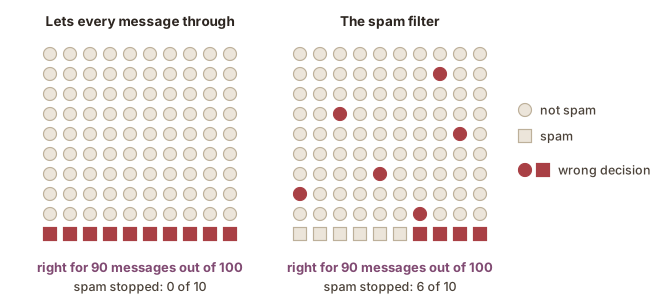
A score does not say, on its own, whether a system is good. If you are told
that a spam filter is right for 90 messages out of 100, you still need to know
what a very simple method would score on the same messages. If 90 of the 100
messages are not spam, a filter that lets every message through is also right
90 times out of 100, and it has not stopped any spam
(Figure 8figure 8).
Figure 8. The same 100 messages judged twice: by letting every message through, and by a spam filter. Both are right for 90 messages. The example is invented.
The score of such a simple method is called a baseline.
right as often as that class occurs: 90 % when nine items in ten belong to it
Most frequent answer for each item
gives each item the answer it had most often in a set of labelled examples; only possible where the same items come back, as words do
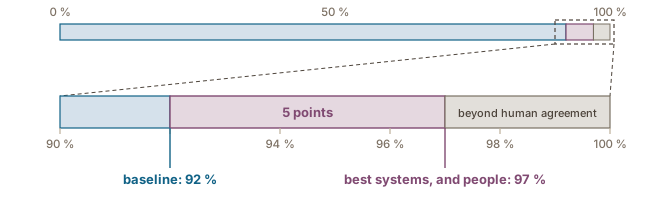
depends on the task, and can be high: about 92 % of the words for part-of-speech tagging of English, the example below
Three simple baselines for a classification task.
A baseline can also be an existing tool: a new system is then expected to do
better than the one it replaces.The third baseline is not always
possible: it needs labelled examples, and the items of the test have to come
back from those examples, as words do in running text. Jurafsky and Martin
(2026) give it for part-of-speech tagging. No two emails are identical, so a
spam filter has no such baseline.
Figure 9. Part-of-speech tagging of English: the share of words labelled correctly by the baseline, and by the best systems and by people, with the top of the scale enlarged (Jurafsky & Martin, 2026).
Sources
Jurafsky, D., & Martin, J. H. (2026). Speech and Language Processing: An Introduction to Natural Language Processing, Computational Linguistics, and Speech Recognition with Language Models. Online draft, 3rd edition. https://web.stanford.edu/~jurafsky/slp3/
Un score comparé à une méthode simple
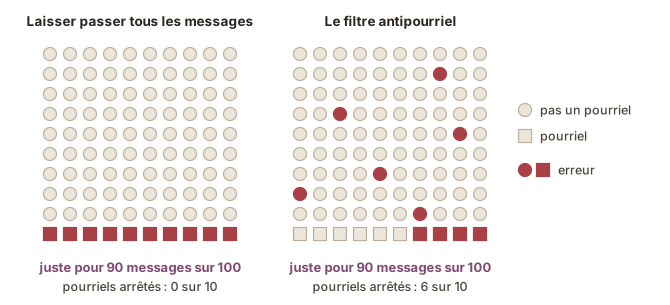
Un score ne dit pas, à lui seul, si un système est bon. Si l’on vous dit
qu’un filtre antipourriel a raison pour 90 messages sur 100, il vous reste à
savoir quel score une méthode très simple obtiendrait sur les mêmes
messages. Si 90 des 100 messages ne sont pas des pourriels, un filtre qui
laisse passer tous les messages a lui aussi raison 90 fois sur 100, et il
n’a arrêté aucun pourriel
(Figure 8figure 8).
Figure 8. Les mêmes 100 messages jugés deux fois : en laissant passer tous les messages, et par un filtre antipourriel. Les deux ont raison pour 90 messages. L'exemple est inventé.
Le score d’une telle méthode simple s’appelle un étalon.
avec deux classes, a raison environ une fois sur deux
Classe majoritaire
répond toujours la classe la plus fréquente
a raison aussi souvent que cette classe apparaît : 90 % lorsque neuf éléments sur dix lui appartiennent
Réponse la plus fréquente pour chaque élément
donne à chaque élément la réponse qu’il a reçue le plus souvent dans un ensemble d’exemples étiquetés ; possible seulement lorsque les mêmes éléments reviennent, comme le font les mots
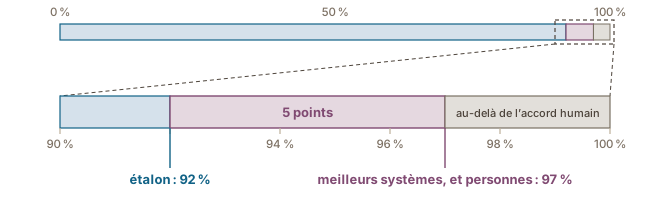
dépend de la tâche, et peut être élevé : environ 92 % des mots pour l’étiquetage morphosyntaxique de l’anglais, l’exemple ci-dessous
Trois étalons simples pour une tâche de classification.
Un étalon peut aussi être un outil existant : on attend alors d’un nouveau
système qu’il fasse mieux que celui qu’il remplace.Le troisième
étalon n’est pas toujours possible : il lui faut des exemples étiquetés, et
les éléments du test doivent revenir dans ces exemples, comme le font les
mots dans un texte suivi. Jurafsky et Martin (2026) le donnent pour
l’étiquetage morphosyntaxique. Il n’y a pas deux courriels identiques, de
sorte qu’un filtre antipourriel n’a pas d’étalon de ce type.
Un score s’interprète entre deux points de comparaison : l’étalon, et le
niveau que des personnes atteignent pour la même
tâche (see also the Agreement between annotators page) (voir aussi la page L'accord entre annotateurs).
Figure 9. Étiquetage morphosyntaxique de l'anglais : la proportion de mots étiquetés correctement par l'étalon, par les meilleurs systèmes et par des personnes, avec le haut de l'échelle agrandi (Jurafsky & Martin, 2026).
Sources
Jurafsky, D., & Martin, J. H. (2026). Speech and Language Processing: An Introduction to Natural Language Processing, Computational Linguistics, and Speech Recognition with Language Models. Online draft, 3rd edition. https://web.stanford.edu/~jurafsky/slp3/
Interpreting a scoreInterpréter un score
What a score depends on
A score of 0.53 for a term extractor, or of 80 % for a chatbot on a set of
questions, looks like a property of the system, but five other things
produced it:
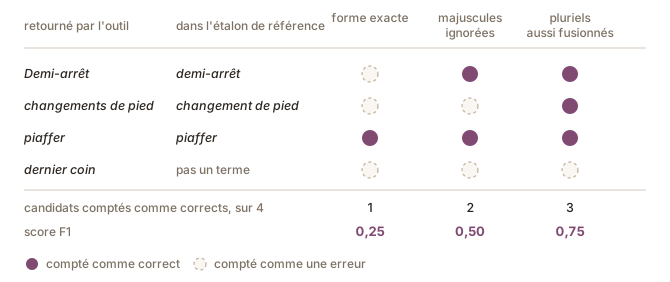
What counts as correct. An evaluation has to decide how strictly an
output must match the gold standard. For example, if a tool returns
half-halts and the gold standard has half-halt, the output can be
counted as correct or as wrong. The stricter the rule, the lower the
score (see also the Matching rules page) (voir aussi la page Les règles de correspondance).
A score says how often a system was wrong, but not how. Whatever the way of
evaluating, looking at the output itself always adds something to the score,
and it can be done in two ways:
Qualitative error analysis: a person reads a sample of the output,
wrong and correct, and describes what the system does.
Error analysis has two uses:
It finds flaws that a score does not show. For example, a
large language model can score very poorly because its answers are not
in the format that was asked for, so the program that counts them cannot
read them, although the answers themselves are good.
A difference between two scores means something only when the texts, the
gold standard or the judges, and the rule for what counts as correct are the
same for both.
Even then, a small difference can arise by chance. The smaller the evaluation
data, the more easily that happens, and for a system built on a large
language model, two runs of the same evaluation can already give different
scores. Statistical significance tests estimate whether a difference is
larger than chance would produce (Dror et al., 2018). In practice, a
difference is more convincing when the evaluation data are large, when the
evaluation was run several times, and when the difference is larger than the
variation between runs.
Sources
Dror, R., Baumer, G., Shlomov, S., & Reichart, R. (2018). The Hitchhiker's Guide to Testing Statistical Significance in Natural Language Processing. Proceedings of the 56th Annual Meeting of the Association for Computational Linguistics (Volume 1: Long Papers), 1383–1392. https://doi.org/10.18653/v1/P18-1128
Freitag, M., Foster, G., Grangier, D., Ratnakar, V., Tan, Q., & Macherey, W. (2021). Experts, Errors, and Context: A Large-Scale Study of Human Evaluation for Machine Translation. Transactions of the Association for Computational Linguistics, 9, 1460–1474. https://doi.org/10.1162/tacl_a_00437
Ouyang, S., Zhang, J. M., Harman, M., & Wang, M. (2025). An Empirical Study of the Non-Determinism of ChatGPT in Code Generation. ACM Transactions on Software Engineering and Methodology, 34(2). https://doi.org/10.1145/3697010
Rigouts Terryn, A., Hoste, V., Drouin, P., & Lefever, E. (2020b). TermEval 2020: Shared Task on Automatic Term Extraction Using the Annotated Corpora for Term Extraction Research (ACTER) Dataset. Proceedings of the 6th International Workshop on Computational Terminology (CompuTerm 2020), 85–94. https://aclanthology.org/2020.computerm-1.12/
Ce dont dépend un score
Un score de 0,53 pour un extracteur de termes, ou de 80 % pour un agent
conversationnel sur un ensemble de questions, a l’air d’une propriété du
système, mais cinq autres éléments l’ont produit :
Les sorties comptées comme correctes. Une évaluation doit décider avec
quelle rigueur une sortie doit correspondre à l’étalon de référence. Par
exemple, si un outil renvoie demi-arrêts et que l’étalon de référence
contient demi-arrêt, la sortie peut être comptée comme correcte ou comme
fausse. Plus la règle est stricte, plus le score est
bas (see also the Matching rules page) (voir aussi la page Les règles de correspondance).
Un score dit à quelle fréquence un système s’est trompé, mais pas comment.
Quelle que soit la façon d’évaluer, examiner la sortie elle-même ajoute
toujours quelque chose au score, et cela peut se faire de deux façons :
L’analyse qualitative des erreurs : une personne lit un échantillon de
la sortie, fautif et correct, et décrit ce que fait le système.
L’analyse des erreurs a deux utilités :
Elle révèle des défauts qu’un score ne montre pas. Par exemple, un
grand modèle de langue peut obtenir un très mauvais score parce que ses
réponses ne sont pas dans le format demandé, de sorte que le programme qui
les compte ne peut pas les lire, alors que les réponses elles-mêmes sont
bonnes.
Une différence entre deux scores n’a de sens que si les textes, l’étalon de
référence ou les juges, et la règle qui fixe les sorties comptées comme
correctes sont les mêmes pour les deux.
Même dans ce cas, une petite différence peut être due au hasard. Plus les
données d’évaluation sont peu nombreuses, plus cela se produit facilement,
et pour un système construit sur un grand modèle de langue, deux exécutions
de la même évaluation peuvent déjà donner des scores différents. Les tests
de signification statistique estiment si une différence est plus grande que
ce que le hasard produirait (Dror et al., 2018). En pratique, une différence
est plus convaincante lorsque les données d’évaluation sont nombreuses,
lorsque l’évaluation a été exécutée plusieurs fois et lorsque la différence
est plus grande que la variation entre les exécutions.
Sources
Dror, R., Baumer, G., Shlomov, S., & Reichart, R. (2018). The Hitchhiker's Guide to Testing Statistical Significance in Natural Language Processing. Proceedings of the 56th Annual Meeting of the Association for Computational Linguistics (Volume 1: Long Papers), 1383–1392. https://doi.org/10.18653/v1/P18-1128
Freitag, M., Foster, G., Grangier, D., Ratnakar, V., Tan, Q., & Macherey, W. (2021). Experts, Errors, and Context: A Large-Scale Study of Human Evaluation for Machine Translation. Transactions of the Association for Computational Linguistics, 9, 1460–1474. https://doi.org/10.1162/tacl_a_00437
Ouyang, S., Zhang, J. M., Harman, M., & Wang, M. (2025). An Empirical Study of the Non-Determinism of ChatGPT in Code Generation. ACM Transactions on Software Engineering and Methodology, 34(2). https://doi.org/10.1145/3697010
Rigouts Terryn, A., Hoste, V., Drouin, P., & Lefever, E. (2020b). TermEval 2020: Shared Task on Automatic Term Extraction Using the Annotated Corpora for Term Extraction Research (ACTER) Dataset. Proceedings of the 6th International Workshop on Computational Terminology (CompuTerm 2020), 85–94. https://aclanthology.org/2020.computerm-1.12/
Evaluating extraction and classificationÉvaluation de l'extraction et de la classification
Written in English. The French version was automatically generated
and I have not revised it.
Rédigé en anglais. La version française a été
générée automatiquement et je ne l'ai pas révisée.
False positives and false negativesFaux positifs et faux négatifs
Extraction and classification
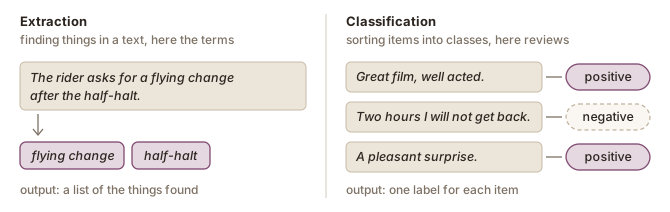
This chapter is about two kinds of system
(Figure 1figure 1):
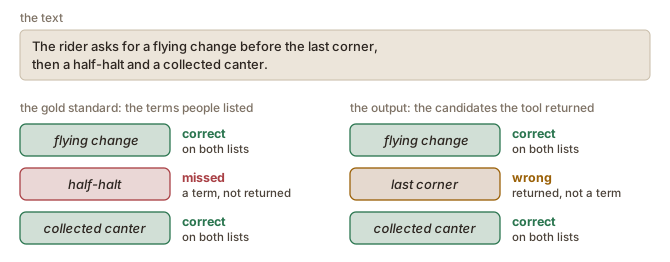
For example, a term extractor, a tool that lists the specialized terms of a
text, is run on a sentence about dressage, an equestrian sport
(Figure 2figure 2):
the tool returns a list of three candidates: flying change, last corner
and collected canter;
the gold standard is a list of three terms: flying change, half-halt
and collected canter.
Two candidates are on both lists, so they are correct. The tool has also
made two errors, of different kinds:
last corner was returned, but it is not a term;
half-halt is a term, but it was not returned.
Figure 2. A text, the list of the gold standard and the list a tool returned: two correct candidates, one term that was missed and one candidate that is not a term.
The four outcomes
When the output of a system is compared with a gold standard, every decision
is one of four cases, defined in the boxes below and often abbreviated TP, FP,
FN and TN.
In the example above, flying change and collected canter are true
positives, last corner is a false positive and half-halt is a false
negative. The true negatives are everything else in the text.
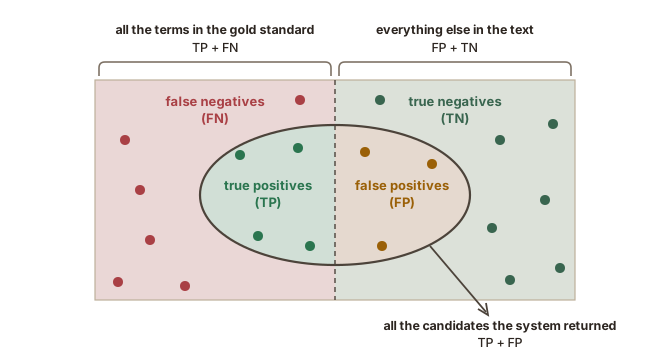
Figure 3figure 3 builds up the four cases for a term
extractor.
Click the drawing, or a line below, to build it up stage by stage.Cliquez sur le dessin, ou sur une ligne ci-dessous, pour le construire étape par étape.
Figure 3. The four outcomes as regions: what is in the gold standard, what the system returned, and where the two overlap.
Jurafsky and Martin (2026) present the same four cases as a table, called a
confusion matrix, for a system that sorts items into two classes, such as a
spam filter: a message stopped by mistake is a false positive, and spam that
reaches the inbox is a false negative.
In the gold standard
Not in the gold standard
Returned by the system
true positive
false positive
Not returned by the system
false negative
true negative
The four outcomes as a confusion matrix.
Noise and silence
The false positives are also called noise, and the false negatives silence.
You can interpret the two words quite literally: noise is output that should
not be there, and silence is output that is missing.
True negatives
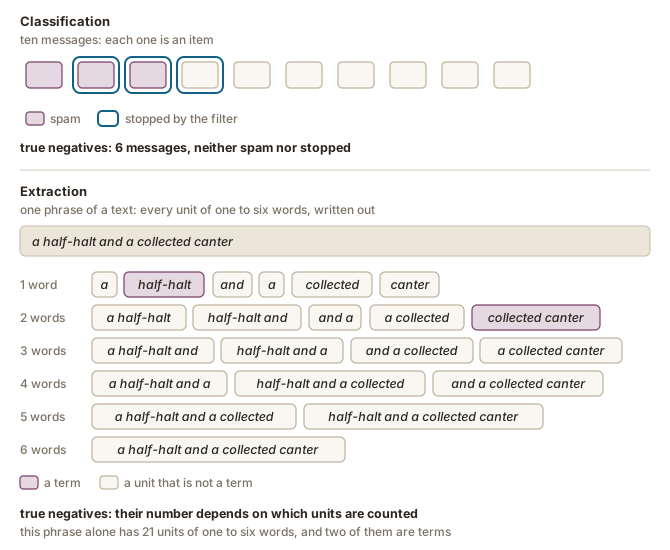
The fourth case differs between the two kinds of system
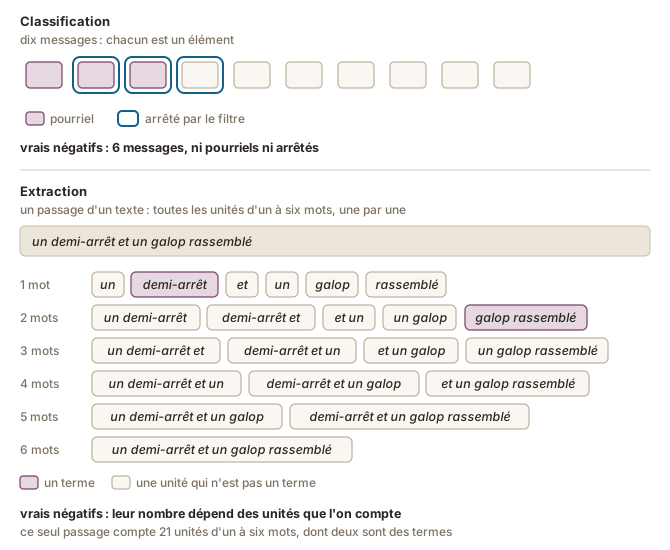
(Figure 4figure 4):
For a spam filter, each message is one item, so the true negatives, the
messages that are not spam and were let through, can be counted.
For a system that finds things in a text, such as a term extractor, the
true negatives would be every word and every sequence of words that is not
a term and was not returned. Such units vary in length and overlap, so
their number is not well defined (Hripcsak & Rothschild, 2005).
Figure 4. True negatives in the two kinds of system: messages can be counted, but the units of a text that are not terms vary in length and overlap.
The scores most often used for both kinds of system, precision and recall,
are calculated from the other three cases only (Jurafsky & Martin,
2026) (see also the Precision, recall and F1 page) (voir aussi la page Précision, rappel et score F1).
The trade-off between the two errors
The two errors work against each other. A tool set to return more candidates
misses fewer terms, but it also returns more units that are not terms. A tool
set to return fewer candidates does the reverse.
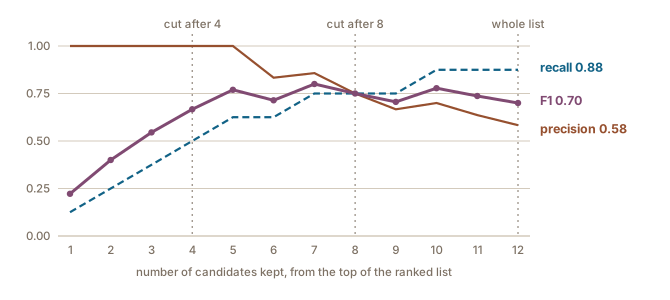
In Figure 5figure 5, a tool has ranked twelve candidates, and the
list is cut at three points. The further down the list the cut is made, the
fewer terms are missed and the more noise comes with them. An evaluation
therefore reports each of the two errors as well as a score that combines
them.
Click the drawing, or a line below, to build it up stage by stage.Cliquez sur le dessin, ou sur une ligne ci-dessous, pour le construire étape par étape.
Figure 5. One ranked list of candidates cut at three points, against a gold standard of eight terms.
Sources
Hripcsak, G., & Rothschild, A. S. (2005). Agreement, the F-measure, and reliability in information retrieval. Journal of the American Medical Informatics Association, 12(3), 296–298. https://doi.org/10.1197/jamia.M1733
Jurafsky, D., & Martin, J. H. (2026). Speech and Language Processing: An Introduction to Natural Language Processing, Computational Linguistics, and Speech Recognition with Language Models. Online draft, 3rd edition. https://web.stanford.edu/~jurafsky/slp3/
Extraction et classification
Ce chapitre porte sur deux types de système
(Figure 1figure 1) :
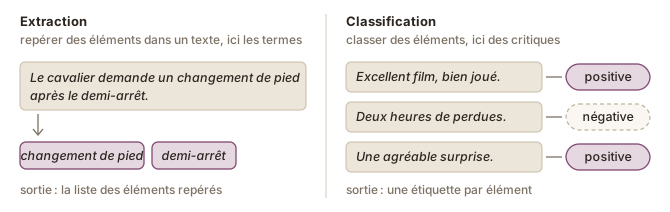
Figure 1. Les deux types de système de ce chapitre : l'un donne la liste des éléments qu'il a repérés dans un texte, l'autre donne une étiquette à chaque élément.
Par exemple, un extracteur de termes, un outil qui dresse la liste des termes
spécialisés d’un texte, traite une phrase sur le dressage, un sport équestre
(Figure 2figure 2) :
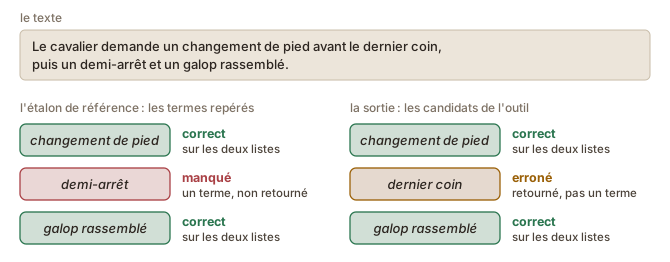
l’outil propose une liste de trois candidats : changement de pied,
dernier coin et galop rassemblé ;
l’étalon de référence est une liste de trois termes : changement de pied,
demi-arrêt et galop rassemblé.
Deux candidats figurent sur les deux listes : ils sont donc corrects. L’outil
a aussi fait deux erreurs, de types différents :
dernier coin a été proposé, mais ce n’est pas un terme ;
demi-arrêt est un terme, mais il n’a pas été trouvé.
Figure 2. Un texte, la liste de l'étalon de référence et la liste proposée par un outil : deux candidats corrects, un terme manqué et un candidat qui n'est pas un terme.
Les quatre cas
Quand la sortie d’un système est comparée à un étalon de référence, chaque
décision correspond à l’un de quatre cas, définis dans les encadrés
ci-dessous et souvent abrégés VP, FP, FN et VN.
Dans l’exemple ci-dessus, changement de pied et galop rassemblé sont des
vrais positifs, dernier coin est un faux positif et demi-arrêt est un
faux négatif. Les vrais négatifs sont tout le reste du texte.
La Figure 3figure 3 construit les quatre cas pour un extracteur
de termes.
Click the drawing, or a line below, to build it up stage by stage.Cliquez sur le dessin, ou sur une ligne ci-dessous, pour le construire étape par étape.
Figure 3. Les quatre cas sous forme de zones : ce qui est dans l'étalon de référence, ce que le système a trouvé, et là où les deux se chevauchent.
Jurafsky et Martin (2026) présentent les mêmes quatre cas sous forme de
tableau, appelé matrice de confusion, pour un système qui classe des éléments
en deux classes, comme un filtre antipourriel : un message arrêté par erreur
est un faux positif, et un pourriel qui arrive dans la boîte de réception est
un faux négatif.
Dans l’étalon de référence
Absent de l’étalon de référence
Trouvé par le système
vrai positif
faux positif
Non trouvé par le système
faux négatif
vrai négatif
Les quatre cas sous forme de matrice de confusion.
Le bruit et le silence
L’ensemble des faux positifs s’appelle aussi le bruit, et l’ensemble des faux
négatifs, le silence. Les deux mots peuvent se comprendre littéralement : le
bruit est ce qui ne devrait pas se trouver dans la sortie, et le silence, ce
qui y manque.
Les vrais négatifs
Le quatrième cas n’est pas le même pour les deux types de système
(Figure 4figure 4) :
Pour un filtre antipourriel, chaque message est un élément : les vrais
négatifs, les messages qui ne sont pas des pourriels et que le filtre a
laissés passer, peuvent donc être comptés.
Pour un système qui repère des éléments dans un texte, comme un extracteur
de termes, les vrais négatifs seraient chaque mot et chaque suite de mots
qui n’est pas un terme et n’a pas été trouvée. Ces unités varient en
longueur et se chevauchent : leur nombre n’est donc pas bien défini
(Hripcsak & Rothschild, 2005).
Figure 4. Les vrais négatifs dans les deux types de système : les messages peuvent être comptés, mais les unités d'un texte qui ne sont pas des termes varient en longueur et se chevauchent.
Les scores les plus utilisés pour les deux types de système, la précision et
le rappel, se calculent à partir des trois autres cas seulement (Jurafsky &
Martin, 2026) (see also the Precision, recall and F1 page) (voir aussi la page Précision, rappel et score F1).
Le compromis entre les deux erreurs
Les deux erreurs s’opposent. Un outil réglé pour proposer plus de candidats
manque moins de termes, mais il propose aussi plus d’unités qui ne sont pas
des termes. Un outil réglé pour proposer moins de candidats fait l’inverse.
Dans Figure 5figure 5, un outil a classé douze candidats, et la
liste est coupée à trois endroits. Plus la coupure se fait bas dans la liste,
moins il manque de termes, et plus il y a de bruit. Une évaluation indique
donc chacune des deux erreurs, en plus d’un score qui les combine.
Click the drawing, or a line below, to build it up stage by stage.Cliquez sur le dessin, ou sur une ligne ci-dessous, pour le construire étape par étape.
Figure 5. Une liste classée de candidats coupée à trois endroits, comparée à un étalon de référence de huit termes.
Sources
Hripcsak, G., & Rothschild, A. S. (2005). Agreement, the F-measure, and reliability in information retrieval. Journal of the American Medical Informatics Association, 12(3), 296–298. https://doi.org/10.1197/jamia.M1733
Jurafsky, D., & Martin, J. H. (2026). Speech and Language Processing: An Introduction to Natural Language Processing, Computational Linguistics, and Speech Recognition with Language Models. Online draft, 3rd edition. https://web.stanford.edu/~jurafsky/slp3/
Precision, recall and F1Précision, rappel et score F1
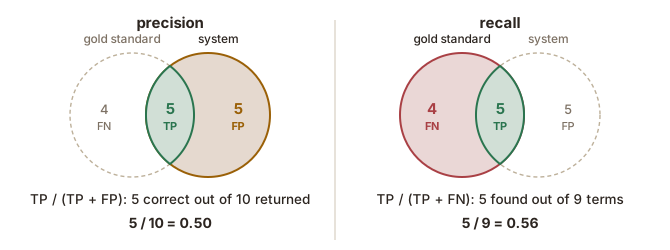
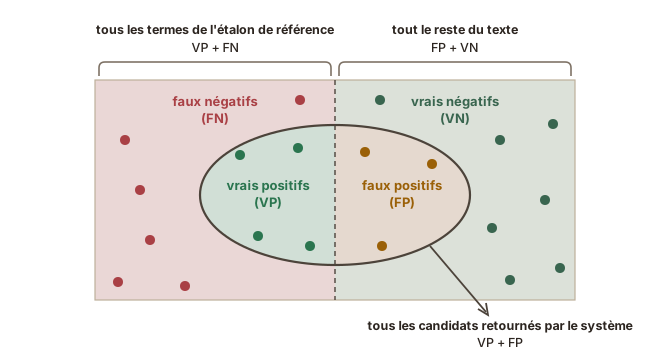
Figure 6. The parts that precision and recall are calculated from: the terms in the gold standard, the candidates the system returned, and their overlap.
Each score can be explained in several ways, and one may be clearer to you
than the others:
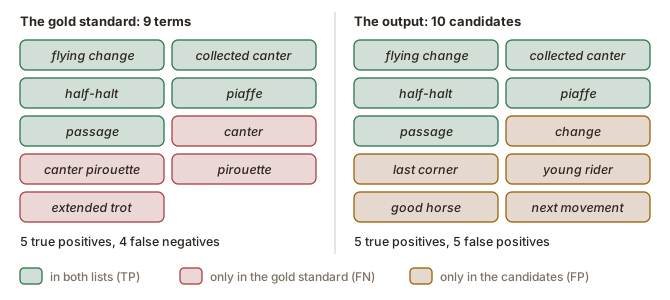
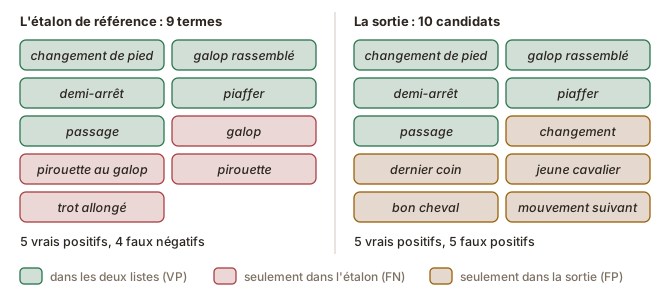
In this example, a term extractor returns ten candidates for a short text
about dressage, and the gold standard for that text has nine terms
(Figure 7figure 7).
Figure 7. A gold standard of nine terms and the ten candidates of a tool, coloured by outcome.
Five candidates are on both lists, so there are 5 true positives, 5 false
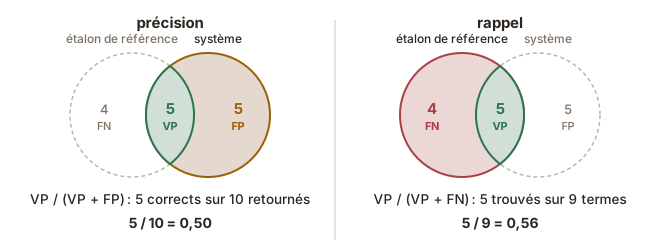
positives and 4 false negatives
(Figure 8figure 8):
precision = 5 / (5 + 5) = 0.50;
recall = 5 / (5 + 4) = 0.56.
Figure 8. Precision and recall measure the same overlap against two different totals: what the system returned, and what the gold standard contains.
The F1 score
The F1 score combines precision and recall into one number.
It is twice their product divided by their sum:
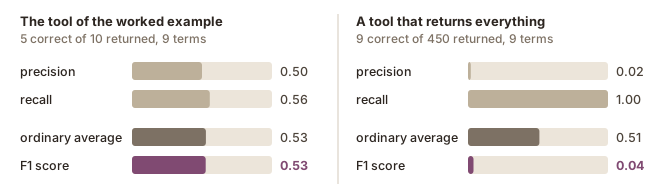
F1 = 2 × precision × recall / (precision + recall), here
2 × 0.50 × 0.56 / (0.50 + 0.56) = 0.53. As a harmonic mean, it is closer to
the lower of the two values than an ordinary average would be (Jurafsky &
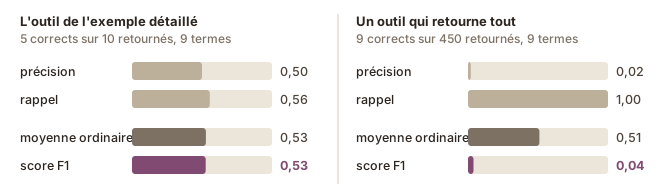
Martin, 2026), so a tool cannot score well by doing one thing only. For
example, if a tool returned every word and every sequence of words of a text,
it would have perfect recall, a precision close to zero, and an F1 score
close to zero (Figure 9figure 9).
Figure 9. The F1 score and the ordinary average of precision and recall, for the tool of the worked example and for a tool that returns everything.
The scores change with the number of candidates a tool returns.
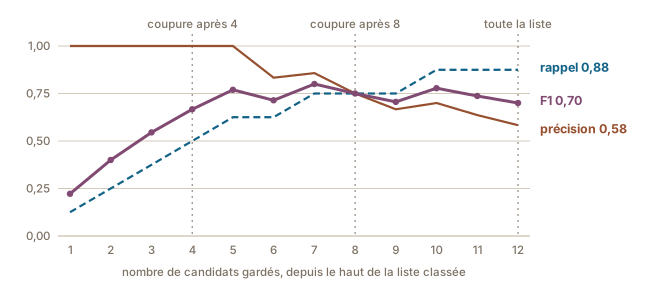
Figure 10figure 10 gives the three scores after each candidate of the ranked list of
Figure 5figure 5: as more candidates are kept, precision falls and recall
rises, and the F1 score is highest after seven candidates.
Figure 10. Precision, recall and F1 after each candidate of one ranked list, against a gold standard of eight terms.
More than two classes
When a system sorts items into more than two classes, for example emails into
urgent, normal and spam, precision and recall are calculated for each class.
The scores of the classes are then averaged (macroaveraging), or the
decisions for all classes are pooled before the calculation (microaveraging),
in which case the most frequent class has the most influence on the result
(Jurafsky & Martin, 2026).
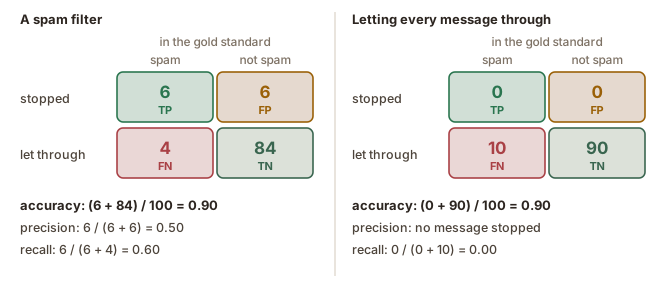
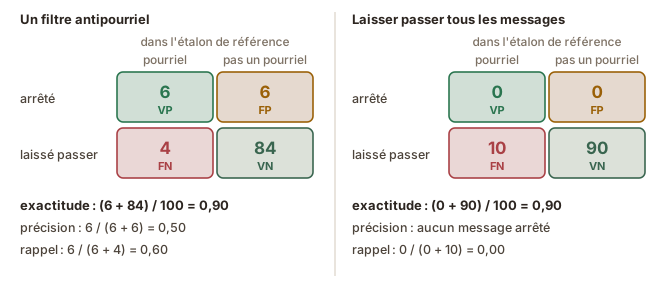
Figure 11figure 11 calculates it for a spam filter and 100 messages: 10 of the
messages are spam, and the filter stops 6 of them and 6 messages that are not
spam.
Figure 11. The same 100 messages judged by a spam filter and by letting every message through: the same accuracy, very different recall.
Accuracy is misleading when the class to find is rare, as the second matrix
shows. Jurafsky and Martin (2026) give a more extreme example: a million social media
posts, of which a hundred are about the product a company wants to follow: a system that labels every
post as not about the product is right for 99.99 % of the posts, but it has
found none of the hundred. Precision and recall do not count the true
negatives, so the same system has a recall of
zero (see also the Baselines page) (voir aussi la page Les étalons).
Sources
Jurafsky, D., & Martin, J. H. (2026). Speech and Language Processing: An Introduction to Natural Language Processing, Computational Linguistics, and Speech Recognition with Language Models. Online draft, 3rd edition. https://web.stanford.edu/~jurafsky/slp3/
Rigouts Terryn, A., Hoste, V., & Lefever, E. (2020a). In No Uncertain Terms: A Dataset for Monolingual and Multilingual Automatic Term Extraction from Comparable Corpora. Language Resources and Evaluation, 54(2), 385–418. https://doi.org/10.1007/s10579-019-09453-9
Figure 6. Les parties à partir desquelles se calculent la précision et le rappel : les termes de l'étalon de référence, les candidats proposés par le système, et leur chevauchement.
Chaque score peut s’expliquer de plusieurs façons, et l’une d’elles vous
paraîtra peut-être plus claire que les autres :
Précision
sous forme de formule : précision = VP / (VP + FP) ;
Dans cet exemple, un extracteur de termes propose dix candidats pour un
court texte sur le dressage, et l’étalon de référence de ce texte compte neuf
termes
(Figure 7figure 7).
Figure 7. Un étalon de référence de neuf termes et les dix candidats d'un outil, en couleur selon le cas.
Cinq candidats figurent sur les deux listes : il y a donc 5 vrais positifs,
5 faux positifs et 4 faux négatifs
(Figure 8figure 8) :
précision = 5 / (5 + 5) = 0,50 ;
rappel = 5 / (5 + 4) = 0,56.
Figure 8. La précision et le rappel mesurent le même chevauchement par rapport à deux totaux différents : ce que le système a trouvé, et ce que contient l'étalon de référence.
Le score F1
Le score F1 combine la précision et le rappel en un seul nombre.
Il vaut deux fois leur produit, divisé par leur somme :
F1 = 2 × précision × rappel / (précision + rappel), ici
2 × 0,50 × 0,56 / (0,50 + 0,56) = 0,53. Comme moyenne harmonique, il est plus
proche de la plus basse des deux valeurs que ne le serait une moyenne
ordinaire (Jurafsky & Martin, 2026) : un outil ne peut donc pas obtenir un bon
score en ne faisant qu’une seule chose. Par exemple, si un outil proposait
chaque mot et chaque suite de mots d’un texte, il aurait un rappel parfait,
une précision proche de zéro et un score F1 proche de zéro
(Figure 9figure 9).
Figure 9. Le score F1 et la moyenne ordinaire de la précision et du rappel, pour l'outil de l'exemple détaillé et pour un outil qui propose tout.
Les scores changent avec le nombre de candidats qu’un outil propose.
La Figure 10figure 10 donne les trois scores après chaque candidat de la liste classée de
Figure 5figure 5 : à mesure qu’on garde plus de candidats, la précision baisse et
le rappel augmente, et le score F1 est le plus élevé après sept candidats.
Figure 10. La précision, le rappel et le score F1 après chaque candidat d'une liste classée, comparée à un étalon de référence de huit termes.
Plus de deux classes
Quand un système classe des éléments en plus de deux classes, par exemple des
courriels en urgents, normaux et pourriels, la précision et le rappel se
calculent pour chaque classe. On fait ensuite la moyenne des scores des
classes (macromoyenne), ou on regroupe les décisions de toutes les classes
avant le calcul (micromoyenne) ; dans ce cas, la classe la plus fréquente
pèse le plus sur le résultat (Jurafsky & Martin, 2026).
La Figure 11figure 11 la calcule pour un filtre antipourriel et 100 messages : 10
de ces messages sont des pourriels, et le filtre en arrête 6, ainsi que 6
messages qui ne sont pas des pourriels.
Figure 11. Les mêmes 100 messages jugés par un filtre antipourriel et en laissant passer tous les messages : la même exactitude, un rappel très différent.
L’exactitude est trompeuse quand la classe à trouver est rare, comme le
montre la deuxième matrice. Jurafsky et Martin (2026) donnent un exemple plus
extrême : un million de publications sur les réseaux sociaux, dont une
centaine portent sur le produit qu’une entreprise veut suivre. Un système qui
étiquette chaque publication comme ne portant pas sur le produit a raison
pour 99,99 % des publications, mais il n’a trouvé aucune des cent. La
précision et le rappel ne comptent pas les vrais négatifs : le même système a
donc un rappel de
zéro (see also the Baselines page) (voir aussi la page Les étalons).
Sources
Jurafsky, D., & Martin, J. H. (2026). Speech and Language Processing: An Introduction to Natural Language Processing, Computational Linguistics, and Speech Recognition with Language Models. Online draft, 3rd edition. https://web.stanford.edu/~jurafsky/slp3/
Rigouts Terryn, A., Hoste, V., & Lefever, E. (2020a). In No Uncertain Terms: A Dataset for Monolingual and Multilingual Automatic Term Extraction from Comparable Corpora. Language Resources and Evaluation, 54(2), 385–418. https://doi.org/10.1007/s10579-019-09453-9
Practice: precision, recall and F1Pratique : précision, rappel et score F1
The gold standard has eight terms and the tool found four of them. Recall is the share of the terms of the gold standard that the tool found: 4 / 8 = 0.50.
La référence compte huit termes et l'outil en a trouvé quatre. Le rappel est la part des termes de la référence que l'outil a trouvés : 4 / 8 = 0,50.
ExerciseExercice 3 · the F1 scorele score F1not startedà fairesolvedréussikeep tryingà retravailler
What is the F1 score of the tool? Round the answer to two decimals.
Quel est le score F1 de l'outil ? Arrondissez la réponse à deux décimales.
Show the explanationVoir l'explication
The F1 score is twice the product of precision and recall, divided by their sum: 2 × 0.67 × 0.50 / (0.67 + 0.50) = 0.57. It lies between the two values, closer to the lower one.
Le score F1 vaut deux fois le produit de la précision et du rappel, divisé par leur somme : 2 × 0,67 × 0,50 / (0,67 + 0,50) = 0,57. Il se situe entre les deux valeurs, plus près de la plus basse.
A second tool returns twenty candidates for the same text, and all eight terms of the gold standard are among them. Which of the following statements is true?
Un deuxième outil propose vingt candidats pour le même texte, et les huit termes de la référence en font partie. Lequel des énoncés suivants est exact ?
Show the solutionVoir la solution
The second tool has a recall of 8 / 8 = 1.00 and a precision of 8 / 20 = 0.40. Its F1 score is therefore 2 × 0.40 × 1.00 / (0.40 + 1.00) = 0.57, the same as the first tool's.
Two tools can reach the same F1 score with opposite errors: the first misses half of the terms, and most of the second tool's candidates are not terms. That is why an evaluation reports precision and recall as well as the F1 score.
Le deuxième outil a un rappel de 8 / 8 = 1,00 et une précision de 8 / 20 = 0,40. Son score F1 est donc de 2 × 0,40 × 1,00 / (0,40 + 1,00) = 0,57, comme celui du premier outil.
Deux outils peuvent obtenir le même score F1 avec des erreurs opposées : le premier manque la moitié des termes, et la plupart des candidats du second ne sont pas des termes. C'est pourquoi une évaluation indique la précision et le rappel en plus du score F1.
The gold standard has eight terms and the tool found four of them. Recall is the share of the terms of the gold standard that the tool found: 4 / 8 = 0.50.
La référence compte huit termes et l'outil en a trouvé quatre. Le rappel est la part des termes de la référence que l'outil a trouvés : 4 / 8 = 0,50.
ExerciseExercice 3 · the F1 scorele score F1not startedà fairesolvedréussikeep tryingà retravailler
What is the F1 score of the tool? Round the answer to two decimals.
Quel est le score F1 de l'outil ? Arrondissez la réponse à deux décimales.
Show the explanationVoir l'explication
The F1 score is twice the product of precision and recall, divided by their sum: 2 × 0.67 × 0.50 / (0.67 + 0.50) = 0.57. It lies between the two values, closer to the lower one.
Le score F1 vaut deux fois le produit de la précision et du rappel, divisé par leur somme : 2 × 0,67 × 0,50 / (0,67 + 0,50) = 0,57. Il se situe entre les deux valeurs, plus près de la plus basse.
A second tool returns twenty candidates for the same text, and all eight terms of the gold standard are among them. Which of the following statements is true?
Un deuxième outil propose vingt candidats pour le même texte, et les huit termes de la référence en font partie. Lequel des énoncés suivants est exact ?
Show the solutionVoir la solution
The second tool has a recall of 8 / 8 = 1.00 and a precision of 8 / 20 = 0.40. Its F1 score is therefore 2 × 0.40 × 1.00 / (0.40 + 1.00) = 0.57, the same as the first tool's.
Two tools can reach the same F1 score with opposite errors: the first misses half of the terms, and most of the second tool's candidates are not terms. That is why an evaluation reports precision and recall as well as the F1 score.
Le deuxième outil a un rappel de 8 / 8 = 1,00 et une précision de 8 / 20 = 0,40. Son score F1 est donc de 2 × 0,40 × 1,00 / (0,40 + 1,00) = 0,57, comme celui du premier outil.
Deux outils peuvent obtenir le même score F1 avec des erreurs opposées : le premier manque la moitié des termes, et la plupart des candidats du second ne sont pas des termes. C'est pourquoi une évaluation indique la précision et le rappel en plus du score F1.
Partial matches and cut-off in term extraction. Reported scores differ greatly depending
on how strict the evaluation is, for example on whether partial matches are
accepted, and they change with the point at which a ranked list is cut off
(Rigouts Terryn et al., 2019).
Unique terms or occurrences. Scores for every occurrence in the running text
and scores for a list of unique terms can lead to different conclusions,
for example about the language or the domain in which a system does best
(Rigouts Terryn et al., 2022b).
A strict comparison has two outcomes, correct or not, but many candidates of
a term extractor are between the two
(Figure 13figure 13):
the candidate is part of a term in the gold standard;
the candidate is a term of the gold standard with another word attached;
the candidate would be a term for some purposes and not for others.
Figure 13. Between a candidate that is wrong and one that is right: three cases a strict comparison counts as errors.
The same cases come up in named entity recognition, for instance Curie for
Marie Curie, or the University of Paris with one word too many. A strict
evaluation counts all of them as errors. A more lenient evaluation
accepts some of them and gives higher scores, so scores obtained with
different rules cannot be compared.
Sources
Jurafsky, D., & Martin, J. H. (2026). Speech and Language Processing: An Introduction to Natural Language Processing, Computational Linguistics, and Speech Recognition with Language Models. Online draft, 3rd edition. https://web.stanford.edu/~jurafsky/slp3/
Rigouts Terryn, A. (2026). Large Language Models Are Good Term Extractors: A Systematic Evaluation. Proceedings of the Fifteenth Language Resources and Evaluation Conference (LREC 2026), 7631–7643. https://doi.org/10.63317/49gta5itne3q
Rigouts Terryn, A., Drouin, P., Hoste, V., & Lefever, E. (2019). Analysing the Impact of Supervised Machine Learning on Automatic Term Extraction: HAMLET vs TermoStat. Proceedings of the International Conference on Recent Advances in Natural Language Processing (RANLP 2019), 1012–1021. https://doi.org/10.26615/978-954-452-056-4_117
Rigouts Terryn, A., Hoste, V., & Lefever, E. (2022b). Tagging Terms in Text: A Supervised Sequential Labelling Approach to Automatic Term Extraction. Terminology, 28(1), 157–189. https://doi.org/10.1075/term.21010.rig
Correspondances partielles et seuil en extraction de termes. Les scores
publiés varient beaucoup selon la rigueur de l’évaluation, par exemple selon
que les correspondances partielles sont acceptées ou non, et ils changent
avec l’endroit où une liste classée est coupée (Rigouts Terryn et al.,
2019).
Termes uniques ou occurrences. Les scores calculés sur chaque
occurrence dans le texte et les scores calculés sur une liste de termes
uniques peuvent mener à des conclusions différentes, par exemple sur la
langue ou le domaine où un système réussit le mieux (Rigouts Terryn et al.,
2022b).
Une comparaison stricte n’a que deux issues, correct ou non, mais beaucoup de
candidats d’un extracteur de termes se situent entre les deux
(Figure 13figure 13) :
le candidat est une partie d’un terme de l’étalon de référence ;
le candidat est un terme de l’étalon de référence auquel s’ajoute un autre
mot ;
le candidat serait un terme pour certains usages, mais pas pour d’autres.
Figure 13. Entre un candidat faux et un candidat juste : trois cas qu'une comparaison stricte compte comme des erreurs.
Les mêmes cas se présentent en reconnaissance d’entités nommées, par exemple
Curie pour Marie Curie, ou l’Université de Paris avec un mot de trop.
Une évaluation stricte les compte tous comme des erreurs. Une évaluation plus
souple en accepte certains et donne des scores plus élevés : des scores
obtenus avec des règles différentes ne peuvent donc pas être comparés.
Sources
Jurafsky, D., & Martin, J. H. (2026). Speech and Language Processing: An Introduction to Natural Language Processing, Computational Linguistics, and Speech Recognition with Language Models. Online draft, 3rd edition. https://web.stanford.edu/~jurafsky/slp3/
Rigouts Terryn, A. (2026). Large Language Models Are Good Term Extractors: A Systematic Evaluation. Proceedings of the Fifteenth Language Resources and Evaluation Conference (LREC 2026), 7631–7643. https://doi.org/10.63317/49gta5itne3q
Rigouts Terryn, A., Drouin, P., Hoste, V., & Lefever, E. (2019). Analysing the Impact of Supervised Machine Learning on Automatic Term Extraction: HAMLET vs TermoStat. Proceedings of the International Conference on Recent Advances in Natural Language Processing (RANLP 2019), 1012–1021. https://doi.org/10.26615/978-954-452-056-4_117
Rigouts Terryn, A., Hoste, V., & Lefever, E. (2022b). Tagging Terms in Text: A Supervised Sequential Labelling Approach to Automatic Term Extraction. Terminology, 28(1), 157–189. https://doi.org/10.1075/term.21010.rig
Agreement as an F1 scoreL'accord mesuré par le score F1
Measured this way, the IAA between people is on the same scale as the score
of a system, and the two can be set side by side.
Sources
Hripcsak, G., & Rothschild, A. S. (2005). Agreement, the F-measure, and reliability in information retrieval. Journal of the American Medical Informatics Association, 12(3), 296–298. https://doi.org/10.1197/jamia.M1733
Figure 14. Deux annotateurs évalués l'un par rapport à l'autre : la précision et le rappel s'inversent selon l'étalon de référence, et le score F1 ne change pas.
Mesuré ainsi, l’accord inter-annotateurs est sur la même échelle que le score
d’un système, et les deux peuvent être comparés directement.
Sources
Hripcsak, G., & Rothschild, A. S. (2005). Agreement, the F-measure, and reliability in information retrieval. Journal of the American Medical Informatics Association, 12(3), 296–298. https://doi.org/10.1197/jamia.M1733
All outputs are put in the same form as the gold standard, with the
matching rules decided beforehand and applied to every system, for example
one entry per term, in lowercase, with one decision on
plurals (see also the Matching rules page) (voir aussi la page Les règles de correspondance).
The errors are examined: the kinds of item each system missed, and
the kinds it returned
wrongly (see also the Interpreting a score page) (voir aussi la page Interpréter un score).
Toutes les sorties sont mises sous la même forme que l’étalon de
référence, avec des règles de correspondance fixées à l’avance et
appliquées à tous les systèmes, par exemple une entrée par terme, en
minuscules, avec une seule décision sur les
pluriels (see also the Matching rules page) (voir aussi la page Les règles de correspondance).
Les erreurs sont examinées : les types d’éléments que chaque système a
manqués, et ceux qu’il a trouvés à
tort (see also the Interpreting a score page) (voir aussi la page Interpréter un score).
Evaluating machine translationÉvaluation de la traduction automatique
Written in English. The French version was automatically generated
and I have not revised it.
Rédigé en anglais. La version française a été
générée automatiquement et je ne l'ai pas révisée.
Many correct translationsDe nombreuses traductions correctes
Translation shares this difficulty in a more complex form, and adds a second
one, because translation means generating new text rather than selecting
text or labels from a limited set:
The correct answers cannot be listed. The terms of a text are
sequences of words in that text, so a gold standard can list
them (see also the Matching rules page) (voir aussi la page Les règles de correspondance). A
sentence has too many correct translations to list, and a correct output
rarely matches a translation made by a person word for word.
An answer can be partly right. Even a borderline term is either on a
list or not. A translated sentence contains many decisions and can be
wrong in one part, slightly or seriously: awkward phrasing is not as
serious as reversing the meaning.
Figure 1figure 1 shows both on one French idiom: four English translations are correct and
differ from each other in wording, two are partly wrong because they lose
part of the meaning or are awkwardly phrased, and two are wrong.
Figure 1. One sentence to translate, four correct translations, two partly wrong ones and two wrong ones. The first correct translation serves as the reference.
Adequacy and fluency
Two dimensions are standard in judging a translation (Jurafsky & Martin, 2026):
adequacy, also called fidelity: how well the translation conveys the
meaning of the source;
fluency: whether the translation is grammatical, clear and natural in
the target language.
The two come apart, as Figure 2figure 2 shows on four translations of one sentence.
Figure 2. Four translations of one sentence, placed by adequacy and by fluency.
In professional work, style and terminology are judged as well; MQM treats
them as separate error categories (Freitag et al.,
2021) (see also the Human evaluation: DA, MQM and ESA page) (voir aussi la page L'évaluation humaine : DA, MQM et ESA). Raters without
translation training find adequacy and fluency hard to keep apart,
so human evaluations train their raters with examples (Jurafsky & Martin,
2026).
The reference translation
In machine translation, the gold standard is a reference translation: a
translation of the test sentence by a professional translator, taken as one
correct answer among many.
A metric that compares an output with a reference therefore measures
resemblance to one translation, and a perfect match is rare, even for a
very good translation. Some evaluations give each sentence several
references to soften that (Papineni et al., 2002).
A reference-based evaluation can penalize a correct translation, and a
system that is better than the reference, for differing from it (Freitag
et al., 2021).
Sources
Basile, V., Fell, M., Fornaciari, T., Hovy, D., Paun, S., Plank, B., et al. (2021). We Need to Consider Disagreement in Evaluation. Proceedings of the 1st Workshop on Benchmarking: Past, Present and Future. https://doi.org/10.18653/v1/2021.bppf-1.3
Freitag, M., Foster, G., Grangier, D., Ratnakar, V., Tan, Q., & Macherey, W. (2021). Experts, Errors, and Context: A Large-Scale Study of Human Evaluation for Machine Translation. Transactions of the Association for Computational Linguistics, 9, 1460–1474. https://doi.org/10.1162/tacl_a_00437
Jurafsky, D., & Martin, J. H. (2026). Speech and Language Processing: An Introduction to Natural Language Processing, Computational Linguistics, and Speech Recognition with Language Models. Online draft, 3rd edition. https://web.stanford.edu/~jurafsky/slp3/
Kocmi, T., Artemova, E., Avramidis, E., Bawden, R., Bojar, O., Dranch, K., et al. (2025). Findings of the WMT25 General Machine Translation Shared Task: Time to Stop Evaluating on Easy Test Sets. Proceedings of the Tenth Conference on Machine Translation (WMT 2025), Volume 2: Shared Task Papers, 355–413. https://doi.org/10.18653/v1/2025.wmt-1.22
Papineni, K., Roukos, S., Ward, T., & Zhu, W.-J. (2002). BLEU: a method for automatic evaluation of machine translation. Proceedings of the 40th Annual Meeting of the Association for Computational Linguistics (ACL 2002), Philadelphia, 311–318. https://doi.org/10.3115/1073083.1073135
La traduction partage cette difficulté sous une forme plus complexe, et en
ajoute une seconde, parce que traduire consiste à produire un texte nouveau
plutôt qu’à choisir des passages ou des étiquettes dans un ensemble
limité :
Les bonnes réponses ne peuvent pas être énumérées. Les termes d’un
texte sont des suites de mots de ce texte, si bien qu’un étalon de
référence peut en dresser la
liste (see also the Matching rules page) (voir aussi la page Les règles de correspondance). Une
phrase a trop de traductions correctes pour qu’on les énumère, et une
sortie correcte correspond rarement mot pour mot à une traduction faite
par une personne.
Une réponse peut être en partie juste. Même un terme limite figure sur
une liste ou n’y figure pas. Une phrase traduite contient de nombreuses
décisions et peut être fausse sur un point, légèrement ou gravement : une
tournure maladroite est moins grave qu’un sens inversé.
La Figure 1figure 1 montre les deux sur une expression figée française : quatre traductions
anglaises sont correctes et diffèrent entre elles par leur formulation, deux
sont en partie fausses parce qu’elles perdent une partie du sens ou sont
maladroites, et deux sont fausses.
Figure 1. Une phrase à traduire, quatre traductions correctes, deux en partie fausses et deux fausses. La première traduction correcte sert de référence.
L’adéquation et la fluidité
Deux dimensions servent habituellement à juger une traduction (Jurafsky &
Martin, 2026) :
l’adéquation, aussi appelée fidélité : la mesure dans laquelle la
traduction rend le sens de la source ;
la fluidité : la traduction est-elle grammaticale, claire et naturelle
dans la langue cible ?
Les deux peuvent diverger, comme le montre la Figure 2figure 2 sur quatre traductions d’une même phrase.
Figure 2. Quatre traductions d'une même phrase, placées selon leur adéquation et leur fluidité.
Dans le travail professionnel, le style et la terminologie sont aussi
jugés ; MQM en fait des catégories d’erreurs distinctes (Freitag et al.,
2021) (see also the Human evaluation: DA, MQM and ESA page) (voir aussi la page L'évaluation humaine : DA, MQM et ESA). Les évaluateurs
sans formation en traduction ont du mal à séparer
l’adéquation de la fluidité, si bien que les évaluations humaines forment
leurs évaluateurs à l’aide d’exemples (Jurafsky & Martin, 2026).
La traduction de référence
En traduction automatique, l’étalon de référence est une traduction de
référence : une traduction de la phrase de test faite par une traductrice ou
un traducteur professionnel, retenue comme une bonne réponse parmi
d’autres.
Une métrique qui compare une sortie avec une référence mesure donc la
ressemblance avec une seule traduction, et une correspondance parfaite est
rare, même pour une très bonne traduction. Certaines évaluations donnent
plusieurs références à chaque phrase pour atténuer ce problème (Papineni et
al., 2002).
Une évaluation fondée sur une référence peut pénaliser une traduction
correcte, et un système meilleur que la référence, parce qu’ils s’en
écartent (Freitag et al., 2021).
Sources
Basile, V., Fell, M., Fornaciari, T., Hovy, D., Paun, S., Plank, B., et al. (2021). We Need to Consider Disagreement in Evaluation. Proceedings of the 1st Workshop on Benchmarking: Past, Present and Future. https://doi.org/10.18653/v1/2021.bppf-1.3
Freitag, M., Foster, G., Grangier, D., Ratnakar, V., Tan, Q., & Macherey, W. (2021). Experts, Errors, and Context: A Large-Scale Study of Human Evaluation for Machine Translation. Transactions of the Association for Computational Linguistics, 9, 1460–1474. https://doi.org/10.1162/tacl_a_00437
Jurafsky, D., & Martin, J. H. (2026). Speech and Language Processing: An Introduction to Natural Language Processing, Computational Linguistics, and Speech Recognition with Language Models. Online draft, 3rd edition. https://web.stanford.edu/~jurafsky/slp3/
Kocmi, T., Artemova, E., Avramidis, E., Bawden, R., Bojar, O., Dranch, K., et al. (2025). Findings of the WMT25 General Machine Translation Shared Task: Time to Stop Evaluating on Easy Test Sets. Proceedings of the Tenth Conference on Machine Translation (WMT 2025), Volume 2: Shared Task Papers, 355–413. https://doi.org/10.18653/v1/2025.wmt-1.22
Papineni, K., Roukos, S., Ward, T., & Zhu, W.-J. (2002). BLEU: a method for automatic evaluation of machine translation. Proceedings of the 40th Annual Meeting of the Association for Computational Linguistics (ACL 2002), Philadelphia, 311–318. https://doi.org/10.3115/1073083.1073135
Ways of evaluating a translationLes façons d'évaluer une traduction
Figure 3. The ways of evaluating machine translation, by who or what judges, coloured by the use of a reference translation. The named metrics and protocols are examples, not complete lists. The dashed combinations exist but are less common in current machine translation evaluation, where people annotate errors and automatic methods give scores (Kocmi et al., 2025); this chapter does not cover them.
The rows of the figure are the three families of methods:
Automatic metrics: a program computes the score, and the same input
always gets the same score.
Automatic metrics differ in what they compare. There are three main kinds:
surface metrics count the words or characters that the output shares
with the reference, for instance BLEU (Papineni et al., 2002) and chrF
(Popović, 2015);
learned metrics are trained on human judgements to predict the score
a person would give, for instance COMET (Rei et al., 2020); some work
without a reference, which is called quality estimation.
In 2021, on the largest collection of human judgements then available,
learned metrics ranked pairs of systems more like people than surface
metrics did (Kocmi et al., 2021).
In 2025, large language models used as judges were the best at ranking
whole systems. On single sentences, simple metrics that compare the output
with a reference, surface ones such as chrF and embedding-based ones such
as BERTScore, were among the best, ahead of most learned metrics and model
judges; only one model judge and one learned metric equalled or exceeded
them. The organizers call this result surprising (Lavie et al., 2025).
Large language models as judges
A large language model used as a judge receives the source, the output,
the reference if there is one, and an instruction saying what to judge and
in what form to answer (Kocmi & Federmann, 2023a). It can give a score, a
list of errors with their category and severity, or both.
Model judges rank whole systems well, but most score single sentences less
reliably, as the 2025 results above show.
Raters disagree, since a source can be ambiguous and raters know
different things and use scales differently; evaluations remove outlier
raters and normalize their scores (Jurafsky & Martin, 2026).
The table below compares the three families on eight criteria, with the
automatic metrics split in two. A reference translation for every test
sentence is expensive, and for some language pairs and domains there is
none, so the need for a reference often decides which methods can be used
at all.
Surface metrics
Semantic and learned metrics
Large language model as judge
People
Reference needed
yes
yes for most; quality estimation works without
optional
no for error annotation; optional for scores and comparisons
The families of methods compared on eight criteria.
Scores are not comparable across test sets or language pairs, even from
the same metric: a score depends on the texts and the language pair as well
as on the translation (Kocmi et al., 2021, 2025) (see also the Reading the scores page) (voir aussi la page Lire les scores).
Purposes of an evaluation
Which method fits depends partly on what the evaluation is for. Machine
translation is evaluated for several purposes:
to compare systems, as WMT does every year, and as a company does
before choosing a system;
to guide development, where a fast automatic score shows whether a
change helped;
to find errors, which needs more than a score: where the errors are,
of what kind, and how serious;
to decide what the output can be used for: good enough to understand a
web page is not always good enough to publish, and the question is answered
mainly by reading the output.
Sources
Freitag, M., Foster, G., Grangier, D., Ratnakar, V., Tan, Q., & Macherey, W. (2021). Experts, Errors, and Context: A Large-Scale Study of Human Evaluation for Machine Translation. Transactions of the Association for Computational Linguistics, 9, 1460–1474. https://doi.org/10.1162/tacl_a_00437
Jurafsky, D., & Martin, J. H. (2026). Speech and Language Processing: An Introduction to Natural Language Processing, Computational Linguistics, and Speech Recognition with Language Models. Online draft, 3rd edition. https://web.stanford.edu/~jurafsky/slp3/
Kocmi, T., & Federmann, C. (2023a). GEMBA-MQM: Detecting Translation Quality Error Spans with GPT-4. Proceedings of the Eighth Conference on Machine Translation (WMT 2023), 768–775. https://doi.org/10.18653/v1/2023.wmt-1.64
Kocmi, T., Artemova, E., Avramidis, E., Bawden, R., Bojar, O., Dranch, K., et al. (2025). Findings of the WMT25 General Machine Translation Shared Task: Time to Stop Evaluating on Easy Test Sets. Proceedings of the Tenth Conference on Machine Translation (WMT 2025), Volume 2: Shared Task Papers, 355–413. https://doi.org/10.18653/v1/2025.wmt-1.22
Kocmi, T., Federmann, C., Grundkiewicz, R., Junczys-Dowmunt, M., Matsushita, H., & Menezes, A. (2021). To Ship or Not to Ship: An Extensive Evaluation of Automatic Metrics for Machine Translation. Proceedings of the Sixth Conference on Machine Translation (WMT 2021), 478–494. https://aclanthology.org/2021.wmt-1.57/
Kocmi, T., Zouhar, V., Avramidis, E., Grundkiewicz, R., Karpinska, M., Popović, M., et al. (2024a). Error Span Annotation: A Balanced Approach for Human Evaluation of Machine Translation. Proceedings of the Ninth Conference on Machine Translation (WMT 2024), 1440–1453. https://doi.org/10.18653/v1/2024.wmt-1.131
Lavie, A., Hanneman, G., Agrawal, S., Kanojia, D., Lo, C., Zouhar, V., et al. (2025). Findings of the WMT25 Shared Task on Automated Translation Evaluation Systems: Linguistic Diversity is Challenging and References Still Help. Proceedings of the Tenth Conference on Machine Translation (WMT 2025), Volume 2: Shared Task Papers, 436–483. https://doi.org/10.18653/v1/2025.wmt-1.24
Papineni, K., Roukos, S., Ward, T., & Zhu, W.-J. (2002). BLEU: a method for automatic evaluation of machine translation. Proceedings of the 40th Annual Meeting of the Association for Computational Linguistics (ACL 2002), Philadelphia, 311–318. https://doi.org/10.3115/1073083.1073135
Popović, M. (2015). chrF: character n-gram F-score for automatic MT evaluation. Proceedings of the Tenth Workshop on Statistical Machine Translation (WMT 2015), Lisbon, 392–395. https://doi.org/10.18653/v1/W15-3049
Rei, R., Stewart, C., Farinha, A. C., & Lavie, A. (2020). COMET: A Neural Framework for MT Evaluation. Proceedings of the 2020 Conference on Empirical Methods in Natural Language Processing (EMNLP 2020), 2685–2702. https://doi.org/10.18653/v1/2020.emnlp-main.213
Zhang, T., Kishore, V., Wu, F., Weinberger, K. Q., & Artzi, Y. (2020). BERTScore: Evaluating Text Generation with BERT. Eighth International Conference on Learning Representations (ICLR 2020). http://arxiv.org/abs/1904.09675
réunit donc les deux. Ses couleurs montrent que de nombreuses méthodes
peuvent fonctionner avec ou sans référence.
Figure 3. Les façons d'évaluer la traduction automatique, selon qui ou quoi juge, colorées selon l'emploi d'une traduction de référence. Les métriques et les protocoles nommés sont des exemples, non des listes complètes. Les combinaisons en pointillé existent, mais sont moins courantes dans l'évaluation actuelle de la traduction automatique, où les personnes annotent les erreurs et les méthodes automatiques donnent des scores (Kocmi et al., 2025) ; ce chapitre ne les traite pas.
Les lignes de la figure correspondent aux trois familles de méthodes :
Les métriques automatiques : un programme calcule le score, et une
même entrée reçoit toujours le même score.
Des personnes : des évaluateurs jugent eux-mêmes la traduction.
Les métriques automatiques
Les métriques automatiques diffèrent par ce qu’elles comparent. On en
distingue trois grands types :
les métriques de surface comptent les mots ou les caractères que la
sortie partage avec la référence, par exemple BLEU (Papineni et al., 2002)
et chrF (Popović, 2015) ;
les métriques apprises sont entraînées sur des jugements humains pour
prédire le score qu’une personne donnerait, par exemple COMET (Rei et al.,
2020) ; certaines fonctionnent sans référence, ce qu’on appelle
l’estimation de la qualité.
En 2021, sur la plus grande collection de jugements humains alors
disponible, les métriques apprises classaient des paires de systèmes plus
comme les personnes que les métriques de surface (Kocmi et al., 2021).
En 2025, les grands modèles de langue employés comme juges étaient les
meilleurs pour classer des systèmes entiers. Sur des phrases isolées, des
métriques simples qui comparent la sortie avec une référence, de surface
comme chrF ou fondées sur des plongements comme BERTScore, comptaient parmi
les meilleures, devant la plupart des métriques apprises et des modèles
juges ; seuls un modèle juge et une métrique apprise les égalaient ou les
dépassaient. Les organisateurs qualifient ce résultat de surprenant (Lavie
et al., 2025).
Les grands modèles de langue comme juges
Un grand modèle de langue employé comme juge reçoit la source, la sortie,
la référence s’il y en a une, et une consigne qui dit quoi juger et sous
quelle forme répondre (Kocmi & Federmann, 2023a). Il peut donner un score,
une liste d’erreurs avec leur catégorie et leur gravité, ou les deux.
Les modèles juges classent bien des systèmes entiers, mais la plupart
notent les phrases isolées de façon moins fiable, comme le montrent les
résultats de 2025 ci-dessus.
Les évaluateurs ne sont pas toujours d’accord, parce qu’une source peut
être ambiguë et que les évaluateurs n’ont pas les mêmes connaissances ni la
même façon d’utiliser une échelle ; les évaluations écartent les
évaluateurs aberrants et normalisent leurs scores (Jurafsky & Martin,
2026).
Le choix des évaluateurs change le résultat : des traducteurs
professionnels et des travailleurs de la production participative ont
classé les mêmes systèmes différemment (Freitag et al.,
2021) (see also the Human evaluation: DA, MQM and ESA page) (voir aussi la page L'évaluation humaine : DA, MQM et ESA).
Les méthodes comparées
Le tableau ci-dessous compare les trois familles selon huit critères, en
séparant les métriques automatiques en deux. Une traduction de référence pour
chaque phrase de test coûte cher, et pour certaines paires de langues et
certains domaines il n’en existe pas : la nécessité d’une référence décide
donc souvent des méthodes qui peuvent être employées.
Métriques de surface
Métriques sémantiques et apprises
Grand modèle de langue comme juge
Personnes
Référence nécessaire
oui
oui pour la plupart ; l’estimation de la qualité s’en passe
facultative
non pour l’annotation des erreurs ; facultative pour les scores et les comparaisons
un score ; certaines métriques marquent aussi des passages erronés
un score, une liste d’erreurs, ou les deux
des erreurs avec type et gravité, ou un score
Accord avec les personnes
inférieur aux métriques apprises en 2021 (Kocmi et al., 2021) ; parmi les meilleurs sur des phrases isolées en 2025 (Lavie et al., 2025)
supérieur aux métriques de surface en 2021 ; sur des phrases isolées en 2025, BERTScore parmi les meilleures, la plupart des métriques apprises derrière
le meilleur pour classer des systèmes en 2025, moins fiable par phrase
la norme à laquelle les autres sont mesurées, avec des désaccords entre personnes
Explicabilité
oui : le comptage peut être refait à la main
non : c’est la sortie d’un modèle
en partie : le modèle donne des raisons, mais elles sont générées elles aussi
oui
Réemploi sur une nouvelle sortie
oui, sans frais, une fois la référence disponible
oui, au prix de l’exécution du modèle
oui, mais un autre modèle ou une autre requête donne d’autres scores
non : chaque nouvelle sortie demande de nouveaux jugements
Coût
négligeable
un modèle à exécuter
un modèle à interroger, phrase par phrase
élevé : du temps et de l’expertise
Robustesse selon les langues, les domaines et les paraphrases
dépend des langues sur lesquelles le modèle a été entraîné
sensible à la requête, avec des biais connus
dépend des évaluateurs et des consignes
Les familles de méthodes comparées selon huit critères.
Les scores ne sont pas comparables d’un jeu de test ou d’une paire de langues
à l’autre, même pour une même métrique : un score dépend des textes et de la
paire de langues autant que de la traduction (Kocmi et al., 2021,
2025) (see also the Reading the scores page) (voir aussi la page Lire les scores).
Les buts d’une évaluation
La méthode qui convient dépend en partie de ce à quoi sert l’évaluation. La
traduction automatique est évaluée à plusieurs fins :
pour comparer des systèmes, comme le fait WMT chaque année, et comme le
fait une entreprise avant de choisir un système ;
pour guider le développement, où un score automatique rapide montre si
une modification a aidé ;
pour trouver les erreurs, ce qui demande plus qu’un score : où sont les
erreurs, de quel type, et quelle est leur gravité ;
pour décider de l’usage possible de la sortie : assez bonne pour
comprendre une page Web ne veut pas toujours dire assez bonne pour être
publiée, et la question se tranche surtout en lisant la sortie.
Sources
Freitag, M., Foster, G., Grangier, D., Ratnakar, V., Tan, Q., & Macherey, W. (2021). Experts, Errors, and Context: A Large-Scale Study of Human Evaluation for Machine Translation. Transactions of the Association for Computational Linguistics, 9, 1460–1474. https://doi.org/10.1162/tacl_a_00437
Jurafsky, D., & Martin, J. H. (2026). Speech and Language Processing: An Introduction to Natural Language Processing, Computational Linguistics, and Speech Recognition with Language Models. Online draft, 3rd edition. https://web.stanford.edu/~jurafsky/slp3/
Kocmi, T., & Federmann, C. (2023a). GEMBA-MQM: Detecting Translation Quality Error Spans with GPT-4. Proceedings of the Eighth Conference on Machine Translation (WMT 2023), 768–775. https://doi.org/10.18653/v1/2023.wmt-1.64
Kocmi, T., Artemova, E., Avramidis, E., Bawden, R., Bojar, O., Dranch, K., et al. (2025). Findings of the WMT25 General Machine Translation Shared Task: Time to Stop Evaluating on Easy Test Sets. Proceedings of the Tenth Conference on Machine Translation (WMT 2025), Volume 2: Shared Task Papers, 355–413. https://doi.org/10.18653/v1/2025.wmt-1.22
Kocmi, T., Federmann, C., Grundkiewicz, R., Junczys-Dowmunt, M., Matsushita, H., & Menezes, A. (2021). To Ship or Not to Ship: An Extensive Evaluation of Automatic Metrics for Machine Translation. Proceedings of the Sixth Conference on Machine Translation (WMT 2021), 478–494. https://aclanthology.org/2021.wmt-1.57/
Kocmi, T., Zouhar, V., Avramidis, E., Grundkiewicz, R., Karpinska, M., Popović, M., et al. (2024a). Error Span Annotation: A Balanced Approach for Human Evaluation of Machine Translation. Proceedings of the Ninth Conference on Machine Translation (WMT 2024), 1440–1453. https://doi.org/10.18653/v1/2024.wmt-1.131
Lavie, A., Hanneman, G., Agrawal, S., Kanojia, D., Lo, C., Zouhar, V., et al. (2025). Findings of the WMT25 Shared Task on Automated Translation Evaluation Systems: Linguistic Diversity is Challenging and References Still Help. Proceedings of the Tenth Conference on Machine Translation (WMT 2025), Volume 2: Shared Task Papers, 436–483. https://doi.org/10.18653/v1/2025.wmt-1.24
Papineni, K., Roukos, S., Ward, T., & Zhu, W.-J. (2002). BLEU: a method for automatic evaluation of machine translation. Proceedings of the 40th Annual Meeting of the Association for Computational Linguistics (ACL 2002), Philadelphia, 311–318. https://doi.org/10.3115/1073083.1073135
Popović, M. (2015). chrF: character n-gram F-score for automatic MT evaluation. Proceedings of the Tenth Workshop on Statistical Machine Translation (WMT 2015), Lisbon, 392–395. https://doi.org/10.18653/v1/W15-3049
Rei, R., Stewart, C., Farinha, A. C., & Lavie, A. (2020). COMET: A Neural Framework for MT Evaluation. Proceedings of the 2020 Conference on Empirical Methods in Natural Language Processing (EMNLP 2020), 2685–2702. https://doi.org/10.18653/v1/2020.emnlp-main.213
Zhang, T., Kishore, V., Wu, F., Weinberger, K. Q., & Artzi, Y. (2020). BERTScore: Evaluating Text Generation with BERT. Eighth International Conference on Learning Representations (ICLR 2020). http://arxiv.org/abs/1904.09675
Click the drawing, or a line below, to build it up stage by stage.Cliquez sur le dessin, ou sur une ligne ci-dessous, pour le construire étape par étape.
Figure 4. BLEU computed by hand for one output against one reference.
The method has two further details (Papineni et al., 2002).
The counts are clipped. A word of the output counts only as many times
as it occurs in the reference, which is why Papineni et al. (2002) speak of
a modified n-gram precision. Without this, the output the the the the the
the the would have a perfect single-word precision against The cat is on
the mat; with it, the precision is 2/7, since the occurs twice in the
reference.
The three give the same result when the numbers are equal. When they are not,
the geometric and the harmonic mean are pulled towards the smallest numbers,
and both are zero as soon as one number is zero. The table below applies the
three to the four precisions of Figure 4figure 4.
Mean
Computed as
Result
arithmetic
(5/6 + 3/5 + 2/4 + 1/3) / 4
0.57
geometric
⁴√(5/6 × 3/5 × 2/4 × 1/3)
0.54
harmonic
4 / (6/5 + 5/3 + 4/2 + 3/1)
0.51
Three means of the same four precisions.
Papineni et al. (2002) chose the geometric mean because the precisions fall
steeply from single words to quadruples, and in their tests it agreed
slightly better with human judgements than the arithmetic mean. They also
note its cost: one precision of zero makes the whole score zero.
An output shorter than the reference
In Figure 5figure 5,
the output differs from the reference in two places, un for le and the
missing du salon, and it is shorter, so the brevity penalty applies.
Click the drawing, or a line below, to build it up stage by stage.Cliquez sur le dessin, ou sur une ligne ci-dessous, pour le construire étape par étape.
Figure 5. BLEU computed by hand for an output shorter than its reference.
The missing du salon lowers none of the four precisions, since a precision
only looks at what the output contains. The brevity penalty is the only part
of BLEU that registers what the output leaves out.
To avoid this, tools that give a BLEU score per sentence apply a correction,
called smoothing: a precision of zero gets a small value instead, so that a
sentence with no shared quadruple no longer scores zero. Several such
corrections exist, and they give different scores for the same sentence
(Chen & Cherry, 2014), so a BLEU score for one sentence is only a rough
indication.
Weaknesses of BLEU
BLEU compares the exact words of the output with those of the reference
(Jurafsky & Martin, 2026), which has five consequences:
Synonyms and paraphrases.Félin for chat loses 46 points in the
figure. A translation that says the same thing in other words is scored
lower.
Errors of meaning.Le chien est sur le tapis names the wrong animal
and scores 54, exactly like Le félin est sur le tapis: BLEU counts how
many words differ from the reference, not what the difference does to the
meaning.
Word order.Sur le tapis est le chat contains every word of the
reference and scores 0 at sentence level: the order is only rewarded
through the longer n-grams, which the new order has broken.
Inflection.Les chats sont sur le tapis shares three words of six
with the reference and scores 0 for the same reason; BLEU works less well
for languages with complex morphology (Jurafsky & Martin, 2026).
BLEU was long the common metric, and it is still sometimes reported, in
particular for translation into English (Jurafsky & Martin, 2026). Kocmi et
al. (2021) advise against using it at all: it is “inferior to other metrics,
and it has been overused” (see also the Ways of evaluating a translation page) (voir aussi la page Les façons d'évaluer une traduction).
Interpreting a BLEU score
A BLEU score runs from 0 to 1 and is usually reported from 0 to 100. The
higher the score, the more of its n-grams the output shares with the
reference, so higher is better. The score is not a percentage of correct
words, though, and there is no fixed scale on which a given value means good
or bad:
A good translation scores far below 100. A translation by a person
rarely matches a reference word for word, so it scores low as well: in the
paper that introduced BLEU, one human translation of Chinese news into
English scored 35 when compared with four reference translations, and 26
when compared with two (Papineni et al., 2002).
The number of references changes the score, as those two figures show:
with more references, an n-gram of the output has more chances to occur in
one of them.
Scores from different languages are not comparable. In a language
with rich morphology, more of the words differ from the reference by their
form alone.
A BLEU score can therefore be compared only with another BLEU score computed
on the same test set, against the same references and with the same tool,
and even then a small difference is uncertain (see also the Reading the scores page) (voir aussi la page Lire les scores).
Sources
Chen, B., & Cherry, C. (2014). A Systematic Comparison of Smoothing Techniques for Sentence-Level BLEU. Proceedings of the Ninth Workshop on Statistical Machine Translation, 362–367. https://doi.org/10.3115/v1/W14-3346
Jurafsky, D., & Martin, J. H. (2026). Speech and Language Processing: An Introduction to Natural Language Processing, Computational Linguistics, and Speech Recognition with Language Models. Online draft, 3rd edition. https://web.stanford.edu/~jurafsky/slp3/
Kocmi, T., Federmann, C., Grundkiewicz, R., Junczys-Dowmunt, M., Matsushita, H., & Menezes, A. (2021). To Ship or Not to Ship: An Extensive Evaluation of Automatic Metrics for Machine Translation. Proceedings of the Sixth Conference on Machine Translation (WMT 2021), 478–494. https://aclanthology.org/2021.wmt-1.57/
Papineni, K., Roukos, S., Ward, T., & Zhu, W.-J. (2002). BLEU: a method for automatic evaluation of machine translation. Proceedings of the 40th Annual Meeting of the Association for Computational Linguistics (ACL 2002), Philadelphia, 311–318. https://doi.org/10.3115/1073083.1073135
Post, M. (2018). A Call for Clarity in Reporting BLEU Scores. Proceedings of the Third Conference on Machine Translation: Research Papers (WMT 2018), 186–191. https://doi.org/10.18653/v1/W18-6319
Click the drawing, or a line below, to build it up stage by stage.Cliquez sur le dessin, ou sur une ligne ci-dessous, pour le construire étape par étape.
Figure 4. BLEU calculé à la main pour une sortie par rapport à une référence.
La méthode comporte deux autres détails (Papineni et al., 2002).
Les comptes sont plafonnés. Un mot de la sortie ne compte qu’autant de
fois qu’il apparaît dans la référence, d’où le nom de précision modifiée
des n-grammes que lui donnent Papineni et al. (2002). Sans ce plafond, la
sortie the the the the the the the aurait une précision parfaite pour
les mots isolés par rapport à The cat is on the mat ; avec lui, la
précision est de 2/7, puisque the apparaît deux fois dans la référence.
Les trois donnent le même résultat quand les nombres sont égaux. Sinon, la
moyenne géométrique et la moyenne harmonique sont tirées vers les plus petits
nombres, et toutes deux valent zéro dès qu’un des nombres vaut zéro. Le
tableau ci-dessous applique les trois aux quatre précisions de la
Figure 4figure 4.
Moyenne
Calcul
Résultat
arithmétique
(5/6 + 3/5 + 2/4 + 1/3) / 4
0,57
géométrique
⁴√(5/6 × 3/5 × 2/4 × 1/3)
0,54
harmonique
4 / (6/5 + 5/3 + 4/2 + 3/1)
0,51
Trois moyennes des mêmes quatre précisions.
Papineni et al. (2002) ont choisi la moyenne géométrique parce que les
précisions chutent fortement des mots isolés aux quadruplets, et que, dans
leurs essais, elle s’accordait un peu mieux avec les jugements humains que la
moyenne arithmétique. Ils en notent aussi le prix : une seule précision nulle
rend tout le score nul.
Une sortie plus courte que la référence
Dans la Figure 5figure 5,
la sortie diffère de la référence en deux endroits, un pour le et
l’absence de du salon, et elle est plus courte : la pénalité de brièveté
s’applique.
Click the drawing, or a line below, to build it up stage by stage.Cliquez sur le dessin, ou sur une ligne ci-dessous, pour le construire étape par étape.
Figure 5. BLEU calculé à la main pour une sortie plus courte que sa référence.
L’absence de du salon ne fait baisser aucune des quatre précisions,
puisqu’une précision ne regarde que ce que contient la sortie. La pénalité
de brièveté est la seule partie de BLEU qui enregistre ce que la sortie
laisse de côté.
Pour l’éviter, les outils qui donnent un score BLEU par phrase appliquent
une correction, appelée lissage : une précision nulle reçoit à la place une
petite valeur, si bien qu’une phrase sans quadruplet partagé n’obtient plus
zéro. Il existe plusieurs corrections de ce type, et elles donnent des
scores différents pour la même phrase (Chen & Cherry, 2014) : un score BLEU
pour une seule phrase n’est donc qu’une indication approximative.
Les faiblesses de BLEU
BLEU compare les mots exacts de la sortie avec ceux de la référence
(Jurafsky & Martin, 2026), ce qui a cinq conséquences :
Les synonymes et les paraphrases.Félin pour chat fait perdre
46 points dans la figure. Une traduction qui dit la même chose en d’autres
mots obtient un score plus bas.
Les erreurs de sens.Le chien est sur le tapis nomme le mauvais
animal et obtient 54, exactement comme Le félin est sur le tapis : BLEU
compte combien de mots diffèrent de la référence, et non ce que la
différence fait au sens.
L’ordre des mots.Sur le tapis est le chat contient tous les mots de
la référence et obtient 0 au niveau de la phrase : l’ordre n’est récompensé
que par les n-grammes plus longs, que le nouvel ordre a brisés.
La flexion.Les chats sont sur le tapis partage trois mots sur six
avec la référence et obtient 0 pour la même raison ; BLEU fonctionne moins
bien pour les langues à morphologie complexe (Jurafsky & Martin, 2026).
BLEU a longtemps été la métrique courante, et il est encore parfois
présenté, en particulier pour la traduction vers l’anglais (Jurafsky &
Martin, 2026). Kocmi et al. (2021) déconseillent de l’employer :
« inferior to other metrics, and it has been overused » [ma traduction :
« inférieur aux autres métriques, et surutilisé »] (see also the Ways of evaluating a translation page) (voir aussi la page Les façons d'évaluer une traduction).
Interpréter un score BLEU
Un score BLEU va de 0 à 1 et est habituellement présenté de 0 à 100. Plus le
score est élevé, plus la sortie partage de n-grammes avec la référence : un
score plus élevé est donc meilleur. Le score n’est cependant pas un
pourcentage de mots corrects, et aucune échelle fixe ne dit qu’une valeur
donnée est bonne ou mauvaise :
Une bonne traduction obtient bien moins de 100. Une traduction faite
par une personne correspond rarement mot pour mot à une référence, si bien
qu’elle obtient elle aussi un score bas : dans l’article qui a présenté
BLEU, une traduction humaine d’actualités chinoises vers l’anglais
obtenait 35 par rapport à quatre traductions de référence, et 26 par
rapport à deux (Papineni et al., 2002).
Le nombre de références change le score, comme le montrent ces deux
chiffres : avec plus de références, un n-gramme de la sortie a plus de
chances de figurer dans l’une d’elles.
Les scores de langues différentes ne sont pas comparables. Dans une
langue à morphologie riche, davantage de mots diffèrent de la référence par
leur seule forme.
Un score BLEU ne peut donc être comparé qu’à un autre score BLEU calculé sur
le même jeu de test, par rapport aux mêmes références et avec le même outil,
et même alors une petite différence reste
incertaine (see also the Reading the scores page) (voir aussi la page Lire les scores).
Sources
Chen, B., & Cherry, C. (2014). A Systematic Comparison of Smoothing Techniques for Sentence-Level BLEU. Proceedings of the Ninth Workshop on Statistical Machine Translation, 362–367. https://doi.org/10.3115/v1/W14-3346
Jurafsky, D., & Martin, J. H. (2026). Speech and Language Processing: An Introduction to Natural Language Processing, Computational Linguistics, and Speech Recognition with Language Models. Online draft, 3rd edition. https://web.stanford.edu/~jurafsky/slp3/
Kocmi, T., Federmann, C., Grundkiewicz, R., Junczys-Dowmunt, M., Matsushita, H., & Menezes, A. (2021). To Ship or Not to Ship: An Extensive Evaluation of Automatic Metrics for Machine Translation. Proceedings of the Sixth Conference on Machine Translation (WMT 2021), 478–494. https://aclanthology.org/2021.wmt-1.57/
Papineni, K., Roukos, S., Ward, T., & Zhu, W.-J. (2002). BLEU: a method for automatic evaluation of machine translation. Proceedings of the 40th Annual Meeting of the Association for Computational Linguistics (ACL 2002), Philadelphia, 311–318. https://doi.org/10.3115/1073083.1073135
Post, M. (2018). A Call for Clarity in Reporting BLEU Scores. Proceedings of the Third Conference on Machine Translation: Research Papers (WMT 2018), 186–191. https://doi.org/10.18653/v1/W18-6319
Click the drawing, or a line below, to build it up stage by stage.Cliquez sur le dessin, ou sur une ligne ci-dessous, pour le construire étape par étape.
Figure 6. chrF computed by hand for the same output and reference as on the BLEU page.
The usual setting, written chrF2, uses character n-grams up to length 6 and
the weight of 2 on recall. Of the lengths Popović (2015) tested (4, 6 and
10), 6 agreed best with human rankings; of the two weights she compared, 1
and 3, the weight of 3 agreed better, and she chose it as a preliminary
value. Jurafsky and Martin (2026) give 2 as the common choice. A variant, chrF++, adds word unigrams and bigrams to the count (Popović, 2017).
The effect of counting characters
On the pair in the figure, chrF gives 65 where BLEU gave 54: a synonym still
costs points, since félin and chat share no characters, but the rest of
the sentence still matches. In the table below, the difference between the
two metrics is largest when the words differ only slightly, or only in their
order.
Output
Difference
BLEU
chrF
Le félin est sur le tapis
one synonym
54
65
Les chats sont sur le tapis
plural
0
63
Sur le tapis est le chat
word order
0
71
Le félin se trouve sur le tapis
synonym and a paraphrase
0
48
Sentence-level BLEU and chrF for outputs against the reference Le chat est sur le tapis. Computed by hand on lowercased text; sentence BLEU without smoothing.
In other respects chrF has the limits of BLEU. It is a surface metric: it compares
sequences of characters, not meanings, so a correct translation in other
words still scores low, and “a large phrase that is moved around might
barely change the chrF score” (Jurafsky & Martin, 2026), even when the move
changes the meaning. It also needs a reference, with the limits that a single
reference brings (see also the Many correct translations page) (voir aussi la page De nombreuses traductions correctes).
chrF in current use
Among the metrics that count words or characters, chrF agreed best with human judgements
in the comparison of Kocmi et al. (2021), who recommend it where a trained
metric cannot be used. The WMT organizers still rely on it in exactly that
case: for the two lowest-resource languages of the 2025 task, Bhojpuri and
Maasai, where the reliability of the main metrics had not been established,
the automatic ranking used chrF++ alone (Kocmi et al., 2025). It
is also easy to compute and to check by hand. At the 2025 metrics task, it
was in the top three rank clusters for scoring single sentences, with other
simple metrics that compare the output with a reference, ahead of most
trained metrics (Lavie et al., 2025).
Sources
Jurafsky, D., & Martin, J. H. (2026). Speech and Language Processing: An Introduction to Natural Language Processing, Computational Linguistics, and Speech Recognition with Language Models. Online draft, 3rd edition. https://web.stanford.edu/~jurafsky/slp3/
Kocmi, T., Artemova, E., Avramidis, E., Bawden, R., Bojar, O., Dranch, K., et al. (2025). Findings of the WMT25 General Machine Translation Shared Task: Time to Stop Evaluating on Easy Test Sets. Proceedings of the Tenth Conference on Machine Translation (WMT 2025), Volume 2: Shared Task Papers, 355–413. https://doi.org/10.18653/v1/2025.wmt-1.22
Kocmi, T., Federmann, C., Grundkiewicz, R., Junczys-Dowmunt, M., Matsushita, H., & Menezes, A. (2021). To Ship or Not to Ship: An Extensive Evaluation of Automatic Metrics for Machine Translation. Proceedings of the Sixth Conference on Machine Translation (WMT 2021), 478–494. https://aclanthology.org/2021.wmt-1.57/
Lavie, A., Hanneman, G., Agrawal, S., Kanojia, D., Lo, C., Zouhar, V., et al. (2025). Findings of the WMT25 Shared Task on Automated Translation Evaluation Systems: Linguistic Diversity is Challenging and References Still Help. Proceedings of the Tenth Conference on Machine Translation (WMT 2025), Volume 2: Shared Task Papers, 436–483. https://doi.org/10.18653/v1/2025.wmt-1.24
Popović, M. (2015). chrF: character n-gram F-score for automatic MT evaluation. Proceedings of the Tenth Workshop on Statistical Machine Translation (WMT 2015), Lisbon, 392–395. https://doi.org/10.18653/v1/W15-3049
Popović, M. (2017). chrF++: words helping character n-grams. Proceedings of the Second Conference on Machine Translation (WMT 2017), Copenhagen, 612–618. https://doi.org/10.18653/v1/W17-4770
Click the drawing, or a line below, to build it up stage by stage.Cliquez sur le dessin, ou sur une ligne ci-dessous, pour le construire étape par étape.
Figure 6. chrF calculé à la main pour la même sortie et la même référence que sur la page sur BLEU.
Le réglage habituel, noté chrF2, emploie des n-grammes de caractères allant
jusqu’à 6 et un poids de 2 pour le rappel. Des longueurs que Popović (2015) a
testées (4, 6 et 10), 6 s’accordait le mieux avec les classements humains ;
des deux poids qu’elle a comparés, 1 et 3, le poids de 3 s’accordait mieux,
et elle l’a retenu comme valeur provisoire. Jurafsky et Martin (2026)
donnent 2 comme le choix courant. Une variante, chrF++, ajoute au comptage les mots
isolés et les paires de mots (Popović, 2017).
L’effet du comptage des caractères
Sur la paire de la figure, chrF donne 65 là où BLEU donnait 54 : un synonyme
coûte encore des points, puisque félin et chat n’ont aucun caractère en
commun, mais le reste de la phrase correspond toujours. Dans le tableau
ci-dessous, l’écart entre les deux métriques est le plus grand quand les
mots ne diffèrent que légèrement, ou seulement par leur ordre.
Sortie
Différence
BLEU
chrF
Le félin est sur le tapis
un synonyme
54
65
Les chats sont sur le tapis
le pluriel
0
63
Sur le tapis est le chat
l’ordre des mots
0
71
Le félin se trouve sur le tapis
un synonyme et une paraphrase
0
48
BLEU et chrF de phrase pour des sorties comparées avec la référence Le chat est sur le tapis. Calculés à la main sur le texte en minuscules ; BLEU de phrase sans lissage.
Pour le reste, chrF a les limites de BLEU. C’est une métrique de surface :
elle compare des suites de caractères, et non des sens, si bien qu’une
traduction correcte formulée autrement obtient toujours un score bas, et
« a large phrase that is moved around might barely change the chrF score »
[ma traduction : « un long segment déplacé peut à peine modifier le score
chrF »] (Jurafsky & Martin, 2026), même quand le déplacement change le sens.
Elle exige aussi une référence, avec les limites qu’apporte une référence
unique (see also the Many correct translations page) (voir aussi la page De nombreuses traductions correctes).
chrF dans l’usage actuel
Parmi les métriques qui comptent des mots ou des caractères, chrF
s’accordait le mieux avec les jugements humains dans la comparaison de
Kocmi et al. (2021), qui le recommandent quand une métrique entraînée ne
peut pas être employée. Les organisateurs de WMT y recourent encore
précisément dans ce cas : pour les deux langues les moins dotées de la
tâche de 2025, le bhojpuri et le massaï, pour lesquelles la fiabilité des
métriques principales n’avait pas été établie, le classement automatique a
employé chrF++ seul (Kocmi et al., 2025). chrF est aussi facile à calculer
et à vérifier à la main. À la tâche d’évaluation des métriques de 2025, il
figurait dans les trois premiers groupes de rangs pour noter des phrases
isolées, avec d’autres métriques simples qui comparent la sortie avec une
référence, devant la plupart des métriques entraînées (Lavie et al., 2025).
Sources
Jurafsky, D., & Martin, J. H. (2026). Speech and Language Processing: An Introduction to Natural Language Processing, Computational Linguistics, and Speech Recognition with Language Models. Online draft, 3rd edition. https://web.stanford.edu/~jurafsky/slp3/
Kocmi, T., Artemova, E., Avramidis, E., Bawden, R., Bojar, O., Dranch, K., et al. (2025). Findings of the WMT25 General Machine Translation Shared Task: Time to Stop Evaluating on Easy Test Sets. Proceedings of the Tenth Conference on Machine Translation (WMT 2025), Volume 2: Shared Task Papers, 355–413. https://doi.org/10.18653/v1/2025.wmt-1.22
Kocmi, T., Federmann, C., Grundkiewicz, R., Junczys-Dowmunt, M., Matsushita, H., & Menezes, A. (2021). To Ship or Not to Ship: An Extensive Evaluation of Automatic Metrics for Machine Translation. Proceedings of the Sixth Conference on Machine Translation (WMT 2021), 478–494. https://aclanthology.org/2021.wmt-1.57/
Lavie, A., Hanneman, G., Agrawal, S., Kanojia, D., Lo, C., Zouhar, V., et al. (2025). Findings of the WMT25 Shared Task on Automated Translation Evaluation Systems: Linguistic Diversity is Challenging and References Still Help. Proceedings of the Tenth Conference on Machine Translation (WMT 2025), Volume 2: Shared Task Papers, 436–483. https://doi.org/10.18653/v1/2025.wmt-1.24
Popović, M. (2015). chrF: character n-gram F-score for automatic MT evaluation. Proceedings of the Tenth Workshop on Statistical Machine Translation (WMT 2015), Lisbon, 392–395. https://doi.org/10.18653/v1/W15-3049
Popović, M. (2017). chrF++: words helping character n-grams. Proceedings of the Second Conference on Machine Translation (WMT 2017), Copenhagen, 612–618. https://doi.org/10.18653/v1/W17-4770
SourceSourceLe gouvernement a annoncé des mesures importantes concernant le télétravail, avec effet immédiat.
OutputSortie
ReferenceRéférence
aalso in the other textaussi dans l'autre texteanot in the other textabsent de l'autre texteHover over an n-gram to find it in the other text.Survolez un n-gramme pour le retrouver dans l'autre texte.
n
Precision (output)Précision (sortie)
Recall (reference)Rappel (référence)
Three comparisons are worth making:
Words against characters. Against reference A, Google Translate shares
no sequence of four words, so its sentence BLEU is 0, but it shares many
characters, so its chrF stays well above that.
Longer n-grams. Raising n in words shows how quickly the shared
sequences run out, and why a sentence that shares no sequence of four
words with the reference gets a BLEU of zero.
The other reference. A translation that matches reference A word for
word scores much lower against reference B on both metrics, although both
references are correct.
Sources
Papineni, K., Roukos, S., Ward, T., & Zhu, W.-J. (2002). BLEU: a method for automatic evaluation of machine translation. Proceedings of the 40th Annual Meeting of the Association for Computational Linguistics (ACL 2002), Philadelphia, 311–318. https://doi.org/10.3115/1073083.1073135
Popović, M. (2015). chrF: character n-gram F-score for automatic MT evaluation. Proceedings of the Tenth Workshop on Statistical Machine Translation (WMT 2015), Lisbon, 392–395. https://doi.org/10.18653/v1/W15-3049
SourceSourceLe gouvernement a annoncé des mesures importantes concernant le télétravail, avec effet immédiat.
OutputSortie
ReferenceRéférence
aalso in the other textaussi dans l'autre texteanot in the other textabsent de l'autre texteHover over an n-gram to find it in the other text.Survolez un n-gramme pour le retrouver dans l'autre texte.
n
Precision (output)Précision (sortie)
Recall (reference)Rappel (référence)
Trois comparaisons valent la peine d’être faites :
Les mots ou les caractères. Par rapport à la référence A, Google
Translate ne partage aucune suite de quatre mots : son BLEU de phrase vaut
donc 0, mais il partage beaucoup de caractères, et son chrF reste nettement
au-dessus.
Les n-grammes plus longs. En augmentant n pour les mots, vous voyez à
quelle vitesse les suites partagées s’épuisent, et pourquoi une phrase qui
ne partage aucune suite de quatre mots avec la référence obtient un BLEU
de zéro.
L’autre référence. Une traduction qui correspond mot pour mot à la
référence A obtient un score bien plus bas par rapport à la référence B,
avec les deux métriques, bien que les deux références soient correctes.
Sources
Papineni, K., Roukos, S., Ward, T., & Zhu, W.-J. (2002). BLEU: a method for automatic evaluation of machine translation. Proceedings of the 40th Annual Meeting of the Association for Computational Linguistics (ACL 2002), Philadelphia, 311–318. https://doi.org/10.3115/1073083.1073135
Popović, M. (2015). chrF: character n-gram F-score for automatic MT evaluation. Proceedings of the Tenth Workshop on Statistical Machine Translation (WMT 2015), Lisbon, 392–395. https://doi.org/10.18653/v1/W15-3049
ExerciseExercice 1 · word precisionla précision des motsnot startedà fairesolvedréussikeep tryingà retravailler
What is the precision of the single words (1-grams) of the output against the reference? Give a fraction or a number rounded to two decimals.
Quelle est la précision des mots isolés (1-grammes) de la sortie par rapport à la référence ? Donnez une fraction ou un nombre arrondi à deux décimales.
Show the explanationVoir l'explication
Six of the seven words of the output are in the reference; only begins is not. The 1-gram precision is therefore 6 / 7 = 0.86.
Six des sept mots de la sortie figurent dans la référence ; seul begins n'y est pas. La précision des 1-grammes est donc 6 / 7 = 0,86.
ExerciseExercice 2 · shared word pairsles paires de mots partagéesnot startedà fairesolvedréussikeep tryingà retravailler
How many pairs of consecutive words (2-grams) of the output also occur in the reference?
Combien de paires de mots consécutifs (2-grammes) de la sortie se retrouvent dans la référence ?
Show the explanationVoir l'explication
The output has six pairs: the meeting, meeting begins, begins at, at nine, nine tomorrow, tomorrow morning. The two that contain begins are not in the reference; the other four are, a 2-gram precision of 4 / 6. One changed word costs two pairs, three triples and three quadruples: that is how BLEU punishes a synonym.
La sortie compte six paires : the meeting, meeting begins, begins at, at nine, nine tomorrow, tomorrow morning. Les deux qui contiennent begins ne sont pas dans la référence ; les quatre autres y sont, soit une précision des 2-grammes de 4 / 6. Un seul mot changé coûte deux paires, trois triplets et trois quadruplets : c'est ainsi que BLEU punit un synonyme.
A third output, The meeting starts at nine, matches the reference word for word but stops after five words. What does BLEU do with it?
Une troisième sortie, The meeting starts at nine, reprend la référence mot pour mot mais s'arrête après cinq mots. Que fait BLEU de cette sortie ?
Show the solutionVoir la solution
All four precisions are 1, since every n-gram of the output is in the reference. But the output has 5 words against 7, and BLEU then multiplies the score by e(1 − 7/5) ≈ 0.67: the output scores 67, not 100. The brevity penalty stands in for recall, which BLEU does not compute.
Les quatre précisions valent 1, puisque chaque n-gramme de la sortie est dans la référence. Mais la sortie compte 5 mots contre 7, et BLEU multiplie alors le score par e(1 − 7/5) ≈ 0,67 : la sortie obtient 67, pas 100. La pénalité de brièveté remplace le rappel, que BLEU ne calcule pas.
The output The meeting begins at nine tomorrow morning scores 49 on BLEU and 78 on chrF. Which of the following outputs scores lower on BLEU and higher on chrF than it does?
La sortie The meeting begins at nine tomorrow morning obtient 49 en BLEU et 78 en chrF. Laquelle des sorties suivantes obtient un BLEU plus bas et un chrF plus haut qu'elle ?
Show the solutionVoir la solution
In The meetings start at nine tomorrow morning, two of the seven words differ from the reference (meetings, start), which costs BLEU more than a single synonym did: 43 against 49. For chrF only a few characters change (one s moves): 85 against 78. The three other outputs use only words of the reference, so their BLEU goes up (71, 67 and 85).
Dans The meetings start at nine tomorrow morning, deux mots sur sept diffèrent de la référence (meetings, start), ce qui coûte à BLEU plus qu'un seul synonyme : 43 contre 49. Pour chrF, seuls quelques caractères changent (un s déplacé) : 85 contre 78. Les trois autres propositions n'emploient que des mots de la référence, donc leur BLEU monte (71, 67 et 85).
Sources
Papineni, K., Roukos, S., Ward, T., & Zhu, W.-J. (2002). BLEU: a method for automatic evaluation of machine translation. Proceedings of the 40th Annual Meeting of the Association for Computational Linguistics (ACL 2002), Philadelphia, 311–318. https://doi.org/10.3115/1073083.1073135
Popović, M. (2015). chrF: character n-gram F-score for automatic MT evaluation. Proceedings of the Tenth Workshop on Statistical Machine Translation (WMT 2015), Lisbon, 392–395. https://doi.org/10.18653/v1/W15-3049
ExerciseExercice 1 · word precisionla précision des motsnot startedà fairesolvedréussikeep tryingà retravailler
What is the precision of the single words (1-grams) of the output against the reference? Give a fraction or a number rounded to two decimals.
Quelle est la précision des mots isolés (1-grammes) de la sortie par rapport à la référence ? Donnez une fraction ou un nombre arrondi à deux décimales.
Show the explanationVoir l'explication
Six of the seven words of the output are in the reference; only begins is not. The 1-gram precision is therefore 6 / 7 = 0.86.
Six des sept mots de la sortie figurent dans la référence ; seul begins n'y est pas. La précision des 1-grammes est donc 6 / 7 = 0,86.
ExerciseExercice 2 · shared word pairsles paires de mots partagéesnot startedà fairesolvedréussikeep tryingà retravailler
How many pairs of consecutive words (2-grams) of the output also occur in the reference?
Combien de paires de mots consécutifs (2-grammes) de la sortie se retrouvent dans la référence ?
Show the explanationVoir l'explication
The output has six pairs: the meeting, meeting begins, begins at, at nine, nine tomorrow, tomorrow morning. The two that contain begins are not in the reference; the other four are, a 2-gram precision of 4 / 6. One changed word costs two pairs, three triples and three quadruples: that is how BLEU punishes a synonym.
La sortie compte six paires : the meeting, meeting begins, begins at, at nine, nine tomorrow, tomorrow morning. Les deux qui contiennent begins ne sont pas dans la référence ; les quatre autres y sont, soit une précision des 2-grammes de 4 / 6. Un seul mot changé coûte deux paires, trois triplets et trois quadruplets : c'est ainsi que BLEU punit un synonyme.
A third output, The meeting starts at nine, matches the reference word for word but stops after five words. What does BLEU do with it?
Une troisième sortie, The meeting starts at nine, reprend la référence mot pour mot mais s'arrête après cinq mots. Que fait BLEU de cette sortie ?
Show the solutionVoir la solution
All four precisions are 1, since every n-gram of the output is in the reference. But the output has 5 words against 7, and BLEU then multiplies the score by e(1 − 7/5) ≈ 0.67: the output scores 67, not 100. The brevity penalty stands in for recall, which BLEU does not compute.
Les quatre précisions valent 1, puisque chaque n-gramme de la sortie est dans la référence. Mais la sortie compte 5 mots contre 7, et BLEU multiplie alors le score par e(1 − 7/5) ≈ 0,67 : la sortie obtient 67, pas 100. La pénalité de brièveté remplace le rappel, que BLEU ne calcule pas.
The output The meeting begins at nine tomorrow morning scores 49 on BLEU and 78 on chrF. Which of the following outputs scores lower on BLEU and higher on chrF than it does?
La sortie The meeting begins at nine tomorrow morning obtient 49 en BLEU et 78 en chrF. Laquelle des sorties suivantes obtient un BLEU plus bas et un chrF plus haut qu'elle ?
Show the solutionVoir la solution
In The meetings start at nine tomorrow morning, two of the seven words differ from the reference (meetings, start), which costs BLEU more than a single synonym did: 43 against 49. For chrF only a few characters change (one s moves): 85 against 78. The three other outputs use only words of the reference, so their BLEU goes up (71, 67 and 85).
Dans The meetings start at nine tomorrow morning, deux mots sur sept diffèrent de la référence (meetings, start), ce qui coûte à BLEU plus qu'un seul synonyme : 43 contre 49. Pour chrF, seuls quelques caractères changent (un s déplacé) : 85 contre 78. Les trois autres propositions n'emploient que des mots de la référence, donc leur BLEU monte (71, 67 et 85).
Sources
Papineni, K., Roukos, S., Ward, T., & Zhu, W.-J. (2002). BLEU: a method for automatic evaluation of machine translation. Proceedings of the 40th Annual Meeting of the Association for Computational Linguistics (ACL 2002), Philadelphia, 311–318. https://doi.org/10.3115/1073083.1073135
Popović, M. (2015). chrF: character n-gram F-score for automatic MT evaluation. Proceedings of the Tenth Workshop on Statistical Machine Translation (WMT 2015), Lisbon, 392–395. https://doi.org/10.18653/v1/W15-3049
Semantic and learned metricsLes métriques sémantiques et apprises
Figure 7. The matching behind BERTScore, for an output that differs from the reference by one synonym. The similarities are illustrative.
Against the reference people like foreign cars, BLEU prefers people like
visiting places abroad, which shares two words with it, to consumers prefer
imported cars, which shares none; BERTScore ranks them the other way round
(Zhang et al., 2020).
A high similarity shows that the output is about the same thing as the
reference; it does not show that the output says the same thing. BERTScore
is less sensitive to small errors when the output is close to the reference
in its words and style (Hanna & Bojar, 2021). Surface metrics share this
weakness, and in the same study BLEU did worse than BERTScore. A not added to an output, for instance, reverses its meaning
while leaving almost every word and character shared with the reference.
Metrics trained on human judgements
A learned metric is trained on translations that people rated, to predict
the rating a person would give. COMET (Rei et al., 2020) reads the source, the
output and the reference. Two variants are common:
without a reference, from the source and the output alone, which is
called quality estimation, for instance CometKiwi (Rei et al., 2022);
with error spans, marking the words rated as errors with a severity,
so that the score comes with a reason, for instance xCOMET (Guerreiro et
al., 2024).
Metrics multiply, and their details change from one version to the next.
Reading a score therefore starts with checking which kind of metric produced
it and how it was used: what it compares, whether it learned from human
ratings, and whether it needed a reference.
Figure 8figure 8 shows
what each kind of metric reads, and the table below sets out the main
metrics of this chapter by these differences.
Figure 8. What each kind of automatic metric reads, and what it does with it.
Metric
Kind
Compares
Reference needed
BLEU (Papineni et al., 2002)
surface
shared words
yes
chrF (Popović, 2015)
surface
shared characters
yes
BERTScore (Zhang et al., 2020)
semantic
contextual embeddings
yes
COMET (Rei et al., 2020)
learned
predicts a human rating from the source, the output and the reference
usually; versions without a reference exist
BLEURT (Sellam et al., 2020)
learned
predicts a human rating from the output and the reference
yes
xCOMET (Guerreiro et al., 2024)
learned
predicts a rating and marks error spans
optional
CometKiwi (Rei et al., 2022)
learned, quality estimation
predicts a rating from the source and the output
no
The main automatic metrics for translation, by what they compare and what they need.
Strengths and weaknesses of learned metrics
In 2021, learned metrics ranked systems more like people than surface
metrics did, above all between good systems (Kocmi et al., 2021; Rei et al.,
2020). The advantage is not fixed: at the 2025 metrics task, simple metrics
such as chrF and BERTScore came ahead of most of them on single sentences
(Lavie et al., 2025) (see also the Ways of evaluating a translation page) (voir aussi la page Les façons d'évaluer une traduction). Their costs:
A score you cannot check. A BLEU count can be redone by hand; the
output of a trained model cannot, unless the metric marks error spans.
Languages. A learned metric is only as good as the languages it was
trained on: WMT 2025 fell back on chrF++ for two languages for which the
reliability of its main metrics had not been
established (see also the chrF page) (voir aussi la page chrF).
Tuning to the metric. A system can generate several candidate
translations and keep the one the metric prefers
(Figure 9figure 9).
In 2024 the system that led the automatic ranking had chosen among its
candidates with COMET, the metric used for that ranking; people did not
rank it first in every language pair, a gap the organizers attribute,
probably, to metric bias (Kocmi et al., 2024b) (see also the Reading a leaderboard page, in the Using LLMs module) (voir aussi la page Lire un classement, dans le module Utiliser les GML).
Figure 9. Metric bias: a system comes first on the metric but not everywhere with people.
Sources
Guerreiro, N. M., Rei, R., van Stigt, D., Coheur, L., Colombo, P., & Martins, A. F. T. (2024). xCOMET: Transparent Machine Translation Evaluation through Fine-grained Error Detection. Transactions of the Association for Computational Linguistics, 12, 979–995. https://doi.org/10.1162/tacl_a_00683
Hanna, M., & Bojar, O. (2021). A Fine-Grained Analysis of BERTScore. Proceedings of the Sixth Conference on Machine Translation, 507–517. https://aclanthology.org/2021.wmt-1.59/
Jurafsky, D., & Martin, J. H. (2026). Speech and Language Processing: An Introduction to Natural Language Processing, Computational Linguistics, and Speech Recognition with Language Models. Online draft, 3rd edition. https://web.stanford.edu/~jurafsky/slp3/
Kocmi, T., Artemova, E., Avramidis, E., Bawden, R., Bojar, O., Dranch, K., et al. (2025). Findings of the WMT25 General Machine Translation Shared Task: Time to Stop Evaluating on Easy Test Sets. Proceedings of the Tenth Conference on Machine Translation (WMT 2025), Volume 2: Shared Task Papers, 355–413. https://doi.org/10.18653/v1/2025.wmt-1.22
Kocmi, T., Avramidis, E., Bawden, R., Bojar, O., Dvorkovich, A., Federmann, C., et al. (2024b). Findings of the WMT24 General Machine Translation Shared Task: The LLM Era Is Here but MT Is Not Solved Yet. Proceedings of the Ninth Conference on Machine Translation (WMT 2024), 1–46. https://doi.org/10.18653/v1/2024.wmt-1.1
Kocmi, T., Federmann, C., Grundkiewicz, R., Junczys-Dowmunt, M., Matsushita, H., & Menezes, A. (2021). To Ship or Not to Ship: An Extensive Evaluation of Automatic Metrics for Machine Translation. Proceedings of the Sixth Conference on Machine Translation (WMT 2021), 478–494. https://aclanthology.org/2021.wmt-1.57/
Lavie, A., Hanneman, G., Agrawal, S., Kanojia, D., Lo, C., Zouhar, V., et al. (2025). Findings of the WMT25 Shared Task on Automated Translation Evaluation Systems: Linguistic Diversity is Challenging and References Still Help. Proceedings of the Tenth Conference on Machine Translation (WMT 2025), Volume 2: Shared Task Papers, 436–483. https://doi.org/10.18653/v1/2025.wmt-1.24
Papineni, K., Roukos, S., Ward, T., & Zhu, W.-J. (2002). BLEU: a method for automatic evaluation of machine translation. Proceedings of the 40th Annual Meeting of the Association for Computational Linguistics (ACL 2002), Philadelphia, 311–318. https://doi.org/10.3115/1073083.1073135
Popović, M. (2015). chrF: character n-gram F-score for automatic MT evaluation. Proceedings of the Tenth Workshop on Statistical Machine Translation (WMT 2015), Lisbon, 392–395. https://doi.org/10.18653/v1/W15-3049
Rei, R., Stewart, C., Farinha, A. C., & Lavie, A. (2020). COMET: A Neural Framework for MT Evaluation. Proceedings of the 2020 Conference on Empirical Methods in Natural Language Processing (EMNLP 2020), 2685–2702. https://doi.org/10.18653/v1/2020.emnlp-main.213
Rei, R., Treviso, M., Guerreiro, N. M., Zerva, C., Farinha, A. C., Maroti, C., de Souza, J. G. C., Glushkova, T., Alves, D., Lavie, A., Coheur, L., & Martins, A. F. T. (2022). CometKiwi: IST-Unbabel 2022 Submission for the Quality Estimation Shared Task. Proceedings of the Seventh Conference on Machine Translation (WMT 2022), Abu Dhabi, 634–645. https://doi.org/10.18653/v1/2022.wmt-1.60
Sellam, T., Das, D., & Parikh, A. P. (2020). BLEURT: Learning Robust Metrics for Text Generation. Proceedings of the 58th Annual Meeting of the Association for Computational Linguistics (ACL 2020), 7881–7892. https://doi.org/10.18653/v1/2020.acl-main.704
Zhang, T., Kishore, V., Wu, F., Weinberger, K. Q., & Artzi, Y. (2020). BERTScore: Evaluating Text Generation with BERT. Eighth International Conference on Learning Representations (ICLR 2020). http://arxiv.org/abs/1904.09675
Figure 7. L'appariement sur lequel repose BERTScore, pour une sortie qui diffère de la référence par un synonyme. Les similarités sont données à titre d'illustration.
Par rapport à la référence anglaise people like foreign cars, BLEU
préfère people like visiting places abroad, qui partage deux mots avec
elle, à consumers prefer imported cars, qui n’en partage aucun ; BERTScore
les classe dans l’ordre inverse (Zhang et al., 2020).
Une similarité élevée montre que la sortie parle de la même chose que la
référence ; elle ne montre pas que la sortie dit la même chose. BERTScore
est moins sensible aux petites erreurs quand la sortie est proche de la
référence par ses mots et son style (Hanna & Bojar, 2021). Les métriques de
surface ont la même faiblesse, et dans la même étude, BLEU faisait moins
bien que BERTScore. Une négation ajoutée à une sortie, par exemple, en
inverse le sens tout en laissant presque tous les mots et les caractères en commun avec
la référence.
Les métriques entraînées sur des jugements humains
Une métrique apprise est entraînée sur des traductions que des personnes ont
notées, pour prédire la note qu’une personne donnerait. COMET (Rei et al.,
2020) lit la source, la sortie et la référence. Deux variantes sont
courantes :
sans référence, à partir de la source et de la sortie seules, ce qu’on
appelle l’estimation de la qualité, par exemple CometKiwi (Rei et al., 2022) ;
avec des passages erronés, qui marquent les mots jugés erronés avec
une gravité, si bien que le score s’accompagne d’une raison, par exemple
xCOMET (Guerreiro et al., 2024).
Les métriques se multiplient, et leurs détails changent d’une version à
l’autre. Lire un score commence donc par vérifier quel type de métrique l’a
produit et comment elle a été employée : ce qu’elle compare, si elle a
appris à partir de notes humaines, et si elle avait besoin d’une référence.
La Figure 8figure 8
montre ce que lit chaque type de métrique, et le tableau ci-dessous présente
les principales métriques du chapitre selon ces différences.
Figure 8. Ce que lit chaque type de métrique automatique, et ce qu'elle en fait.
Métrique
Type
Compare
Référence nécessaire
BLEU (Papineni et al., 2002)
surface
les mots partagés
oui
chrF (Popović, 2015)
surface
les caractères partagés
oui
BERTScore (Zhang et al., 2020)
sémantique
des plongements contextuels
oui
COMET (Rei et al., 2020)
apprise
prédit une note humaine à partir de la source, de la sortie et de la référence
habituellement ; des versions sans référence existent
BLEURT (Sellam et al., 2020)
apprise
prédit une note humaine à partir de la sortie et de la référence
oui
xCOMET (Guerreiro et al., 2024)
apprise
prédit une note et marque les passages erronés
facultative
CometKiwi (Rei et al., 2022)
apprise, estimation de la qualité
prédit une note à partir de la source et de la sortie
non
Les principales métriques automatiques pour la traduction, selon ce qu'elles comparent et ce dont elles ont besoin.
Les forces et les faiblesses des métriques apprises
En 2021, les métriques apprises classaient les systèmes plus comme les
personnes que les métriques de surface, surtout entre de bons systèmes
(Kocmi et al., 2021 ; Rei et al., 2020). Cet avantage n’est pas acquis : à
la tâche d’évaluation des métriques de 2025, des métriques simples comme
chrF et BERTScore passaient devant la plupart d’entre elles sur des phrases
isolées (Lavie et al., 2025) (see also the Ways of evaluating a translation page) (voir aussi la page Les façons d'évaluer une traduction).
Leurs coûts :
Un score impossible à vérifier. Un comptage BLEU peut être refait à la
main ; la sortie d’un modèle entraîné ne le peut pas, sauf si la métrique
marque les passages erronés.
Les langues. Une métrique apprise ne vaut que pour les langues sur
lesquelles elle a été entraînée : WMT 2025 s’est rabattu sur chrF++ pour
deux langues pour lesquelles la fiabilité de ses métriques principales
n’avait pas été établie (see also the chrF page) (voir aussi la page chrF).
Le réglage sur la métrique. Un système peut produire plusieurs
traductions candidates et garder celle que préfère la métrique
(Figure 9figure 9).
En 2024, le système en tête du classement automatique avait choisi parmi
ses candidates avec COMET, la métrique employée pour ce classement ; les
personnes ne l’ont pas placé en tête pour toutes les paires de langues, un
écart que les organisateurs attribuent, probablement, à un biais de la
métrique (Kocmi et al., 2024b) (see also the Reading a leaderboard page, in the Using LLMs module) (voir aussi la page Lire un classement, dans le module Utiliser les GML).
Figure 9. Le biais de la métrique : un système arrive en tête selon la métrique, mais pas partout selon les personnes.
Sources
Guerreiro, N. M., Rei, R., van Stigt, D., Coheur, L., Colombo, P., & Martins, A. F. T. (2024). xCOMET: Transparent Machine Translation Evaluation through Fine-grained Error Detection. Transactions of the Association for Computational Linguistics, 12, 979–995. https://doi.org/10.1162/tacl_a_00683
Hanna, M., & Bojar, O. (2021). A Fine-Grained Analysis of BERTScore. Proceedings of the Sixth Conference on Machine Translation, 507–517. https://aclanthology.org/2021.wmt-1.59/
Jurafsky, D., & Martin, J. H. (2026). Speech and Language Processing: An Introduction to Natural Language Processing, Computational Linguistics, and Speech Recognition with Language Models. Online draft, 3rd edition. https://web.stanford.edu/~jurafsky/slp3/
Kocmi, T., Artemova, E., Avramidis, E., Bawden, R., Bojar, O., Dranch, K., et al. (2025). Findings of the WMT25 General Machine Translation Shared Task: Time to Stop Evaluating on Easy Test Sets. Proceedings of the Tenth Conference on Machine Translation (WMT 2025), Volume 2: Shared Task Papers, 355–413. https://doi.org/10.18653/v1/2025.wmt-1.22
Kocmi, T., Avramidis, E., Bawden, R., Bojar, O., Dvorkovich, A., Federmann, C., et al. (2024b). Findings of the WMT24 General Machine Translation Shared Task: The LLM Era Is Here but MT Is Not Solved Yet. Proceedings of the Ninth Conference on Machine Translation (WMT 2024), 1–46. https://doi.org/10.18653/v1/2024.wmt-1.1
Kocmi, T., Federmann, C., Grundkiewicz, R., Junczys-Dowmunt, M., Matsushita, H., & Menezes, A. (2021). To Ship or Not to Ship: An Extensive Evaluation of Automatic Metrics for Machine Translation. Proceedings of the Sixth Conference on Machine Translation (WMT 2021), 478–494. https://aclanthology.org/2021.wmt-1.57/
Lavie, A., Hanneman, G., Agrawal, S., Kanojia, D., Lo, C., Zouhar, V., et al. (2025). Findings of the WMT25 Shared Task on Automated Translation Evaluation Systems: Linguistic Diversity is Challenging and References Still Help. Proceedings of the Tenth Conference on Machine Translation (WMT 2025), Volume 2: Shared Task Papers, 436–483. https://doi.org/10.18653/v1/2025.wmt-1.24
Papineni, K., Roukos, S., Ward, T., & Zhu, W.-J. (2002). BLEU: a method for automatic evaluation of machine translation. Proceedings of the 40th Annual Meeting of the Association for Computational Linguistics (ACL 2002), Philadelphia, 311–318. https://doi.org/10.3115/1073083.1073135
Popović, M. (2015). chrF: character n-gram F-score for automatic MT evaluation. Proceedings of the Tenth Workshop on Statistical Machine Translation (WMT 2015), Lisbon, 392–395. https://doi.org/10.18653/v1/W15-3049
Rei, R., Stewart, C., Farinha, A. C., & Lavie, A. (2020). COMET: A Neural Framework for MT Evaluation. Proceedings of the 2020 Conference on Empirical Methods in Natural Language Processing (EMNLP 2020), 2685–2702. https://doi.org/10.18653/v1/2020.emnlp-main.213
Rei, R., Treviso, M., Guerreiro, N. M., Zerva, C., Farinha, A. C., Maroti, C., de Souza, J. G. C., Glushkova, T., Alves, D., Lavie, A., Coheur, L., & Martins, A. F. T. (2022). CometKiwi: IST-Unbabel 2022 Submission for the Quality Estimation Shared Task. Proceedings of the Seventh Conference on Machine Translation (WMT 2022), Abu Dhabi, 634–645. https://doi.org/10.18653/v1/2022.wmt-1.60
Sellam, T., Das, D., & Parikh, A. P. (2020). BLEURT: Learning Robust Metrics for Text Generation. Proceedings of the 58th Annual Meeting of the Association for Computational Linguistics (ACL 2020), 7881–7892. https://doi.org/10.18653/v1/2020.acl-main.704
Zhang, T., Kishore, V., Wu, F., Weinberger, K. Q., & Artzi, Y. (2020). BERTScore: Evaluating Text Generation with BERT. Eighth International Conference on Learning Representations (ICLR 2020). http://arxiv.org/abs/1904.09675
A large language model as judgeUn grand modèle de langue comme juge
the texts: the source, the output to judge and, if there is one, the
reference;
the criteria: what to rate, and on what scale;
the form of the answer: a single score, a list of errors with a
category and a severity as a human annotator would give, or both.
Judges in translation evaluation
The table below sets out three uses of a large language model as judge of
translations, two of them at WMT, the Conference on Machine Translation. The
first, GEMBA, appeared a few months before Zheng et al. (2023) named the
approach.
Method
What the model was asked
Result
GEMBA (Kocmi & Federmann, 2023b)
a score per segment, with or without a reference
the best system-level accuracy on the WMT 2022 data, with GPT-3.5 and larger models only
GEMBA-MQM (Kocmi & Federmann, 2023a)
error spans with category and severity, from a prompt with three examples, without a reference
state-of-the-art system ranking with GPT-4; the authors advise caution, the model being proprietary and changing
WMT 2025 (Kocmi et al., 2025)
GPT-4.1 and Command A: error spans as in ESA (Kocmi et al., 2024a), without a reference
Three uses of a large language model as judge of translations.
A prompt and its variant
The prompt below is one I wrote for an evaluation of English-to-French
translations of medical abstracts, with a reference translation; its variant
works without one. They ask for a score from 0 to 100 and for a short list of errors
with a category and a severity, which is the shape of the human
protocols (see also the Human evaluation: DA, MQM and ESA page) (voir aussi la page L'évaluation humaine : DA, MQM et ESA). The
placeholders in square brackets are replaced by the texts.
You are an impartial MQM rater for English>French (Canada) translations of medical abstracts.# Task- Read the English source (SOURCE_EN), the human reference (REF_FR), and the translation to evaluate (TGT_FR).- Judge quality only. Do not rewrite the translation.# How to rate (basics)- General score: 0–100 • 0 = broken/poor • 33 = flawed with significant issues • 66 = good with only minor issues • 100 = perfect in meaning and grammar- Error categories: Accuracy, Fluency, Terminology, Punctuation, Numbers/Units, Named entities, Style, Other.- Severity levels: minor, major, critical (critical if meaning changes in safety-relevant content like dosage, units, indications, contraindications).# What to output1) Overall judgment: score 0–100 + one short sentence of justification.2) Errors (keep concise; up to 5): for each, give [Category] – [Severity] – [ERROR] - very short note.# InputsSOURCE_EN:[ADD SOURCE]REF_FR:[ADD REFERENCE]TGT_FR:[ADD TRANSLATION]
The version without a reference drops the reference and tells the model what
to judge the output against instead:
- Read the English source (SOURCE_EN) and the translation to evaluate (TGT_FR). No reference is provided.- Judge adequacy against the source and fluency in the target language. Do not rewrite the translation.
No reference is needed. The judge reads the source, so a text with no
reference translation can be scored. The score then depends on the model’s
own processing of the source, with no reference to anchor it.
The verdict comes with reasons. The errors are named and located, in
plain language.
The criteria are set in the prompt. It can ask about terminology,
register, a client’s style guide, and any other criterion a scale or a
scheme can express.
The reasons are generated like the rest, so a named error can be no error
at all (see also the Hallucinations chapter, in the Critical issues with LLMs module) (voir aussi le chapitre Les fabulations de l'IA, dans le module Enjeux critiques des GML). A variant of
GEMBA-MQM marked Admission to the monument is 16.50 Euros, a correct
translation from Czech, as a currency error (Kocmi & Federmann, 2023a).
Zheng et al. (2023) found biases in the judgements of the models they
tested: they tended to rate the first answer higher, to rate longer answers
higher and, to some extent, to rate their own answers higher.Measured on the models of 2023 (GPT-4, Claude and others of that year); the biases of today’s models have to be measured again.
A judge used to train a system is no longer independent of it: at WMT
2025, some participants had used the judge of the automatic ranking as a
reward model (Kocmi et al., 2025).
At WMT, the organizers therefore keep human evaluation as the final
arbiter (Kocmi et al., 2025) (see also the Reading the scores page) (voir aussi la page Lire les scores).
Verification rules
A judge is asked for every error at once. A verification rule names
the failure to look for, so the model only has to check whether it occurs.
The Last Translation Benchmark evaluates this way
(Zouhar et al., 2026): every example comes with rules written by the person
who contributed it, and a model checks each translation against each rule
(Figure 10figure 10).
Figure 10. The same model as judge and as verifier of one translation. After Zouhar et al. (2026); the judge's score is illustrative.
A score that can be read directly. The score of a system is the share
of examples whose translation passes every rule, such as 42 of 100; a
judge’s 87 has no such reading.
Less dependent on the model. Rankings produced with the rules were
stable across the models used to check them, where the rankings of
generic judges and of trained metrics changed with the model chosen; and
the tendency of a model to rate its own output higher, measurable with a
generic judge, was much smaller with the rules (Zouhar et al., 2026).
Writing the rules takes expertise. A verification rule takes a person
who can see where the translation goes wrong. Rules written by models
were mostly too generic, and models that translated with rules they had
written themselves improved only slightly (Zouhar et al.,
2026) (see also the Remaining failures page, in the Machine translation module) (voir aussi la page Les échecs qui subsistent, dans le module Traduction automatique).
Sources
Chen, Y., Benton, J., Radhakrishnan, A., Uesato, J., Denison, C., Schulman, J., et al. (2025b). Reasoning Models Don't Always Say What They Think. arXiv preprint arXiv:2505.05410. https://doi.org/10.48550/arXiv.2505.05410
Fernandes, P., Deutsch, D., Finkelstein, M., Riley, P., Martins, A. F. T., Neubig, G., et al. (2023). The Devil Is in the Errors: Leveraging Large Language Models for Fine-grained Machine Translation Evaluation. Proceedings of the Eighth Conference on Machine Translation (WMT 2023), 1066–1083. https://doi.org/10.18653/v1/2023.wmt-1.100
Kocmi, T., & Federmann, C. (2023a). GEMBA-MQM: Detecting Translation Quality Error Spans with GPT-4. Proceedings of the Eighth Conference on Machine Translation (WMT 2023), 768–775. https://doi.org/10.18653/v1/2023.wmt-1.64
Kocmi, T., & Federmann, C. (2023b). Large Language Models Are State-of-the-Art Evaluators of Translation Quality. Proceedings of the 24th Annual Conference of the European Association for Machine Translation, 193–203. https://aclanthology.org/2023.eamt-1.19/
Kocmi, T., Artemova, E., Avramidis, E., Bawden, R., Bojar, O., Dranch, K., et al. (2025). Findings of the WMT25 General Machine Translation Shared Task: Time to Stop Evaluating on Easy Test Sets. Proceedings of the Tenth Conference on Machine Translation (WMT 2025), Volume 2: Shared Task Papers, 355–413. https://doi.org/10.18653/v1/2025.wmt-1.22
Kocmi, T., Avramidis, E., Bawden, R., Bojar, O., Dvorkovich, A., Federmann, C., et al. (2024b). Findings of the WMT24 General Machine Translation Shared Task: The LLM Era Is Here but MT Is Not Solved Yet. Proceedings of the Ninth Conference on Machine Translation (WMT 2024), 1–46. https://doi.org/10.18653/v1/2024.wmt-1.1
Kocmi, T., Zouhar, V., Avramidis, E., Grundkiewicz, R., Karpinska, M., Popović, M., et al. (2024a). Error Span Annotation: A Balanced Approach for Human Evaluation of Machine Translation. Proceedings of the Ninth Conference on Machine Translation (WMT 2024), 1440–1453. https://doi.org/10.18653/v1/2024.wmt-1.131
Lavie, A., Hanneman, G., Agrawal, S., Kanojia, D., Lo, C., Zouhar, V., et al. (2025). Findings of the WMT25 Shared Task on Automated Translation Evaluation Systems: Linguistic Diversity is Challenging and References Still Help. Proceedings of the Tenth Conference on Machine Translation (WMT 2025), Volume 2: Shared Task Papers, 436–483. https://doi.org/10.18653/v1/2025.wmt-1.24
Turpin, M., Michael, J., Perez, E., & Bowman, S. R. (2023). Language Models Don't Always Say What They Think: Unfaithful Explanations in Chain-of-Thought Prompting. Advances in Neural Information Processing Systems 36 (NeurIPS 2023). https://openreview.net/forum?id=bzs4uPLXvi
les textes : la source, la sortie à juger et, s’il y en a une, la
référence ;
les critères : ce qu’il faut noter, et sur quelle échelle ;
la forme de la réponse : un seul score, une liste d’erreurs avec une
catégorie et une gravité comme les donnerait une annotatrice ou un
annotateur humain, ou les deux.
Les juges dans l’évaluation de la traduction
Le tableau ci-dessous présente trois usages d’un grand modèle de langue
comme juge de traductions, dont deux à WMT, la Conference on Machine
Translation. Le premier, GEMBA, est paru quelques mois avant que Zheng et
al. (2023) ne nomment l’approche.
Méthode
Ce qui était demandé au modèle
Résultat
GEMBA (Kocmi & Federmann, 2023b)
un score par segment, avec ou sans référence
la meilleure exactitude au niveau des systèmes sur les données de WMT 2022, avec GPT-3.5 et des modèles plus grands seulement
GEMBA-MQM (Kocmi & Federmann, 2023a)
des passages erronés avec catégorie et gravité, à partir d’une requête comportant trois exemples, sans référence
un classement des systèmes au niveau de l’état de l’art avec GPT-4 ; les auteurs appellent à la prudence, le modèle étant propriétaire et changeant
WMT 2025 (Kocmi et al., 2025)
GPT-4.1 et Command A : des passages erronés comme dans ESA (Kocmi et al., 2024a), sans référence
Trois usages d'un grand modèle de langue comme juge de traductions.
Une requête et sa variante
La requête ci-dessous est l’une de celles que j’ai rédigées pour une
évaluation de traductions de l’anglais vers le français de résumés
médicaux, avec une traduction de référence ; sa variante fonctionne sans
référence. Elles demandent un score de 0 à 100 et une courte liste
d’erreurs avec une catégorie et une gravité, ce qui est la forme des
protocoles humains (see also the Human evaluation: DA, MQM and ESA page) (voir aussi la page L'évaluation humaine : DA, MQM et ESA). Les
éléments entre crochets sont remplacés par les textes.
You are an impartial MQM rater for English>French (Canada) translations of medical abstracts.# Task- Read the English source (SOURCE_EN), the human reference (REF_FR), and the translation to evaluate (TGT_FR).- Judge quality only. Do not rewrite the translation.# How to rate (basics)- General score: 0–100 • 0 = broken/poor • 33 = flawed with significant issues • 66 = good with only minor issues • 100 = perfect in meaning and grammar- Error categories: Accuracy, Fluency, Terminology, Punctuation, Numbers/Units, Named entities, Style, Other.- Severity levels: minor, major, critical (critical if meaning changes in safety-relevant content like dosage, units, indications, contraindications).# What to output1) Overall judgment: score 0–100 + one short sentence of justification.2) Errors (keep concise; up to 5): for each, give [Category] – [Severity] – [ERROR] - very short note.# InputsSOURCE_EN:[ADD SOURCE]REF_FR:[ADD REFERENCE]TGT_FR:[ADD TRANSLATION]
La version sans référence retire la référence et indique au modèle par
rapport à quoi juger la sortie :
- Read the English source (SOURCE_EN) and the translation to evaluate (TGT_FR). No reference is provided.- Judge adequacy against the source and fluency in the target language. Do not rewrite the translation.
Aucune référence n’est nécessaire. Le juge lit la source, si bien
qu’un texte sans traduction de référence peut être noté. Le score dépend
alors du traitement que le modèle fait de la source, sans référence pour
l’ancrer.
Le verdict s’accompagne de raisons. Les erreurs sont nommées et
situées, en langage courant.
Les critères sont fixés dans la requête. Celle-ci peut porter sur la
terminologie, le registre, le guide de rédaction d’un client et tout autre
critère qu’une échelle ou un système de classement peut exprimer.
Les raisons sont générées comme le reste, si bien qu’une erreur nommée
peut ne pas en être une (see also the Hallucinations chapter, in the Critical issues with LLMs module) (voir aussi le chapitre Les fabulations de l'IA, dans le module Enjeux critiques des GML).
Une variante de GEMBA-MQM a marqué Admission to the monument is 16.50
Euros, une traduction correcte du tchèque, comme une erreur de devise
(Kocmi & Federmann, 2023a).
Zheng et al. (2023) ont relevé des biais dans les jugements des modèles
testés : ils avaient tendance à mieux noter la première réponse, à mieux
noter les réponses longues et, dans une certaine mesure, à mieux noter
leurs propres réponses.Mesuré sur les modèles de 2023 (GPT-4, Claude et d’autres de la même année) ; les biais des modèles actuels sont à mesurer de nouveau.
Un juge qui sert à entraîner un système n’en est plus indépendant : à WMT
2025, certains participants avaient employé le juge du classement
automatique comme modèle de récompense (Kocmi et al., 2025).
À WMT, les organisateurs gardent donc l’évaluation humaine comme arbitre
final (Kocmi et al., 2025) (see also the Reading the scores page) (voir aussi la page Lire les scores).
Les règles de vérification
On demande à un juge toutes les erreurs à la fois. Une règle de
vérification nomme l’échec à rechercher, si bien que le modèle n’a qu’à
vérifier s’il se produit. Le Last Translation Benchmark évalue de cette
façon (Zouhar et al., 2026) : chaque exemple s’accompagne de règles
rédigées par la personne qui l’a fourni, et un modèle vérifie chaque
traduction par rapport à chaque règle
(Figure 10figure 10).
Figure 10. Le même modèle comme juge et comme vérificateur d'une même traduction. D'après Zouhar et al. (2026) ; le score du juge est donné à titre d'illustration.
Un score qui se lit directement. Le score d’un système est la
proportion d’exemples dont la traduction respecte toutes les règles, par
exemple 42 sur 100 ; le 87 d’un juge n’a pas de lecture de ce genre.
Moins dépendant du modèle. Les classements obtenus avec les règles
étaient stables quel que soit le modèle employé pour les vérifier, alors
que les classements des juges génériques et des métriques entraînées
changeaient avec le modèle choisi ; et la tendance d’un modèle à mieux
noter sa propre sortie, mesurable avec un juge générique, était bien plus
faible avec les règles (Zouhar et al., 2026).
Rédiger les règles demande de l’expertise. Une règle de vérification
demande une personne capable de voir où la traduction se trompe. Les
règles rédigées par des modèles étaient pour la plupart trop générales, et
les modèles qui traduisaient avec des règles rédigées par eux-mêmes ne
s’amélioraient que légèrement (Zouhar et al.,
2026) (see also the Remaining failures page, in the Machine translation module) (voir aussi la page Les échecs qui subsistent, dans le module Traduction automatique).
Sources
Chen, Y., Benton, J., Radhakrishnan, A., Uesato, J., Denison, C., Schulman, J., et al. (2025b). Reasoning Models Don't Always Say What They Think. arXiv preprint arXiv:2505.05410. https://doi.org/10.48550/arXiv.2505.05410
Fernandes, P., Deutsch, D., Finkelstein, M., Riley, P., Martins, A. F. T., Neubig, G., et al. (2023). The Devil Is in the Errors: Leveraging Large Language Models for Fine-grained Machine Translation Evaluation. Proceedings of the Eighth Conference on Machine Translation (WMT 2023), 1066–1083. https://doi.org/10.18653/v1/2023.wmt-1.100
Kocmi, T., & Federmann, C. (2023a). GEMBA-MQM: Detecting Translation Quality Error Spans with GPT-4. Proceedings of the Eighth Conference on Machine Translation (WMT 2023), 768–775. https://doi.org/10.18653/v1/2023.wmt-1.64
Kocmi, T., & Federmann, C. (2023b). Large Language Models Are State-of-the-Art Evaluators of Translation Quality. Proceedings of the 24th Annual Conference of the European Association for Machine Translation, 193–203. https://aclanthology.org/2023.eamt-1.19/
Kocmi, T., Artemova, E., Avramidis, E., Bawden, R., Bojar, O., Dranch, K., et al. (2025). Findings of the WMT25 General Machine Translation Shared Task: Time to Stop Evaluating on Easy Test Sets. Proceedings of the Tenth Conference on Machine Translation (WMT 2025), Volume 2: Shared Task Papers, 355–413. https://doi.org/10.18653/v1/2025.wmt-1.22
Kocmi, T., Avramidis, E., Bawden, R., Bojar, O., Dvorkovich, A., Federmann, C., et al. (2024b). Findings of the WMT24 General Machine Translation Shared Task: The LLM Era Is Here but MT Is Not Solved Yet. Proceedings of the Ninth Conference on Machine Translation (WMT 2024), 1–46. https://doi.org/10.18653/v1/2024.wmt-1.1
Kocmi, T., Zouhar, V., Avramidis, E., Grundkiewicz, R., Karpinska, M., Popović, M., et al. (2024a). Error Span Annotation: A Balanced Approach for Human Evaluation of Machine Translation. Proceedings of the Ninth Conference on Machine Translation (WMT 2024), 1440–1453. https://doi.org/10.18653/v1/2024.wmt-1.131
Lavie, A., Hanneman, G., Agrawal, S., Kanojia, D., Lo, C., Zouhar, V., et al. (2025). Findings of the WMT25 Shared Task on Automated Translation Evaluation Systems: Linguistic Diversity is Challenging and References Still Help. Proceedings of the Tenth Conference on Machine Translation (WMT 2025), Volume 2: Shared Task Papers, 436–483. https://doi.org/10.18653/v1/2025.wmt-1.24
Turpin, M., Michael, J., Perez, E., & Bowman, S. R. (2023). Language Models Don't Always Say What They Think: Unfaithful Explanations in Chain-of-Thought Prompting. Advances in Neural Information Processing Systems 36 (NeurIPS 2023). https://openreview.net/forum?id=bzs4uPLXvi
Zouhar, V., Bafna, N., Choudhary, M., Züfle, M., Rajaee, S., Chen, P., et al. (2026). Last Translation Benchmark. Preprint, arXiv:2609.04173. http://arxiv.org/abs/2609.04173
Human evaluation: DA, MQM and ESAL'évaluation humaine : DA, MQM et ESA
Three levels of detail
The automatic methods of this chapter involve people only indirectly,
through a reference translation or the human judgements a metric was
trained on. Human evaluation is often out of reach because of its
cost, but it remains the best evaluation available, for machine translation
too: WMT keeps it as the final arbiter of its rankings (Kocmi et al., 2025).
People can judge a translation at three levels of detail:
a score per segment, with direct assessment (DA);
the errors located, each marked as minor or major, and a score for the
segment, with Error Span Annotation (ESA);
the errors located and classified, each with a category and a
severity, with Multidimensional Quality Metrics (MQM).
This page takes these three methods as examples; there are many others.
Figure 11figure 11 shows
one translation under the three.
Figure 11. One translation under three human protocols. The scores are illustrative.
In direct assessment, a rater reads a segment and gives it a score on a
scale, for instance from 0 to 100. A rater who knows both languages compares
the translation with the source; a rater who knows only the target language
compares it with a reference translation (Jurafsky & Martin, 2026). Direct
assessment was the human evaluation of WMT from 2016 until ESA replaced it in
2024 (Kocmi et al., 2024a).
Fast and cheap. One score per segment, and the raters need no training
in an error scheme.
Noisy. Raters use the scale differently, so their scores are usually
normalized per rater and outlier raters removed (Jurafsky & Martin, 2026).
The scores vary so much that each system needs many annotations, and the
system rankings were less reliable than with MQM or ESA (Kocmi et al.,
2024a).
No explanation. The score says how good a translation is, not what is
wrong with it.
The annotator reads each segment of the translation in the context of its
whole document, and records up to five errors per segment. For each error,
the annotator
(Figure 12figure 12):
highlights the span, that is, the stretch of text that contains the error;
chooses a category, from the table below;
assigns a severity: major for an actual error of translation or
grammar, minor for a smaller imperfection, neutral for a
subjective remark that does not count as an error (Freitag et al.,
2021).
Figure 12. One sentence annotated in the MQM scheme of Freitag et al. (2021): each error has a span, a category, a severity and a weight.
Category
Errors it covers
Example
Accuracy
an addition, an omission, a mistranslation, untranslated text
the format of addresses, currencies, dates, names, telephone numbers and times
10/13/2026 in a text for French readers
Non-translation
a segment too garbled, or too unrelated to the source, for separate errors to be identified
an output about something else entirely
The error categories of MQM in the version of Freitag et al. (2021), with an example of each.
The scheme also has a category for an error in the source, annotated
separately, and one for any other problem.
From errors to a score
Each error gets a weight according to its severity and its category, and
the weights of a segment are added up: the lower the total, the better the
translation. The segment in the figure has a penalty of 5.1.
Severity
Category
Weight
major
non-translation
25
major
any other
5
minor
punctuation
0.1
minor
any other
1
neutral
any
0
The weights of the MQM scheme of Freitag et al. (2021).
Minor punctuation errors weigh little because they are frequent and easy to
correct automatically (Freitag et al., 2021). Other versions of the
framework differ in two ways:
a critical severity, worse than major, which Freitag et al. (2021)
left out because the line between major and critical depends too much on
context;
a quality score expressed as a percentage, from which the penalties
are subtracted (Lommel et al., 2014); ISO 5060:2024 likewise turns penalty
points into an error score and a quality rating (International
Organization for Standardization, 2024).
Limits of MQM
It depends on the annotators. When professional translators annotated
the output of the systems of a WMT edition with this scheme, their ranking
of the systems differed substantially from the ranking that crowd workers
had produced by rating the same output (Freitag et al., 2021).
It is the most expensive of the three protocols on this page. It takes
time, and it takes experts, who are not available for every language
(Kocmi et al., 2024a).
Terminology checks can penalize valid variation. Automatic measures
of terminological consistency assume that every occurrence of a term
should get the same translation, and an annotator applying the
inconsistency subcategory of MQM can do the same, but translators
sometimes vary their terms on purpose. On English-French scientific texts, systems varied less than
people, and forcing a system to follow a glossary improved accuracy and
consistency but suppressed valid variation (Dahan et al., 2026).
ESA
Error Span Annotation, ESA, keeps most of what MQM gives at a lower cost
(Kocmi et al., 2024a). The annotator marks each error span as minor or major,
without a category, then scores the whole segment from 0 to 100, as in the
last panel of Figure 11figure 11.
Marking the errors first makes the score more consistent than a score given
directly, because the annotator has the errors in view (Kocmi et al., 2024a).
WMT adopted ESA in 2024; in 2025 its annotators, many of them professional
translators or linguists and not experts in this kind of annotation, marked
and scored whole paragraphs (Kocmi et al., 2025).
Choosing a protocol
Direct assessment (a score per segment)
MQM
ESA
The annotator’s task
reads the segment, gives a score
marks every error span, with a category and a severity
marks every error span as minor or major, then gives a score from 0 to 100
The result
a score
the errors, located and classified; a weighted score
the errors located; a score
Annotators
anyone fluent
trained annotators, ideally translators
translators, without MQM training
Cost
lowest
highest: a median of 38 seconds per paragraph against 29 for ESA, and experts paid twice the hourly wage
between the two
Use
a quick ranking, though a noisy one
diagnosis: what is wrong and how often
ranking many systems at a quality close to MQM; WMT’s main protocol since 2024
Three human protocols for translation, compared (Kocmi et al., 2024a).
All three depend on their annotators, so an evaluation reports who
annotated, with what instructions, and how well they agreed with each
other.
Sources
Dahan, N., Peng, Z., Yvon, F., & Bawden, R. (2026). Improving Term Evaluation in Machine Translation: Variation Matters. Proceedings of the 17th Conference of the Association for Machine Translation in the Americas (Research Track). https://aclanthology.org/2026.amta-research.7/
Freitag, M., Foster, G., Grangier, D., Ratnakar, V., Tan, Q., & Macherey, W. (2021). Experts, Errors, and Context: A Large-Scale Study of Human Evaluation for Machine Translation. Transactions of the Association for Computational Linguistics, 9, 1460–1474. https://doi.org/10.1162/tacl_a_00437
International Organization for Standardization (2024). ISO 5060:2024: Translation services — Evaluation of translation output — General guidance. International Organization for Standardization, Geneva. https://www.iso.org/standard/80701.html
Jurafsky, D., & Martin, J. H. (2026). Speech and Language Processing: An Introduction to Natural Language Processing, Computational Linguistics, and Speech Recognition with Language Models. Online draft, 3rd edition. https://web.stanford.edu/~jurafsky/slp3/
Kocmi, T., Artemova, E., Avramidis, E., Bawden, R., Bojar, O., Dranch, K., et al. (2025). Findings of the WMT25 General Machine Translation Shared Task: Time to Stop Evaluating on Easy Test Sets. Proceedings of the Tenth Conference on Machine Translation (WMT 2025), Volume 2: Shared Task Papers, 355–413. https://doi.org/10.18653/v1/2025.wmt-1.22
Kocmi, T., Zouhar, V., Avramidis, E., Grundkiewicz, R., Karpinska, M., Popović, M., et al. (2024a). Error Span Annotation: A Balanced Approach for Human Evaluation of Machine Translation. Proceedings of the Ninth Conference on Machine Translation (WMT 2024), 1440–1453. https://doi.org/10.18653/v1/2024.wmt-1.131
Läubli, S., Sennrich, R., & Volk, M. (2018). Has machine translation achieved human parity? A case for document-level evaluation. Proceedings of EMNLP 2018, 4791–4796. https://aclanthology.org/D18-1512/
Lommel, A., Uszkoreit, H., & Burchardt, A. (2014). Multidimensional Quality Metrics (MQM): A Framework for Declaring and Describing Translation Quality Metrics. Tradumàtica: tecnologies de la traducció, 12, 455–463. https://doi.org/10.5565/rev/tradumatica.77
Trois niveaux de détail
Les méthodes automatiques de ce chapitre ne font intervenir des personnes
qu’indirectement, par une traduction de référence ou par les jugements
humains sur lesquels une métrique a été entraînée. L’évaluation humaine est
souvent hors de portée à cause de son coût, mais elle reste la meilleure
évaluation disponible, pour la traduction automatique aussi : WMT la garde
comme arbitre final de ses classements (Kocmi et al., 2025). Les personnes
peuvent juger une traduction à trois niveaux de détail :
un score par segment, avec l’évaluation directe (en anglais direct
assessment, DA) ;
les erreurs situées, chacune marquée comme mineure ou majeure, et un
score pour le segment, avec l’annotation des passages erronés (en anglais
Error Span Annotation, ESA) ;
les erreurs situées et classées, chacune avec une catégorie et une
gravité, avec MQM (Multidimensional Quality Metrics).
Cette page prend ces trois méthodes comme exemples ; il en existe beaucoup
d’autres. La Figure 11figure 11
montre une même traduction selon les trois.
Figure 11. Une même traduction selon trois protocoles humains. Les scores sont donnés à titre d'illustration.
L’unité que jugent les personnes peut changer le résultat. Certaines
erreurs n’apparaissent que d’une phrase à l’autre, si bien qu’une traduction
jugée phrase par phrase peut paraître meilleure que la même traduction jugée
comme un document entier (Läubli et al.,
2018) (see also the Comparing machine and human translation page) (voir aussi la page Comparer la traduction automatique et la traduction humaine).
L’évaluation directe
Dans l’évaluation directe, un évaluateur lit un segment et lui donne un
score sur une échelle, par exemple de 0 à 100. Un évaluateur qui connaît les
deux langues compare la traduction avec la source ; un évaluateur qui ne
connaît que la langue cible la compare avec une traduction de référence
(Jurafsky & Martin, 2026). L’évaluation directe a été l’évaluation humaine
de WMT de 2016 jusqu’à ce qu’ESA la remplace en 2024 (Kocmi et al., 2024a).
Rapide et peu coûteuse. Un score par segment, et les évaluateurs n’ont
pas besoin d’être formés à un système d’erreurs.
Bruitée. Les évaluateurs n’utilisent pas l’échelle de la même façon :
leurs scores sont donc habituellement normalisés par évaluateur, et les
évaluateurs aberrants sont écartés (Jurafsky & Martin, 2026). Les scores
varient tant que chaque système demande de nombreuses annotations, et les
classements des systèmes étaient moins fiables qu’avec MQM ou ESA (Kocmi
et al., 2024a).
Aucune explication. Le score dit si une traduction est bonne, et non
ce qui ne va pas.
L’annotatrice ou l’annotateur lit chaque segment de la traduction dans le
contexte de tout son document, et note jusqu’à cinq erreurs par segment.
Pour chaque erreur, la personne
(Figure 12figure 12) :
surligne le passage, c’est-à-dire la portion de texte qui contient
l’erreur ;
choisit une catégorie, dans le tableau ci-dessous ;
attribue une gravité : majeure pour une véritable erreur de
traduction ou de grammaire, mineure pour une imperfection plus
légère, neutre pour une remarque subjective qui ne compte pas comme
une erreur (Freitag et al., 2021).
Figure 12. Une phrase annotée selon le système MQM de Freitag et al. (2021) : chaque erreur a un passage, une catégorie, une gravité et un poids.
Catégorie
Erreurs couvertes
Exemple
Exactitude
un ajout, une omission, une erreur de sens, un passage non traduit
contact pour contract
Fluidité
la ponctuation, l’orthographe, la grammaire, le registre, l’incohérence
un point final manquant ; Le client ont rappelé
Terminologie
un terme qui ne convient pas au contexte, ou employé de façon incohérente
le format des adresses, des devises, des dates, des noms, des numéros de téléphone et des heures
10/13/2026 dans un texte destiné à des lecteurs francophones
Non-traduction
un segment trop confus, ou trop éloigné de la source, pour qu’on puisse y relever des erreurs distinctes
une sortie qui parle de tout autre chose
Les catégories d'erreurs de MQM dans la version de Freitag et al. (2021), avec un exemple de chacune.
Le système prévoit aussi une catégorie pour une erreur dans la source,
annotée à part, et une autre pour tout autre problème.
Des erreurs au score
Chaque erreur reçoit un poids selon sa gravité et sa catégorie, et les poids
d’un segment sont additionnés : plus le total est bas, meilleure est la
traduction. Le segment de la figure a une pénalité de 5,1.
Gravité
Catégorie
Poids
majeure
non-traduction
25
majeure
toute autre
5
mineure
ponctuation
0,1
mineure
toute autre
1
neutre
toute catégorie
0
Les poids du système MQM de Freitag et al. (2021).
Les erreurs mineures de ponctuation pèsent peu parce qu’elles sont
fréquentes et faciles à corriger automatiquement (Freitag et al., 2021).
D’autres versions du cadre diffèrent sur deux points :
une gravité critique, plus grave que majeure, que Freitag et al.
(2021) ont écartée parce que la limite entre majeure et critique dépend
trop du contexte ;
un score de qualité exprimé en pourcentage, dont on soustrait les
pénalités (Lommel et al., 2014) ; la norme ISO 5060:2024 transforme elle
aussi les points de pénalité en un score d’erreurs et une note de qualité
(International Organization for Standardization, 2024).
Les limites de MQM
Le résultat dépend des annotateurs. Quand des traducteurs
professionnels ont annoté avec ce système la sortie des systèmes d’une
édition de WMT, leur classement des systèmes différait nettement de celui
que des travailleurs recrutés sur une plateforme de production
participative avaient établi en notant la même sortie (Freitag et al.,
2021).
C’est le plus coûteux des trois protocoles de cette page. Il demande
du temps, et il demande des experts, qui ne sont pas disponibles pour
toutes les langues (Kocmi et al., 2024a).
Les vérifications terminologiques peuvent pénaliser une variation
légitime. Les mesures automatiques de cohérence terminologique supposent
que chaque occurrence d’un terme doit recevoir la même traduction, et une
personne qui applique la sous-catégorie d’incohérence de MQM peut faire de
même, mais il arrive que les traducteurs varient leurs termes à dessein.
Sur des textes scientifiques anglais-français, les systèmes variaient moins
que les personnes, et imposer un glossaire à un système améliorait
l’exactitude et la cohérence, mais supprimait une variation légitime
(Dahan et al., 2026).
ESA
ESA, pour Error Span Annotation, conserve l’essentiel de ce que donne MQM
pour un coût moindre (Kocmi et al., 2024a). L’annotatrice ou l’annotateur
marque chaque passage erroné comme mineur ou majeur, sans catégorie, puis
note le segment entier de 0 à 100, comme dans le dernier panneau de la
Figure 11figure 11.
Marquer d’abord les erreurs rend le score plus cohérent qu’un score donné
directement, parce que la personne a les erreurs sous les yeux (Kocmi et
al., 2024a). WMT a adopté ESA en 2024 ; en 2025, ses annotateurs, dont
beaucoup de traducteurs professionnels ou de linguistes qui n’étaient pas
spécialistes de ce type d’annotation, ont marqué et noté des paragraphes
entiers (Kocmi et al., 2025).
Choisir un protocole
Évaluation directe (un score par segment)
MQM
ESA
La tâche de l’annotateur
lit le segment, donne un score
marque chaque passage erroné, avec une catégorie et une gravité
marque chaque passage erroné comme mineur ou majeur, puis donne un score de 0 à 100
Le résultat
un score
les erreurs, situées et classées ; un score pondéré
les erreurs situées ; un score
Les annotateurs
toute personne qui maîtrise la langue
des annotateurs formés, idéalement des traducteurs
des traducteurs, sans formation à MQM
Le coût
le plus bas
le plus élevé : une médiane de 38 secondes par paragraphe contre 29 pour ESA, et des experts payés deux fois le salaire horaire
entre les deux
L’usage
un classement rapide, mais bruité
le diagnostic : ce qui ne va pas, et à quelle fréquence
classer de nombreux systèmes avec une qualité proche de MQM ; principal protocole de WMT depuis 2024
Trois protocoles humains pour la traduction, comparés (Kocmi et al., 2024a).
Les trois dépendent de leurs annotateurs : une évaluation précise donc qui a
annoté, avec quelles consignes, et dans quelle mesure les annotateurs
s’accordaient entre eux.
Sources
Dahan, N., Peng, Z., Yvon, F., & Bawden, R. (2026). Improving Term Evaluation in Machine Translation: Variation Matters. Proceedings of the 17th Conference of the Association for Machine Translation in the Americas (Research Track). https://aclanthology.org/2026.amta-research.7/
Freitag, M., Foster, G., Grangier, D., Ratnakar, V., Tan, Q., & Macherey, W. (2021). Experts, Errors, and Context: A Large-Scale Study of Human Evaluation for Machine Translation. Transactions of the Association for Computational Linguistics, 9, 1460–1474. https://doi.org/10.1162/tacl_a_00437
International Organization for Standardization (2024). ISO 5060:2024: Translation services — Evaluation of translation output — General guidance. International Organization for Standardization, Geneva. https://www.iso.org/standard/80701.html
Jurafsky, D., & Martin, J. H. (2026). Speech and Language Processing: An Introduction to Natural Language Processing, Computational Linguistics, and Speech Recognition with Language Models. Online draft, 3rd edition. https://web.stanford.edu/~jurafsky/slp3/
Kocmi, T., Artemova, E., Avramidis, E., Bawden, R., Bojar, O., Dranch, K., et al. (2025). Findings of the WMT25 General Machine Translation Shared Task: Time to Stop Evaluating on Easy Test Sets. Proceedings of the Tenth Conference on Machine Translation (WMT 2025), Volume 2: Shared Task Papers, 355–413. https://doi.org/10.18653/v1/2025.wmt-1.22
Kocmi, T., Zouhar, V., Avramidis, E., Grundkiewicz, R., Karpinska, M., Popović, M., et al. (2024a). Error Span Annotation: A Balanced Approach for Human Evaluation of Machine Translation. Proceedings of the Ninth Conference on Machine Translation (WMT 2024), 1440–1453. https://doi.org/10.18653/v1/2024.wmt-1.131
Läubli, S., Sennrich, R., & Volk, M. (2018). Has machine translation achieved human parity? A case for document-level evaluation. Proceedings of EMNLP 2018, 4791–4796. https://aclanthology.org/D18-1512/
Lommel, A., Uszkoreit, H., & Burchardt, A. (2014). Multidimensional Quality Metrics (MQM): A Framework for Declaring and Describing Translation Quality Metrics. Tradumàtica: tecnologies de la traducció, 12, 455–463. https://doi.org/10.5565/rev/tradumatica.77
Comparing machine and human translationComparer la traduction automatique et la traduction humaine
Human parity
In 2018, Microsoft reported that its system translated Chinese news into
English “at human parity when compared to professional human translations”
(Hassan et al., 2018). Toral et al. (2018) and Läubli et al. (2018, 2020)
re-examined the claim and found that the outcome changed with four factors.
judged as whole documents rather than isolated sentences, the human translations were preferred more clearly
The source texts
on the texts originally written in Chinese, rather than translated into Chinese, the difference was significant and parity was not reached
The human translation
the result depends on how the human translation used for comparison was produced
What changed the outcome when the 2018 claim was re-examined (Toral et al., 2018; Läubli et al., 2018, 2020).
With these taken into account, “the professional human translations
contained significantly fewer errors” (Läubli et al., 2020). The paper ends
with recommendations for any such comparison: professional translators as
raters, whole documents, fluency evaluated as well as adequacy, reference
translations not heavily edited for fluency, and original source texts;
Toral et al. (2018) add human translations made from scratch by experienced
professionals.Measured on the neural systems of 2017 and 2018, for Chinese to English news.
Results since
Meaning against fluency. In a blind evaluation with context, an
English-to-Czech neural system preserved meaning better than
professional-agency translations of news, while the human translations
were still rated more fluent, and most participants of a “Translation
Turing test” struggled to tell the two apart (Popel et al., 2020).Named after Alan Turing’s test, in which a judge tries to tell a machine from a person. Here each participant saw 100 separate sentences, each with its source and a single translation, and said whether a machine or a person had translated it; 15 participants (5 professional translators, 6 MT researchers and 4 others) judged the system’s translations mixed with human ones.
WMT 2024. The human translations were in the winning cluster for 7 of
11 language pairs (Kocmi et al., 2024b).
WMT 2025. Gemini 2.5 Pro was on par with or better than the human
translation in 10 of 16 language pairs, and of the 15 pairs in which a
human translation was ranked, it reached the top group in only 6 (Kocmi et
al., 2025).
The WMT organizers add two caveats to their own results: their human
translations, made by professionals, “are not necessarily free of errors or
undergo the same level of post-editing” as sworn or published translations,
and the ranking “could also reflect the stylistic or lexical preferences of
the annotators” (Kocmi et al., 2025).
Literary translation
Literary translation is a hard case for the comparison, and the results
divide according to who judges and how:
Judgements on fluency favour the machine. Raters who read only the
translations preferred a multi-agent LLM system to the human references
(Wu et al., 2025a), and in blind evaluations, LLM translations were
frequently preferred “particularly in terms of fluency” (Wang et al.,
2026b).
Metrics follow neither the experts nor the readers. Automatic metrics did not correlate
with the experts’ preferences (Thai et al., 2022), and automatic metrics and
LLM judges favoured the machine translations that readers liked less
(Ferstler et al., 2026).
Fluency and expertise
The position of machine translation against human translation has changed
with each generation of systems. A neural system of 2018 was judged less
fluent than human translators even where it preserved meaning better (Popel
et al., 2020), and raters who judged the fluency of the 2017 and 2018 systems
without the source preferred the human translations more clearly than
raters who saw it (Läubli et al., 2020). GPT-3.5 translated whole paragraphs with fewer
mistranslations, grammar errors and stylistic inconsistencies than sentence
by sentence, although critical errors such as omissions remained (Karpinska
& Iyyer, 2023).Tested on literary paragraphs, in 18 language pairs.
In the recent literary comparisons above, LLM translations were preferred
for their fluency. These studies differ in their languages, texts and
raters, so the contrast is a pattern across studies rather than a measured
change.
The better machine translation gets, the less its errors show on the
surface. In rule-based and statistical output, an omission usually came with
a fluency error around it; in neural output, “the fluency is no indicator
that all the source content is being transferred into the target” (Van
Brussel et al., 2018). With recent systems, a rater who reads only the
translation, or who lacks the expertise to weigh it, is therefore likely to
judge mainly on fluency.
With student evaluators and a detailed error scheme, nearly 60 % of the human literary
translations were “misjudged as indistinguishable or inferior to machine
translations”, but evaluations by professionals were more adequate than
those by students (Zhang et al., 2025a); professional translators also ranked
news systems differently from crowd workers, with a clearer preference for
the human translations (Freitag et al., 2021). I know of no study that has
tested directly whether the expertise needed grows as the systems improve. The same question arises
for generated text in general.
Reading a parity claim
A claim that a system translates as well as people, or better, says little
until it is clear:
which human translation it was compared with, by whom, and how
carefully it was checked;
who judged: professional translators or not, with the source or only
the target;
what they saw: isolated sentences or whole documents;
which texts: written in the source language or themselves translated;
what was measured: meaning, fluency, a preference or errors.
Sources
Ferstler, Y., Podoxin, A., Brassington, T., Laperrière, G., Grundkiewicz, R., Meurs, M.-J., et al. (2026). AI translation of literary texts is "fine", but readers still prefer human translations. arXiv preprint arXiv:2606.26040; accepted at Findings of EMNLP 2026. https://doi.org/10.48550/arXiv.2606.26040
Freitag, M., Foster, G., Grangier, D., Ratnakar, V., Tan, Q., & Macherey, W. (2021). Experts, Errors, and Context: A Large-Scale Study of Human Evaluation for Machine Translation. Transactions of the Association for Computational Linguistics, 9, 1460–1474. https://doi.org/10.1162/tacl_a_00437
Hassan, H., Aue, A., Chen, C., Chowdhary, V., Clark, J., Federmann, C., et al. (2018). Achieving Human Parity on Automatic Chinese to English News Translation. arXiv preprint arXiv:1803.05567. https://doi.org/10.48550/arXiv.1803.05567
Karpinska, M., & Iyyer, M. (2023). Large language models effectively leverage document-level context for literary translation, but critical errors persist. Proceedings of the Eighth Conference on Machine Translation (WMT 2023). https://aclanthology.org/2023.wmt-1.41/
Kocmi, T., Artemova, E., Avramidis, E., Bawden, R., Bojar, O., Dranch, K., et al. (2025). Findings of the WMT25 General Machine Translation Shared Task: Time to Stop Evaluating on Easy Test Sets. Proceedings of the Tenth Conference on Machine Translation (WMT 2025), Volume 2: Shared Task Papers, 355–413. https://doi.org/10.18653/v1/2025.wmt-1.22
Kocmi, T., Avramidis, E., Bawden, R., Bojar, O., Dvorkovich, A., Federmann, C., et al. (2024b). Findings of the WMT24 General Machine Translation Shared Task: The LLM Era Is Here but MT Is Not Solved Yet. Proceedings of the Ninth Conference on Machine Translation (WMT 2024), 1–46. https://doi.org/10.18653/v1/2024.wmt-1.1
Läubli, S., Castilho, S., Neubig, G., Sennrich, R., Shen, Q., & Toral, A. (2020). A Set of Recommendations for Assessing Human–Machine Parity in Language Translation. Journal of Artificial Intelligence Research, 67. https://doi.org/10.1613/jair.1.11371
Läubli, S., Sennrich, R., & Volk, M. (2018). Has machine translation achieved human parity? A case for document-level evaluation. Proceedings of EMNLP 2018, 4791–4796. https://aclanthology.org/D18-1512/
Popel, M., Tomkova, M., Tomek, J., Kaiser, Ł., Uszkoreit, J., Bojar, O., & Žabokrtský, Z. (2020). Transforming machine translation: a deep learning system reaches news translation quality comparable to human professionals. Nature Communications, 11, 4381. https://doi.org/10.1038/s41467-020-18073-9
Thai, K., Karpinska, M., Krishna, K., Ray, B., Inghilleri, M., Wieting, J., & Iyyer, M. (2022). Exploring Document-Level Literary Machine Translation with Parallel Paragraphs from World Literature. Proceedings of EMNLP 2022, 9882–9902. https://doi.org/10.18653/v1/2022.emnlp-main.672
Toral, A., Castilho, S., Hu, K., & Way, A. (2018). Attaining the Unattainable? Reassessing Claims of Human Parity in Neural Machine Translation. Proceedings of the Third Conference on Machine Translation: Research Papers, 113–123. https://doi.org/10.18653/v1/W18-6312
Van Brussel, L., Tezcan, A., & Macken, L. (2018). A fine-grained error analysis of NMT, SMT and RBMT output for English-to-Dutch. Proceedings of LREC 2018. https://aclanthology.org/L18-1600/
Wang, L., Sun, S., Wang, X., Gu, J., & Liu, K. (2026b). Workflow matters: Comparing human translators and multi-agent LLMs in literary translation. Target. International Journal of Translation Studies, 38(3), 422–453. https://doi.org/10.1075/target.25081.wan
Wu, M., Xu, J., Yuan, Y., Haffari, G., Wang, L., Luo, W., & Zhang, K. (2025a). (Perhaps) Beyond Human Translation: Harnessing Multi-Agent Collaboration for Translating Ultra-Long Literary Texts. Transactions of the Association for Computational Linguistics, 13, 901–922. https://doi.org/10.1162/TACL.a.25
Zhang, R., Zhao, W., & Eger, S. (2025a). How Good Are LLMs for Literary Translation, Really? Literary Translation Evaluation with Humans and LLMs. Proceedings of NAACL 2025 (Long Papers), 10961–10988. https://doi.org/10.18653/v1/2025.naacl-long.548
La parité avec l’humain
En 2018, Microsoft a annoncé que son système traduisait des actualités
chinoises vers l’anglais « at human parity when compared to professional
human translations » [ma traduction : « à parité avec l’humain par rapport
à des traductions humaines professionnelles »] (Hassan et al., 2018). Toral
et al. (2018) et Läubli et al. (2018, 2020) ont réexaminé cette affirmation
et constaté que le résultat changeait selon quatre facteurs.
jugées comme des documents entiers plutôt que comme des phrases isolées, les traductions humaines étaient préférées plus nettement
Les textes sources
sur les textes écrits à l’origine en chinois, plutôt que traduits vers le chinois, l’écart était significatif et la parité n’était pas atteinte
La traduction humaine
le résultat dépend de la façon dont la traduction humaine employée pour la comparaison a été produite
Ce qui a changé le résultat quand l'affirmation de 2018 a été réexaminée (Toral et al., 2018 ; Läubli et al., 2018, 2020).
Une fois ces facteurs pris en compte, « the professional human translations
contained significantly fewer errors » [ma traduction : « les traductions
humaines professionnelles contenaient significativement moins d’erreurs »]
(Läubli et al., 2020). L’article se termine par des recommandations pour
toute comparaison de ce genre : des traducteurs professionnels comme
évaluateurs, des documents entiers, une évaluation de la fluidité en plus de
l’adéquation, des traductions de référence qui n’ont pas été fortement
retouchées pour la fluidité, et des textes sources originaux ; Toral et al.
(2018) y ajoutent des traductions humaines faites de zéro par des
professionnels expérimentés.Mesuré sur les systèmes neuronaux de 2017 et 2018, pour des actualités traduites du chinois vers l’anglais.
Les résultats depuis
Le sens contre la fluidité. Dans une évaluation à l’aveugle avec
contexte, un système neuronal de l’anglais vers le tchèque rendait mieux le
sens que des traductions d’actualités faites par des agences
professionnelles, alors que les traductions humaines étaient encore jugées
plus fluides, et la plupart des participants d’un « test de Turing de la
traduction » avaient du mal à distinguer les deux (Popel et al.,
2020).D’après le test d’Alan Turing, où un juge tente de distinguer une machine d’une personne. Ici, chaque participant voyait 100 phrases séparées, chacune avec sa source et une seule traduction, et disait si une machine ou une personne l’avait traduite ; 15 participants (5 traducteurs professionnels, 6 chercheurs en traduction automatique et 4 autres personnes) ont jugé les traductions du système mêlées à des traductions humaines.
WMT 2024. Les traductions humaines figuraient dans le groupe gagnant
pour 7 paires de langues sur 11 (Kocmi et al., 2024b).
WMT 2025. Gemini 2.5 Pro égalait ou dépassait la traduction humaine
pour 10 paires de langues sur 16, et sur les 15 paires pour lesquelles une
traduction humaine a été classée, celle-ci n’a atteint le groupe de tête
que pour 6 (Kocmi et al., 2025).
Les organisateurs de WMT assortissent leurs propres résultats de deux
réserves : leurs traductions humaines, faites par des professionnels, « are
not necessarily free of errors or undergo the same level of post-editing »
[ma traduction : « ne sont pas forcément exemptes d’erreurs ni révisées au
même degré »] que des traductions assermentées ou publiées, et le
classement « could also reflect the stylistic or lexical preferences of the
annotators » [ma traduction : « pourrait aussi refléter les préférences
stylistiques ou lexicales des annotateurs »] (Kocmi et al., 2025).
La traduction littéraire
La traduction littéraire est un cas difficile pour la comparaison, et les
résultats divergent selon qui juge et comment :
Les jugements sur la fluidité avantagent la machine. Des évaluateurs
qui ne lisaient que les traductions préféraient un système de GML à
plusieurs agents aux traductions humaines de référence (Wu et al., 2025a),
et dans des évaluations à l’aveugle, les traductions des GML étaient
souvent préférées « particularly in terms of fluency » [ma traduction :
« en particulier pour la fluidité »] (Wang et al., 2026b).
Les métriques ne suivent ni les experts ni les lecteurs. Les
métriques automatiques n’étaient pas corrélées aux préférences des experts
(Thai et al., 2022), et les métriques automatiques et les GML employés
comme juges favorisaient les traductions automatiques que les lecteurs
aimaient moins (Ferstler et al., 2026).
La fluidité et l’expertise
La position de la traduction automatique par rapport à la traduction
humaine a changé à chaque génération de systèmes. Un système neuronal de
2018 était jugé moins fluide que des traducteurs humains, même là où il
rendait mieux le sens (Popel et al., 2020), et les évaluateurs qui jugeaient
la fluidité des systèmes de 2017 et 2018 sans la source préféraient les
traductions humaines plus nettement que ceux qui la voyaient (Läubli et al.,
2020). GPT-3.5 traduisait des paragraphes entiers avec moins d’erreurs de
sens, de fautes de grammaire et d’incohérences de style que phrase par
phrase, même si des erreurs critiques comme les omissions subsistaient
(Karpinska & Iyyer, 2023).Testé sur des paragraphes littéraires, dans 18 paires de langues.
Dans les comparaisons littéraires récentes présentées plus haut, les
traductions des GML étaient préférées pour leur fluidité. Ces études
diffèrent par leurs langues, leurs textes et leurs évaluateurs : le
contraste est donc une tendance d’une étude à l’autre plutôt qu’un
changement mesuré.
Plus la traduction automatique s’améliore, moins ses erreurs se voient en
surface. Dans la sortie des systèmes à base de règles et des systèmes
statistiques, une omission s’accompagnait d’ordinaire d’une erreur de
fluidité autour d’elle ; dans la sortie neuronale, « the fluency is no
indicator that all the source content is being transferred into the
target » [ma traduction : « la fluidité n’indique pas que tout le contenu
de la source a été transféré dans la cible »] (Van Brussel et al., 2018).
Avec les systèmes récents, un évaluateur qui ne lit que la traduction, ou
qui n’a pas l’expertise pour la juger, risque donc de juger surtout sur la
fluidité.
Avec des évaluateurs étudiants et un système d’erreurs détaillé, près de
60 % des traductions littéraires humaines ont été « misjudged as
indistinguishable or inferior to machine translations » [ma traduction :
« jugées à tort impossibles à distinguer des traductions automatiques, ou
inférieures à celles-ci »], mais les évaluations faites par des
professionnels étaient plus justes que celles des étudiants (Zhang et al.,
2025a) ; des traducteurs professionnels ont aussi classé des systèmes de
traduction d’actualités autrement que des travailleurs recrutés sur une
plateforme de production participative, avec une préférence plus nette pour
les traductions humaines (Freitag et al., 2021). Je ne connais aucune étude
qui ait vérifié directement si l’expertise nécessaire augmente à mesure que
les systèmes s’améliorent. La même question se pose pour les textes générés
en général.
Lire une affirmation de parité
Une affirmation selon laquelle un système traduit aussi bien que des
personnes, ou mieux, ne dit pas grand-chose tant qu’on ne sait pas
clairement :
à quelle traduction humaine il a été comparé, faite par qui, et
vérifiée avec quel soin ;
qui a jugé : des traducteurs professionnels ou non, avec la source ou
seulement le texte cible ;
ce que les évaluateurs ont vu : des phrases isolées ou des documents
entiers ;
quels textes : écrits dans la langue source ou eux-mêmes traduits ;
ce qui a été mesuré : le sens, la fluidité, une préférence ou des
erreurs.
Sources
Ferstler, Y., Podoxin, A., Brassington, T., Laperrière, G., Grundkiewicz, R., Meurs, M.-J., et al. (2026). AI translation of literary texts is "fine", but readers still prefer human translations. arXiv preprint arXiv:2606.26040; accepted at Findings of EMNLP 2026. https://doi.org/10.48550/arXiv.2606.26040
Freitag, M., Foster, G., Grangier, D., Ratnakar, V., Tan, Q., & Macherey, W. (2021). Experts, Errors, and Context: A Large-Scale Study of Human Evaluation for Machine Translation. Transactions of the Association for Computational Linguistics, 9, 1460–1474. https://doi.org/10.1162/tacl_a_00437
Hassan, H., Aue, A., Chen, C., Chowdhary, V., Clark, J., Federmann, C., et al. (2018). Achieving Human Parity on Automatic Chinese to English News Translation. arXiv preprint arXiv:1803.05567. https://doi.org/10.48550/arXiv.1803.05567
Karpinska, M., & Iyyer, M. (2023). Large language models effectively leverage document-level context for literary translation, but critical errors persist. Proceedings of the Eighth Conference on Machine Translation (WMT 2023). https://aclanthology.org/2023.wmt-1.41/
Kocmi, T., Artemova, E., Avramidis, E., Bawden, R., Bojar, O., Dranch, K., et al. (2025). Findings of the WMT25 General Machine Translation Shared Task: Time to Stop Evaluating on Easy Test Sets. Proceedings of the Tenth Conference on Machine Translation (WMT 2025), Volume 2: Shared Task Papers, 355–413. https://doi.org/10.18653/v1/2025.wmt-1.22
Kocmi, T., Avramidis, E., Bawden, R., Bojar, O., Dvorkovich, A., Federmann, C., et al. (2024b). Findings of the WMT24 General Machine Translation Shared Task: The LLM Era Is Here but MT Is Not Solved Yet. Proceedings of the Ninth Conference on Machine Translation (WMT 2024), 1–46. https://doi.org/10.18653/v1/2024.wmt-1.1
Läubli, S., Castilho, S., Neubig, G., Sennrich, R., Shen, Q., & Toral, A. (2020). A Set of Recommendations for Assessing Human–Machine Parity in Language Translation. Journal of Artificial Intelligence Research, 67. https://doi.org/10.1613/jair.1.11371
Läubli, S., Sennrich, R., & Volk, M. (2018). Has machine translation achieved human parity? A case for document-level evaluation. Proceedings of EMNLP 2018, 4791–4796. https://aclanthology.org/D18-1512/
Popel, M., Tomkova, M., Tomek, J., Kaiser, Ł., Uszkoreit, J., Bojar, O., & Žabokrtský, Z. (2020). Transforming machine translation: a deep learning system reaches news translation quality comparable to human professionals. Nature Communications, 11, 4381. https://doi.org/10.1038/s41467-020-18073-9
Thai, K., Karpinska, M., Krishna, K., Ray, B., Inghilleri, M., Wieting, J., & Iyyer, M. (2022). Exploring Document-Level Literary Machine Translation with Parallel Paragraphs from World Literature. Proceedings of EMNLP 2022, 9882–9902. https://doi.org/10.18653/v1/2022.emnlp-main.672
Toral, A., Castilho, S., Hu, K., & Way, A. (2018). Attaining the Unattainable? Reassessing Claims of Human Parity in Neural Machine Translation. Proceedings of the Third Conference on Machine Translation: Research Papers, 113–123. https://doi.org/10.18653/v1/W18-6312
Van Brussel, L., Tezcan, A., & Macken, L. (2018). A fine-grained error analysis of NMT, SMT and RBMT output for English-to-Dutch. Proceedings of LREC 2018. https://aclanthology.org/L18-1600/
Wang, L., Sun, S., Wang, X., Gu, J., & Liu, K. (2026b). Workflow matters: Comparing human translators and multi-agent LLMs in literary translation. Target. International Journal of Translation Studies, 38(3), 422–453. https://doi.org/10.1075/target.25081.wan
Wu, M., Xu, J., Yuan, Y., Haffari, G., Wang, L., Luo, W., & Zhang, K. (2025a). (Perhaps) Beyond Human Translation: Harnessing Multi-Agent Collaboration for Translating Ultra-Long Literary Texts. Transactions of the Association for Computational Linguistics, 13, 901–922. https://doi.org/10.1162/TACL.a.25
Zhang, R., Zhao, W., & Eger, S. (2025a). How Good Are LLMs for Literary Translation, Really? Literary Translation Evaluation with Humans and LLMs. Proceedings of NAACL 2025 (Long Papers), 10961–10988. https://doi.org/10.18653/v1/2025.naacl-long.548
Reading the scoresLire les scores
Comparing like with like
Scores from different metrics, test sets, references or tools cannot be
compared directly (Figure 13figure 13).
Figure 13. The same output scored by three metrics. The scores are illustrative.
A score depends on
Consequence
the metric
a BLEU of 32 and a chrF of 58 for the same output are not two measurements of one thing, and neither is a percentage of anything
the language pair
some trained metrics, such as COMET and BLEURT, have different ranges of values for different language pairs, so their scores cannot be assumed to share one scale (Kocmi et al., 2021)
two BLEU scores computed with different tools can differ by up to 1.8 points on the same output (Post, 2018)
The things a score depends on.
When all of these are the same, the difference between two scores can be
read, with caution. A small difference may be noise: a BLEU
difference of one or two points corresponded to a real difference in human
judgement only about half the time on the WMT 2019 data Mathur et al.
(2020) re-examined. Resampling the test set shows whether a difference is
significant (Kocmi et al., 2021; Jurafsky & Martin,
2026) (see also the Interpreting a score page) (voir aussi la page Interpréter un score).
Rank of each translation, by reference and metricRang de chaque traduction, par référence et par métrique
Rank 1 is the highest score; equal scores share a rank. Hover over a translation to follow it.Le rang 1 est le meilleur score ; des scores égaux partagent un rang. Survolez une traduction pour la suivre.
The demonstration uses only the simplest metrics, BLEU and chrF, because the
others need a trained model that is much harder to run on a web page. The
lesson is the same for them: a score depends on the reference, for every
metric that compares the output with one, and on the method, since different
metrics can rank the same translations
differently (see also the Ways of evaluating a translation page) (voir aussi la page Les façons d'évaluer une traduction).
where two systems are far apart, which shows the kind of error each
system makes;
where two metrics disagree about the same output, which shows the kind
of error each metric misses.
A segment score points to a sentence worth reading, and the sentence still
has to be read. MATEO gives the scores per sentence for metrics such as
COMET (see also the Computing scores with MATEO page) (voir aussi la page Calculer des scores avec MATEO).
Combining methods
No single metric is enough: in one company, relying on BLEU alone held back
improved models and led to bad deployment decisions (Kocmi et al., 2021).
At WMT, an automatic ranking decides which systems people evaluate, and
human evaluation is the final arbiter (Kocmi et al.,
2025) (see also the WMT general translation task page, in the Machine translation module) (voir aussi la page La tâche générale de traduction de WMT, dans le module Traduction automatique). The same division works on a smaller scale: an automatic score for every
system, then a human reading of the leading systems and of the sentences on
which the scores disagree.
Sources
Jurafsky, D., & Martin, J. H. (2026). Speech and Language Processing: An Introduction to Natural Language Processing, Computational Linguistics, and Speech Recognition with Language Models. Online draft, 3rd edition. https://web.stanford.edu/~jurafsky/slp3/
Kocmi, T., Artemova, E., Avramidis, E., Bawden, R., Bojar, O., Dranch, K., et al. (2025). Findings of the WMT25 General Machine Translation Shared Task: Time to Stop Evaluating on Easy Test Sets. Proceedings of the Tenth Conference on Machine Translation (WMT 2025), Volume 2: Shared Task Papers, 355–413. https://doi.org/10.18653/v1/2025.wmt-1.22
Kocmi, T., Federmann, C., Grundkiewicz, R., Junczys-Dowmunt, M., Matsushita, H., & Menezes, A. (2021). To Ship or Not to Ship: An Extensive Evaluation of Automatic Metrics for Machine Translation. Proceedings of the Sixth Conference on Machine Translation (WMT 2021), 478–494. https://aclanthology.org/2021.wmt-1.57/
Mathur, N., Baldwin, T., & Cohn, T. (2020). Tangled up in BLEU: Reevaluating the Evaluation of Automatic Machine Translation Evaluation Metrics. Proceedings of the 58th Annual Meeting of the Association for Computational Linguistics, 4984–4997. https://doi.org/10.18653/v1/2020.acl-main.448
Post, M. (2018). A Call for Clarity in Reporting BLEU Scores. Proceedings of the Third Conference on Machine Translation: Research Papers (WMT 2018), 186–191. https://doi.org/10.18653/v1/W18-6319
Comparer ce qui est comparable
Les scores de métriques, de jeux de test, de références ou d’outils
différents ne peuvent pas être comparés directement
(Figure 13figure 13).
Figure 13. La même sortie notée par trois métriques. Les scores sont donnés à titre d'illustration.
Un score dépend de
Conséquence
la métrique
un BLEU de 32 et un chrF de 58 pour la même sortie ne sont pas deux mesures d’une même chose, et aucun n’est un pourcentage de quoi que ce soit
la paire de langues
certaines métriques entraînées, comme COMET et BLEURT, ont des plages de valeurs différentes selon les paires de langues, si bien qu’on ne peut pas supposer que leurs scores partagent une même échelle (Kocmi et al., 2021)
un jeu de test plus difficile donne des scores plus bas pour un même système ; WMT a rendu ses jeux de test de 2025 plus difficiles à dessein (Kocmi et al., 2025)
deux scores BLEU calculés avec des outils différents peuvent présenter un écart allant jusqu’à 1,8 point sur la même sortie (Post, 2018)
Ce dont dépend un score.
Quand tous ces éléments sont identiques, la différence entre deux scores
peut être lue, avec prudence. Une petite différence peut n’être que du
bruit : une différence BLEU d’un ou deux points ne correspondait à une
différence réelle dans le jugement humain qu’environ une fois sur deux, sur
les données de WMT 2019 que Mathur et al. (2020) ont réexaminées. Un
rééchantillonnage du jeu de test montre si une différence est significative
(Kocmi et al., 2021 ; Jurafsky & Martin,
2026) (see also the Interpreting a score page) (voir aussi la page Interpréter un score).
Rank of each translation, by reference and metricRang de chaque traduction, par référence et par métrique
Rank 1 is the highest score; equal scores share a rank. Hover over a translation to follow it.Le rang 1 est le meilleur score ; des scores égaux partagent un rang. Survolez une traduction pour la suivre.
La démonstration n’emploie que les métriques les plus simples, BLEU et chrF,
parce que les autres demandent un modèle entraîné, beaucoup plus difficile à
faire tourner dans une page Web. La leçon vaut aussi pour elles : un score
dépend de la référence, pour toute métrique qui compare la sortie avec une
référence, et de la méthode, puisque des métriques différentes peuvent
classer les mêmes traductions
différemment (see also the Ways of evaluating a translation page) (voir aussi la page Les façons d'évaluer une traduction).
celles où deux systèmes sont très éloignés, qui montrent le type
d’erreur que fait chaque système ;
celles où deux métriques sont en désaccord sur une même sortie, qui
montrent le type d’erreur qui échappe à chaque métrique.
Un score de segment désigne une phrase à lire, et la phrase doit encore
être lue. MATEO donne les scores par phrase pour des métriques comme
COMET (see also the Computing scores with MATEO page) (voir aussi la page Calculer des scores avec MATEO).
Combiner les méthodes
Aucune métrique ne suffit à elle seule : dans une entreprise, s’en remettre
à BLEU seul a freiné l’adoption de modèles améliorés et conduit à de
mauvaises décisions de déploiement (Kocmi et al., 2021). À WMT, un
classement automatique décide des systèmes que des personnes évaluent, et
l’évaluation humaine est l’arbitre final (Kocmi et al.,
2025) (see also the WMT general translation task page, in the Machine translation module) (voir aussi la page La tâche générale de traduction de WMT, dans le module Traduction automatique). La même
répartition fonctionne à plus petite échelle : un score automatique pour
chaque système, puis une lecture humaine des systèmes de tête et des
phrases sur lesquelles les scores ne concordent pas.
Sources
Jurafsky, D., & Martin, J. H. (2026). Speech and Language Processing: An Introduction to Natural Language Processing, Computational Linguistics, and Speech Recognition with Language Models. Online draft, 3rd edition. https://web.stanford.edu/~jurafsky/slp3/
Kocmi, T., Artemova, E., Avramidis, E., Bawden, R., Bojar, O., Dranch, K., et al. (2025). Findings of the WMT25 General Machine Translation Shared Task: Time to Stop Evaluating on Easy Test Sets. Proceedings of the Tenth Conference on Machine Translation (WMT 2025), Volume 2: Shared Task Papers, 355–413. https://doi.org/10.18653/v1/2025.wmt-1.22
Kocmi, T., Federmann, C., Grundkiewicz, R., Junczys-Dowmunt, M., Matsushita, H., & Menezes, A. (2021). To Ship or Not to Ship: An Extensive Evaluation of Automatic Metrics for Machine Translation. Proceedings of the Sixth Conference on Machine Translation (WMT 2021), 478–494. https://aclanthology.org/2021.wmt-1.57/
Mathur, N., Baldwin, T., & Cohn, T. (2020). Tangled up in BLEU: Reevaluating the Evaluation of Automatic Machine Translation Evaluation Metrics. Proceedings of the 58th Annual Meeting of the Association for Computational Linguistics, 4984–4997. https://doi.org/10.18653/v1/2020.acl-main.448
Post, M. (2018). A Call for Clarity in Reporting BLEU Scores. Proceedings of the Third Conference on Machine Translation: Research Papers (WMT 2018), 186–191. https://doi.org/10.18653/v1/W18-6319
Computing scores with MATEOCalculer des scores avec MATEO
A tool that computes metrics
MATEO, for MAchine Translation Evaluation Online, is a web interface that
computes the main automatic metrics for machine translation without any
programming, built for students, translators and researchers in the
humanities as well as for experts (Vanroy et al., 2023).
Each score MATEO shows comes from one of the metrics you select, such as
chrF or COMET, with that metric’s own
scale (see also the Reading the scores page) (voir aussi la page Lire les scores). MATEO
does not store the files you upload: they are processed in memory and
removed once the processing is done.As stated on MATEO’s home page, read on 13 October 2026.
Preparing the files
MATEO compares the files line by line: line 1 of a translation is scored
against line 1 of the reference, and so on. Each file must be:
MATEO checks the files as they are uploaded. When a file is missing, or has
a different number of lines from the reference, a message under the upload
boxes says so, and the button that starts the evaluation does not appear
until the problem is solved
(Figure 14figure 14).
In that message, Reference file #1 is the first system file.
Figure 14. MATEO's message when a system file has a different number of lines from the reference.
Running an evaluation
On the Evaluate page of MATEO:
Choose the metrics under Metric selection
(Figure 15figure 15). BLEU, chrF and
COMET are ticked by default; BERTScore, BLEURT and TER are not. Each
metric has a panel of options; the default options are the usual
settings.
Upload the files under Input data
(Figure 16figure 16): the reference in
Reference file, the source in Source file, and each translation in a
System box. Set How many systems do you wish to compare? first, to get
one box per system; the first system is marked as the baseline. Each file
is dragged onto its box or chosen with Browse files; text cannot be
pasted.
Click Evaluate MT. The button appears once the files listed under
the boxes are in place: a reference, at least one system, and a source if
COMET is selected.
Figure 15. Choosing the metrics: chrF and COMET ticked, with their default options. Figure 16. Uploading the files: a reference, a source and two systems, the first of which serves as the baseline.
When the evaluation shown here was run on six sentences with chrF, BLEU and
COMET on 13 October 2026, the results appeared within a few seconds. The site is shared,
so a longer text, or many people using it at the same time, takes longer.
Reading the results
The whole text
Under Evaluation results (corpus), MATEO gives a bar plot and a radar plot
of the scores (Figure 17figure 17), which can
be downloaded with the camera icon that appears when the pointer is over
them, and a table with one row per system and one column per metric
(Figure 18figure 18). In the captures,
system-a is a translation worded differently from the reference, and
system-b a literal translation with several errors.
Figure 17. The bar plot of the scores for the whole text, one group of bars per metric.
In the table, each cell gives:
the score of the metric for the whole text, before the brackets. This
is the number to report.
in brackets, a mean and a 95 % confidence interval, computed by drawing
1,000 resampled versions of the text: a range in which the score would
probably fall with other sentences of the same kind. It can be left aside
for a first comparison.
for every system but the first, a p-value, with an asterisk when the
system differs significantly from the first one, which MATEO calls the
baseline and highlights. The order in which the systems are uploaded
therefore decides which system the others are tested against.
The best score of each metric is in bold. The table can be downloaded with or
without the confidence intervals and p-values, as an Excel file or a
tab-separated file. Under the table, the Signatures line records the
settings of each metric, the information another person needs to compute
the same scores.
Figure 18. The table for the whole text, with the download links, the signatures and a LaTeX version under it.
In these results, system-b, the literal translation with errors, has the
higher chrF, by a significant margin, because it keeps more of the
reference’s character sequences. The COMET difference between the two systems is small
and not significant.
COMET appears in MATEO on a scale up to 100, which makes it look like a
percentage. It is not one, and neither is any other score in the table.
Sentence by sentence
Under Evaluation results (sentences), MATEO gives a plot with one point per
sentence and per system (Figure 19figure 19),
and a table with the source and the reference of every sentence, followed by
each system’s translation and its score, in a column named after the system
(Figure 20figure 20). The table scrolls
sideways to show the systems, and it can be downloaded as an Excel file,
with one sheet per metric.
These scores exist only for metrics whose score for the whole text is the
mean of their scores per sentence, such as COMET. BLEU and chrF are computed
over the whole text at once, so MATEO gives them no score per sentence, as
its note About sentence-level scores explains.
Figure 19. The note on scores per sentence, and the COMET score of each sentence for the two systems. Figure 20. The start of the table per sentence: the source and the reference, with the systems' translations and scores further to the right.
The sentences with the lowest scores, and those on which two systems are far
apart, are the ones to read (see also the Reading the scores page) (voir aussi la page Lire les scores).
Writing about the scores
Name the metric and the tool. For instance: “COMET 91.9 (model
Unbabel/wmt22-comet-da, COMET 2.2.6), computed with MATEO 1.8.4”, with the
Signatures line in a note. The same metric with other settings or another
version gives another score (see also the BLEU page) (voir aussi la page BLEU).
The metric is BERTScore, not BERT, which is one of the models BERTScore can
use.
Compare within one metric. A difference between two systems on the
same metric can be read; a chrF score set against a COMET score
cannot (see also the Reading the scores page) (voir aussi la page Lire les scores).
Keep “significant” for the test. A difference is significant in the
statistical sense only when the test says so, and a small difference may
be noise.
Describe what the metric does. A metric counts shared words or characters,
compares vectors or predicts a human score; it does not understand the
translation.
Running MATEO once
Sources
Vanroy, B., Tezcan, A., & Macken, L. (2023). MATEO: MAchine Translation Evaluation Online. Proceedings of the 24th Annual Conference of the European Association for Machine Translation (EAMT 2023), Tampere, 499–500. https://aclanthology.org/2023.eamt-1.52/
Un outil qui calcule des métriques
MATEO, pour MAchine Translation Evaluation Online, est une interface Web
qui calcule les principales métriques automatiques de la traduction
automatique sans aucune programmation, conçue pour les étudiants, les
traducteurs et les chercheurs en sciences humaines autant que pour les
spécialistes (Vanroy et al., 2023).
Chaque score que montre MATEO vient de l’une des métriques que vous
sélectionnez, comme chrF ou COMET, avec l’échelle propre à cette
métrique (see also the Reading the scores page) (voir aussi la page Lire les scores). MATEO
ne conserve pas les fichiers que vous téléversez : ils sont traités en
mémoire et supprimés une fois le traitement terminé.Selon la page d’accueil de MATEO, consultée le 13 octobre 2026.
Préparer les fichiers
MATEO compare les fichiers ligne par ligne : la ligne 1 d’une traduction
est notée par rapport à la ligne 1 de la référence, et ainsi de suite.
Chaque fichier doit être :
MATEO vérifie les fichiers au moment du téléversement. Quand un fichier
manque, ou qu’il n’a pas le même nombre de lignes que la référence, un
message sous les zones de téléversement le signale, et le bouton qui lance
l’évaluation n’apparaît pas tant que le problème n’est pas réglé
(Figure 14figure 14).
Dans ce message, Reference file #1 désigne le premier fichier de système.
Figure 14. Le message de MATEO quand un fichier de système n'a pas le même nombre de lignes que la référence.
Lancer une évaluation
Sur la page Evaluate de MATEO :
Choisissez les métriques sous Metric selection
(Figure 15figure 15).
BLEU, chrF et COMET sont cochées par défaut ; BERTScore, BLEURT et TER
ne le sont pas. Chaque métrique a un panneau d’options ; les options par
défaut correspondent aux réglages habituels.
Téléversez les fichiers sous Input data
(Figure 16figure 16) :
la référence dans Reference file, la source dans Source file, et
chaque traduction dans une zone System. Réglez d’abord How many
systems do you wish to compare?, pour obtenir une zone par système ; le
premier système est marqué comme système de comparaison, que MATEO
appelle baseline. Chaque fichier est glissé sur sa zone ou choisi avec
Browse files ; il n’est pas possible de coller du texte.
Cliquez sur Evaluate MT. Le bouton apparaît une fois que les
fichiers indiqués sous les zones sont en place : une référence, au moins
un système, et une source si COMET est sélectionnée.
Figure 15. Le choix des métriques : chrF et COMET cochées, avec leurs options par défaut. Figure 16. Le téléversement des fichiers : une référence, une source et deux systèmes, dont le premier sert de système de comparaison.
Quand l’évaluation présentée ici a été lancée sur six phrases avec chrF,
BLEU et COMET le 13 octobre 2026, les résultats sont apparus en quelques
secondes. Le site est partagé : un texte plus long, ou de nombreuses
personnes qui l’emploient en même temps, demande plus de temps.
Lire les résultats
Le texte entier
Sous Evaluation results (corpus), MATEO donne un diagramme à barres et un
diagramme en radar des scores
(Figure 17figure 17),
qui peuvent être téléchargés avec l’icône d’appareil photo qui apparaît
quand le pointeur les survole, ainsi qu’un tableau avec une ligne par
système et une colonne par métrique
(Figure 18figure 18).
Dans les captures, system-a est une traduction formulée autrement que la
référence, et system-b une traduction littérale qui comporte plusieurs
erreurs.
Figure 17. Le diagramme à barres des scores pour tout le texte, un groupe de barres par métrique.
Dans le tableau, chaque case donne :
le score de la métrique pour tout le texte, avant les parenthèses.
C’est le nombre à présenter.
entre parenthèses, une moyenne et un intervalle de confiance à 95 %,
calculés en tirant 1 000 versions rééchantillonnées du texte : une plage
dans laquelle le score tomberait probablement avec d’autres phrases du
même genre. Il peut être laissé de côté pour une première comparaison.
pour chaque système sauf le premier, une valeur p, avec un astérisque
quand le système diffère significativement du premier, que MATEO appelle
baseline et met en évidence. L’ordre dans lequel les systèmes sont
téléversés décide donc du système auquel les autres sont comparés.
Le meilleur score de chaque métrique est en gras. Le tableau peut être
téléchargé avec ou sans les intervalles de confiance et les valeurs p, en
fichier Excel ou en fichier à valeurs séparées par des tabulations. Sous le
tableau, la ligne Signatures consigne les réglages de chaque métrique,
l’information dont une autre personne a besoin pour calculer les mêmes
scores.
Figure 18. Le tableau pour tout le texte, avec les liens de téléchargement, les signatures et une version LaTeX au-dessous.
Dans ces résultats, system-b, la traduction littérale qui comporte des
erreurs, a le chrF le plus élevé, avec un écart significatif, parce qu’elle
reprend davantage de suites de caractères de la référence. L’écart de COMET
entre les deux systèmes est faible et non significatif.
COMET apparaît dans MATEO sur une échelle allant jusqu’à 100, ce qui le fait
ressembler à un pourcentage. Ce n’en est pas un, pas plus qu’aucun autre
score du tableau.
Phrase par phrase
Sous Evaluation results (sentences), MATEO donne un graphique avec un
point par phrase et par système
(Figure 19figure 19),
et un tableau avec la source et la référence de chaque phrase, suivies de la
traduction de chaque système et de son score, dans une colonne qui porte le
nom du système
(Figure 20figure 20).
Le tableau défile horizontalement pour montrer les systèmes, et il peut être
téléchargé en fichier Excel, avec une feuille par métrique.
Ces scores n’existent que pour les métriques dont le score pour tout le
texte est la moyenne de leurs scores par phrase, comme COMET. BLEU et chrF
sont calculés sur tout le texte d’un coup : MATEO ne leur donne donc pas de
score par phrase, comme l’explique sa note About sentence-level scores.
Figure 19. La note sur les scores par phrase, et le score COMET de chaque phrase pour les deux systèmes. Figure 20. Le début du tableau par phrase : la source et la référence, avec les traductions et les scores des systèmes plus à droite.
Les phrases qui obtiennent les scores les plus bas, et celles sur lesquelles
deux systèmes sont très éloignés, sont celles à
lire (see also the Reading the scores page) (voir aussi la page Lire les scores).
Rendre compte des scores
Nommez la métrique et l’outil. Par exemple : « COMET 91,9 (modèle
Unbabel/wmt22-comet-da, COMET 2.2.6), calculé avec MATEO 1.8.4 », avec la
ligne Signatures en note. La même métrique avec d’autres réglages ou
une autre version donne un autre
score (see also the BLEU page) (voir aussi la page BLEU). La métrique est
BERTScore, et non BERT, qui n’est que l’un des modèles que BERTScore peut
employer.
Comparez à l’intérieur d’une même métrique. Une différence entre deux
systèmes sur la même métrique peut être lue ; un score chrF mis en regard
d’un score COMET ne le peut
pas (see also the Reading the scores page) (voir aussi la page Lire les scores).
Réservez « significatif » au test. Une différence n’est significative
au sens statistique que si le test le dit, et une petite différence peut
n’être que du bruit.
Décrivez ce que fait la métrique. Une métrique compte des mots ou des
caractères partagés, compare des vecteurs ou prédit un score humain ; elle
ne comprend pas la traduction.
Essayer MATEO une fois
Sources
Vanroy, B., Tezcan, A., & Macken, L. (2023). MATEO: MAchine Translation Evaluation Online. Proceedings of the 24th Annual Conference of the European Association for Machine Translation (EAMT 2023), Tampere, 499–500. https://aclanthology.org/2023.eamt-1.52/