The gold standardL'étalon de référence
TRA2600 To read for S9À lire pour la S9
TRA6008 S5 · in classS5 · en classe
Output and gold standard
The most common way to evaluate an NLP system is to compare its output with a gold standard (see also the Ways of evaluating page) (voir aussi la page Les façons d'évaluer). The gold standard states what the output should have been, and it is most often made of the answers people gave for the same input (Jurafsky & Martin, 2026).
For example, in named entity recognition named entity recognition (NER)reconnaissance d'entités nommées (REN) NLPTAL The task of finding the spans of a text that are proper names, and labelling the category, most often a person, a location or an organization.Tâche qui consiste à repérer dans un texte les segments qui sont des noms propres, et à en étiqueter la catégorie, le plus souvent une personne, un lieu ou une organisation. , a system finds the names of people, places and organizations in a text. If such a system returned three names for a sentence, you could only say how well it worked by knowing which names people find in that sentence. Figure 3figure 3 builds up this example in three stages.
Click the drawing, or a line below, to build it up stage by stage. Cliquez sur le dessin, ou sur une ligne ci-dessous, pour le construire étape par étape.
A gold standard has to be made for each task. To score a term extractor automatic term extraction (ATE)extraction automatique de termes NLPTAL The identification, by a program, of candidate terms in a text or a corpus, for a person to validate.Repérage, par un programme, de candidats terminologiques dans un texte ou un corpus, en vue de leur validation par une personne. , a tool that lists the specialized terms of a text, you need the list of terms that are in the text, and that list has to be made by hand: one or more people read the text and mark the terms, following written guidelines.
Gold standard, reference and ground truth
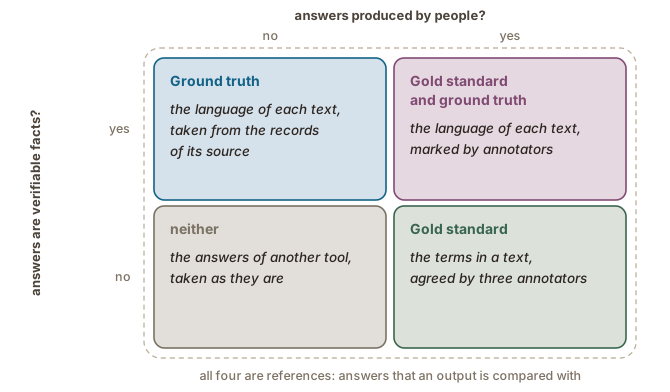
The general word for the answers that an output is compared with is the reference. A gold standard is a reference that people produced. For a translation system, it is a translation made by a person, called a reference translation.
Ground truth is often used as a synonym of gold standard, but the two answer different questions about a reference (Figure 4figure 4): a gold standard is produced by people, and a ground truth consists of verifiable facts. Where the answers depend on judgement, people can disagree and more than one answer can be correct (Basile et al., 2021), so a gold standard is then not a ground truth.
Limits of a gold standard
Every score computed against a gold standard is a comparison with one particular set of answers, and that set has limits of its own:
- It depends on the guidelines. The people who made it followed written guidelines and decided the unclear cases, for instance whether names count as terms or how long a term may be. Had they decided differently, the same system would score differently on the same text (see also the Where people disagree about terms page, in the Classical NLP module) (voir aussi la page Les points de désaccord sur les termes, dans le module TAL classique). For many language tasks, some of these decisions are a matter of judgement (Basile et al., 2021).
- It depends on the annotators. Other people, with other expertise, would mark some items differently, and any annotator makes mistakes (Artstein & Poesio, 2008). Comparing the annotators with each other shows how far a gold standard can be relied on (see also the Agreement between annotators page) (voir aussi la page L'accord entre annotateurs).
- It covers a limited set of texts. A score says how a system does on texts like those in the gold standard, from one domain, one language and one type of document, and it says less about other texts (see also the Interpreting a score page) (voir aussi la page Interpréter un score).
- It is costly to extend. A new domain or a new language needs a new gold standard, annotated by hand again.
- It can end up in training data. Once a gold standard is published, the systems it is meant to evaluate may have been trained on it (Sainz et al., 2023) (see also the Benchmarks and test sets page) (voir aussi la page Tests de performances et jeux de test).
- It lists a limited number of answers. For a system that produces text, such as a translation system or a chatbot, an output can be good without resembling any of them, which is one reason why people also judge such output directly (see also the Ways of evaluating page) (voir aussi la page Les façons d'évaluer).
La sortie et l’étalon de référence
La façon la plus courante d’évaluer un système de TAL est de comparer sa sortie avec un étalon de référence (angl. gold standard) (see also the Ways of evaluating page) (voir aussi la page Les façons d'évaluer). L’étalon de référence indique quelle aurait dû être la sortie, et il est le plus souvent constitué des réponses que des personnes ont données pour la même entrée (Jurafsky & Martin, 2026).
Par exemple, en reconnaissance d’entités nommées named entity recognition (NER)reconnaissance d'entités nommées (REN) NLPTAL The task of finding the spans of a text that are proper names, and labelling the category, most often a person, a location or an organization.Tâche qui consiste à repérer dans un texte les segments qui sont des noms propres, et à en étiqueter la catégorie, le plus souvent une personne, un lieu ou une organisation. , un système trouve les noms de personnes, de lieux et d’organisations dans un texte. Si un tel système renvoyait trois noms pour une phrase, vous ne pourriez dire s’il a bien fonctionné qu’en sachant quels noms des personnes trouvent dans cette phrase. La Figure 3figure 3 construit cet exemple en trois étapes.
Click the drawing, or a line below, to build it up stage by stage. Cliquez sur le dessin, ou sur une ligne ci-dessous, pour le construire étape par étape.
Un étalon de référence doit être créé pour chaque tâche. Pour attribuer un score à un extracteur de termes automatic term extraction (ATE)extraction automatique de termes NLPTAL The identification, by a program, of candidate terms in a text or a corpus, for a person to validate.Repérage, par un programme, de candidats terminologiques dans un texte ou un corpus, en vue de leur validation par une personne. , un outil qui dresse la liste des termes spécialisés d’un texte, il faut la liste des termes qui se trouvent dans le texte, et cette liste doit être établie à la main : une ou plusieurs personnes lisent le texte et marquent les termes, en suivant des consignes écrites.
Étalon de référence, référence et réalité de terrain
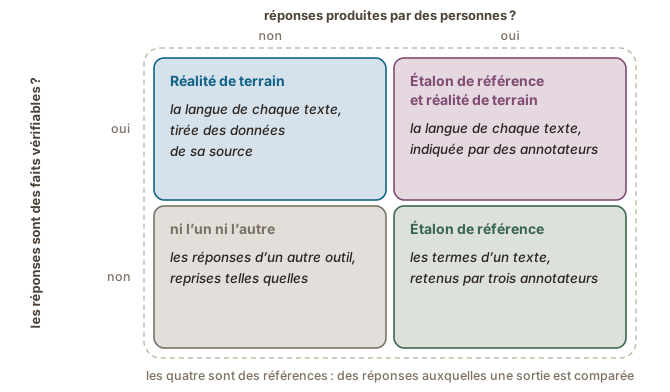
Le mot général pour les réponses auxquelles une sortie est comparée est la référence. Un étalon de référence est une référence que des personnes ont produite. Pour un système de traduction, c’est une traduction faite par une personne, appelée traduction de référence.
Le terme réalité de terrain (angl. ground truth) est souvent employé comme synonyme d’étalon de référence, mais les deux répondent à des questions différentes sur une référence (Figure 4figure 4) : un étalon de référence est produit par des personnes, et une réalité de terrain est constituée de faits vérifiables. Lorsque les réponses dépendent d’un jugement, les personnes peuvent être en désaccord et plusieurs réponses peuvent être correctes (Basile et al., 2021) : un étalon de référence n’est alors pas une réalité de terrain.
Les limites d’un étalon de référence
Chaque score calculé par rapport à un étalon de référence est une comparaison avec un ensemble de réponses particulier, et cet ensemble a ses propres limites :
- Il dépend des consignes. Les personnes qui l’ont établi ont suivi des consignes écrites et ont tranché les cas flous, par exemple si les noms propres comptent comme des termes, ou quelle longueur un terme peut avoir. Si elles avaient décidé autrement, le même système obtiendrait un autre score sur le même texte (see also the Where people disagree about terms page, in the Classical NLP module) (voir aussi la page Les points de désaccord sur les termes, dans le module TAL classique). Pour beaucoup de tâches langagières, une partie de ces décisions relève du jugement (Basile et al., 2021).
- Il dépend des annotateurs. D’autres personnes, avec une autre expertise, marqueraient certains éléments autrement, et tout annotateur fait des erreurs (Artstein & Poesio, 2008). Comparer les annotateurs entre eux montre à quel point on peut se fier à un étalon de référence (see also the Agreement between annotators page) (voir aussi la page L'accord entre annotateurs).
- Il porte sur un ensemble limité de textes. Un score dit ce que donne un système sur des textes semblables à ceux de l’étalon de référence, d’un domaine, d’une langue et d’un type de document, et il en dit moins sur d’autres textes (see also the Interpreting a score page) (voir aussi la page Interpréter un score).
- Il coûte cher à étendre. Un nouveau domaine ou une nouvelle langue demande un nouvel étalon de référence, annoté de nouveau à la main.
- Il peut se retrouver dans les données d’entraînement. Une fois publié, un étalon de référence peut avoir servi à entraîner les systèmes qu’il doit évaluer (Sainz et al., 2023) (see also the Benchmarks and test sets page) (voir aussi la page Tests de performances et jeux de test).
- Il énumère un nombre limité de réponses. Pour un système qui produit du texte, comme un système de traduction ou un agent conversationnel, une sortie peut être bonne sans ressembler à aucune d’elles, et c’est l’une des raisons pour lesquelles des personnes jugent aussi de telles sorties directement (see also the Ways of evaluating page) (voir aussi la page Les façons d'évaluer).
Sources
- Artstein, R., & Poesio, M. (2008). Inter-coder agreement for computational linguistics. Computational Linguistics, 34(4), 555–596. https://doi.org/10.1162/coli.07-034-R2
- Basile, V., Fell, M., Fornaciari, T., Hovy, D., Paun, S., Plank, B., et al. (2021). We Need to Consider Disagreement in Evaluation. Proceedings of the 1st Workshop on Benchmarking: Past, Present and Future. https://doi.org/10.18653/v1/2021.bppf-1.3
- Jurafsky, D., & Martin, J. H. (2026). Speech and Language Processing: An Introduction to Natural Language Processing, Computational Linguistics, and Speech Recognition with Language Models. Online draft, 3rd edition. https://web.stanford.edu/~jurafsky/slp3/
- Rebholz-Schuhmann, D., Jimeno Yepes, A. J., van Mulligen, E. M., Kang, N., Kors, J., Milward, D., et al. (2010). The CALBC Silver Standard Corpus for Biomedical Named Entities — A Study in Harmonizing the Contributions from Four Independent Named Entity Taggers. Proceedings of the Seventh International Conference on Language Resources and Evaluation (LREC'10). https://aclanthology.org/L10-1609/
- Sainz, O., Campos, J., García-Ferrero, I., Etxaniz, J., Lopez de Lacalle, O., & Agirre, E. (2023). NLP Evaluation in Trouble: On the Need to Measure LLM Data Contamination for Each Benchmark. Findings of the Association for Computational Linguistics: EMNLP 2023, 10776–10787. https://doi.org/10.18653/v1/2023.findings-emnlp.722
- Tan, Z., Li, D., Wang, S., Beigi, A., Jiang, B., Bhattacharjee, A., et al. (2024). Large Language Models for Data Annotation and Synthesis: A Survey. Proceedings of the 2024 Conference on Empirical Methods in Natural Language Processing, 930–957. https://aclanthology.org/2024.emnlp-main.54/
Sources
- Artstein, R., & Poesio, M. (2008). Inter-coder agreement for computational linguistics. Computational Linguistics, 34(4), 555–596. https://doi.org/10.1162/coli.07-034-R2
- Basile, V., Fell, M., Fornaciari, T., Hovy, D., Paun, S., Plank, B., et al. (2021). We Need to Consider Disagreement in Evaluation. Proceedings of the 1st Workshop on Benchmarking: Past, Present and Future. https://doi.org/10.18653/v1/2021.bppf-1.3
- Jurafsky, D., & Martin, J. H. (2026). Speech and Language Processing: An Introduction to Natural Language Processing, Computational Linguistics, and Speech Recognition with Language Models. Online draft, 3rd edition. https://web.stanford.edu/~jurafsky/slp3/
- Rebholz-Schuhmann, D., Jimeno Yepes, A. J., van Mulligen, E. M., Kang, N., Kors, J., Milward, D., et al. (2010). The CALBC Silver Standard Corpus for Biomedical Named Entities — A Study in Harmonizing the Contributions from Four Independent Named Entity Taggers. Proceedings of the Seventh International Conference on Language Resources and Evaluation (LREC'10). https://aclanthology.org/L10-1609/
- Sainz, O., Campos, J., García-Ferrero, I., Etxaniz, J., Lopez de Lacalle, O., & Agirre, E. (2023). NLP Evaluation in Trouble: On the Need to Measure LLM Data Contamination for Each Benchmark. Findings of the Association for Computational Linguistics: EMNLP 2023, 10776–10787. https://doi.org/10.18653/v1/2023.findings-emnlp.722
- Tan, Z., Li, D., Wang, S., Beigi, A., Jiang, B., Bhattacharjee, A., et al. (2024). Large Language Models for Data Annotation and Synthesis: A Survey. Proceedings of the 2024 Conference on Empirical Methods in Natural Language Processing, 930–957. https://aclanthology.org/2024.emnlp-main.54/