English in other languagesL'anglais dans les autres langues
TRA6008 S3 · in classS3 · en classe
An English accent
When I work with a chatbot in French or in Dutch, I sometimes have the impression of talking to a native speaker of English who has learned the language very, very well. The text is fluent and grammatical, but every once in a while it phrases something, or refers to something, in a way that does not quite feel right.
The impression is anthropomorphic: a language model language model (LM)modèle de langue language modelsmodèles de langue A machine-learning model that estimates how likely different sequences of language are.Modèle d'apprentissage automatique qui estime la probabilité de différentes séquences de langue. has no native language and does not think in one. Research on what happens inside models still gives the analogy some support.
- The concepts are largely shared across languages. A request passes through representations that are much the same whatever the language it was written in (Dumas et al., 2025).
- That shared space leans toward English. In Llama 2, the intermediate representations of a request in another language pointed more readily to the English word than to the word in the language of the request (Wendler et al., 2024). Schut et al. (2025) found the same in four open models from different developers, and concluded that they “perform key reasoning steps in a representation that is heavily shaped by English in a way that is not transparent to system users”.Llama 2 in Wendler et al.; Llama 3.1 70B, Mixtral 8x22B, Gemma 2 27B and Aya 23 35B in Schut et al., with Gemma the most English-centric and Aya, built for many languages, the least. These methods need access to a model’s internals, so the closed models behind most chatbots have not been studied this way.
A model does not translate from English as it writes, but the representation it works from is shaped by English, and traces of that can surface in the text.
Measured on French and Dutch
In a study of mine (Rigouts Terryn & de Lhoneux, 2024), we built a comparable corpus comparable corpuscorpus comparable corporacorpus A corpus containing texts in two or more languages (or language varieties) matched on subject, genre or communicative function, whose components are typically written originally in each language rather than translated: press articles written independently in French and in English on the same events, for instance.Corpus réunissant des textes en deux ou plusieurs langues (ou variétés de langue) appariés par sujet, genre ou fonction de communication, et dont les composantes sont généralement rédigées à l'origine dans chaque langue plutôt que traduites : par exemple des articles de presse rédigés indépendamment en français et en anglais sur les mêmes événements. of news texts written by people and by three models, prompted in Dutch and in French, and annotated the linguistic problems in the generated texts. On average, 39 % of all annotated errors and peculiarities had a clear or suspected link to English, 16 % a clear one.The three models were GPT-4, Zephyr and GEITje, a model fine-tuned on Dutch and used for Dutch only; the texts were generated in January 2024.
Nothing was being translated: the prompts promptrequête promptingrequêtes Input given to a generative AI system to specify a task, provide context, or otherwise guide its output.Entrée fournie à un système d'IA générative pour préciser une tâche, donner du contexte ou orienter la sortie. were in Dutch or in French and the task was to write a news article from a headline, so the English influence came from the model rather than from the task.
Two further findings are useful in practice:
- The model fine-tuned on Dutch had fewer linguistic problems and probably less English influence, but not none.In two of GEITje’s three settings, 4 to 5 % of its annotated problems had a clear link to English; in the third, 30 %, mostly because one English name (Tour of California) was repeated six times in a short text. GEITje is Mistral 7B, a model trained mostly on English, trained further on Dutch text.
- A more elaborate prompt produced better output than a terse one, although the difference was not always statistically significant. With the terse prompt, Zephyr wrote 36 of its 50 Dutch texts entirely in English.
A rhyme that only works in English
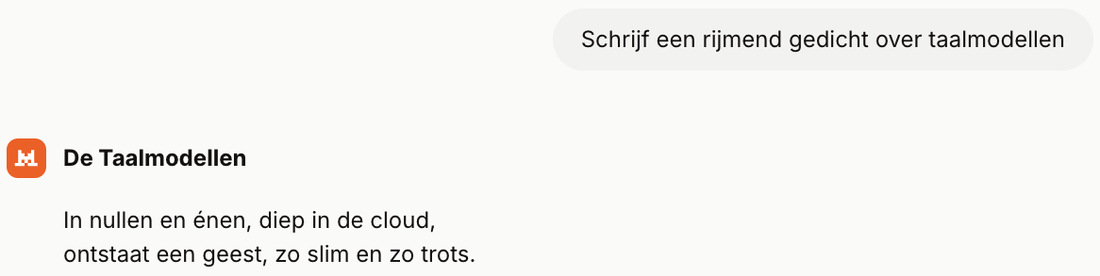
Asked in Dutch for a rhyming poem about language models, Le Chat Mistral opened with In nullen en énen, diep in de cloud, / ontstaat een geest, zo slim en zo trots: “In zeros and ones, deep in the cloud, / a mind arises, so smart and so proud” (Figure 8figure 8).
In Dutch, cloud and trots do not rhyme. In English, cloud and proud do, and trots is the Dutch for proud. The lines rhyme as if they had been written in English and then translated.
The developers of a Bulgarian model saw the same in their first version, which was fine-tuned mostly on translated instructions: it “struggled to make any rhymes at all, often actually trying to rhyme words that would rhyme in English but when translated into Bulgarian would not” (Alexandrov et al., 2024).
Un accent anglais
Quand je travaille avec un agent conversationnel en français ou en néerlandais, j’ai parfois l’impression de parler à une personne de langue maternelle anglaise qui a appris la langue très, très bien. Le texte est fluide et grammatical, mais de temps en temps une tournure ou une référence ne sonne pas tout à fait juste.
Cette impression est anthropomorphique : un modèle de langue language model (LM)modèle de langue language modelsmodèles de langue A machine-learning model that estimates how likely different sequences of language are.Modèle d'apprentissage automatique qui estime la probabilité de différentes séquences de langue. n’a pas de langue maternelle et ne pense dans aucune langue. Les recherches sur ce qui se passe à l’intérieur des modèles donnent pourtant une certaine assise à l’analogie.
- Les concepts sont largement partagés d’une langue à l’autre. Une demande passe par des représentations qui sont à peu près les mêmes, quelle que soit la langue dans laquelle elle est écrite (Dumas et al., 2025).
- Cet espace partagé penche vers l’anglais. Dans Llama 2, les représentations intermédiaires d’une demande formulée dans une autre langue renvoyaient plus facilement au mot anglais qu’au mot de la langue de la demande (Wendler et al., 2024). Schut et al. (2025) ont trouvé la même chose dans quatre modèles ouverts de développeurs différents, et ont conclu que ces modèles « perform key reasoning steps in a representation that is heavily shaped by English in a way that is not transparent to system users » [ma traduction : « effectuent des étapes clés de raisonnement dans une représentation fortement façonnée par l’anglais, d’une manière qui n’est pas transparente pour les utilisateurs »].Llama 2 chez Wendler et al. ; Llama 3.1 70B, Mixtral 8x22B, Gemma 2 27B et Aya 23 35B chez Schut et al., Gemma étant le plus centré sur l’anglais et Aya, conçu pour de nombreuses langues, le moins. Ces méthodes demandent un accès à l’intérieur d’un modèle ; les modèles fermés derrière la plupart des agents conversationnels n’ont donc pas été étudiés de cette façon.
Un modèle ne traduit pas depuis l’anglais en écrivant, mais la représentation à partir de laquelle il travaille est façonnée par l’anglais, et des traces peuvent en apparaître dans le texte.
Mesuré en français et en néerlandais
Dans une étude que j’ai menée (Rigouts Terryn et de Lhoneux, 2024), nous avons construit un corpus comparable comparable corpuscorpus comparable corporacorpus A corpus containing texts in two or more languages (or language varieties) matched on subject, genre or communicative function, whose components are typically written originally in each language rather than translated: press articles written independently in French and in English on the same events, for instance.Corpus réunissant des textes en deux ou plusieurs langues (ou variétés de langue) appariés par sujet, genre ou fonction de communication, et dont les composantes sont généralement rédigées à l'origine dans chaque langue plutôt que traduites : par exemple des articles de presse rédigés indépendamment en français et en anglais sur les mêmes événements. d’articles de presse écrits par des personnes et par trois modèles, sollicités en néerlandais et en français, puis annoté les problèmes linguistiques des textes générés. En moyenne, 39 % de toutes les erreurs et particularités annotées avaient un lien clair ou soupçonné avec l’anglais, et 16 % un lien clair.Les trois modèles étaient GPT-4, Zephyr et GEITje, un modèle affiné sur le néerlandais et utilisé pour le néerlandais seulement ; les textes ont été générés en janvier 2024.
Rien n’était traduit : les requêtes promptrequête promptingrequêtes Input given to a generative AI system to specify a task, provide context, or otherwise guide its output.Entrée fournie à un système d'IA générative pour préciser une tâche, donner du contexte ou orienter la sortie. étaient en néerlandais ou en français et la tâche consistait à rédiger un article de presse à partir d’un titre ; l’influence de l’anglais venait donc du modèle et non de la tâche.
Deux autres constats sont utiles en pratique :
- Le modèle affiné sur le néerlandais présentait moins de problèmes linguistiques et probablement moins d’influence de l’anglais, sans que celle-ci disparaisse.Dans deux des trois configurations de GEITje, 4 à 5 % des problèmes annotés avaient un lien clair avec l’anglais ; dans la troisième, 30 %, surtout parce qu’un nom anglais (Tour of California) revenait six fois dans un texte court. GEITje est Mistral 7B, un modèle entraîné surtout sur de l’anglais, entraîné ensuite sur du texte néerlandais.
- Une requête plus détaillée donnait de meilleurs textes qu’une requête laconique, bien que la différence ne soit pas toujours statistiquement significative. Avec la requête laconique, Zephyr a écrit 36 de ses 50 textes néerlandais entièrement en anglais.
Une rime qui ne fonctionne qu’en anglais
Invité en néerlandais à écrire un poème rimé sur les modèles de langue, Le Chat Mistral a commencé par In nullen en énen, diep in de cloud, / ontstaat een geest, zo slim en zo trots [ma traduction : « Dans les zéros et les uns, au fond du nuage, / naît un esprit, si intelligent et si fier »] (Figure 8figure 8).
En néerlandais, cloud et trots ne riment pas. En anglais, cloud et proud riment, et trots est le mot néerlandais pour proud (fier). Les vers riment comme s’ils avaient été écrits en anglais, puis traduits.
Les développeurs d’un modèle bulgare ont observé la même chose dans leur première version, affinée surtout sur des instructions traduites : elle « struggled to make any rhymes at all, often actually trying to rhyme words that would rhyme in English but when translated into Bulgarian would not » [ma traduction : « peinait à produire la moindre rime, essayant souvent de faire rimer des mots qui riment en anglais mais pas une fois traduits en bulgare »] (Alexandrov et al., 2024).
Sources
- Alexandrov, A., Raychev, V., Dimitrov, D. I., Zhang, C., Vechev, M., & Toutanova, K. (2024). BgGPT 1.0: Extending English-centric LLMs to other languages. arXiv preprint 2412.10893. https://arxiv.org/abs/2412.10893
- Dumas, C., Wendler, C., Veselovsky, V., Monea, G., & West, R. (2025). Separating Tongue from Thought: Activation Patching Reveals Language-Agnostic Concept Representations in Transformers. Proceedings of the 63rd Annual Meeting of the Association for Computational Linguistics (Volume 1: Long Papers), 31822–31841. https://doi.org/10.18653/v1/2025.acl-long.1536
- Rigouts Terryn, A., & de Lhoneux, M. (2024). Exploratory Study on the Impact of English Bias of Generative Large Language Models in Dutch and French. Proceedings of the Fourth Workshop on Human Evaluation of NLP Systems (HumEval) @ LREC-COLING 2024, 12–27. https://aclanthology.org/2024.humeval-1.2/
- Schut, L., Gal, Y., & Farquhar, S. (2025). Do Multilingual LLMs Think In English?. ICLR 2025 Workshop on Building Trust in Language Models and Applications. https://openreview.net/forum?id=I8BOtOPcOv
- Wendler, C., Veselovsky, V., Monea, G., & West, R. (2024). Do Llamas Work in English? On the Latent Language of Multilingual Transformers. Proceedings of the 62nd Annual Meeting of the Association for Computational Linguistics (Volume 1: Long Papers), 15366–15394. https://doi.org/10.18653/v1/2024.acl-long.820
Sources
- Alexandrov, A., Raychev, V., Dimitrov, D. I., Zhang, C., Vechev, M., & Toutanova, K. (2024). BgGPT 1.0: Extending English-centric LLMs to other languages. arXiv preprint 2412.10893. https://arxiv.org/abs/2412.10893
- Dumas, C., Wendler, C., Veselovsky, V., Monea, G., & West, R. (2025). Separating Tongue from Thought: Activation Patching Reveals Language-Agnostic Concept Representations in Transformers. Proceedings of the 63rd Annual Meeting of the Association for Computational Linguistics (Volume 1: Long Papers), 31822–31841. https://doi.org/10.18653/v1/2025.acl-long.1536
- Rigouts Terryn, A., & de Lhoneux, M. (2024). Exploratory Study on the Impact of English Bias of Generative Large Language Models in Dutch and French. Proceedings of the Fourth Workshop on Human Evaluation of NLP Systems (HumEval) @ LREC-COLING 2024, 12–27. https://aclanthology.org/2024.humeval-1.2/
- Schut, L., Gal, Y., & Farquhar, S. (2025). Do Multilingual LLMs Think In English?. ICLR 2025 Workshop on Building Trust in Language Models and Applications. https://openreview.net/forum?id=I8BOtOPcOv
- Wendler, C., Veselovsky, V., Monea, G., & West, R. (2024). Do Llamas Work in English? On the Latent Language of Multilingual Transformers. Proceedings of the 62nd Annual Meeting of the Association for Computational Linguistics (Volume 1: Long Papers), 15366–15394. https://doi.org/10.18653/v1/2024.acl-long.820