What computers computeCe que les ordinateurs calculent
TRA6008 To read for S2À lire pour la S2
When you read the word happiness, you may think of many things. You may think of related words, like joy or contentment. You may think about the translation in another language, like bonheur or geluk. You may think about a different form of the word: happy. Depending on your musical preferences, you may think of a song by Taylor Swift, Pharrell Williams, or “if you’re happy and you know it clap your hands”.
When a computer program “reads” the word happiness, it only gets a series of bits: the numbers associated to the characters of that exact word. The only easy connections to compute would be to other sequences of similar bits. For instance, the word happening has many of the same letters and exactly the same length.
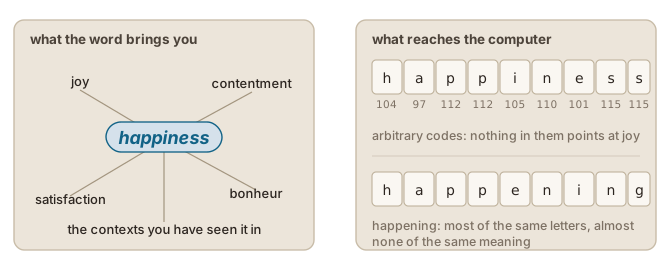
So this is the fundamental challenge of NLP natural language processing (NLP)traitement automatique de la langue (TAL) NLPTAL An interdisciplinary field that develops and studies computational methods for analyzing, processing, and generating human language.Domaine interdisciplinaire qui développe et étudie des méthodes computationnelles pour analyser, traiter et générer le langage humain. : how do we get computer systems, designed to compute, i.e., calculate with numbers, to work with language? How can we capture language in numbers, beyond simple character similarities?
Quand vous lisez le mot bonheur, vous pouvez penser à bien des choses. Vous pouvez penser à des mots apparentés, comme joie ou contentement. Vous pouvez penser à sa traduction dans une autre langue, comme happiness ou geluk. Vous pouvez penser à une autre forme du mot : heureux. Selon vos goûts musicaux, vous pouvez penser à une chanson de Taylor Swift, de Pharrell Williams ou à « si tu aimes le soleil, tape des mains ».
Quand un programme informatique « lit » le mot bonheur, il ne reçoit qu’une suite de bits : les nombres associés aux caractères de ce mot précis. Les seules mises en relation faciles à calculer seraient avec d’autres suites de bits semblables. Le mot honneur, par exemple, a exactement la même longueur et cinq de ses sept lettres à la même place.
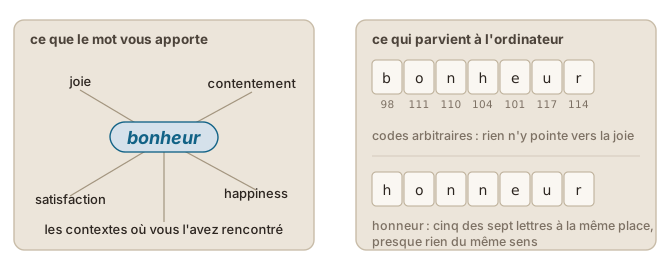
Voilà le défi fondamental du TAL natural language processing (NLP)traitement automatique de la langue (TAL) NLPTAL An interdisciplinary field that develops and studies computational methods for analyzing, processing, and generating human language.Domaine interdisciplinaire qui développe et étudie des méthodes computationnelles pour analyser, traiter et générer le langage humain. : comment amener des systèmes informatiques, conçus pour calculer, c’est-à-dire pour faire des opérations sur des nombres, à travailler sur la langue ? Comment capter la langue en nombres, au-delà des simples ressemblances entre caractères ?
Sources
- Jurafsky, D., & Martin, J. H. (2026). Speech and Language Processing: An Introduction to Natural Language Processing, Computational Linguistics, and Speech Recognition with Language Models. Online draft, 3rd edition. https://web.stanford.edu/~jurafsky/slp3/
Sources
- Jurafsky, D., & Martin, J. H. (2026). Speech and Language Processing: An Introduction to Natural Language Processing, Computational Linguistics, and Speech Recognition with Language Models. Online draft, 3rd edition. https://web.stanford.edu/~jurafsky/slp3/