AmbiguityAmbiguïté
TRA6008 To read for S2À lire pour la S2
Il est encore là means he is still there, when you have been waiting for him to leave. It means he is there again, when he also came yesterday. Same four words, and English has no one word that covers both: the translation has to commit to still or to again. You make that choice from context, instantly and usually without registering that a choice existed.
Ambiguity like this runs through language at every level:
- Words. Livre is a book or a pound; marche is a step, a walk, or a form of marcher; English bat is an animal or sports equipment. Most frequent words have several senses, a property called polysemy polysemypolysémie linguisticslinguistique The property of a word or lemma having two or more related senses.Propriété d'un mot ou d'un lemme qui possède deux sens apparentés ou plus. , and text does not label which sense is meant.
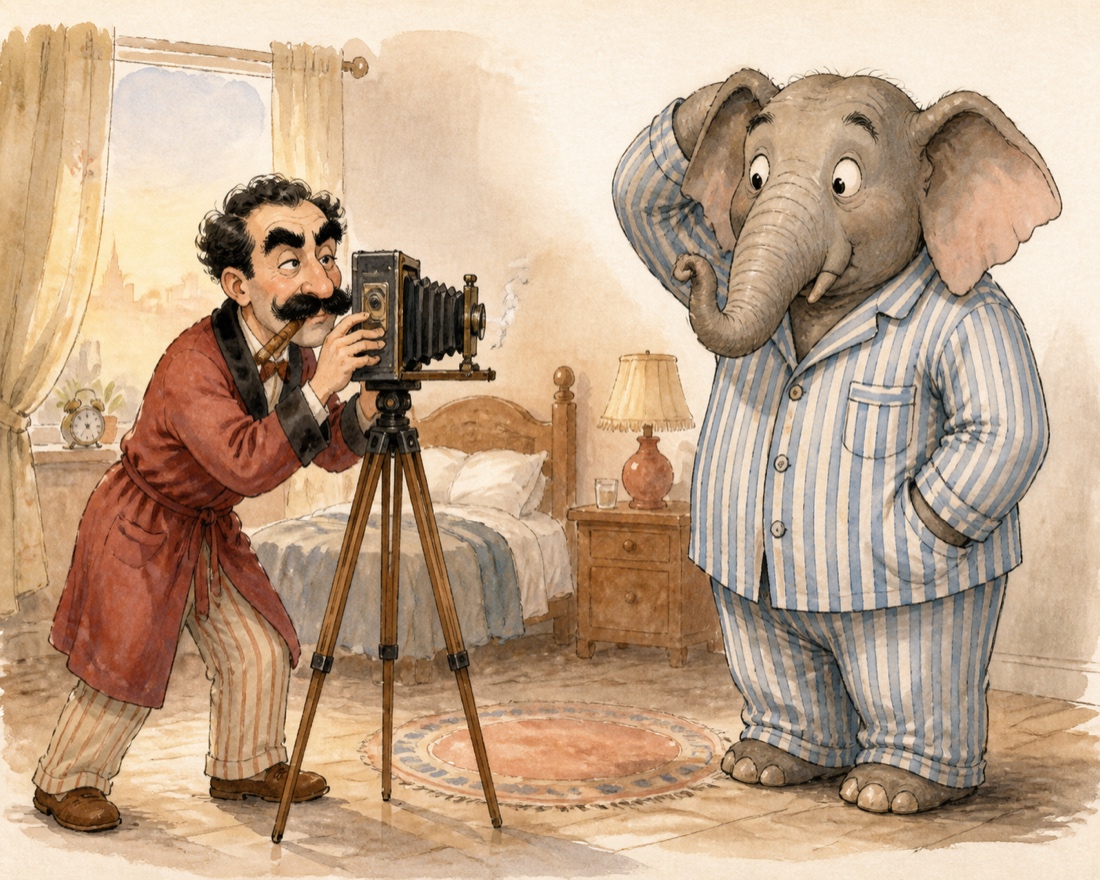
- Structure. Groucho Marx, in Animal Crackers: “One morning I shot an elephant in my pajamas. How he got in my pajamas, I don’t know.” The joke is the second sentence taking the reading you did not. In my pajamas can hang from shot or from elephant, both are grammatical, and nothing but your sense of what is likely picked one.
The promptLa requête
I want to generate an image to illustrate Groucho Marx's joke "One morning I shot an elephant in my pajamas. How he got into my pajamas I'll never know." Can you generate an image of a moustached person with big eyebrows and a cigar, shooting a picture of an elephant wearing pajamas? Make it resemble a watercolour picture.
- Reference. In the animal didn’t cross the street because it was too tired, the word it points at the animal; make the ending too wide and the same word points at the street. Nothing in the grammar decides; what streets and animals can be does.
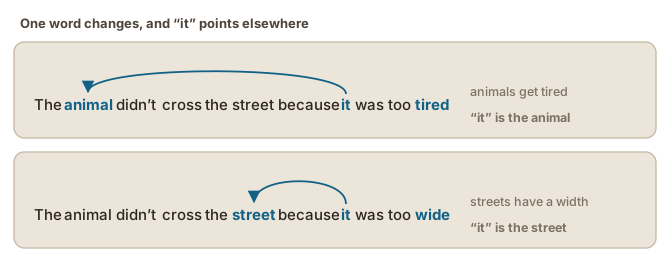
The same property makes this hard for machines and invisible to people. Resolving it was too wide takes knowledge about streets; resolving encore takes the surrounding sentences. You bring that knowledge for free. A computer has to be given it, in a form it can compute with.
Your professional reflex, it depends on the context, is the requirement that word-by-word approaches to language technology could not satisfy.
Il est encore là veut dire qu’il n’est pas encore parti, quand vous attendiez qu’il parte. Cela veut dire qu’il est revenu, quand il était déjà venu la veille. Les quatre mêmes mots, et l’anglais n’a aucun mot qui couvre les deux sens : la traduction doit trancher entre still et again. Vous faites ce choix à partir du contexte, immédiatement et sans même remarquer qu’un choix se présentait.
Une ambiguïté de ce genre traverse la langue à tous les niveaux :
- Les mots. Livre est un ouvrage ou une unité de poids ; marche est un degré d’escalier, une promenade ou une forme de marcher ; l’anglais bat est un animal ou un instrument de sport. La plupart des mots fréquents ont plusieurs sens, une propriété appelée polysémie polysemypolysémie linguisticslinguistique The property of a word or lemma having two or more related senses.Propriété d'un mot ou d'un lemme qui possède deux sens apparentés ou plus. , et le texte n’indique pas lequel est visé.
- La structure. Groucho Marx, dans Animal Crackers : « One morning I shot an elephant in my pajamas. How he got in my pajamas, I don’t know. » La blague tient à la deuxième phrase, qui prend le sens que vous n’aviez pas retenu. In my pajamas peut se rattacher à shot ou à elephant, les deux sont grammaticaux, et rien d’autre que votre idée du vraisemblable n’en a choisi un.
The promptLa requête
I want to generate an image to illustrate Groucho Marx's joke "One morning I shot an elephant in my pajamas. How he got into my pajamas I'll never know." Can you generate an image of a moustached person with big eyebrows and a cigar, shooting a picture of an elephant wearing pajamas? Make it resemble a watercolour picture.
- La référence. Dans le camion n’a pas franchi le pont parce qu’il était trop lourd, le mot il désigne le camion ; mettez trop étroit à la fin et le même mot désigne le pont. Les deux noms sont masculins, donc la grammaire ne tranche pas ; ce sont les propriétés des camions et des ponts qui le font.
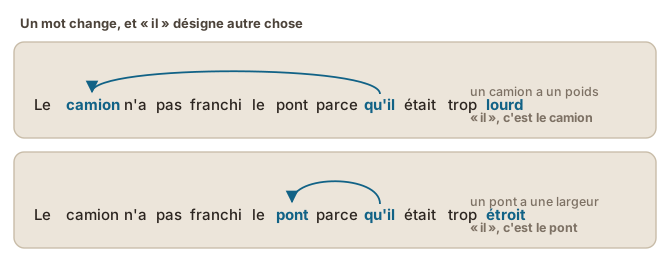
C’est la même propriété qui rend la chose difficile pour une machine et invisible pour une personne. Résoudre trop étroit demande de savoir ce qu’est un pont ; résoudre encore demande les phrases autour. Vous apportez ce savoir gratuitement. Il faut le donner à un ordinateur, sous une forme avec laquelle il peut calculer.
Votre réflexe professionnel, cela dépend du contexte, est l’exigence à laquelle les approches mot à mot de la technologie langagière n’ont pas pu répondre.
Sources
- Jurafsky, D., & Martin, J. H. (2026). Speech and Language Processing: An Introduction to Natural Language Processing, Computational Linguistics, and Speech Recognition with Language Models. Online draft, 3rd edition. https://web.stanford.edu/~jurafsky/slp3/
Sources
- Jurafsky, D., & Martin, J. H. (2026). Speech and Language Processing: An Introduction to Natural Language Processing, Computational Linguistics, and Speech Recognition with Language Models. Online draft, 3rd edition. https://web.stanford.edu/~jurafsky/slp3/