Split the whole corpus into single characters. These are the first
tokens.
Count every pair of adjacent tokens, and merge the most frequent pair
into one new token, everywhere it occurs.
Repeat step 2 until the vocabulary reaches the size you chose.
Learned once, applied forever
Frequent words quickly get their own token (the is one of the first) and
rarer ones stay in a few pieces. Length counts as well as frequency: every
merge joins two neighbours, so a long word needs many of them before it is
whole again, and a short word of the same frequency gets there sooner.
Frequent endings and stems, -ing, -tion, get a token too, because they
recur across thousands of words.
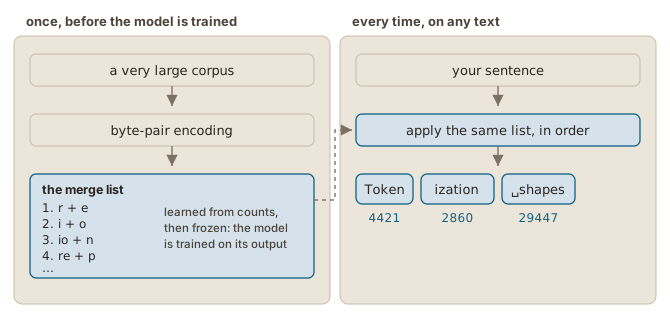
The counting happens once and produces a list of merges. That
list is then applied unchanged to every text the model ever reads, including
yours.
Figure 6. Byte-pair encoding runs twice over in two different senses: once as learning, on a corpus, and then as a lookup applied unchanged to everything the model reads.
Written in English. The French version was automatically generated
and I have not revised it.
Rédigé en anglais. La version française a été
générée automatiquement et je ne l'ai pas révisée.
Updated 9 September 2026
Découper tout le corpus en caractères isolés. Ce sont les premiers jetons.
Compter chaque paire de jetons voisins, et fusionner la paire la plus
fréquente en un nouveau jeton, partout où elle apparaît.
Répéter l’étape 2 jusqu’à ce que le vocabulaire atteigne la taille choisie.
Appris une fois, appliqué pour toujours
Les mots fréquents obtiennent vite leur propre jeton (le est l’un des
premiers) et les plus rares restent en quelques morceaux. La longueur compte
aussi, en plus de la fréquence : chaque fusion joint deux voisins, un long mot a donc
besoin de nombreuses fusions avant d’être entier de nouveau, et un mot court de
même fréquence y arrive plus tôt. Les terminaisons et les radicaux fréquents,
-ion, -ment, obtiennent aussi un jeton, parce qu’ils reviennent dans des
milliers de mots.
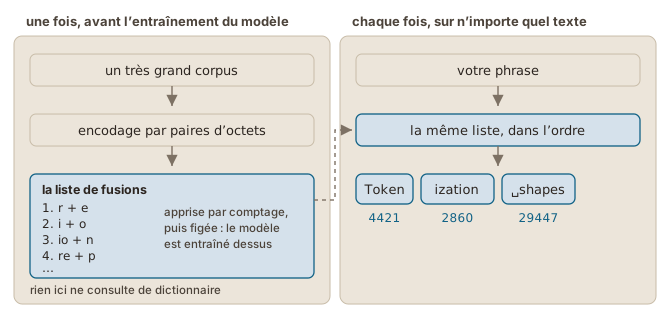
Le comptage n’a lieu qu’une fois et produit une liste de fusions. Cette liste
est ensuite appliquée sans changement à tous les textes que le modèle lira, y
compris les vôtres.
Figure 6. L'encodage par paires d'octets tourne deux fois en deux sens différents : une fois comme apprentissage, sur un corpus, puis comme consultation appliquée sans changement à tout ce que le modèle lit.
Written in English. The French version was automatically generated
and I have not revised it.
Rédigé en anglais. La version française a été
générée automatiquement et je ne l'ai pas révisée.
Mise à jour 10 septembre 2026
Sources
Jurafsky, D., & Martin, J. H. (2026). Speech and Language Processing: An Introduction to Natural Language Processing, Computational Linguistics, and Speech Recognition with Language Models. Online draft, 3rd edition. https://web.stanford.edu/~jurafsky/slp3/
Sennrich, R., Haddow, B., & Birch, A. (2016). Neural Machine Translation of Rare Words with Subword Units. Proceedings of the 54th Annual Meeting of the Association for Computational Linguistics (Volume 1: Long Papers). https://doi.org/10.18653/v1/P16-1162
Sources
Jurafsky, D., & Martin, J. H. (2026). Speech and Language Processing: An Introduction to Natural Language Processing, Computational Linguistics, and Speech Recognition with Language Models. Online draft, 3rd edition. https://web.stanford.edu/~jurafsky/slp3/
Sennrich, R., Haddow, B., & Birch, A. (2016). Neural Machine Translation of Rare Words with Subword Units. Proceedings of the 54th Annual Meeting of the Association for Computational Linguistics (Volume 1: Long Papers). https://doi.org/10.18653/v1/P16-1162