Hybrid term extractionL'extraction hybride de termes
TRA2600 S8 · in classS8 · en classe
TRA6008 To read for S5À lire pour la S5
Two methods with opposite weaknesses
Linguistic and statistical methods fail in different ways, as the table below sets out, and each does well where the other fails.
| Method | What it gives | What it lacks |
|---|---|---|
| Linguistic | candidates with the grammatical form of a term | any way of telling a term from another sequence of the same form |
| Statistical | a ranking of words by how specific they are to the domain | any account of grammar: it scores single words and fragments as readily as whole terms |
A hybrid extractor combines the two.
The two steps
A hybrid extractor works in two steps (Figure 13figure 13).
- A linguistic step collects candidates. The text is split into words, each word gets its part of speech part-of-speech tagging (POS tagging)étiquetage morphosyntaxique NLPTAL The task of taking a sequence of tokenized words and a tagset, and assigning to each word one tag naming its grammatical class, such as noun or verb.Tâche qui consiste à prendre une suite de mots segmentés et un jeu d'étiquettes, puis à attribuer à chaque mot une étiquette nommant sa classe grammaticale, par exemple nom ou verbe. , and every sequence that matches a pattern typical of terms, such as an adjective followed by a noun, becomes a candidate (see also the Linguistic methods: part-of-speech patterns page) (voir aussi la page Méthodes linguistiques : les patrons morphosyntaxiques).
- A statistical step ranks them. Each candidate gets a score for termhood termhooddegré de termitude terminologyterminologie The degree to which a unit of language is related to the concepts of a specialized domain.Degré auquel une unité de la langue se rattache aux concepts d'un domaine spécialisé. , how specific it is to the domain compared with a general corpus corpuscorpus corporacorpus A collection of written texts, speech recordings or transcribed language assembled for analysis or use in language technology (plural: corpora).Ensemble de textes écrits, d'enregistrements de parole ou de langue transcrite réuni pour l'analyse ou pour les technologies langagières. , and candidates of several words often also for unithood unithooddegré de figement terminologyterminologie The degree to which a sequence of words forms a stable unit.Degré auquel une suite de mots forme une unité stable. , how firmly their words belong together (Kageura & Umino, 1996) (see also the Statistical methods: termhood and unithood page) (voir aussi la page Méthodes statistiques : degré de termitude et degré de figement).
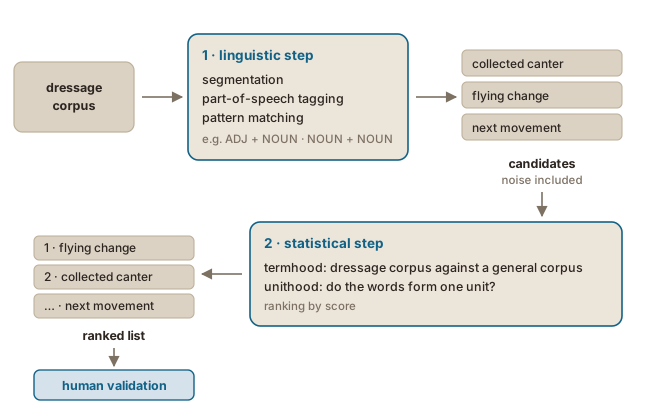
The result is a list of candidates ordered from most to least likely to be a term. Nothing in it says where the terms stop: the person who uses the list chooses a cut-off, reads the top of it, or sets a threshold on the score (Rigouts Terryn et al., 2019). TermoStat is a tool of this kind (see also the TermoStat: a hybrid extractor page) (voir aussi la page TermoStat : un extracteur hybride).
Strengths and limits
The table below sets the strengths of a hybrid extractor beside its limits.
| Strengths | Limits |
|---|---|
|
|
On the size of the corpus, TermoStat’s guide recommends at least 50,000 words and warns that under 10,000 few candidates come out as statistically significant.TermoStat, Guide de l’utilisateur, version 4.0 beta, read 30 September 2026. The Keywords function of Sketch Engine ranks words by the same kind of comparison and has the same limit (see also the Going further page, in the Corpus analysis module) (voir aussi la page Pour aller plus loin, dans le module L'analyse de corpus).
Deux méthodes aux faiblesses opposées
Les méthodes linguistiques et statistiques échouent de façons différentes, comme le montre le tableau ci-dessous, et chacune réussit là où l’autre échoue.
| Méthode | Ce qu’elle apporte | Ce qui lui manque |
|---|---|---|
| Linguistique | des candidats qui ont la forme grammaticale d’un terme | un moyen de distinguer un terme d’une autre suite de même forme |
| Statistique | un classement des mots selon leur spécificité au domaine | toute prise en compte de la grammaire : elle donne un score aux mots isolés et aux fragments aussi facilement qu’aux termes entiers |
Un extracteur hybride combine les deux.
Les deux étapes
Un extracteur hybride procède en deux étapes (Figure 13figure 13).
- Une étape linguistique recueille les candidats. Le texte est découpé en mots, chaque mot reçoit sa partie du discours part-of-speech tagging (POS tagging)étiquetage morphosyntaxique NLPTAL The task of taking a sequence of tokenized words and a tagset, and assigning to each word one tag naming its grammatical class, such as noun or verb.Tâche qui consiste à prendre une suite de mots segmentés et un jeu d'étiquettes, puis à attribuer à chaque mot une étiquette nommant sa classe grammaticale, par exemple nom ou verbe. , et toute suite qui correspond à un patron typique des termes, par exemple un nom suivi d’un adjectif, devient un candidat (see also the Linguistic methods: part-of-speech patterns page) (voir aussi la page Méthodes linguistiques : les patrons morphosyntaxiques).
- Une étape statistique les classe. Chaque candidat reçoit un score pour son degré de termitude termhooddegré de termitude terminologyterminologie The degree to which a unit of language is related to the concepts of a specialized domain.Degré auquel une unité de la langue se rattache aux concepts d'un domaine spécialisé. , c’est-à-dire sa spécificité au domaine par rapport à un corpus corpuscorpus corporacorpus A collection of written texts, speech recordings or transcribed language assembled for analysis or use in language technology (plural: corpora).Ensemble de textes écrits, d'enregistrements de parole ou de langue transcrite réuni pour l'analyse ou pour les technologies langagières. général, et les candidats de plusieurs mots en reçoivent souvent un aussi pour leur degré de figement unithooddegré de figement terminologyterminologie The degree to which a sequence of words forms a stable unit.Degré auquel une suite de mots forme une unité stable. , c’est-à-dire la solidité du lien entre leurs mots (Kageura et Umino, 1996) (see also the Statistical methods: termhood and unithood page) (voir aussi la page Méthodes statistiques : degré de termitude et degré de figement).
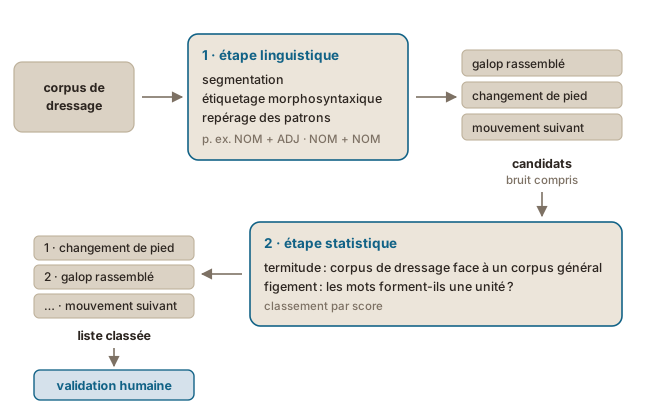
Le résultat est une liste de candidats classés du plus probable au moins probable comme terme. Rien n’y indique où les termes s’arrêtent : la personne qui utilise la liste choisit un seuil, en lit le début, ou fixe un score minimal (Rigouts Terryn et al., 2019). TermoStat est un outil de ce type (see also the TermoStat: a hybrid extractor page) (voir aussi la page TermoStat : un extracteur hybride).
Les forces et les limites
Le tableau ci-dessous met les forces d’un extracteur hybride en regard de ses limites.
| Forces | Limites |
|---|---|
|
|
Sur la taille du corpus, le guide de TermoStat recommande au moins 50 000 mots et prévient qu’en dessous de 10 000, peu de candidats ressortent comme statistiquement significatifs.TermoStat, Guide de l’utilisateur, version 4.0 bêta, consulté le 30 septembre 2026. La fonction Keywords de Sketch Engine classe les mots selon le même type de comparaison et a la même limite (see also the Going further page, in the Corpus analysis module) (voir aussi la page Pour aller plus loin, dans le module L'analyse de corpus).
Sources
- Kageura, K., & Umino, B. (1996). Methods of automatic term recognition: A review. Terminology, 3(2), 259–289. https://doi.org/10.1075/term.3.2.03kag
- Rigouts Terryn, A., Drouin, P., Hoste, V., & Lefever, E. (2019). Analysing the Impact of Supervised Machine Learning on Automatic Term Extraction: HAMLET vs TermoStat. Proceedings of the International Conference on Recent Advances in Natural Language Processing (RANLP 2019), 1012–1021. https://doi.org/10.26615/978-954-452-056-4_117
Sources
- Kageura, K., & Umino, B. (1996). Methods of automatic term recognition: A review. Terminology, 3(2), 259–289. https://doi.org/10.1075/term.3.2.03kag
- Rigouts Terryn, A., Drouin, P., Hoste, V., & Lefever, E. (2019). Analysing the Impact of Supervised Machine Learning on Automatic Term Extraction: HAMLET vs TermoStat. Proceedings of the International Conference on Recent Advances in Natural Language Processing (RANLP 2019), 1012–1021. https://doi.org/10.26615/978-954-452-056-4_117