TermoStat: a hybrid extractorTermoStat : un extracteur hybride
TRA2600 S8 · in classS8 · en classe
TRA6008 To read for S5À lire pour la S5
Origin and method
TermoStat, developed by Patrick Drouin at the Université de Montréal, is a hybrid term extractor, free for academic use.TermoStat runs in the browser at termostat.ling.umontreal.ca, in English or French, and asks for a free account. The method behind it compares a specialized corpus corpuscorpus corporacorpus A collection of written texts, speech recordings or transcribed language assembled for analysis or use in language technology (plural: corpora).Ensemble de textes écrits, d'enregistrements de parole ou de langue transcrite réuni pour l'analyse ou pour les technologies langagières. with a reference corpus of non-technical text; in the original study, 13,746 articles from The Gazette, a Montreal newspaper, 7.4 million words in all. It keeps the nouns and adjectives that occur significantly more often in the specialized corpus than the comparison predicts, and builds the candidate terms candidate termcandidat terminologique NLPTAL A unit that a term extraction program proposes as a possible term, before a person has validated it.Unité qu'un programme d'extraction automatique de termes propose comme terme possible, avant qu'une personne ne l'ait validée. around those words, which cuts down the number of candidates that are not terms (Drouin, 2003).
Settings
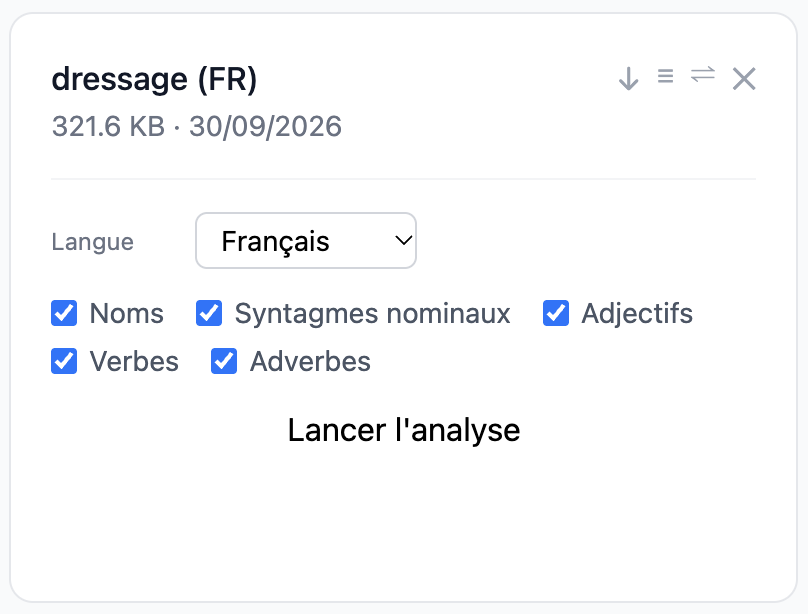
Running TermoStat takes three settingsTermoStat, Guide de l’utilisateur, version 4.0 beta, read 30 September 2026; the guide is in the tool’s Help menu, behind the login. (Figure 14figure 14):
- a corpus, which can be one file or many separate files, in plain text plain texttexte brut text encodingencodage du texte Text represented as a sequence of characters alone, with no formatting or layout of its own. A plain-text file opens in any text editor, whatever produced it, which is why interchange formats are written this way: markup languages record structure inside plain text, by writing that structure as characters in the text itself.Texte représenté par la seule suite de ses caractères, sans mise en forme ni mise en page propre. Un fichier en texte brut s'ouvre dans n'importe quel éditeur de texte, quel que soit le logiciel qui l'a produit, ce qui explique que les formats d'échange s'écrivent ainsi : les langages de balisage consignent la structure à l'intérieur du texte brut, en l'écrivant sous forme de caractères dans le texte lui-même. , PDF, Word or a few other formats;
- its language, one of eight;
- the parts of speech to extract, among nouns, noun phrases, adjectives, verbs and adverbs.
The ranked list and its scores
TermoStat returns a list of candidates ranked by specificity (Figure 15figure 15). Each row gives the candidate, the forms it takes in the corpus, its grammatical pattern, its frequency and its scores.
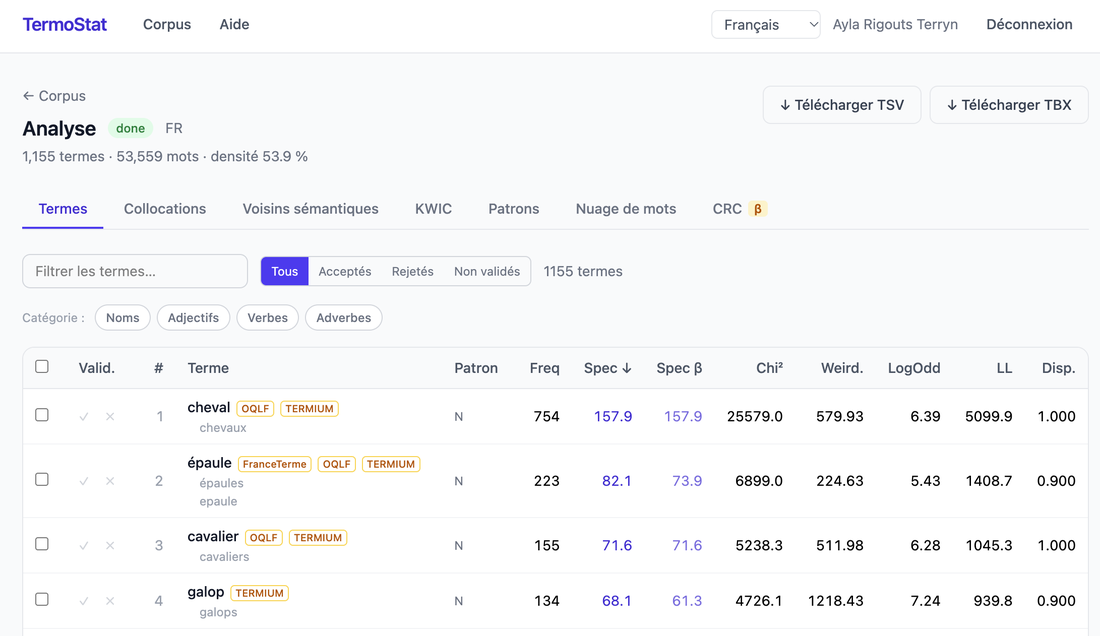
The first score, Spec, ranks the list (Drouin et al., 2020). The other columns measure the same comparison in other ways, as the table below sets out.
| Column | What it measures |
|---|---|
| Spec | specificity: how far the candidate’s frequency in the corpus departs from the frequency the reference corpus predicts |
| Chi² and LL | two statistical tests of that difference, the chi-square and the log-likelihood; the guide calls the second more reliable for infrequent candidates |
| LogOdd | how many times more likely the candidate is in the corpus than in the reference corpus, on a logarithmic scale |
| Weird. | the candidate’s relative frequency in the corpus divided by its relative frequency in the reference corpus |
| Disp. | how evenly the candidate is spread over the corpus |
| Spec β | Spec multiplied by Disp., so that a candidate frequent in one document only moves down the list |
Term bank badges
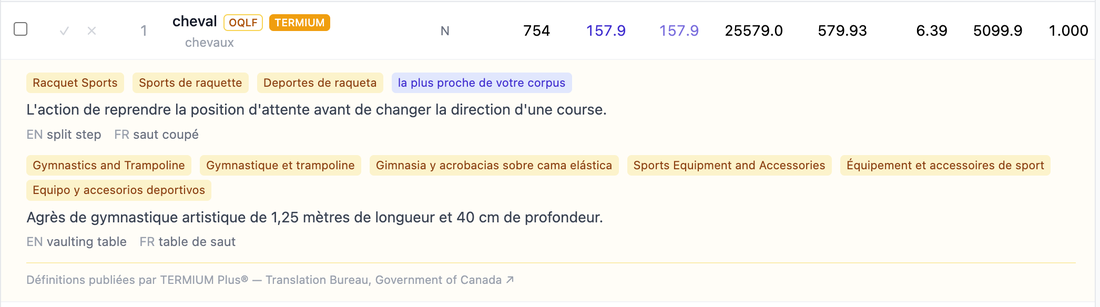
In TermoStat’s list of results, a badge beside a candidate names a term bank that publishes a definition for it, and opening it shows the bank’s definitions with their subject fields (Figure 16figure 16). When a bank has several records, the tool orders them by how well they fit the corpus. Its own guide calls that order a hint and not a verdict, right about two times in three: for cheval, the records shown are a racquet-sports move and a gymnastics apparatus.
Validating and exporting
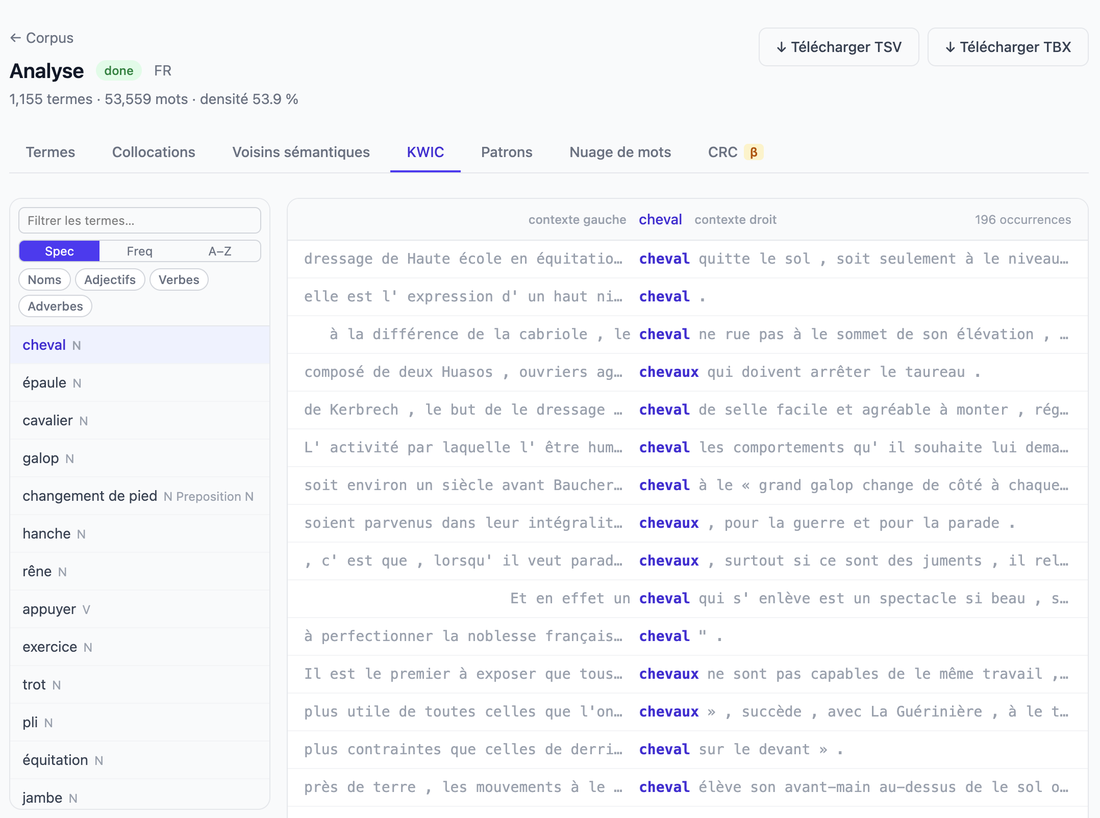
In the first column of TermoStat’s list of results, every candidate can be accepted or rejected, which is the validation step done inside the tool. The sentences a candidate occurs in are the quickest check on a doubtful one (Figure 17figure 17): they show whether the word always names a concept of the domain, or also turns up in its everyday sense. Other tabs give its collocates, the grammatical patterns of all the candidates, and a word cloud.
The list can be downloaded in two formats, which keep different parts of the result. The spreadsheet (TSV) has every column of the list, one candidate per row, and is the file to work from when you want to sort, filter or count; the first twenty rows are below.
rank	lemma	variants	pos	freq	spec	spec_beta	chi2	weirdness	logodd	ll	dispersion	validation
1	cheval	cheval|chevaux	Common_Noun	754	157.872	157.872	25579.0085	579.9283	6.3871	5099.8568	1
2	épaule	épaule|épaules|epaule	Common_Noun	223	82.1229	73.9106	6899.0167	224.6315	5.4304	1408.7496	0.9
3	cavalier	cavalier|cavaliers	Common_Noun	155	71.6309	71.6309	5238.2604	511.9848	6.2845	1045.3317	1
4	galop	galop|galops	Common_Noun	134	68.0742	61.2668	4726.1266	1218.4255	7.2376	939.7621	0.9
5	changement de pied	changement de pied|changements de pied|changements de pieds	Common_Noun Preposition Common_Noun	102	59.8532	35.9119	3644.8102	1859.227	7.8126	725.981	0.6
6	hanche	hanches|hanche	Common_Noun	105	59.2659	59.2659	3574.614	546.6798	6.3752	712.513	1
7	rêne	rêne|rênes	Common_Noun	84	51.7897	41.4369	2722.9489	306.8627	5.7733	548.45	0.8001
8	appuyer	appuyer|appuyez|appuie	Verb	121	49.7402	39.7922	2520.7599	53.712	3.9879	606.8733	0.8
9	exercice	exercice|exercices	Common_Noun	128	48.4306	48.4306	2390.8009	42.7256	3.7578	605.5295	1
10	trot	trot	Common_Noun	66	48.1427	43.3718	2345.2454	1209.4001	7.3793	466.663	0.9009
11	pli	pli	Common_Noun	64	47.4074	28.4776	2273.0552	1173.2986	7.3487	452.2695	0.6007
12	équitation	équitation|equitation|équitations	Common_Noun	66	47.4004	37.9582	2273.4465	604.7001	6.532	452.4861	0.8008
13	jambe	jambe|jambes	Common_Noun	98	47.322	42.5898	2277.1156	70.0794	4.2562	521.6902	0.9
14	postérieur	postérieurs|postérieur	Common_Noun	57	44.7389	44.7389	2020.4001	1046.9434	7.2337	401.908	1
15	équestre	équestre|équestres	Adjective	55	42.002	25.2768	1779.5304	288.812	5.7319	358.6113	0.6018
16	extérieur	extérieure|extérieur|extérieures	Adjective	98	39.235	35.3115	1565.0385	32.1986	3.4731	426.6313	0.9
17	cercle	cercle|cercles	Common_Noun	69	38.2647	34.4612	1482.1946	57.4342	4.0562	351.8606	0.9006
18	changement	changement|changements	Common_Noun	146	37.37	29.896	1424.4873	16.0816	2.7783	487.0365	0.8
19	droit	droite|droit|droits	Adjective	98	36.016	32.4144	1318.6281	24.6486	3.2049	389.4598	0.9
20	rectitude	rectitude	Common_Noun	36	35.5517	21.8217	1262.6064	667.8777	6.7788	251.0434	0.6138
The TBX TermBase eXchange (TBX)TermBase eXchange (TBX) exchange formatsformats d'échange The XML-based standard (ISO 30042) for exchanging termbases: each concept entry can gather the terms of several languages plus rich metadata such as definitions, part of speech, domain and usage notes.Norme fondée sur XML (ISO 30042) pour échanger des bases terminologiques : chaque entrée conceptuelle peut contenir les termes de plusieurs langues et des métadonnées riches comme des définitions, la partie du discours, le domaine et des notes d'usage. file keeps only the terms, their forms and their
part of speech, one entry per candidate, in the exchange format interchange formatformat d'échange exchange formatsformats d'échange A documented way of organizing and representing data so that it can be transferred between different systems or applications. In translation technology, TMX is primarily used to exchange translation-memory data, TBX to exchange terminological data, and XLIFF to move localizable content, translations, and related workflow information. A standardized format facilitates interoperability, but successful exchange may still depend on the versions, optional features, and metadata supported by each tool.Manière documentée d'organiser et de représenter des données afin qu'elles puissent être transférées entre différents systèmes ou applications. En technologies de la traduction, TMX sert principalement à échanger des données de mémoire de traduction, TBX à échanger des données terminologiques, et XLIFF à transporter du contenu localisable, ses traductions et les informations de flux de travail associées. Un format normalisé facilite l'interopérabilité, mais la réussite de l'échange peut dépendre des versions, des fonctionnalités facultatives et des métadonnées que prend en charge chaque outil. a
termbase termbasebase terminologique terminologyterminologie A database of terminological entries organized by concept, grouping the terms of several languages with metadata such as definitions, domains and usage status.Base de données d'entrées terminologiques organisée par concept, contenant les termes de plusieurs langues et des métadonnées comme des définitions, des domaines et des marques d'usage. can
import (see also the TBX: exchanging termbases page, in the Exchange formats in translation module) (voir aussi la page TBX : échanger des bases terminologiques, dans le module Les formats d'échange en traduction).
The first five entries are below. The export declares the current version of
the standard in its namespace namespaceespace de noms XMLXML A name, written as a URI, that says which vocabulary an element or attribute belongs to.Nom, écrit sous la forme d'un URI, qui indique à quel vocabulaire appartient un élément ou un attribut. but keeps the
older element elementélément XMLXML The building block of an XML document: an opening tag, the content it delimits and a closing tag, or a single empty-element tag when there is no content.Unité de base d'un document XML : une balise ouvrante, le contenu qu'elle délimite et une balise fermante, ou une seule balise d'élément vide quand il n'y a pas de contenu. name termEntry, which that
version calls conceptEntry.
<?xml version="1.0" encoding="UTF-8"?>
<tbx type="TBX-Basic" style="dca" xml:lang="fr" xmlns="urn:iso:std:iso:30042:ed-2">
  <tbxHeader>
    <fileDesc>
      <titleStmt><title>Termostat export</title></titleStmt>
    </fileDesc>
  </tbxHeader>
  <text>
    <body>
      <!-- Extract: the first 5 of the 1,155 entries TermoStat exported for the dressage corpus (2026-09-30). -->
      <termEntry xml:id="te1">
        <langSec xml:lang="fr">
          <termSec>
            <term>cheval</term>
            <termNote type="partOfSpeech">Common_Noun</termNote>
          </termSec>
          <termSec>
            <term>chevaux</term>
            <termNote type="partOfSpeech">Common_Noun</termNote>
          </termSec>
        </langSec>
      </termEntry>
      <termEntry xml:id="te2">
        <langSec xml:lang="fr">
          <termSec>
            <term>épaule</term>
            <termNote type="partOfSpeech">Common_Noun</termNote>
          </termSec>
          <termSec>
            <term>épaules</term>
            <termNote type="partOfSpeech">Common_Noun</termNote>
          </termSec>
          <termSec>
            <term>epaule</term>
            <termNote type="partOfSpeech">Common_Noun</termNote>
          </termSec>
        </langSec>
      </termEntry>
      <termEntry xml:id="te3">
        <langSec xml:lang="fr">
          <termSec>
            <term>cavalier</term>
            <termNote type="partOfSpeech">Common_Noun</termNote>
          </termSec>
          <termSec>
            <term>cavaliers</term>
            <termNote type="partOfSpeech">Common_Noun</termNote>
          </termSec>
        </langSec>
      </termEntry>
      <termEntry xml:id="te4">
        <langSec xml:lang="fr">
          <termSec>
            <term>galop</term>
            <termNote type="partOfSpeech">Common_Noun</termNote>
          </termSec>
          <termSec>
            <term>galops</term>
            <termNote type="partOfSpeech">Common_Noun</termNote>
          </termSec>
        </langSec>
      </termEntry>
      <termEntry xml:id="te5">
        <langSec xml:lang="fr">
          <termSec>
            <term>changement de pied</term>
            <termNote type="partOfSpeech">Common_Noun Preposition Common_Noun</termNote>
          </termSec>
          <termSec>
            <term>changements de pied</term>
            <termNote type="partOfSpeech">Common_Noun Preposition Common_Noun</termNote>
          </termSec>
          <termSec>
            <term>changements de pieds</term>
            <termNote type="partOfSpeech">Common_Noun Preposition Common_Noun</termNote>
          </termSec>
        </langSec>
      </termEntry>
    </body>
  </text>
</tbx>L’origine et la méthode
TermoStat, conçu par Patrick Drouin à l’Université de Montréal, est un extracteur de termes hybride, gratuit pour l’usage universitaire.TermoStat s’utilise dans le navigateur à l’adresse termostat.ling.umontreal.ca, en anglais ou en français, et demande un compte gratuit. Sa méthode compare un corpus corpuscorpus corporacorpus A collection of written texts, speech recordings or transcribed language assembled for analysis or use in language technology (plural: corpora).Ensemble de textes écrits, d'enregistrements de parole ou de langue transcrite réuni pour l'analyse ou pour les technologies langagières. spécialisé à un corpus de référence de textes non techniques ; dans l’étude d’origine, 13 746 articles de The Gazette, un quotidien montréalais, soit 7,4 millions de mots. Elle retient les noms et les adjectifs nettement plus fréquents dans le corpus spécialisé que ne le prédit la comparaison, et construit les candidats terminologiques candidate termcandidat terminologique NLPTAL A unit that a term extraction program proposes as a possible term, before a person has validated it.Unité qu'un programme d'extraction automatique de termes propose comme terme possible, avant qu'une personne ne l'ait validée. autour de ces mots, ce qui réduit le nombre de candidats qui ne sont pas des termes (Drouin, 2003).
Les réglages
Lancer TermoStat demande trois réglagesTermoStat, Guide de l’utilisateur, version 4.0 bêta, consulté le 30 septembre 2026 ; le guide se trouve dans le menu Aide de l’outil, après connexion. (Figure 14figure 14) :
- un corpus, qui peut être un seul fichier ou plusieurs fichiers distincts, en texte brut plain texttexte brut text encodingencodage du texte Text represented as a sequence of characters alone, with no formatting or layout of its own. A plain-text file opens in any text editor, whatever produced it, which is why interchange formats are written this way: markup languages record structure inside plain text, by writing that structure as characters in the text itself.Texte représenté par la seule suite de ses caractères, sans mise en forme ni mise en page propre. Un fichier en texte brut s'ouvre dans n'importe quel éditeur de texte, quel que soit le logiciel qui l'a produit, ce qui explique que les formats d'échange s'écrivent ainsi : les langages de balisage consignent la structure à l'intérieur du texte brut, en l'écrivant sous forme de caractères dans le texte lui-même. , en PDF, en Word ou dans quelques autres formats ;
- sa langue, parmi huit ;
- les parties du discours à extraire, parmi les noms, les syntagmes nominaux, les adjectifs, les verbes et les adverbes.
La liste classée et ses scores
TermoStat renvoie une liste de candidats classés par spécificité (Figure 15figure 15). Chaque ligne donne le candidat, les formes qu’il prend dans le corpus, son patron grammatical, sa fréquence et ses scores.
Le premier score, Spec, classe la liste (Drouin et al., 2020). Les autres colonnes mesurent la même comparaison d’autres façons, comme le présente le tableau ci-dessous.
| Colonne | Ce qu’elle mesure |
|---|---|
| Spec | la spécificité : l’écart entre la fréquence du candidat dans le corpus et la fréquence que prédit le corpus de référence |
| Chi² et LL | deux tests statistiques de cette différence, le chi-deux et le rapport de vraisemblance ; le guide juge le second plus fiable pour les candidats peu fréquents |
| LogOdd | combien de fois le candidat est plus probable dans le corpus que dans le corpus de référence, sur une échelle logarithmique |
| Weird. | la fréquence relative du candidat dans le corpus divisée par sa fréquence relative dans le corpus de référence |
| Disp. | la régularité de la répartition du candidat dans le corpus |
| Spec β | Spec multiplié par Disp., de sorte qu’un candidat fréquent dans un seul document descend dans la liste |
Les badges de banques terminologiques
Dans la liste de résultats de TermoStat, un badge à côté d’un candidat nomme une banque terminologique qui en publie une définition, et l’ouvrir affiche les définitions de la banque avec leurs domaines (Figure 16figure 16). Quand une banque a plusieurs fiches, l’outil les ordonne selon leur proximité avec le corpus. Son propre guide présente cet ordre comme un indice et non comme un verdict, juste environ deux fois sur trois : pour cheval, les fiches affichées concernent un déplacement des sports de raquette et un agrès de gymnastique.
La validation et l’exportation
Dans la première colonne de la liste de résultats de TermoStat, chaque candidat peut être accepté ou rejeté : c’est l’étape de validation, faite dans l’outil même. Les phrases où un candidat apparaît sont le moyen le plus rapide de vérifier un cas douteux (Figure 17figure 17) : elles montrent si le mot désigne toujours un concept du domaine, ou s’il apparaît aussi dans son sens courant. D’autres onglets donnent ses cooccurrents, les patrons grammaticaux de tous les candidats et un nuage de mots.
La liste se télécharge dans deux formats, qui ne conservent pas les mêmes parties du résultat. Le tableur (TSV) contient toutes les colonnes de la liste, un candidat par ligne, et c’est le fichier à utiliser pour trier, filtrer ou compter ; les vingt premières lignes figurent ci-dessous.
rank	lemma	variants	pos	freq	spec	spec_beta	chi2	weirdness	logodd	ll	dispersion	validation
1	cheval	cheval|chevaux	Common_Noun	754	157.872	157.872	25579.0085	579.9283	6.3871	5099.8568	1
2	épaule	épaule|épaules|epaule	Common_Noun	223	82.1229	73.9106	6899.0167	224.6315	5.4304	1408.7496	0.9
3	cavalier	cavalier|cavaliers	Common_Noun	155	71.6309	71.6309	5238.2604	511.9848	6.2845	1045.3317	1
4	galop	galop|galops	Common_Noun	134	68.0742	61.2668	4726.1266	1218.4255	7.2376	939.7621	0.9
5	changement de pied	changement de pied|changements de pied|changements de pieds	Common_Noun Preposition Common_Noun	102	59.8532	35.9119	3644.8102	1859.227	7.8126	725.981	0.6
6	hanche	hanches|hanche	Common_Noun	105	59.2659	59.2659	3574.614	546.6798	6.3752	712.513	1
7	rêne	rêne|rênes	Common_Noun	84	51.7897	41.4369	2722.9489	306.8627	5.7733	548.45	0.8001
8	appuyer	appuyer|appuyez|appuie	Verb	121	49.7402	39.7922	2520.7599	53.712	3.9879	606.8733	0.8
9	exercice	exercice|exercices	Common_Noun	128	48.4306	48.4306	2390.8009	42.7256	3.7578	605.5295	1
10	trot	trot	Common_Noun	66	48.1427	43.3718	2345.2454	1209.4001	7.3793	466.663	0.9009
11	pli	pli	Common_Noun	64	47.4074	28.4776	2273.0552	1173.2986	7.3487	452.2695	0.6007
12	équitation	équitation|equitation|équitations	Common_Noun	66	47.4004	37.9582	2273.4465	604.7001	6.532	452.4861	0.8008
13	jambe	jambe|jambes	Common_Noun	98	47.322	42.5898	2277.1156	70.0794	4.2562	521.6902	0.9
14	postérieur	postérieurs|postérieur	Common_Noun	57	44.7389	44.7389	2020.4001	1046.9434	7.2337	401.908	1
15	équestre	équestre|équestres	Adjective	55	42.002	25.2768	1779.5304	288.812	5.7319	358.6113	0.6018
16	extérieur	extérieure|extérieur|extérieures	Adjective	98	39.235	35.3115	1565.0385	32.1986	3.4731	426.6313	0.9
17	cercle	cercle|cercles	Common_Noun	69	38.2647	34.4612	1482.1946	57.4342	4.0562	351.8606	0.9006
18	changement	changement|changements	Common_Noun	146	37.37	29.896	1424.4873	16.0816	2.7783	487.0365	0.8
19	droit	droite|droit|droits	Adjective	98	36.016	32.4144	1318.6281	24.6486	3.2049	389.4598	0.9
20	rectitude	rectitude	Common_Noun	36	35.5517	21.8217	1262.6064	667.8777	6.7788	251.0434	0.6138
Le fichier TBX TermBase eXchange (TBX)TermBase eXchange (TBX) exchange formatsformats d'échange The XML-based standard (ISO 30042) for exchanging termbases: each concept entry can gather the terms of several languages plus rich metadata such as definitions, part of speech, domain and usage notes.Norme fondée sur XML (ISO 30042) pour échanger des bases terminologiques : chaque entrée conceptuelle peut contenir les termes de plusieurs langues et des métadonnées riches comme des définitions, la partie du discours, le domaine et des notes d'usage. ne conserve que les termes, leurs formes et leur
partie du discours, une entrée par candidat, dans le format d’échange interchange formatformat d'échange exchange formatsformats d'échange A documented way of organizing and representing data so that it can be transferred between different systems or applications. In translation technology, TMX is primarily used to exchange translation-memory data, TBX to exchange terminological data, and XLIFF to move localizable content, translations, and related workflow information. A standardized format facilitates interoperability, but successful exchange may still depend on the versions, optional features, and metadata supported by each tool.Manière documentée d'organiser et de représenter des données afin qu'elles puissent être transférées entre différents systèmes ou applications. En technologies de la traduction, TMX sert principalement à échanger des données de mémoire de traduction, TBX à échanger des données terminologiques, et XLIFF à transporter du contenu localisable, ses traductions et les informations de flux de travail associées. Un format normalisé facilite l'interopérabilité, mais la réussite de l'échange peut dépendre des versions, des fonctionnalités facultatives et des métadonnées que prend en charge chaque outil. qu’une
base terminologique termbasebase terminologique terminologyterminologie A database of terminological entries organized by concept, grouping the terms of several languages with metadata such as definitions, domains and usage status.Base de données d'entrées terminologiques organisée par concept, contenant les termes de plusieurs langues et des métadonnées comme des définitions, des domaines et des marques d'usage. peut
importer (see also the TBX: exchanging termbases page, in the Exchange formats in translation module) (voir aussi la page TBX : échanger des bases terminologiques, dans le module Les formats d'échange en traduction).
Les cinq premières entrées figurent ci-dessous. Le fichier exporté déclare la version actuelle de
la norme dans son espace de noms namespaceespace de noms XMLXML A name, written as a URI, that says which vocabulary an element or attribute belongs to.Nom, écrit sous la forme d'un URI, qui indique à quel vocabulaire appartient un élément ou un attribut. , mais garde
l’ancien nom d’élément elementélément XMLXML The building block of an XML document: an opening tag, the content it delimits and a closing tag, or a single empty-element tag when there is no content.Unité de base d'un document XML : une balise ouvrante, le contenu qu'elle délimite et une balise fermante, ou une seule balise d'élément vide quand il n'y a pas de contenu. termEntry, que cette
version appelle conceptEntry.
<?xml version="1.0" encoding="UTF-8"?>
<tbx type="TBX-Basic" style="dca" xml:lang="fr" xmlns="urn:iso:std:iso:30042:ed-2">
  <tbxHeader>
    <fileDesc>
      <titleStmt><title>Termostat export</title></titleStmt>
    </fileDesc>
  </tbxHeader>
  <text>
    <body>
      <!-- Extract: the first 5 of the 1,155 entries TermoStat exported for the dressage corpus (2026-09-30). -->
      <termEntry xml:id="te1">
        <langSec xml:lang="fr">
          <termSec>
            <term>cheval</term>
            <termNote type="partOfSpeech">Common_Noun</termNote>
          </termSec>
          <termSec>
            <term>chevaux</term>
            <termNote type="partOfSpeech">Common_Noun</termNote>
          </termSec>
        </langSec>
      </termEntry>
      <termEntry xml:id="te2">
        <langSec xml:lang="fr">
          <termSec>
            <term>épaule</term>
            <termNote type="partOfSpeech">Common_Noun</termNote>
          </termSec>
          <termSec>
            <term>épaules</term>
            <termNote type="partOfSpeech">Common_Noun</termNote>
          </termSec>
          <termSec>
            <term>epaule</term>
            <termNote type="partOfSpeech">Common_Noun</termNote>
          </termSec>
        </langSec>
      </termEntry>
      <termEntry xml:id="te3">
        <langSec xml:lang="fr">
          <termSec>
            <term>cavalier</term>
            <termNote type="partOfSpeech">Common_Noun</termNote>
          </termSec>
          <termSec>
            <term>cavaliers</term>
            <termNote type="partOfSpeech">Common_Noun</termNote>
          </termSec>
        </langSec>
      </termEntry>
      <termEntry xml:id="te4">
        <langSec xml:lang="fr">
          <termSec>
            <term>galop</term>
            <termNote type="partOfSpeech">Common_Noun</termNote>
          </termSec>
          <termSec>
            <term>galops</term>
            <termNote type="partOfSpeech">Common_Noun</termNote>
          </termSec>
        </langSec>
      </termEntry>
      <termEntry xml:id="te5">
        <langSec xml:lang="fr">
          <termSec>
            <term>changement de pied</term>
            <termNote type="partOfSpeech">Common_Noun Preposition Common_Noun</termNote>
          </termSec>
          <termSec>
            <term>changements de pied</term>
            <termNote type="partOfSpeech">Common_Noun Preposition Common_Noun</termNote>
          </termSec>
          <termSec>
            <term>changements de pieds</term>
            <termNote type="partOfSpeech">Common_Noun Preposition Common_Noun</termNote>
          </termSec>
        </langSec>
      </termEntry>
    </body>
  </text>
</tbx>Sources
- Drouin, P. (2003). Term extraction using non-technical corpora as a point of leverage. Terminology, 9(1), 99–115. https://doi.org/10.1075/term.9.1.06dro
- Drouin, P., Morel, J.-B., & L'Homme, M.-C. (2020). Automatic Term Extraction from Newspaper Corpora: Making the Most of Specificity and Common Features. In B. Daille, K. Kageura & A. Rigouts Terryn (Eds.), Proceedings of the 6th International Workshop on Computational Terminology (CompuTerm 2020) (pp. 1–7). European Language Resources Association. https://aclanthology.org/2020.computerm-1.1/
Sources
- Drouin, P. (2003). Term extraction using non-technical corpora as a point of leverage. Terminology, 9(1), 99–115. https://doi.org/10.1075/term.9.1.06dro
- Drouin, P., Morel, J.-B., & L'Homme, M.-C. (2020). Automatic Term Extraction from Newspaper Corpora: Making the Most of Specificity and Common Features. In B. Daille, K. Kageura & A. Rigouts Terryn (Eds.), Proceedings of the 6th International Workshop on Computational Terminology (CompuTerm 2020) (pp. 1–7). European Language Resources Association. https://aclanthology.org/2020.computerm-1.1/