Linguistic methods: part-of-speech patternsMéthodes linguistiques : les patrons morphosyntaxiques
TRA2600 S8 · in classS8 · en classe
TRA6008 OptionalFacultatif
The reasoning behind the linguistic approach
The linguistic approach to term extraction automatic term extraction (ATE)extraction automatique de termes NLPTAL The identification, by a program, of candidate terms in a text or a corpus, for a person to validate.Repérage, par un programme, de candidats terminologiques dans un texte ou un corpus, en vue de leur validation par une personne. is based on two observations:
- The part of speech of each word in a text (noun, adjective, verb and so on) can be found automatically. Taggers give about 97% of the words the same tag as a person would, in English and in a range of other languages, which is also about how often people agree on the tags (Jurafsky & Martin, 2026, ch. 18, p. 5) (see also the Part-of-speech tagging (including an example of machine learning) chapter) (voir aussi le chapitre L'étiquetage morphosyntaxique (y compris un exemple d'apprentissage automatique)).
- Most terms are nouns or groups built around a noun, such as piaffe, collected canter or canter pirouette, although adjectives, verbs and adverbs can be terms too (Rigouts Terryn, 2021a).
If a program can get the parts of speech, and terms tend to have certain sequences of them, then it can extract every sequence of that form. One of the earliest algorithms for finding terms in text already worked this way (Justeson & Katz, 1995).
The reasoning has a flaw: a noun or a group built around a noun can be a term, but that does not mean that it is one.
Part-of-speech patterns
The linguistic method works in three steps (Lefever & Rigouts Terryn, 2024):
- Tokenization tokenization¹segmentation en unités lexicales linguisticslinguistique The process of dividing running text into individual units that can be counted, annotated or analyzed.Processus de découpage d'un texte suivi en unités individuelles pouvant être comptées, annotées ou analysées. . The text is split into words and punctuation (see also the Tokenization (including an example of the rule-based approach) chapter) (voir aussi le chapitre La segmentation en unités lexicales (y compris un exemple d'approche à base de règles)).
- Tagging. Each word gets its part of speech, such as noun, adjective or verb (see also the Part-of-speech tagging (including an example of machine learning) chapter) (voir aussi le chapitre L'étiquetage morphosyntaxique (y compris un exemple d'apprentissage automatique)).
- Pattern matching. Every sequence of tags that matches a pattern from a list becomes a candidate term candidate termcandidat terminologique NLPTAL A unit that a term extraction program proposes as a possible term, before a person has validated it.Unité qu'un programme d'extraction automatique de termes propose comme terme possible, avant qu'une personne ne l'ait validée. .
The table below gives typical patterns.
| Pattern | English | French |
|---|---|---|
| noun | piaffe | piaffer |
| adjective + noun | collected canter | less common in French |
| noun + adjective | rare in English | galop rassemblé |
| noun + noun | canter pirouette | less common in French |
| noun + preposition + noun | change of rein | changement de pied |
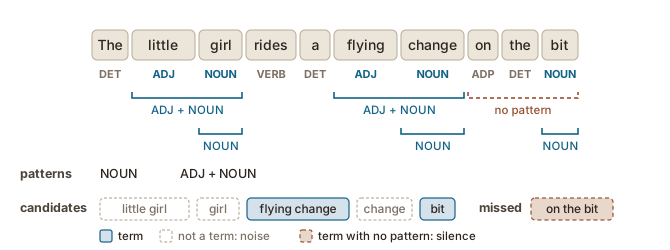
Figure 7figure 7 shows the three steps on one sentence, and what they return: five candidates, of which two are terms, and one term that no pattern matches.
Noise and silence
The candidates that part-of-speech patterns return all have the shape of a term, but many of them are not terms, and some terms match none of the patterns. Candidates that are not terms are called noise noisebruit evaluationévaluation The items a system returns that are not correct: in term extraction, the candidates that are not terms.Éléments trouvés par un système qui ne sont pas corrects : en extraction de termes, les candidats qui ne sont pas des termes. , and terms that the patterns miss are called silence silencesilence evaluationévaluation The correct items a system fails to return: in term extraction, the terms of the gold standard that were not proposed.Éléments corrects qu'un système ne trouve pas : en extraction de termes, les termes de la référence qui n'ont pas été proposés. ; the evaluation module explains both, with the scores that measure them (see also the False positives and false negatives page, in the Evaluating language technology module) (voir aussi la page Faux positifs et faux négatifs, dans le module L'évaluation des technologies langagières).
- Noise. In the sentence of Figure 7figure 7, little girl has the same shape as flying change, and a pattern for single nouns catches every noun in the text: girl, and change on its own, which is only a fragment of a term.
- Silence. In the same sentence, on the bit is a term, but it is a preposition, a determiner and a noun, and neither pattern matches that sequence. Many dressage terms start with a preposition in this way, such as on the forehand. In the Dutch dressage texts annotated for the ACTER dataset, the pattern preposition, determiner and noun alone accounted for 85 annotations data annotationannotation des données datadonnées The process of adding labels or other structured information, such as categories, tags, transcriptions, or marked regions, to data so that it can be used to train or evaluate a machine learning system.Processus consistant à ajouter aux données des étiquettes ou d'autres informations structurées, comme des catégories, des balises, des transcriptions ou des zones marquées, pour qu'elles puissent servir à entraîner ou à évaluer un système d'apprentissage automatique. (Rigouts Terryn et al., 2019). A tagging mistake causes silence too: if the tagger reads flying in flying change as a verb, the pattern “adjective and noun” misses the term.
It is nearly impossible to write every pattern a term can take, especially since the tagger makes mistakes of its own (Rigouts Terryn et al., 2019). The more patterns you have, the less likely you are to miss terms (less silence), but the more likely you are to extract non-terms as well (more noise).
Patterns depend on the language and the domain
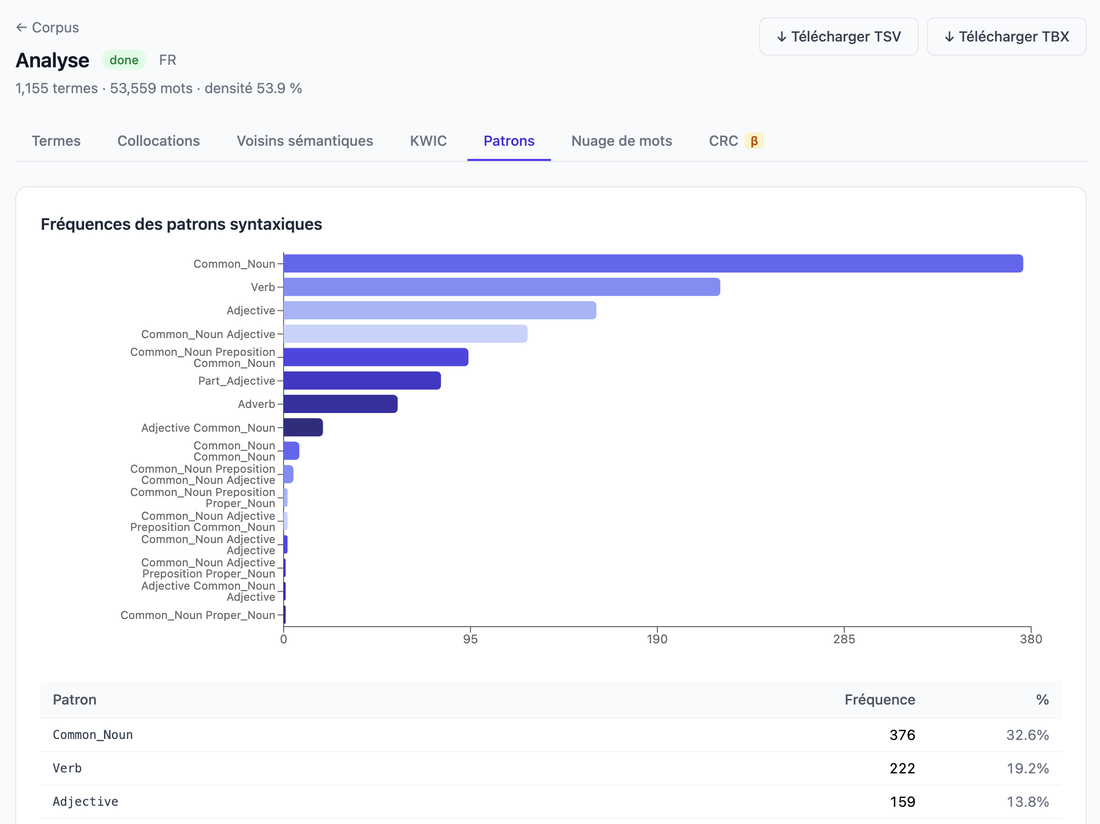
Patterns depend on the grammar of the language, so a list written for one language does not work for another, and the tagger has to be trained for each language too. In French, the adjective usually follows the noun: in a French corpus corpuscorpus corporacorpus A collection of written texts, speech recordings or transcribed language assembled for analysis or use in language technology (plural: corpora).Ensemble de textes écrits, d'enregistrements de parole ou de langue transcrite réuni pour l'analyse ou pour les technologies langagières. about dressage, noun + adjective is the most frequent pattern of several words, and adjective + noun is several times rarer (Figure 8figure 8). In Dutch, many terms that take several words in English are written as one compound word, so a single-noun pattern catches them whole (Rigouts Terryn, 2026).
Patterns depend on the domain as well. A term that starts with a preposition, such as on the bit, is common in dressage and uncommon in many other domains, so a list of patterns that suits one domain can miss terms in another.
Le raisonnement derrière l’approche linguistique
L’approche linguistique de l’extraction de termes automatic term extraction (ATE)extraction automatique de termes NLPTAL The identification, by a program, of candidate terms in a text or a corpus, for a person to validate.Repérage, par un programme, de candidats terminologiques dans un texte ou un corpus, en vue de leur validation par une personne. repose sur deux constats :
- La partie du discours de chaque mot d’un texte (nom, adjectif, verbe, etc.) peut être trouvée automatiquement. Les étiqueteurs donnent à environ 97 % des mots la même étiquette qu’une personne, en anglais et dans plusieurs autres langues, ce qui correspond aussi à peu près au taux d’accord entre personnes sur ces étiquettes (Jurafsky et Martin, 2026, chap. 18, p. 5) (see also the Part-of-speech tagging (including an example of machine learning) chapter) (voir aussi le chapitre L'étiquetage morphosyntaxique (y compris un exemple d'apprentissage automatique)).
- La plupart des termes sont des noms ou des groupes construits autour d’un nom, comme piaffer, galop rassemblé ou pirouette au galop, même si des adjectifs, des verbes et des adverbes peuvent aussi être des termes (Rigouts Terryn, 2021a).
Si un programme peut obtenir les parties du discours, et si les termes tendent à suivre certaines suites de parties du discours, il peut alors extraire toutes les suites de cette forme. L’un des premiers algorithmes de repérage de termes dans un texte fonctionnait déjà ainsi (Justeson et Katz, 1995).
Ce raisonnement a un défaut : un nom ou un groupe construit autour d’un nom peut être un terme, mais cela ne veut pas dire qu’il en est un.
Les patrons morphosyntaxiques
La méthode linguistique procède en trois étapes (Lefever et Rigouts Terryn, 2024) :
- La segmentation. Le texte est découpé en mots et en signes de ponctuation (see also the Tokenization (including an example of the rule-based approach) chapter) (voir aussi le chapitre La segmentation en unités lexicales (y compris un exemple d'approche à base de règles)).
- L’étiquetage. Chaque mot reçoit sa partie du discours, par exemple nom, adjectif ou verbe (see also the Part-of-speech tagging (including an example of machine learning) chapter) (voir aussi le chapitre L'étiquetage morphosyntaxique (y compris un exemple d'apprentissage automatique)).
- Le repérage des patrons. Toute suite d’étiquettes qui correspond à un patron d’une liste devient un candidat terminologique candidate termcandidat terminologique NLPTAL A unit that a term extraction program proposes as a possible term, before a person has validated it.Unité qu'un programme d'extraction automatique de termes propose comme terme possible, avant qu'une personne ne l'ait validée. .
Le tableau ci-dessous donne des patrons typiques.
| Patron | Anglais | Français |
|---|---|---|
| nom | piaffe | piaffer |
| adjectif + nom | collected canter | moins courant en français |
| nom + adjectif | rare en anglais | galop rassemblé |
| nom + nom | canter pirouette | moins courant en français |
| nom + préposition + nom | change of rein | changement de pied |
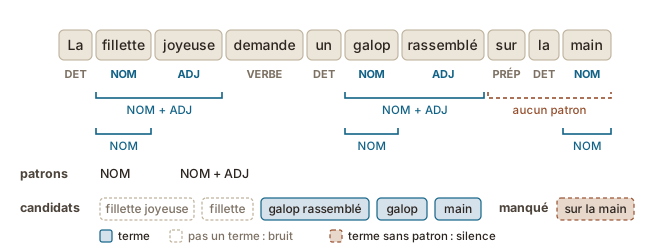
La Figure 7figure 7 montre les trois étapes sur une phrase, et ce qu’elles renvoient : cinq candidats, dont trois sont des termes, et un terme qu’aucun patron ne retient.
Le bruit et le silence
Les candidats que renvoient les patrons morphosyntaxiques ont tous la forme d’un terme, mais beaucoup ne sont pas des termes, et certains termes ne correspondent à aucun patron. Les candidats qui ne sont pas des termes s’appellent le bruit noisebruit evaluationévaluation The items a system returns that are not correct: in term extraction, the candidates that are not terms.Éléments trouvés par un système qui ne sont pas corrects : en extraction de termes, les candidats qui ne sont pas des termes. , et les termes que les patrons manquent, le silence silencesilence evaluationévaluation The correct items a system fails to return: in term extraction, the terms of the gold standard that were not proposed.Éléments corrects qu'un système ne trouve pas : en extraction de termes, les termes de la référence qui n'ont pas été proposés. ; le module sur l’évaluation explique les deux, avec les scores qui les mesurent (see also the False positives and false negatives page, in the Evaluating language technology module) (voir aussi la page Faux positifs et faux négatifs, dans le module L'évaluation des technologies langagières).
- Le bruit. Dans la phrase de la Figure 7figure 7, fillette joyeuse a la même forme que galop rassemblé, et un patron pour les noms seuls retient tous les noms du texte, dont fillette.
- Le silence. Dans la même phrase, sur la main est un terme, mais c’est une préposition, un déterminant et un nom, et aucun des deux patrons ne retient cette suite. Beaucoup de termes du dressage commencent ainsi par une préposition, comme sur les épaules. Dans les textes néerlandais sur le dressage annotés pour le jeu de données ACTER, le seul patron préposition, déterminant et nom correspondait à 85 annotations data annotationannotation des données datadonnées The process of adding labels or other structured information, such as categories, tags, transcriptions, or marked regions, to data so that it can be used to train or evaluate a machine learning system.Processus consistant à ajouter aux données des étiquettes ou d'autres informations structurées, comme des catégories, des balises, des transcriptions ou des zones marquées, pour qu'elles puissent servir à entraîner ou à évaluer un système d'apprentissage automatique. (Rigouts Terryn et al., 2019). Une erreur d’étiquetage produit aussi du silence : si l’étiqueteur prend rassemblé, dans galop rassemblé, pour un verbe, le patron « nom et adjectif » manque le terme.
Il est à peu près impossible d’écrire tous les patrons qu’un terme peut suivre, d’autant que l’étiqueteur commet ses propres erreurs (Rigouts Terryn et al., 2019). Plus vous avez de patrons, moins vous risquez de manquer des termes (moins de silence), mais plus vous risquez d’extraire aussi des unités qui ne sont pas des termes (plus de bruit).
Les patrons dépendent de la langue et du domaine
Les patrons dépendent de la grammaire de la langue : une liste écrite pour une langue ne fonctionne donc pas pour une autre, et l’étiqueteur doit lui aussi être entraîné pour chaque langue. En français, l’adjectif suit le plus souvent le nom : dans un corpus corpuscorpus corporacorpus A collection of written texts, speech recordings or transcribed language assembled for analysis or use in language technology (plural: corpora).Ensemble de textes écrits, d'enregistrements de parole ou de langue transcrite réuni pour l'analyse ou pour les technologies langagières. français sur le dressage, nom + adjectif est le patron de plusieurs mots le plus fréquent, et adjectif + nom est plusieurs fois plus rare (Figure 8figure 8). En néerlandais, beaucoup de termes qui demandent plusieurs mots en anglais s’écrivent en un seul mot composé, si bien qu’un patron pour les noms seuls les retient en entier (Rigouts Terryn, 2026).
Les patrons dépendent aussi du domaine. Un terme qui commence par une préposition, comme sur la main, est courant en dressage et peu courant dans beaucoup d’autres domaines, si bien qu’une liste de patrons adaptée à un domaine peut manquer des termes dans un autre.
Sources
- Jurafsky, D., & Martin, J. H. (2026). Speech and Language Processing: An Introduction to Natural Language Processing, Computational Linguistics, and Speech Recognition with Language Models. Online draft, 3rd edition. https://web.stanford.edu/~jurafsky/slp3/
- Justeson, J. S., & Katz, S. M. (1995). Technical terminology: some linguistic properties and an algorithm for identification in text. Natural Language Engineering, 1(1), 9–27. https://doi.org/10.1017/S1351324900000048
- Lefever, E., & Rigouts Terryn, A. (2024). Computational Terminology. In Y. Peng et al. (Eds.), New Advances in Translation Technology: Applications and Pedagogy (pp. 141–159). Springer Nature. https://doi.org/10.1007/978-981-97-2958-6_8
- Rigouts Terryn, A. (2021a). ACTER terminology annotation guidelines. Ghent University, LT3 Language and Translation Technology Team. http://hdl.handle.net/1854/LU-8503113
- Rigouts Terryn, A. (2026). Large Language Models Are Good Term Extractors: A Systematic Evaluation. Proceedings of the Fifteenth Language Resources and Evaluation Conference (LREC 2026), 7631–7643. https://doi.org/10.63317/49gta5itne3q
- Rigouts Terryn, A., Drouin, P., Hoste, V., & Lefever, E. (2019). Analysing the Impact of Supervised Machine Learning on Automatic Term Extraction: HAMLET vs TermoStat. Proceedings of the International Conference on Recent Advances in Natural Language Processing (RANLP 2019), 1012–1021. https://doi.org/10.26615/978-954-452-056-4_117
Sources
- Jurafsky, D., & Martin, J. H. (2026). Speech and Language Processing: An Introduction to Natural Language Processing, Computational Linguistics, and Speech Recognition with Language Models. Online draft, 3rd edition. https://web.stanford.edu/~jurafsky/slp3/
- Justeson, J. S., & Katz, S. M. (1995). Technical terminology: some linguistic properties and an algorithm for identification in text. Natural Language Engineering, 1(1), 9–27. https://doi.org/10.1017/S1351324900000048
- Lefever, E., & Rigouts Terryn, A. (2024). Computational Terminology. In Y. Peng et al. (Eds.), New Advances in Translation Technology: Applications and Pedagogy (pp. 141–159). Springer Nature. https://doi.org/10.1007/978-981-97-2958-6_8
- Rigouts Terryn, A. (2021a). ACTER terminology annotation guidelines. Ghent University, LT3 Language and Translation Technology Team. http://hdl.handle.net/1854/LU-8503113
- Rigouts Terryn, A. (2026). Large Language Models Are Good Term Extractors: A Systematic Evaluation. Proceedings of the Fifteenth Language Resources and Evaluation Conference (LREC 2026), 7631–7643. https://doi.org/10.63317/49gta5itne3q
- Rigouts Terryn, A., Drouin, P., Hoste, V., & Lefever, E. (2019). Analysing the Impact of Supervised Machine Learning on Automatic Term Extraction: HAMLET vs TermoStat. Proceedings of the International Conference on Recent Advances in Natural Language Processing (RANLP 2019), 1012–1021. https://doi.org/10.26615/978-954-452-056-4_117