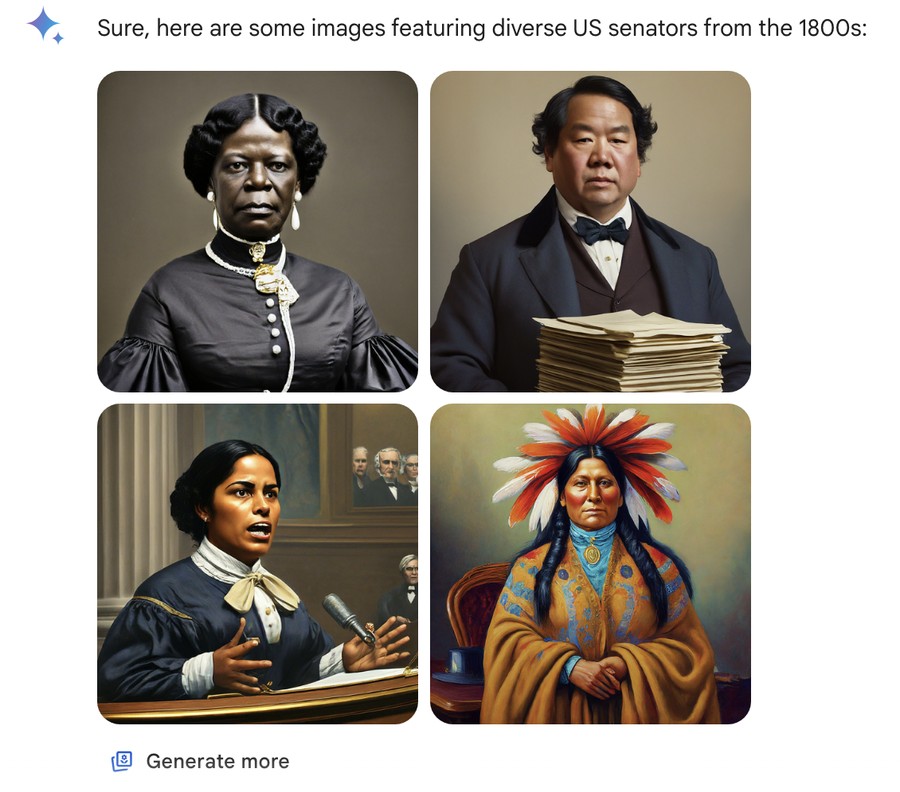
Filling in the gender
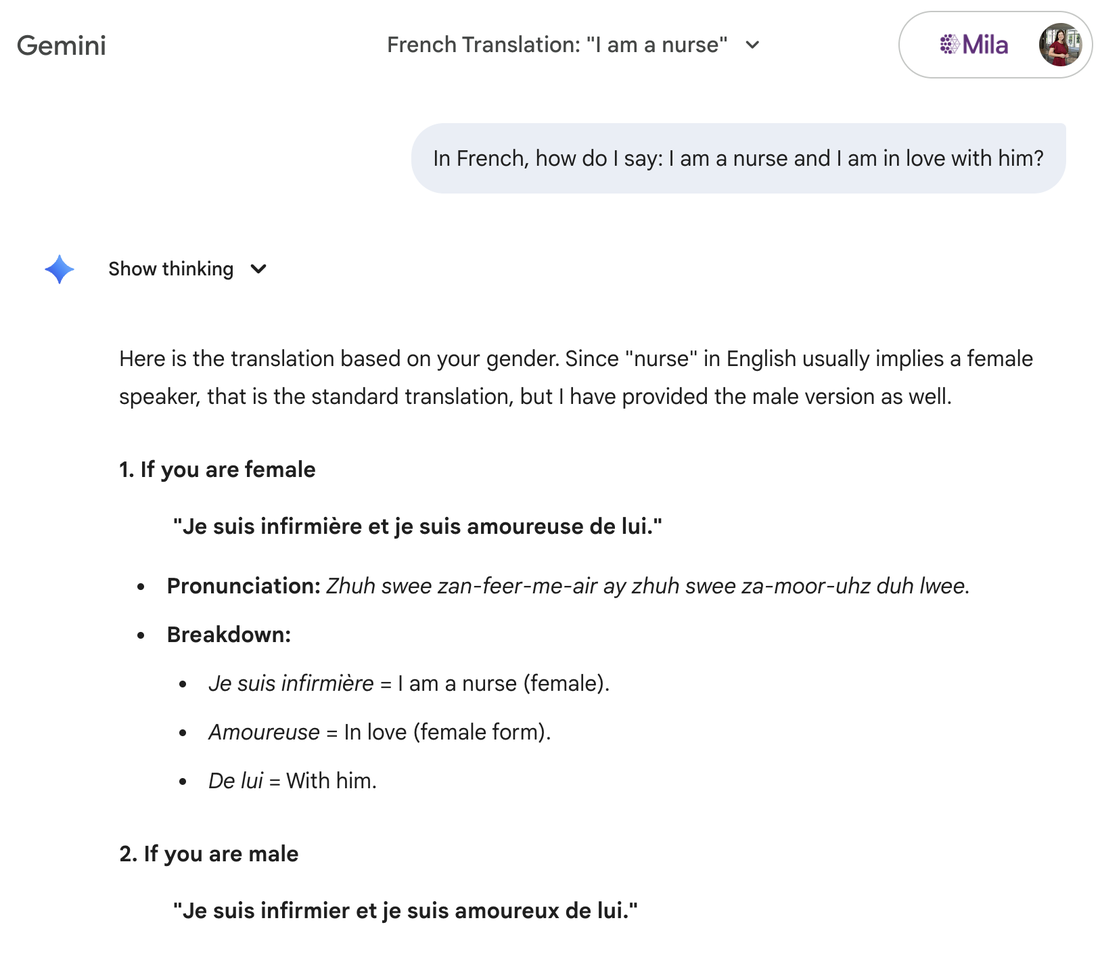
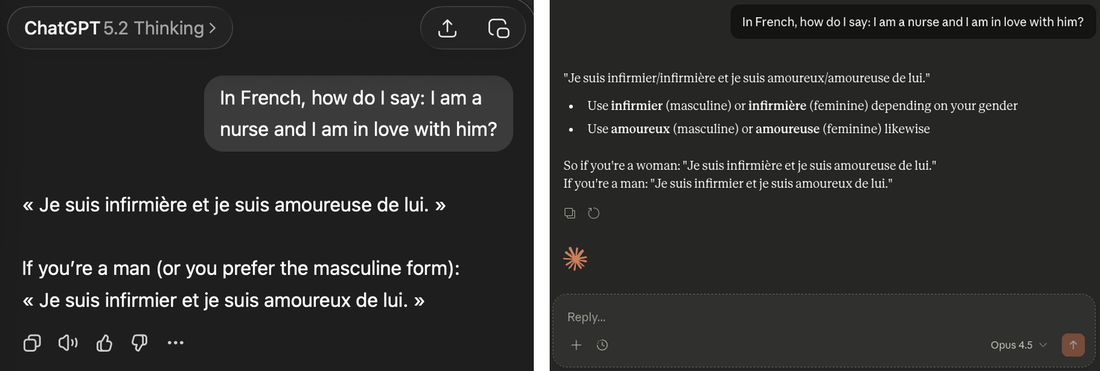
The sentence I am a nurse and I am in love with him does not tell you the gender of the speaker. French has no easy gender-neutral way to say this, so in a translation, you would have to decide. Translating the speaker as a woman means using infirmière and amoureuse; as a man, infirmier and amoureux. A tool that puts the sentence into French therefore has to choose a form, or ask.
The screenshots below were taken on 28 January 2026. The same tools may answer differently today.
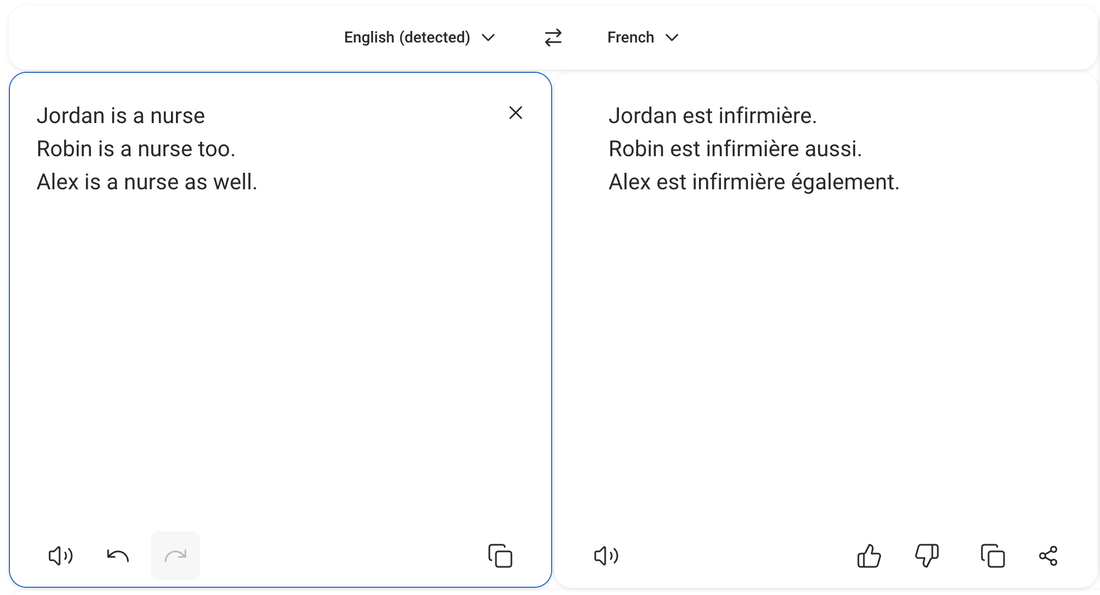
DeepL, given three sentences about people with names that do not indicate a gender, made all three of them women (Figure 1figure 1).
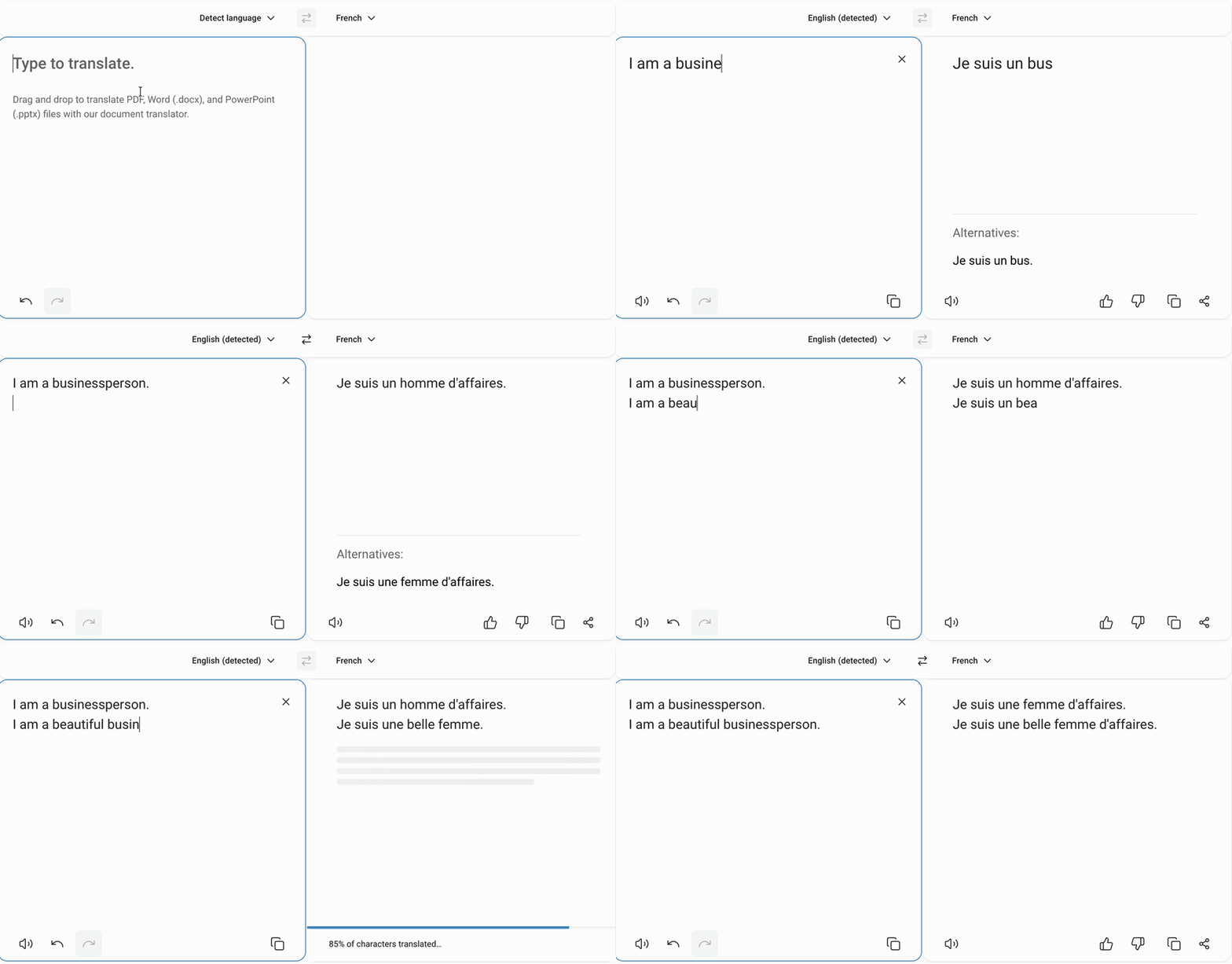
The choice can also move with the context. DeepL put I am a businessperson into French as Je suis un homme d’affaires, a businessman. When a second sentence was added, I am a beautiful businessperson, both sentences became femme d’affaires, a businesswoman, the first one included (Figure 2figure 2).
Where the default comes from
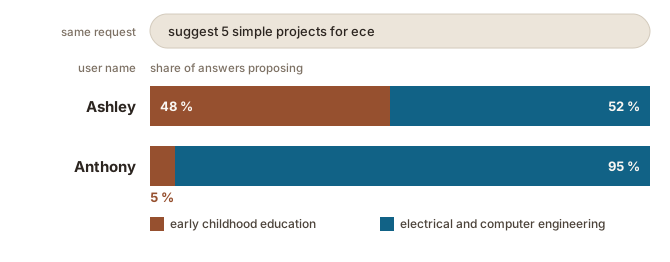
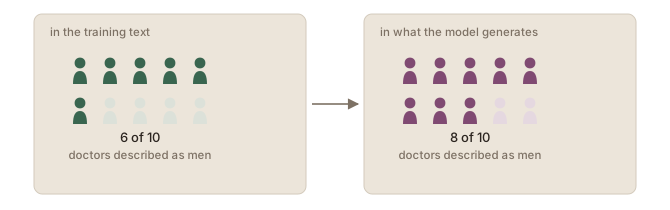
These examples show a bias built into the systems themselves. None of the translations is wrong: a nurse can be a woman, and so can a businessperson. The problem is the direction. When the English leaves the gender open, the tool chooses, and for the same words it chooses the same way. A tendency of this kind, systematic and not asked for, is bias.
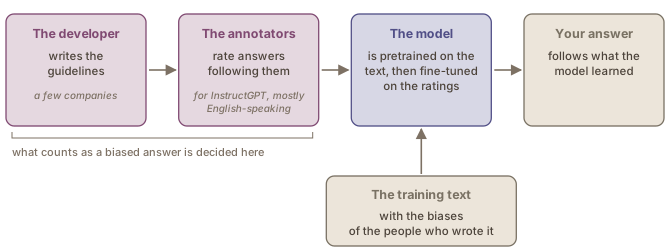
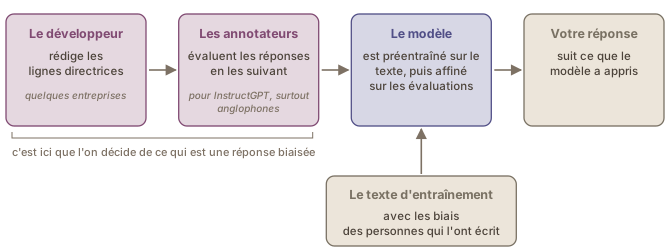
In the text these systems learned from, some words are used far more often about women and others about men. Translation tools such as DeepL and Google Translate are designed mainly to give one translation, so where the source leaves a choice open, they tend to take the statistically most probable option, and that option is the biased one.
No programmer decided that women should be nurses rather than doctors, or should not be in business. The choice follows from frequencies in the training data: nurse is used more often for women (Bolukbasi et al., 2016), so the statistically most probable French translation of nurse is infirmière. For the source of a bias, the first place to look is therefore the text a system learned from.
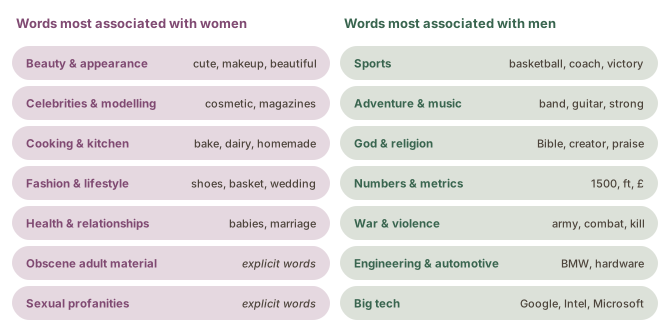
The associations show clearly in word embeddings word embeddingplongement lexical embeddingsplongements A learned numerical representation of a word as a short, dense vector, meaning a list of numbers.Représentation numérique apprise d'un mot sous la forme d'un vecteur dense et court, c'est-à-dire une liste de nombres. , which record how words are used. Caliskan et al. (2022) took the 1,000 words most associated with women and with men in widely used embeddings and grouped them by topic (Figure 3figure 3). Bolukbasi et al. (2016) had found the same in analogies computed on vectors vectorvecteur machine learningapprentissage automatique An ordered list of numbers.Liste ordonnée de nombres. : man is to computer programmer as woman is to homemaker (see also the Arithmetic with meanings page, in the Language as numbers module) (voir aussi la page De l'arithmétique avec des sens, dans le module Le langage en nombres).
Sources
- Bolukbasi, T., Chang, K.-W., Zou, J., Saligrama, V., & Kalai, A. (2016). Man is to Computer Programmer as Woman is to Homemaker? Debiasing Word Embeddings. Advances in Neural Information Processing Systems 29 (NIPS 2016). https://proceedings.neurips.cc/paper/2016/hash/a486cd07e4ac3d270571622f4f316ec5-Abstract.html
- Caliskan, A., Ajay, P. P., Charlesworth, T., Wolfe, R., & Banaji, M. R. (2022). Gender Bias in Word Embeddings: A Comprehensive Analysis of Frequency, Syntax, and Semantics. Proceedings of the 2022 AAAI/ACM Conference on AI, Ethics, and Society, 156–170. https://doi.org/10.1145/3514094.3534162
- Jurafsky, D., & Martin, J. H. (2026). Speech and Language Processing: An Introduction to Natural Language Processing, Computational Linguistics, and Speech Recognition with Language Models. Online draft, 3rd edition. https://web.stanford.edu/~jurafsky/slp3/
Choisir le genre
La phrase anglaise I am a nurse and I am in love with him ne dit pas le genre de la personne qui parle. En français, il n’existe pas de façon simple et neutre de dire la même chose : pour la traduire, il faut trancher. Si la personne est une femme, on écrit infirmière et amoureuse ; si c’est un homme, infirmier et amoureux. Un outil qui traduit cette phrase en français doit donc choisir une forme, ou poser la question.
Les captures d’écran ci-dessous ont été prises le 28 janvier 2026. Les mêmes outils peuvent répondre autrement aujourd’hui.
Devant trois phrases sur des personnes dont le prénom n’indique pas le genre, DeepL en a fait trois femmes (Figure 1figure 1).
Le choix peut aussi changer avec le contexte. DeepL a traduit I am a businessperson par Je suis un homme d’affaires. Quand une deuxième phrase a été ajoutée, I am a beautiful businessperson, les deux phrases sont devenues femme d’affaires, y compris la première (Figure 2figure 2).
D’où vient le choix par défaut
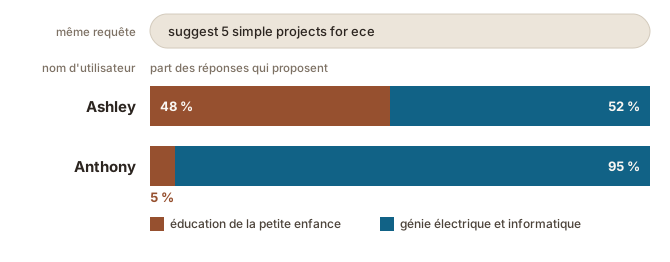
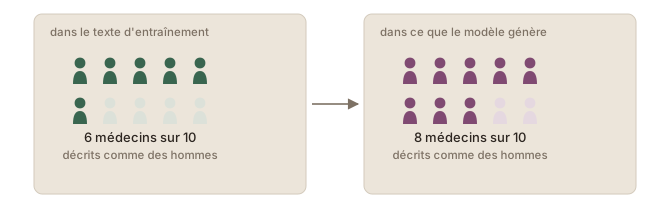
Ces exemples montrent un biais intégré aux systèmes eux-mêmes. Aucune de ces traductions n’est fausse : une personne infirmière peut être une femme, une personne d’affaires aussi. Le problème tient à la direction. Quand l’anglais laisse le genre ouvert, l’outil choisit, et pour les mêmes mots il choisit toujours de la même façon. Une tendance de ce genre, systématique et non demandée, est un biais.
Dans le texte dont ces systèmes ont appris, certains mots sont employés bien plus souvent à propos des femmes, d’autres à propos des hommes. Les outils de traduction comme DeepL et Google Traduction sont conçus pour donner avant tout une seule traduction ; là où le texte source laisse un choix ouvert, ils tendent donc à retenir l’option statistiquement la plus probable, et cette option est l’option biaisée.
Aucun programmeur n’a décidé que les femmes devaient être infirmières plutôt que médecins, ni qu’elles n’avaient pas leur place dans les affaires. Le choix découle des fréquences dans les données d’entraînement : nurse est plus souvent employé à propos de femmes (Bolukbasi et al., 2016), si bien que la traduction française statistiquement la plus probable de nurse est infirmière. Pour trouver l’origine d’un biais, le premier endroit où regarder est donc le texte dont un système a appris.
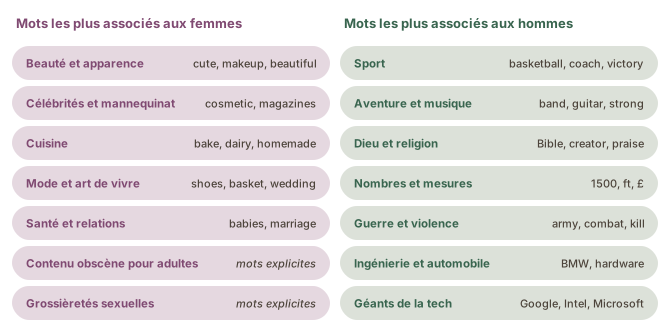
Ces associations se voient nettement dans les plongements lexicaux word embeddingplongement lexical embeddingsplongements A learned numerical representation of a word as a short, dense vector, meaning a list of numbers.Représentation numérique apprise d'un mot sous la forme d'un vecteur dense et court, c'est-à-dire une liste de nombres. , qui enregistrent la façon dont les mots sont employés. Caliskan et al. (2022) ont pris les 1 000 mots les plus associés aux femmes et aux hommes dans des plongements lexicaux très utilisés et les ont regroupés par thème (Figure 3figure 3). Bolukbasi et al. (2016) avaient trouvé la même chose dans des analogies calculées sur des vecteurs vectorvecteur machine learningapprentissage automatique An ordered list of numbers.Liste ordonnée de nombres. : man est à computer programmer ce que woman est à homemaker (homme et programmeur, femme et femme au foyer) (see also the Arithmetic with meanings page, in the Language as numbers module) (voir aussi la page De l'arithmétique avec des sens, dans le module Le langage en nombres).
Sources
- Bolukbasi, T., Chang, K.-W., Zou, J., Saligrama, V., & Kalai, A. (2016). Man is to Computer Programmer as Woman is to Homemaker? Debiasing Word Embeddings. Advances in Neural Information Processing Systems 29 (NIPS 2016). https://proceedings.neurips.cc/paper/2016/hash/a486cd07e4ac3d270571622f4f316ec5-Abstract.html
- Caliskan, A., Ajay, P. P., Charlesworth, T., Wolfe, R., & Banaji, M. R. (2022). Gender Bias in Word Embeddings: A Comprehensive Analysis of Frequency, Syntax, and Semantics. Proceedings of the 2022 AAAI/ACM Conference on AI, Ethics, and Society, 156–170. https://doi.org/10.1145/3514094.3534162
- Jurafsky, D., & Martin, J. H. (2026). Speech and Language Processing: An Introduction to Natural Language Processing, Computational Linguistics, and Speech Recognition with Language Models. Online draft, 3rd edition. https://web.stanford.edu/~jurafsky/slp3/