What a translation system has to doCe qu'un système de traduction doit faire
TRA6008 To read for S7À lire pour la S7
A memory and a translation system
When you open a segment in a CAT tool and see a pre-filled suggestion for a translation, that translation has either been retrieved from a translation memory or been generated by a machine translation system (Figure 1figure 1).
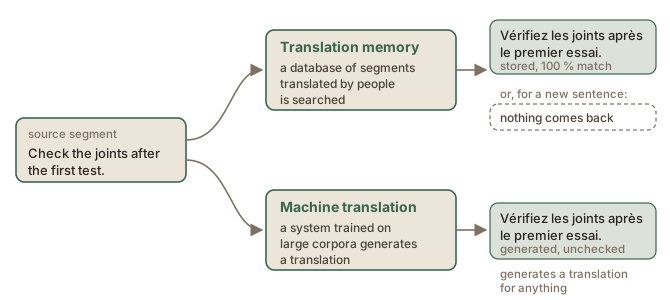
The second of the two, the machine translation system, is the subject of this module, and the term is defined widely enough to cover every system of the kind.
The definition says nothing about how the translation is produced: it covers a rule-based system rule-based systemsystème à base de règles AIIA A system whose behaviour is fixed by rules that people wrote, most often of the form "if this condition, then this action", so that every output can be traced to the rule that produced it.Système dont le comportement est fixé par des règles écrites par des personnes, le plus souvent de la forme « si cette condition, alors cette action », de sorte que chaque résultat peut être rapporté à la règle qui l'a produit. of the 1970s and a chatbot of today alike.
Differences between languages and cultures
If translation were replacing each word with its equivalent, a bilingual dictionary would be a translation system. Figure 2figure 2 shows two of the ways that fails.
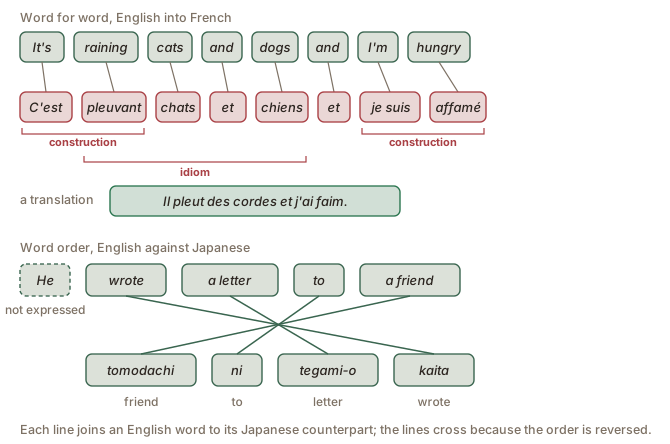
Eight kinds of difference between languages and cultures defeat the dictionary.
| Difference | Example | Consequence for a system |
|---|---|---|
| Word order | English He wrote a letter to a friend; Japanese tomodachi ni tegami-o kaita, word for word friend to letter wrote | the words have to be moved, and sometimes the whole sentence rebuilt |
| One word, several words | English bass is Spanish lubina (the fish) or bajo (the instrument); German has Wand (inside) and Mauer (outside) for wall | a sense has to be chosen from the context |
| What is left unsaid | Spanish Mostró su hallazgo a un descifrador ambulante has no subject; English needs He showed his find to a wandering decoder | a word the target grammar requires has to be supplied, and one it does without dropped |
| A different construction | English I am hungry, with an adjective; French j’ai faim, with a noun. English I like coffee; Spanish me gusta el café, where the coffee is the subject and pleases me | the same idea has to be rebuilt with the part of speech and the construction the target language uses |
| A word with no equivalent | Dutch gezellig, for a warm, convivial atmosphere; Mandarin xiào, for which English makes do with filial piety (Jurafsky & Martin, 2026) | a phrase, a near-equivalent or a loan has to stand in for the missing word |
| Figurative language and idioms | English it’s raining cats and dogs; French il pleut des cordes | the literal wording has to give way to the image the target language uses |
| Cultural knowledge | a Quebec text mentions le cégep; an English one mentions Grade 11 or Thanksgiving, which falls in October in Canada and in November in the United States | an explanation or an equivalent has to be added for readers who do not share the reference |
| Text-type conventions | an English manual says Press the button (imperative), a French one Appuyer sur le bouton (infinitive); a Japanese novel repeats a word where an English one would vary it | the text has to be reshaped to the conventions of its genre in the target culture, beyond the sentence |
Some of these, though not all and not to the same degree, are the difficulties translators face when they learn to translate well. The second difference is drawn in Figure 3figure 3.
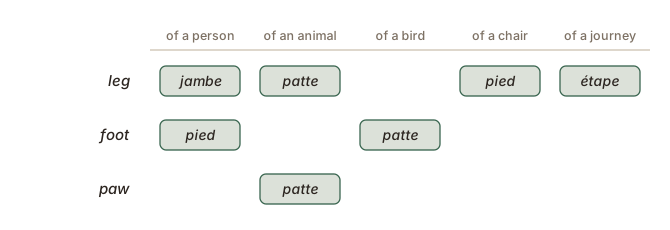
The second difference has one more case: the target grammar can force a decision the source never made. French marks the gender of adjectives, so an English adjective has to be given one, and a system that guesses adds to the bias of machine translation (see also the Bias chapter, in the Critical issues with LLMs module) (voir aussi le chapitre Biais, dans le module Enjeux critiques des GML). To choose the right word is to choose a sense, which is the problem of ambiguity ambiguityambiguïté linguisticslinguistique The property of a stretch of language that allows more than one interpretation.Propriété d'un segment de langue qui autorise plus d'une interprétation. (see also the Why language is hard chapter, in the Language as numbers module) (voir aussi le chapitre Pourquoi le langage est difficile, dans le module Le langage en nombres).
Names, numbers and tags
Beside everything a system has to adapt, there is what it has to leave alone: names, numbers, dates, formatting and inline tags inline tagbalise interne CAT toolsTAO A marker inside a segment standing for formatting or a code of the original document, a bold run or a footnote reference for instance, rather than for text to translate.Marqueur placé à l'intérieur d'un segment qui représente une mise en forme ou un code du document d'origine, par exemple un passage en gras ou un appel de note, et non du texte à traduire. have to come through unchanged, and a system that translates a product name or drops a tag has failed on a sentence it otherwise translated well.
Une mémoire et un système de traduction
Quand vous ouvrez un segment dans un outil de TAO et que vous y trouvez une proposition de traduction déjà remplie, cette traduction a été soit retrouvée dans une mémoire de traduction, soit générée par un système de traduction automatique (Figure 1figure 1).
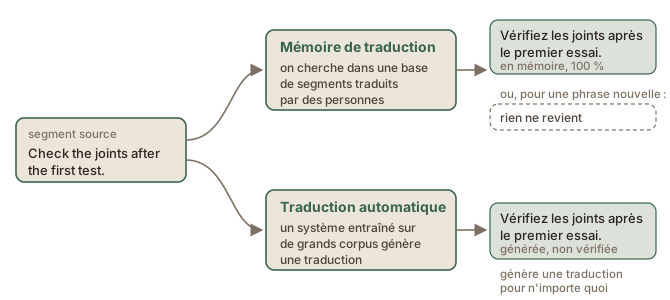
Le second des deux, le système de traduction automatique, est le sujet de ce module, et le terme est défini assez largement pour couvrir tous les systèmes du genre.
La définition ne dit rien de la façon dont la traduction est produite : elle couvre aussi bien un système à base de règles rule-based systemsystème à base de règles AIIA A system whose behaviour is fixed by rules that people wrote, most often of the form "if this condition, then this action", so that every output can be traced to the rule that produced it.Système dont le comportement est fixé par des règles écrites par des personnes, le plus souvent de la forme « si cette condition, alors cette action », de sorte que chaque résultat peut être rapporté à la règle qui l'a produit. des années 1970 qu’un agent conversationnel d’aujourd’hui.
Les différences entre langues et entre cultures
Si traduire consistait à remplacer chaque mot par son équivalent, un dictionnaire bilingue serait un système de traduction. La Figure 2figure 2 montre deux des façons dont cela échoue.
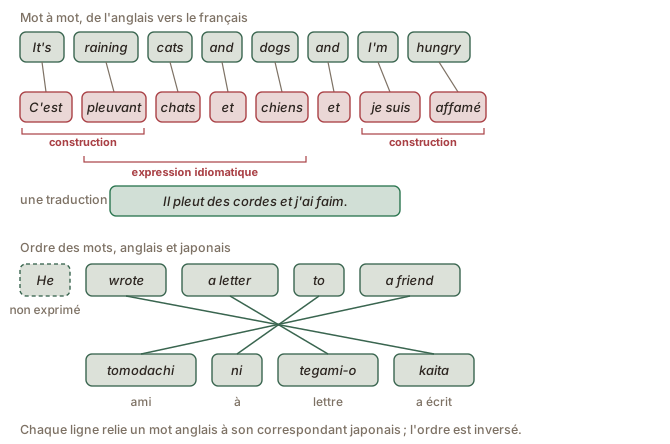
Huit types de différences entre langues et entre cultures mettent le dictionnaire en échec.
| Différence | Exemple | Conséquence pour un système |
|---|---|---|
| L’ordre des mots | anglais He wrote a letter to a friend ; japonais tomodachi ni tegami-o kaita, mot à mot ami à lettre a écrit | il faut déplacer les mots, et parfois reconstruire toute la phrase |
| Un mot, plusieurs mots | l’anglais bass se dit en espagnol lubina (le poisson) ou bajo (l’instrument) ; l’allemand a Wand (à l’intérieur) et Mauer (à l’extérieur) pour mur | il faut choisir un sens d’après le contexte |
| Ce qui reste implicite | l’espagnol Mostró su hallazgo a un descifrador ambulante n’a pas de sujet ; l’anglais exige He showed his find to a wandering decoder | il faut ajouter un mot que la grammaire cible exige, et retirer celui dont elle se passe |
| Une autre construction | l’anglais I am hungry, avec un adjectif ; le français j’ai faim, avec un nom. L’anglais I like coffee ; l’espagnol me gusta el café, où le café est le sujet et me plaît | la même idée doit être reconstruite avec la partie du discours et la construction qu’emploie la langue cible |
| Un mot sans équivalent | le néerlandais gezellig, pour une atmosphère chaleureuse et conviviale ; le mandarin xiào, que l’anglais rend tant bien que mal par filial piety (Jurafsky & Martin, 2026) | une périphrase, un quasi-équivalent ou un emprunt doit remplacer le mot manquant |
| Le langage figuré et les expressions idiomatiques | l’anglais it’s raining cats and dogs ; le français il pleut des cordes | la formulation littérale doit céder la place à l’image qu’emploie la langue cible |
| Les connaissances culturelles | un texte québécois mentionne le cégep ; un texte anglais mentionne Grade 11 ou Thanksgiving, qui tombe en octobre au Canada et en novembre aux États-Unis | il faut ajouter une explication ou un équivalent pour les lecteurs qui ne partagent pas la référence |
| Les conventions du type de texte | un manuel anglais dit Press the button (impératif), un manuel français Appuyer sur le bouton (infinitif) ; un roman japonais répète un mot là où un roman anglais le varierait | le texte doit être remodelé selon les conventions de son genre dans la culture cible, au-delà de la phrase |
Certaines de ces difficultés, pas toutes et pas au même degré, sont celles que les traducteurs affrontent quand ils apprennent à bien traduire. La deuxième différence est dessinée à la Figure 3figure 3.
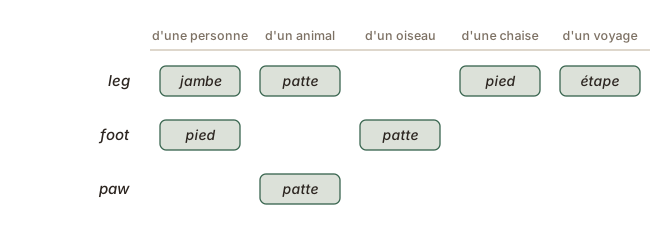
La deuxième différence a un cas de plus : la grammaire cible peut imposer une décision que la source n’a jamais prise. Le français marque le genre des adjectifs ; il faut donc en donner un à un adjectif anglais, et un système qui devine ajoute aux biais de la traduction automatique (see also the Bias chapter, in the Critical issues with LLMs module) (voir aussi le chapitre Biais, dans le module Enjeux critiques des GML). Choisir le bon mot, c’est choisir un sens : c’est le problème de l’ambiguïté ambiguityambiguïté linguisticslinguistique The property of a stretch of language that allows more than one interpretation.Propriété d'un segment de langue qui autorise plus d'une interprétation. (see also the Why language is hard chapter, in the Language as numbers module) (voir aussi le chapitre Pourquoi le langage est difficile, dans le module Le langage en nombres).
Les noms, les nombres et les balises
À côté de tout ce qu’un système doit adapter, il y a ce qu’il doit laisser intact : les noms, les nombres, les dates, la mise en forme et les balises internes inline tagbalise interne CAT toolsTAO A marker inside a segment standing for formatting or a code of the original document, a bold run or a footnote reference for instance, rather than for text to translate.Marqueur placé à l'intérieur d'un segment qui représente une mise en forme ou un code du document d'origine, par exemple un passage en gras ou un appel de note, et non du texte à traduire. doivent ressortir inchangés, et un système qui traduit un nom de produit ou qui perd une balise a échoué sur une phrase qu’il avait par ailleurs bien traduite.
Sources
- Jurafsky, D., & Martin, J. H. (2026). Speech and Language Processing: An Introduction to Natural Language Processing, Computational Linguistics, and Speech Recognition with Language Models. Online draft, 3rd edition. https://web.stanford.edu/~jurafsky/slp3/
Sources
- Jurafsky, D., & Martin, J. H. (2026). Speech and Language Processing: An Introduction to Natural Language Processing, Computational Linguistics, and Speech Recognition with Language Models. Online draft, 3rd edition. https://web.stanford.edu/~jurafsky/slp3/