Semantic and learned metricsLes métriques sémantiques et apprises
TRA6008 To read for S8À lire pour la S8
Semantic metrics
For a surface metric, enfant and gamin are simply different words. In a contextual embedding contextual embeddingplongement contextuel embeddingsplongements A numerical representation generated for a particular occurrence of a token by taking account of the other tokens available to the model.Représentation numérique générée pour une occurrence particulière d'un jeton en tenant compte des autres jetons accessibles au modèle. they are neighbours: words used in the same sense in similar sentences have vectors vectorvecteur machine learningapprentissage automatique An ordered list of numbers.Liste ordonnée de nombres. that lie close together (see also the Contextual embeddings chapter, in the Language as numbers module) (voir aussi le chapitre Plongements contextuels, dans le module Le langage en nombres). BERTScore (Zhang et al., 2020) builds on this. It matches each word of the output to the most similar word of the reference and each word of the reference to the most similar word of the output, and combines the two into an F-score F1 scorescore F1 evaluationévaluation The harmonic mean of precision and recall: a single number between 0 and 1 that is high only when both are high.Moyenne harmonique de la précision et du rappel : un seul nombre entre 0 et 1, qui n'est élevé que si les deux le sont. (Jurafsky & Martin, 2026), as Figure 7figure 7 shows.
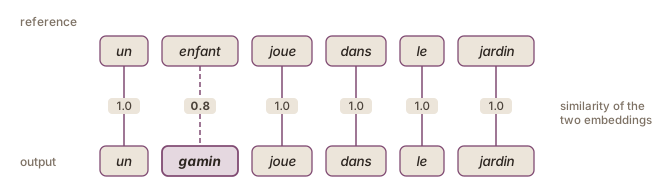
Against the reference people like foreign cars, BLEU prefers people like visiting places abroad, which shares two words with it, to consumers prefer imported cars, which shares none; BERTScore ranks them the other way round (Zhang et al., 2020).
A high similarity shows that the output is about the same thing as the reference; it does not show that the output says the same thing. BERTScore is less sensitive to small errors when the output is close to the reference in its words and style (Hanna & Bojar, 2021). Surface metrics share this weakness, and in the same study BLEU did worse than BERTScore. A not added to an output, for instance, reverses its meaning while leaving almost every word and character shared with the reference.
Metrics trained on human judgements
A learned metric is trained on translations that people rated, to predict the rating a person would give. COMET (Rei et al., 2020) reads the source, the output and the reference. Two variants are common:
- without a reference, from the source and the output alone, which is called quality estimation, for instance CometKiwi (Rei et al., 2022);
- with error spans, marking the words rated as errors with a severity, so that the score comes with a reason, for instance xCOMET (Guerreiro et al., 2024).
At WMT 2025, metrics of this kind ranked the systems automatically, beside large language models large language model (LLM)grand modèle de langue (GML) language modelsmodèles de langue A neural-network language model, usually based on the transformer architecture, that is trained on very large amounts of text and contains many learned parameters.Modèle de langue à réseau de neurones, habituellement fondé sur l'architecture des transformeurs, entraîné sur de très grandes quantités de texte et comptant de très nombreux paramètres appris. used as judges (Kocmi et al., 2025).
The main metrics compared
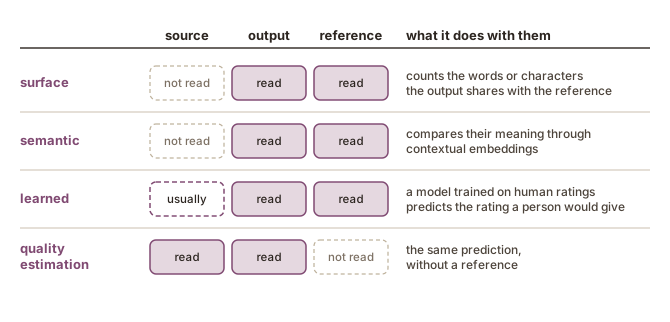
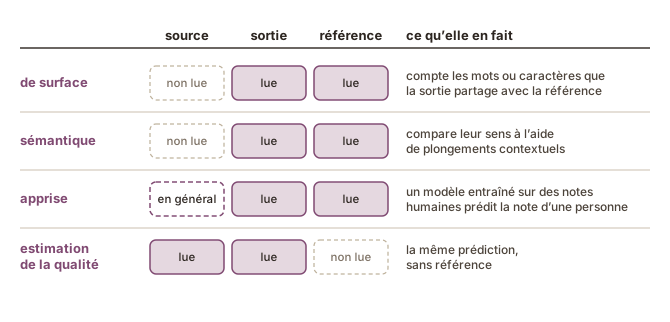
Metrics multiply, and their details change from one version to the next. Reading a score therefore starts with checking which kind of metric produced it and how it was used: what it compares, whether it learned from human ratings, and whether it needed a reference. Figure 8figure 8 shows what each kind of metric reads, and the table below sets out the main metrics of this chapter by these differences.
| Metric | Kind | Compares | Reference needed |
|---|---|---|---|
| BLEU (Papineni et al., 2002) | surface | shared words | yes |
| chrF (Popović, 2015) | surface | shared characters | yes |
| BERTScore (Zhang et al., 2020) | semantic | contextual embeddings | yes |
| COMET (Rei et al., 2020) | learned | predicts a human rating from the source, the output and the reference | usually; versions without a reference exist |
| BLEURT (Sellam et al., 2020) | learned | predicts a human rating from the output and the reference | yes |
| xCOMET (Guerreiro et al., 2024) | learned | predicts a rating and marks error spans | optional |
| CometKiwi (Rei et al., 2022) | learned, quality estimation | predicts a rating from the source and the output | no |
Strengths and weaknesses of learned metrics
In 2021, learned metrics ranked systems more like people than surface metrics did, above all between good systems (Kocmi et al., 2021; Rei et al., 2020). The advantage is not fixed: at the 2025 metrics task, simple metrics such as chrF and BERTScore came ahead of most of them on single sentences (Lavie et al., 2025) (see also the Ways of evaluating a translation page) (voir aussi la page Les façons d'évaluer une traduction). Their costs:
- A score you cannot check. A BLEU count can be redone by hand; the output of a trained model cannot, unless the metric marks error spans.
- Languages. A learned metric is only as good as the languages it was trained on: WMT 2025 fell back on chrF++ for two languages for which the reliability of its main metrics had not been established (see also the chrF page) (voir aussi la page chrF).
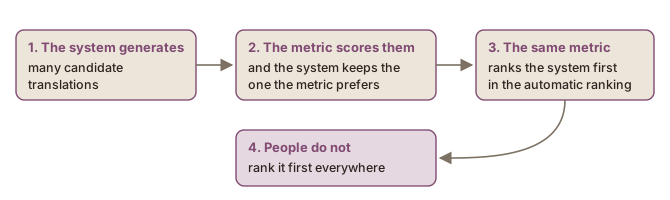
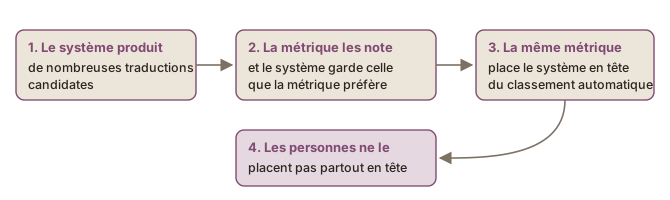
- Tuning to the metric. A system can generate several candidate translations and keep the one the metric prefers (Figure 9figure 9). In 2024 the system that led the automatic ranking had chosen among its candidates with COMET, the metric used for that ranking; people did not rank it first in every language pair, a gap the organizers attribute, probably, to metric bias (Kocmi et al., 2024b) (see also the Reading a leaderboard page, in the Using LLMs module) (voir aussi la page Lire un classement, dans le module Utiliser les GML).
Les métriques sémantiques
Pour une métrique de surface, enfant et gamin sont simplement deux mots différents. Dans un plongement contextuel contextual embeddingplongement contextuel embeddingsplongements A numerical representation generated for a particular occurrence of a token by taking account of the other tokens available to the model.Représentation numérique générée pour une occurrence particulière d'un jeton en tenant compte des autres jetons accessibles au modèle. , ils sont voisins : des mots employés dans le même sens dans des phrases semblables ont des vecteurs vectorvecteur machine learningapprentissage automatique An ordered list of numbers.Liste ordonnée de nombres. proches les uns des autres (see also the Contextual embeddings chapter, in the Language as numbers module) (voir aussi le chapitre Plongements contextuels, dans le module Le langage en nombres). BERTScore (Zhang et al., 2020) repose sur cette propriété. La métrique associe chaque mot de la sortie au mot le plus semblable de la référence et chaque mot de la référence au mot le plus semblable de la sortie, puis combine les deux en un score F F1 scorescore F1 evaluationévaluation The harmonic mean of precision and recall: a single number between 0 and 1 that is high only when both are high.Moyenne harmonique de la précision et du rappel : un seul nombre entre 0 et 1, qui n'est élevé que si les deux le sont. (Jurafsky & Martin, 2026), comme le montre la Figure 7figure 7.
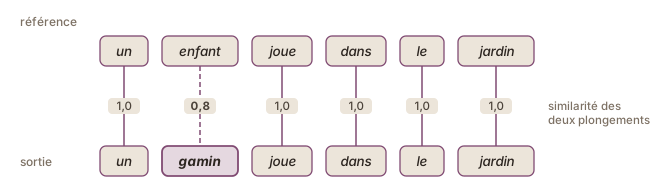
Par rapport à la référence anglaise people like foreign cars, BLEU préfère people like visiting places abroad, qui partage deux mots avec elle, à consumers prefer imported cars, qui n’en partage aucun ; BERTScore les classe dans l’ordre inverse (Zhang et al., 2020).
Une similarité élevée montre que la sortie parle de la même chose que la référence ; elle ne montre pas que la sortie dit la même chose. BERTScore est moins sensible aux petites erreurs quand la sortie est proche de la référence par ses mots et son style (Hanna & Bojar, 2021). Les métriques de surface ont la même faiblesse, et dans la même étude, BLEU faisait moins bien que BERTScore. Une négation ajoutée à une sortie, par exemple, en inverse le sens tout en laissant presque tous les mots et les caractères en commun avec la référence.
Les métriques entraînées sur des jugements humains
Une métrique apprise est entraînée sur des traductions que des personnes ont notées, pour prédire la note qu’une personne donnerait. COMET (Rei et al., 2020) lit la source, la sortie et la référence. Deux variantes sont courantes :
- sans référence, à partir de la source et de la sortie seules, ce qu’on appelle l’estimation de la qualité, par exemple CometKiwi (Rei et al., 2022) ;
- avec des passages erronés, qui marquent les mots jugés erronés avec une gravité, si bien que le score s’accompagne d’une raison, par exemple xCOMET (Guerreiro et al., 2024).
À WMT 2025, des métriques de ce type ont classé les systèmes de façon automatique, aux côtés de grands modèles de langue large language model (LLM)grand modèle de langue (GML) language modelsmodèles de langue A neural-network language model, usually based on the transformer architecture, that is trained on very large amounts of text and contains many learned parameters.Modèle de langue à réseau de neurones, habituellement fondé sur l'architecture des transformeurs, entraîné sur de très grandes quantités de texte et comptant de très nombreux paramètres appris. employés comme juges (Kocmi et al., 2025).
Les principales métriques comparées
Les métriques se multiplient, et leurs détails changent d’une version à l’autre. Lire un score commence donc par vérifier quel type de métrique l’a produit et comment elle a été employée : ce qu’elle compare, si elle a appris à partir de notes humaines, et si elle avait besoin d’une référence. La Figure 8figure 8 montre ce que lit chaque type de métrique, et le tableau ci-dessous présente les principales métriques du chapitre selon ces différences.
| Métrique | Type | Compare | Référence nécessaire |
|---|---|---|---|
| BLEU (Papineni et al., 2002) | surface | les mots partagés | oui |
| chrF (Popović, 2015) | surface | les caractères partagés | oui |
| BERTScore (Zhang et al., 2020) | sémantique | des plongements contextuels | oui |
| COMET (Rei et al., 2020) | apprise | prédit une note humaine à partir de la source, de la sortie et de la référence | habituellement ; des versions sans référence existent |
| BLEURT (Sellam et al., 2020) | apprise | prédit une note humaine à partir de la sortie et de la référence | oui |
| xCOMET (Guerreiro et al., 2024) | apprise | prédit une note et marque les passages erronés | facultative |
| CometKiwi (Rei et al., 2022) | apprise, estimation de la qualité | prédit une note à partir de la source et de la sortie | non |
Les forces et les faiblesses des métriques apprises
En 2021, les métriques apprises classaient les systèmes plus comme les personnes que les métriques de surface, surtout entre de bons systèmes (Kocmi et al., 2021 ; Rei et al., 2020). Cet avantage n’est pas acquis : à la tâche d’évaluation des métriques de 2025, des métriques simples comme chrF et BERTScore passaient devant la plupart d’entre elles sur des phrases isolées (Lavie et al., 2025) (see also the Ways of evaluating a translation page) (voir aussi la page Les façons d'évaluer une traduction). Leurs coûts :
- Un score impossible à vérifier. Un comptage BLEU peut être refait à la main ; la sortie d’un modèle entraîné ne le peut pas, sauf si la métrique marque les passages erronés.
- Les langues. Une métrique apprise ne vaut que pour les langues sur lesquelles elle a été entraînée : WMT 2025 s’est rabattu sur chrF++ pour deux langues pour lesquelles la fiabilité de ses métriques principales n’avait pas été établie (see also the chrF page) (voir aussi la page chrF).
- Le réglage sur la métrique. Un système peut produire plusieurs traductions candidates et garder celle que préfère la métrique (Figure 9figure 9). En 2024, le système en tête du classement automatique avait choisi parmi ses candidates avec COMET, la métrique employée pour ce classement ; les personnes ne l’ont pas placé en tête pour toutes les paires de langues, un écart que les organisateurs attribuent, probablement, à un biais de la métrique (Kocmi et al., 2024b) (see also the Reading a leaderboard page, in the Using LLMs module) (voir aussi la page Lire un classement, dans le module Utiliser les GML).
Sources
- Guerreiro, N. M., Rei, R., van Stigt, D., Coheur, L., Colombo, P., & Martins, A. F. T. (2024). xCOMET: Transparent Machine Translation Evaluation through Fine-grained Error Detection. Transactions of the Association for Computational Linguistics, 12, 979–995. https://doi.org/10.1162/tacl_a_00683
- Hanna, M., & Bojar, O. (2021). A Fine-Grained Analysis of BERTScore. Proceedings of the Sixth Conference on Machine Translation, 507–517. https://aclanthology.org/2021.wmt-1.59/
- Jurafsky, D., & Martin, J. H. (2026). Speech and Language Processing: An Introduction to Natural Language Processing, Computational Linguistics, and Speech Recognition with Language Models. Online draft, 3rd edition. https://web.stanford.edu/~jurafsky/slp3/
- Kocmi, T., Artemova, E., Avramidis, E., Bawden, R., Bojar, O., Dranch, K., et al. (2025). Findings of the WMT25 General Machine Translation Shared Task: Time to Stop Evaluating on Easy Test Sets. Proceedings of the Tenth Conference on Machine Translation (WMT 2025), Volume 2: Shared Task Papers, 355–413. https://doi.org/10.18653/v1/2025.wmt-1.22
- Kocmi, T., Avramidis, E., Bawden, R., Bojar, O., Dvorkovich, A., Federmann, C., et al. (2024b). Findings of the WMT24 General Machine Translation Shared Task: The LLM Era Is Here but MT Is Not Solved Yet. Proceedings of the Ninth Conference on Machine Translation (WMT 2024), 1–46. https://doi.org/10.18653/v1/2024.wmt-1.1
- Kocmi, T., Federmann, C., Grundkiewicz, R., Junczys-Dowmunt, M., Matsushita, H., & Menezes, A. (2021). To Ship or Not to Ship: An Extensive Evaluation of Automatic Metrics for Machine Translation. Proceedings of the Sixth Conference on Machine Translation (WMT 2021), 478–494. https://aclanthology.org/2021.wmt-1.57/
- Lavie, A., Hanneman, G., Agrawal, S., Kanojia, D., Lo, C., Zouhar, V., et al. (2025). Findings of the WMT25 Shared Task on Automated Translation Evaluation Systems: Linguistic Diversity is Challenging and References Still Help. Proceedings of the Tenth Conference on Machine Translation (WMT 2025), Volume 2: Shared Task Papers, 436–483. https://doi.org/10.18653/v1/2025.wmt-1.24
- Papineni, K., Roukos, S., Ward, T., & Zhu, W.-J. (2002). BLEU: a method for automatic evaluation of machine translation. Proceedings of the 40th Annual Meeting of the Association for Computational Linguistics (ACL 2002), Philadelphia, 311–318. https://doi.org/10.3115/1073083.1073135
- Popović, M. (2015). chrF: character n-gram F-score for automatic MT evaluation. Proceedings of the Tenth Workshop on Statistical Machine Translation (WMT 2015), Lisbon, 392–395. https://doi.org/10.18653/v1/W15-3049
- Rei, R., Stewart, C., Farinha, A. C., & Lavie, A. (2020). COMET: A Neural Framework for MT Evaluation. Proceedings of the 2020 Conference on Empirical Methods in Natural Language Processing (EMNLP 2020), 2685–2702. https://doi.org/10.18653/v1/2020.emnlp-main.213
- Rei, R., Treviso, M., Guerreiro, N. M., Zerva, C., Farinha, A. C., Maroti, C., de Souza, J. G. C., Glushkova, T., Alves, D., Lavie, A., Coheur, L., & Martins, A. F. T. (2022). CometKiwi: IST-Unbabel 2022 Submission for the Quality Estimation Shared Task. Proceedings of the Seventh Conference on Machine Translation (WMT 2022), Abu Dhabi, 634–645. https://doi.org/10.18653/v1/2022.wmt-1.60
- Sellam, T., Das, D., & Parikh, A. P. (2020). BLEURT: Learning Robust Metrics for Text Generation. Proceedings of the 58th Annual Meeting of the Association for Computational Linguistics (ACL 2020), 7881–7892. https://doi.org/10.18653/v1/2020.acl-main.704
- Zhang, T., Kishore, V., Wu, F., Weinberger, K. Q., & Artzi, Y. (2020). BERTScore: Evaluating Text Generation with BERT. Eighth International Conference on Learning Representations (ICLR 2020). http://arxiv.org/abs/1904.09675
Sources
- Guerreiro, N. M., Rei, R., van Stigt, D., Coheur, L., Colombo, P., & Martins, A. F. T. (2024). xCOMET: Transparent Machine Translation Evaluation through Fine-grained Error Detection. Transactions of the Association for Computational Linguistics, 12, 979–995. https://doi.org/10.1162/tacl_a_00683
- Hanna, M., & Bojar, O. (2021). A Fine-Grained Analysis of BERTScore. Proceedings of the Sixth Conference on Machine Translation, 507–517. https://aclanthology.org/2021.wmt-1.59/
- Jurafsky, D., & Martin, J. H. (2026). Speech and Language Processing: An Introduction to Natural Language Processing, Computational Linguistics, and Speech Recognition with Language Models. Online draft, 3rd edition. https://web.stanford.edu/~jurafsky/slp3/
- Kocmi, T., Artemova, E., Avramidis, E., Bawden, R., Bojar, O., Dranch, K., et al. (2025). Findings of the WMT25 General Machine Translation Shared Task: Time to Stop Evaluating on Easy Test Sets. Proceedings of the Tenth Conference on Machine Translation (WMT 2025), Volume 2: Shared Task Papers, 355–413. https://doi.org/10.18653/v1/2025.wmt-1.22
- Kocmi, T., Avramidis, E., Bawden, R., Bojar, O., Dvorkovich, A., Federmann, C., et al. (2024b). Findings of the WMT24 General Machine Translation Shared Task: The LLM Era Is Here but MT Is Not Solved Yet. Proceedings of the Ninth Conference on Machine Translation (WMT 2024), 1–46. https://doi.org/10.18653/v1/2024.wmt-1.1
- Kocmi, T., Federmann, C., Grundkiewicz, R., Junczys-Dowmunt, M., Matsushita, H., & Menezes, A. (2021). To Ship or Not to Ship: An Extensive Evaluation of Automatic Metrics for Machine Translation. Proceedings of the Sixth Conference on Machine Translation (WMT 2021), 478–494. https://aclanthology.org/2021.wmt-1.57/
- Lavie, A., Hanneman, G., Agrawal, S., Kanojia, D., Lo, C., Zouhar, V., et al. (2025). Findings of the WMT25 Shared Task on Automated Translation Evaluation Systems: Linguistic Diversity is Challenging and References Still Help. Proceedings of the Tenth Conference on Machine Translation (WMT 2025), Volume 2: Shared Task Papers, 436–483. https://doi.org/10.18653/v1/2025.wmt-1.24
- Papineni, K., Roukos, S., Ward, T., & Zhu, W.-J. (2002). BLEU: a method for automatic evaluation of machine translation. Proceedings of the 40th Annual Meeting of the Association for Computational Linguistics (ACL 2002), Philadelphia, 311–318. https://doi.org/10.3115/1073083.1073135
- Popović, M. (2015). chrF: character n-gram F-score for automatic MT evaluation. Proceedings of the Tenth Workshop on Statistical Machine Translation (WMT 2015), Lisbon, 392–395. https://doi.org/10.18653/v1/W15-3049
- Rei, R., Stewart, C., Farinha, A. C., & Lavie, A. (2020). COMET: A Neural Framework for MT Evaluation. Proceedings of the 2020 Conference on Empirical Methods in Natural Language Processing (EMNLP 2020), 2685–2702. https://doi.org/10.18653/v1/2020.emnlp-main.213
- Rei, R., Treviso, M., Guerreiro, N. M., Zerva, C., Farinha, A. C., Maroti, C., de Souza, J. G. C., Glushkova, T., Alves, D., Lavie, A., Coheur, L., & Martins, A. F. T. (2022). CometKiwi: IST-Unbabel 2022 Submission for the Quality Estimation Shared Task. Proceedings of the Seventh Conference on Machine Translation (WMT 2022), Abu Dhabi, 634–645. https://doi.org/10.18653/v1/2022.wmt-1.60
- Sellam, T., Das, D., & Parikh, A. P. (2020). BLEURT: Learning Robust Metrics for Text Generation. Proceedings of the 58th Annual Meeting of the Association for Computational Linguistics (ACL 2020), 7881–7892. https://doi.org/10.18653/v1/2020.acl-main.704
- Zhang, T., Kishore, V., Wu, F., Weinberger, K. Q., & Artzi, Y. (2020). BERTScore: Evaluating Text Generation with BERT. Eighth International Conference on Learning Representations (ICLR 2020). http://arxiv.org/abs/1904.09675