The practice corpusLe corpus des exercices
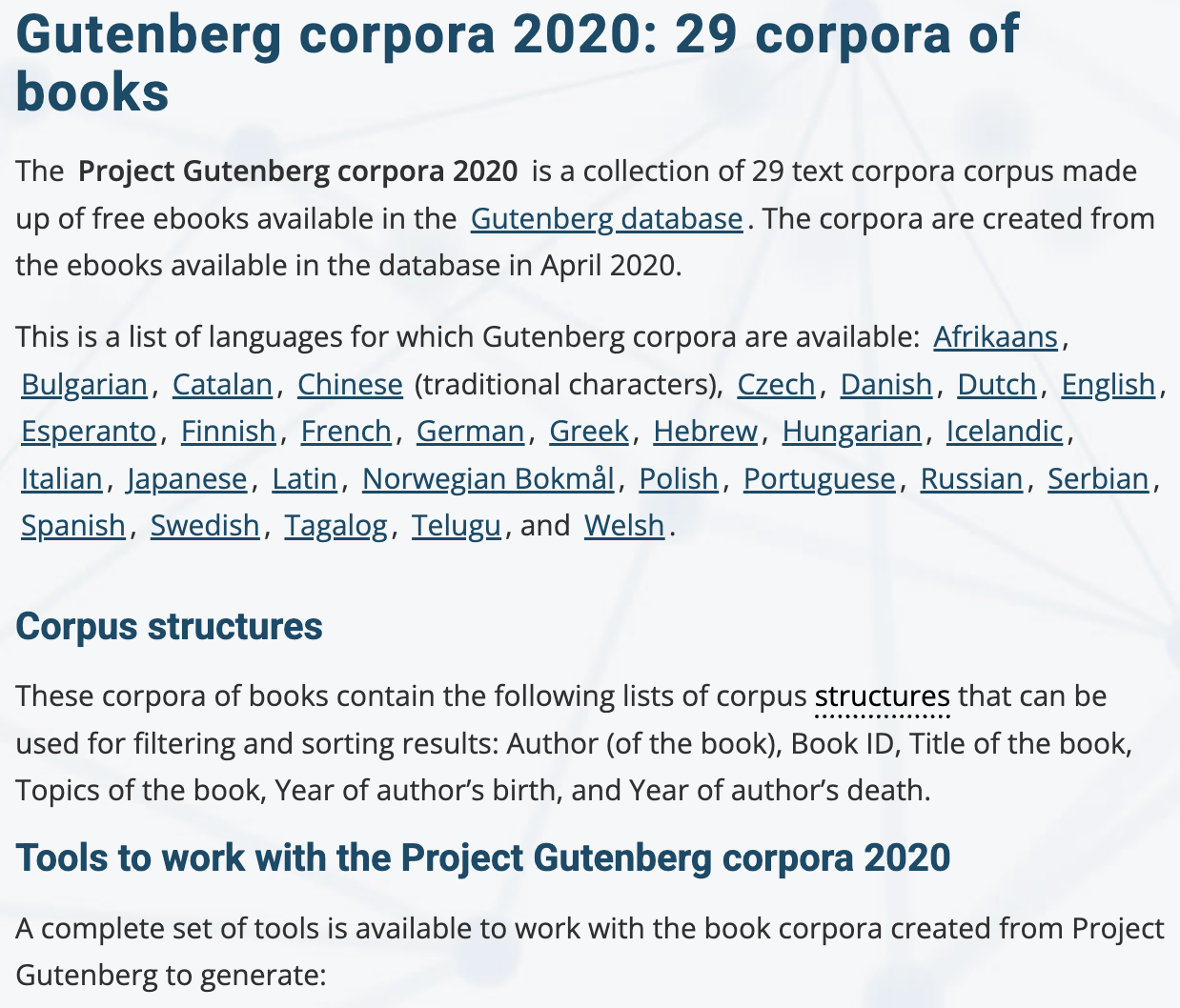
Your own web corpus is unique: nobody else has exactly the same one. So that the exercises have checkable answers, they use a corpus that is already in Sketch Engine and identical for everyone: Gutenberg French 2020, a large corpus of French literary texts built from the ebooks of the Gutenberg project.
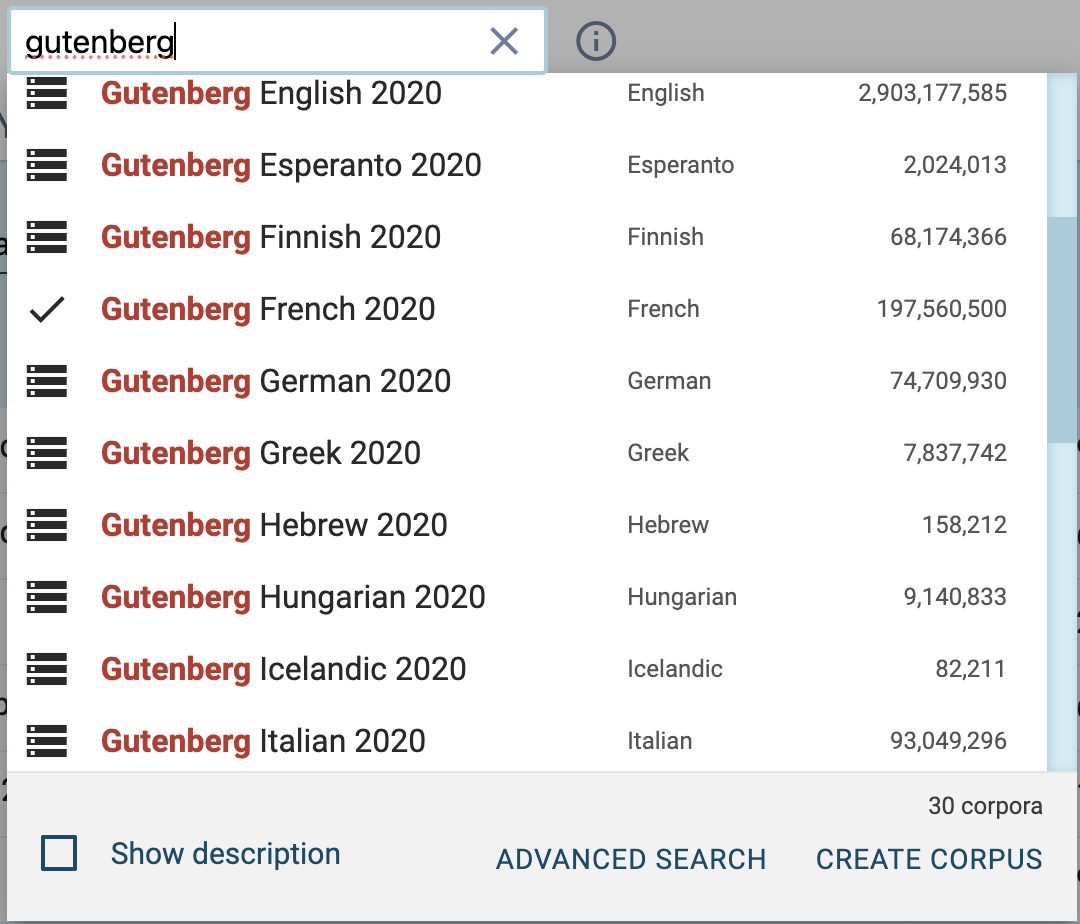
Go back to the corpus search and select it.
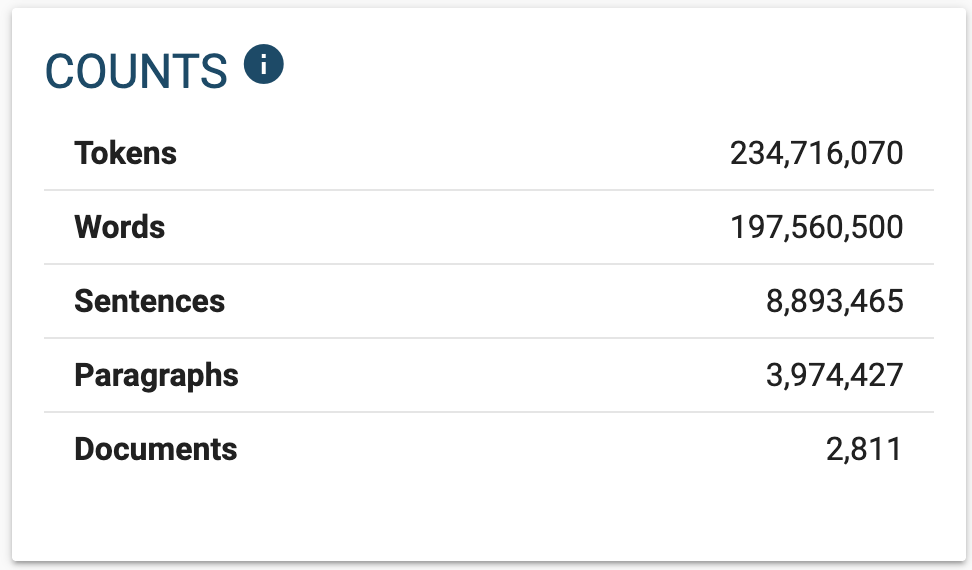
First exercise: reading those statistics. This corpus contains more tokens token¹occurrence de mot linguisticslinguistique An individual occurrence of a word or another countable element in a text.Apparition individuelle d'un mot ou d'un autre élément dénombrable dans un texte. than “words”, and the gap has an explanation. If you cannot see why, look for it in Sketch Engine rather than guessing: the “i” icons on the statistics screen and the “LEARN” tabs say what each figure counts.
The statistics of the Gutenberg French 2020 corpus read 234,716,070 tokens and 197,560,500 words. Which of the following best explains why there are more tokens than words?
Dans les statistiques du corpus Gutenberg French 2020, on lit 234 716 070 « tokens » et 197 560 500 « words ». Lequel des énoncés suivants explique le mieux pourquoi le nombre de tokens est supérieur au nombre de words ?
Show the solutionVoir la solution
In Sketch Engine every token is a separate textual unit (usually separated by spaces or punctuation), but only those that begin with a letter count as words. Punctuation, numbers and symbols are therefore among the tokens and not among the words.
What to take from it: the definition of "word" varies from one tool to another. In Sketch Engine a word is a token that begins with a letter of the alphabet (or with an ideogram, in some Asian languages).
Dans Sketch Engine, tous les tokens sont des unités textuelles séparées (généralement par des espaces ou des signes de ponctuation), mais seuls ceux qui commencent par une lettre sont comptés comme words. La ponctuation, les nombres et les symboles comptent donc parmi les tokens, mais pas parmi les words.
Point à retenir : la définition de « mot » varie d'un outil à l'autre. Dans Sketch Engine, un word est un token qui commence par une lettre de l'alphabet (ou un idéogramme dans certaines langues asiatiques).
Votre propre corpus web est unique : personne d’autre n’a exactement le même. Pour que les exercices aient des réponses vérifiables, ils utilisent donc un corpus déjà présent dans Sketch Engine, identique pour tout le monde : Gutenberg French 2020, un grand corpus de textes littéraires français construit à partir des livres numériques du projet Gutenberg.
Retournez à la recherche de corpus et sélectionnez-le.
Premier exercice : lire ces statistiques. Ce corpus compte plus de tokens token¹occurrence de mot linguisticslinguistique An individual occurrence of a word or another countable element in a text.Apparition individuelle d'un mot ou d'un autre élément dénombrable dans un texte. que de « words », et l’écart s’explique. Si vous ne voyez pas pourquoi, cherchez-le dans Sketch Engine plutôt que de deviner : les « i » de l’écran des statistiques et les onglets « LEARN » disent ce que chaque chiffre compte.
The statistics of the Gutenberg French 2020 corpus read 234,716,070 tokens and 197,560,500 words. Which of the following best explains why there are more tokens than words?
Dans les statistiques du corpus Gutenberg French 2020, on lit 234 716 070 « tokens » et 197 560 500 « words ». Lequel des énoncés suivants explique le mieux pourquoi le nombre de tokens est supérieur au nombre de words ?
Show the solutionVoir la solution
In Sketch Engine every token is a separate textual unit (usually separated by spaces or punctuation), but only those that begin with a letter count as words. Punctuation, numbers and symbols are therefore among the tokens and not among the words.
What to take from it: the definition of "word" varies from one tool to another. In Sketch Engine a word is a token that begins with a letter of the alphabet (or with an ideogram, in some Asian languages).
Dans Sketch Engine, tous les tokens sont des unités textuelles séparées (généralement par des espaces ou des signes de ponctuation), mais seuls ceux qui commencent par une lettre sont comptés comme words. La ponctuation, les nombres et les symboles comptent donc parmi les tokens, mais pas parmi les words.
Point à retenir : la définition de « mot » varie d'un outil à l'autre. Dans Sketch Engine, un word est un token qui commence par une lettre de l'alphabet (ou un idéogramme dans certaines langues asiatiques).
Sources
- Sketch Engine (2020). Gutenberg Corpora 2020. sketchengine.eu. https://www.sketchengine.eu/gutenberg-corpora-2020/
Sources
- Sketch Engine (2020). Gutenberg Corpora 2020. sketchengine.eu. https://www.sketchengine.eu/gutenberg-corpora-2020/