ConcordancesLes concordances
This is the basic tool of corpus linguistics. A frequency list tells you how often a word appears; a concordance shows you the word at work, which is where you can see:
- frequent collocations;
- the syntactic construction around the word (verb plus preposition, and so on);
- register and style (formal, narrative, archaizing);
- polysemy polysemypolysémie linguisticslinguistique The property of a word or lemma having two or more related senses.Propriété d'un mot ou d'un lemme qui possède deux sens apparentés ou plus. , the different senses according to context;
- the habits of an author, a period, a text genre.
The exercises that follow are done in the Concordance function, still on the Gutenberg corpus.
Search for "homme" in Concordance (Gutenberg corpus), then find how to display the collocations of the word from the concordance itself, without going through another function such as Word Sketch. What is the first word of the list of collocates?
Cherchez « homme » dans Concordance (corpus Gutenberg), puis trouvez comment afficher les collocations du mot à partir de la concordance, sans passer par une autre fonctionnalité comme Word Sketch. Quel est le premier mot de la liste de collocatifs ?
Show the explanationVoir l'explication
Answer: "jeune". From a concordance, an icon in the toolbar (top right of the results) computes the collocations of the words surrounding the occurrences. "Jeune homme" is an extremely common expression in classical French literature, which is why "jeune" comes first.
Réponse : « jeune ». Depuis une concordance, une icône de la barre d'outils (en haut à droite des résultats) calcule les collocations des mots qui entourent les occurrences. « Jeune homme » est une expression extrêmement courante dans la littérature française classique, d'où la première place de « jeune ».
Still in Concordance, search this time for "femme", then find the GDEX function (Good Dictionary EXamples) and look at the sentences it offers. What does GDEX do?
Toujours dans Concordance, cherchez cette fois « femme », puis trouvez la fonction GDEX (Good Dictionary EXamples) et regardez les phrases qu'elle propose. Que fait GDEX ?
Show the solutionVoir la solution
GDEX is a Sketch Engine algorithm that automatically picks out good example sentences for a word: short enough to be readable, grammatically complete, representative of typical usage, without too many rare or technical words. It defines nothing and invents nothing: every sentence comes from the corpus.
For translation, GDEX helps you see how a word is used "naturally", and gives examples to quote or to imitate. The order of the sentences it offers can vary from one session to another.
GDEX est un algorithme de Sketch Engine qui repère automatiquement de bonnes phrases d'exemple pour un mot : assez courtes pour être lisibles, grammaticalement complètes, représentatives de l'usage typique, sans trop de mots rares ou techniques. Il ne définit rien et n'invente rien : toutes les phrases viennent du corpus.
Pour la traduction, GDEX aide à voir comment un mot s'utilise « naturellement » et fournit des exemples à citer ou à imiter. L'ordre des phrases proposées peut varier d'une session à l'autre.
One last angle: the distribution of a word, which shows where its occurrences token¹occurrence de mot linguisticslinguistique An individual occurrence of a word or another countable element in a text.Apparition individuelle d'un mot ou d'un autre élément dénombrable dans un texte. sit in the corpus. Here are four distributions taken from the Gutenberg corpus:
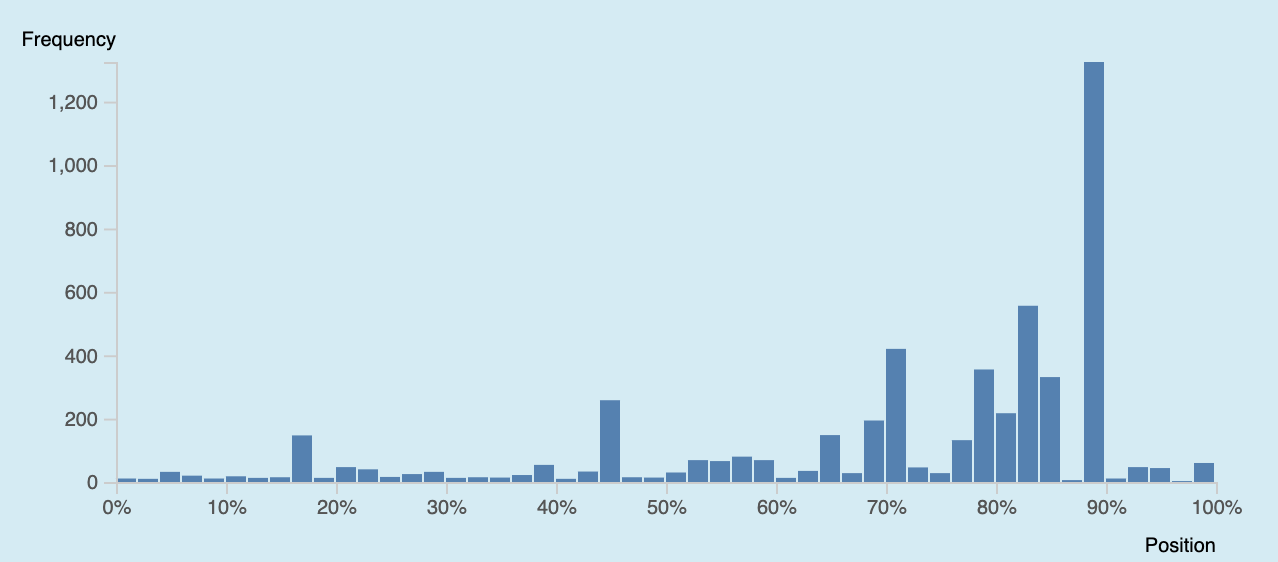
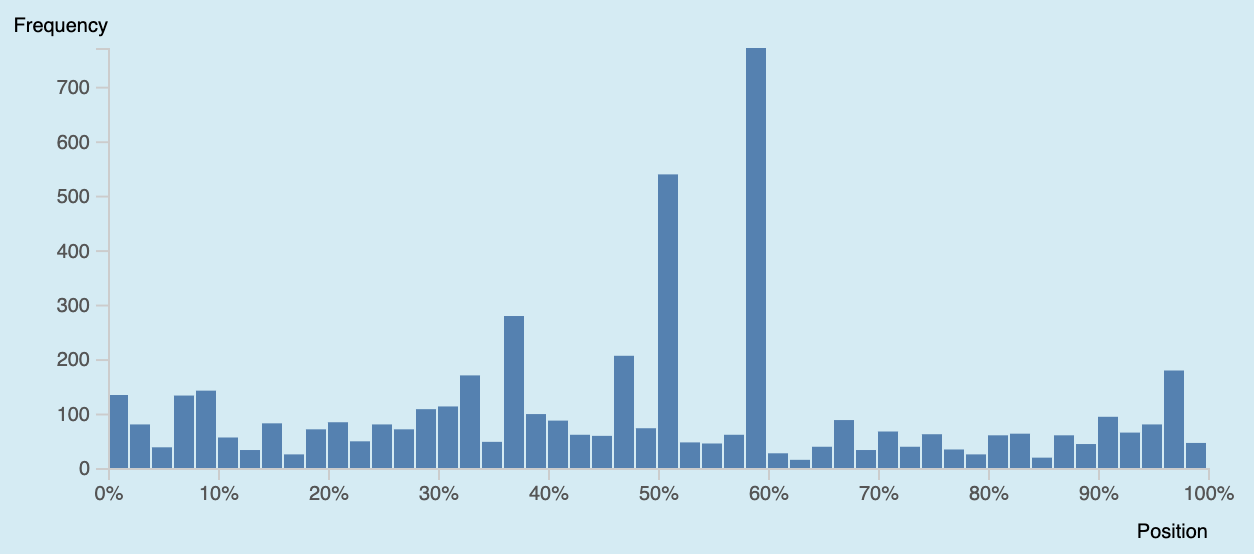
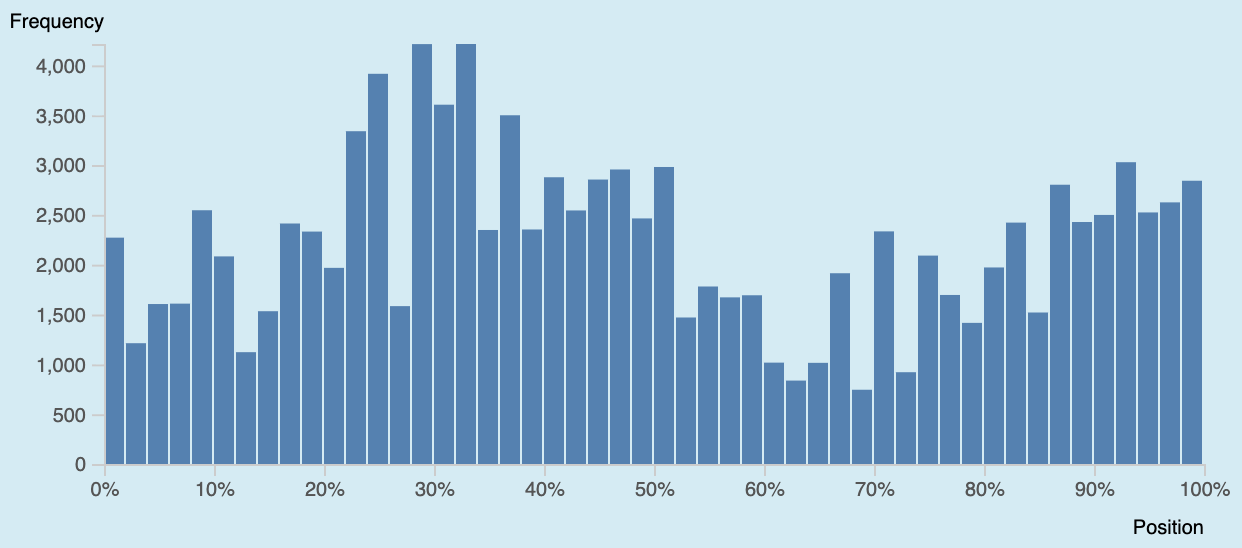
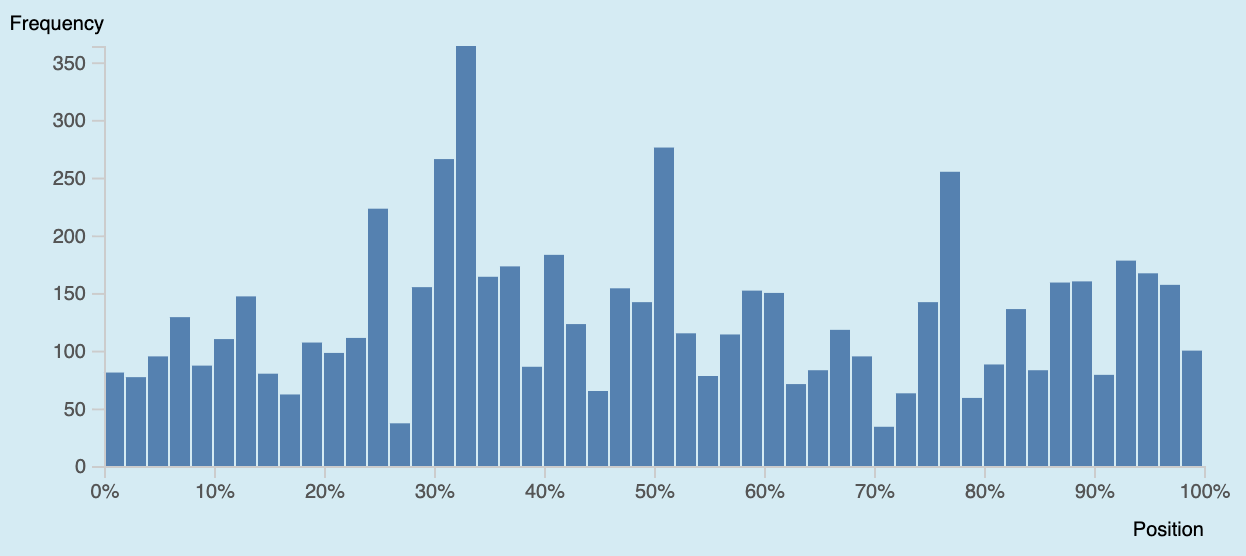
Search for the word "canada" (simple search) in Concordance, then display the distribution of that word across the corpus: does it turn up more or less everywhere, or does it cluster in certain texts? Among the four distributions above, which one is that of "Canada"?
Cherchez le mot « canada » (recherche simple) dans Concordance, puis visualisez la distribution de ce mot dans le corpus : apparaît-il un peu partout, ou se concentre-t-il dans certains textes ? Parmi les quatre distributions ci-dessus, laquelle est celle de « Canada » ?
Show the solutionVoir la solution
The distribution of "Canada" is distribution A: heavily concentrated in a few texts that talk about Canada specifically. (The other three are those of "Belgique", "France" and "Suisse" in the same corpus.)
Why it matters: a very concentrated distribution warns you that the frequency of a word may be inflated by a handful of texts. Reliable analysis wants occurrences spread over several texts; the distribution also helps tell "general" words from "thematic" ones. Compare with "France", spread far more evenly across this French literature.
La distribution de « Canada » est la distribution A : très concentrée dans quelques textes qui parlent spécifiquement du Canada. (Les autres distributions sont celles de « Belgique », « France » et « Suisse » dans le même corpus.)
Pourquoi c'est important : une distribution très concentrée signale que la fréquence d'un mot peut être gonflée par une poignée de textes. Pour une analyse fiable, mieux vaut des occurrences réparties dans plusieurs textes ; la distribution aide aussi à distinguer les mots « généraux » des mots « thématiques ». Comparez avec « France », répartie beaucoup plus uniformément dans cette littérature française.
C’est l’outil de base de la linguistique de corpus. Une liste de fréquences dit combien de fois un mot apparaît ; une concordance le montre à l’œuvre, et c’est là qu’on peut voir :
- les collocations fréquentes ;
- la construction syntaxique autour du mot (verbe + préposition, etc.) ;
- le registre et le style (soutenu, narratif, archaïsant) ;
- la polysémie polysemypolysémie linguisticslinguistique The property of a word or lemma having two or more related senses.Propriété d'un mot ou d'un lemme qui possède deux sens apparentés ou plus. , les différents sens selon le contexte ;
- les habitudes d’une autrice, d’une époque, d’un genre textuel.
Les exercices qui suivent se font dans la fonction Concordance, toujours sur le corpus Gutenberg.
Search for "homme" in Concordance (Gutenberg corpus), then find how to display the collocations of the word from the concordance itself, without going through another function such as Word Sketch. What is the first word of the list of collocates?
Cherchez « homme » dans Concordance (corpus Gutenberg), puis trouvez comment afficher les collocations du mot à partir de la concordance, sans passer par une autre fonctionnalité comme Word Sketch. Quel est le premier mot de la liste de collocatifs ?
Show the explanationVoir l'explication
Answer: "jeune". From a concordance, an icon in the toolbar (top right of the results) computes the collocations of the words surrounding the occurrences. "Jeune homme" is an extremely common expression in classical French literature, which is why "jeune" comes first.
Réponse : « jeune ». Depuis une concordance, une icône de la barre d'outils (en haut à droite des résultats) calcule les collocations des mots qui entourent les occurrences. « Jeune homme » est une expression extrêmement courante dans la littérature française classique, d'où la première place de « jeune ».
Still in Concordance, search this time for "femme", then find the GDEX function (Good Dictionary EXamples) and look at the sentences it offers. What does GDEX do?
Toujours dans Concordance, cherchez cette fois « femme », puis trouvez la fonction GDEX (Good Dictionary EXamples) et regardez les phrases qu'elle propose. Que fait GDEX ?
Show the solutionVoir la solution
GDEX is a Sketch Engine algorithm that automatically picks out good example sentences for a word: short enough to be readable, grammatically complete, representative of typical usage, without too many rare or technical words. It defines nothing and invents nothing: every sentence comes from the corpus.
For translation, GDEX helps you see how a word is used "naturally", and gives examples to quote or to imitate. The order of the sentences it offers can vary from one session to another.
GDEX est un algorithme de Sketch Engine qui repère automatiquement de bonnes phrases d'exemple pour un mot : assez courtes pour être lisibles, grammaticalement complètes, représentatives de l'usage typique, sans trop de mots rares ou techniques. Il ne définit rien et n'invente rien : toutes les phrases viennent du corpus.
Pour la traduction, GDEX aide à voir comment un mot s'utilise « naturellement » et fournit des exemples à citer ou à imiter. L'ordre des phrases proposées peut varier d'une session à l'autre.
Dernier angle : la distribution d’un mot, qui montre où ses occurrences token¹occurrence de mot linguisticslinguistique An individual occurrence of a word or another countable element in a text.Apparition individuelle d'un mot ou d'un autre élément dénombrable dans un texte. se situent dans le corpus. Voici quatre distributions tirées du corpus Gutenberg :
Search for the word "canada" (simple search) in Concordance, then display the distribution of that word across the corpus: does it turn up more or less everywhere, or does it cluster in certain texts? Among the four distributions above, which one is that of "Canada"?
Cherchez le mot « canada » (recherche simple) dans Concordance, puis visualisez la distribution de ce mot dans le corpus : apparaît-il un peu partout, ou se concentre-t-il dans certains textes ? Parmi les quatre distributions ci-dessus, laquelle est celle de « Canada » ?
Show the solutionVoir la solution
The distribution of "Canada" is distribution A: heavily concentrated in a few texts that talk about Canada specifically. (The other three are those of "Belgique", "France" and "Suisse" in the same corpus.)
Why it matters: a very concentrated distribution warns you that the frequency of a word may be inflated by a handful of texts. Reliable analysis wants occurrences spread over several texts; the distribution also helps tell "general" words from "thematic" ones. Compare with "France", spread far more evenly across this French literature.
La distribution de « Canada » est la distribution A : très concentrée dans quelques textes qui parlent spécifiquement du Canada. (Les autres distributions sont celles de « Belgique », « France » et « Suisse » dans le même corpus.)
Pourquoi c'est important : une distribution très concentrée signale que la fréquence d'un mot peut être gonflée par une poignée de textes. Pour une analyse fiable, mieux vaut des occurrences réparties dans plusieurs textes ; la distribution aide aussi à distinguer les mots « généraux » des mots « thématiques ». Comparez avec « France », répartie beaucoup plus uniformément dans cette littérature française.
Sources
- Bowker, L., & Pearson, J. (2002). Working with Specialized Language: A Practical Guide to Using Corpora. Routledge. https://doi.org/10.4324/9780203469255
- Kilgarriff, A., Baisa, V., Bušta, J., Jakubíček, M., Kovář, V., Michelfeit, J., Rychlý, P., & Suchomel, V. (2014). The Sketch Engine: ten years on. Lexicography, 1(1), 7–36. https://doi.org/10.1007/s40607-014-0009-9
Sources
- Bowker, L., & Pearson, J. (2002). Working with Specialized Language: A Practical Guide to Using Corpora. Routledge. https://doi.org/10.4324/9780203469255
- Kilgarriff, A., Baisa, V., Bušta, J., Jakubíček, M., Kovář, V., Michelfeit, J., Rychlý, P., & Suchomel, V. (2014). The Sketch Engine: ten years on. Lexicography, 1(1), 7–36. https://doi.org/10.1007/s40607-014-0009-9