Exploring the existing corporaExplorer les corpus existants
The starting page
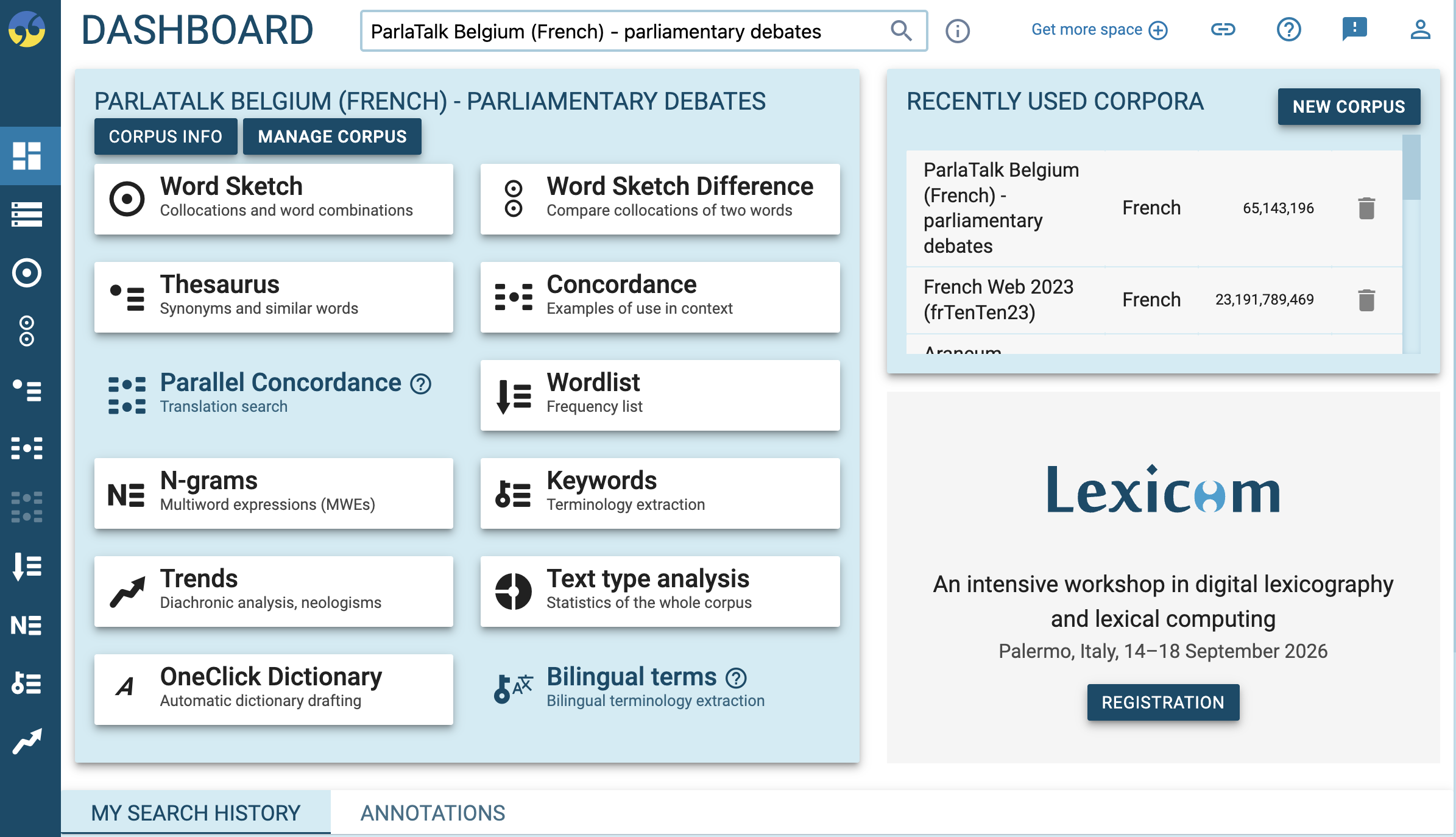
After logging in you land on the starting page: a search box and, if you have used the tool before, your recent corpora.
Finding a corpus
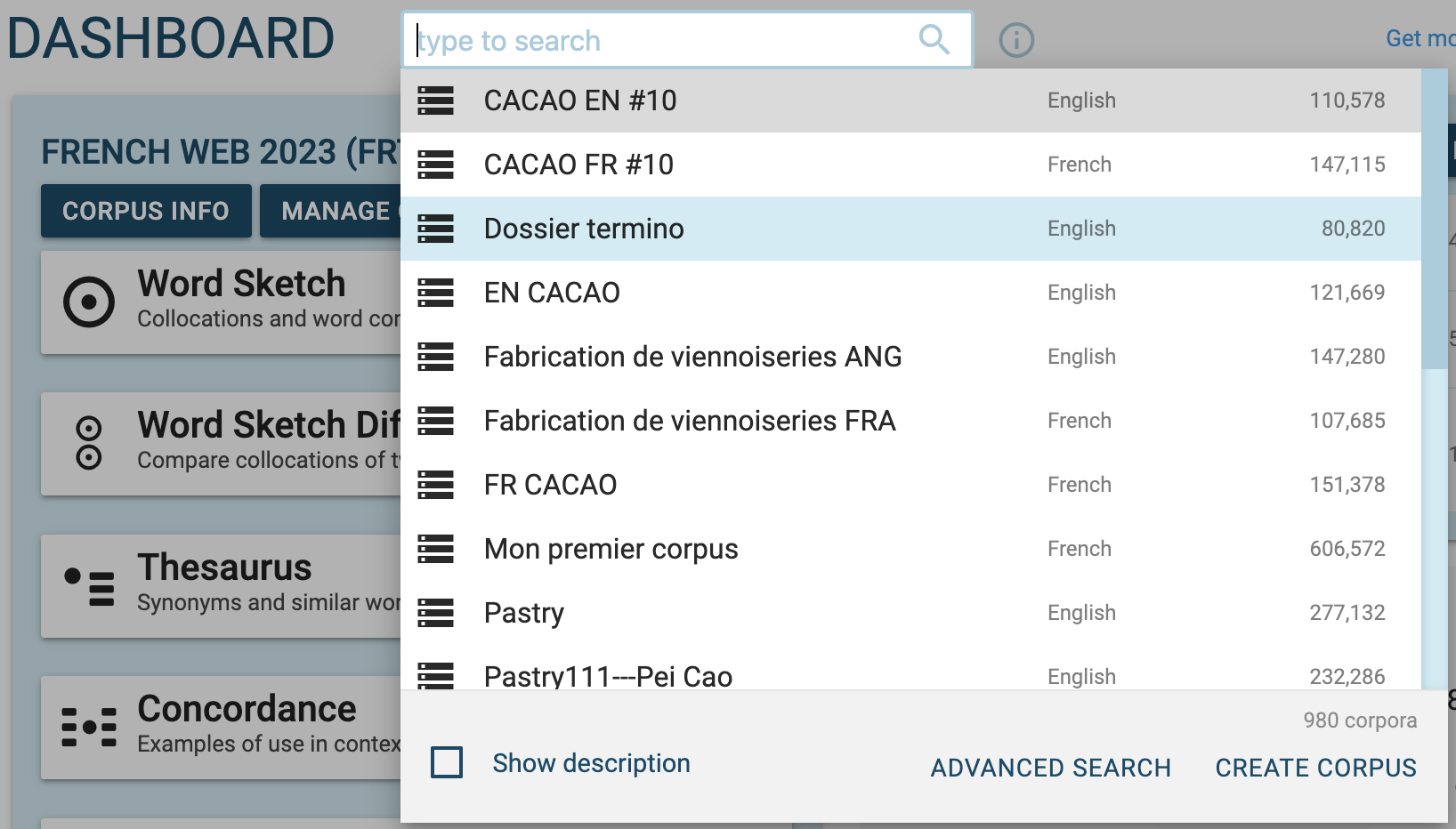
Clicking in “type to search” already suggests a selection of corpora. To see everything, click “ADVANCED SEARCH”.
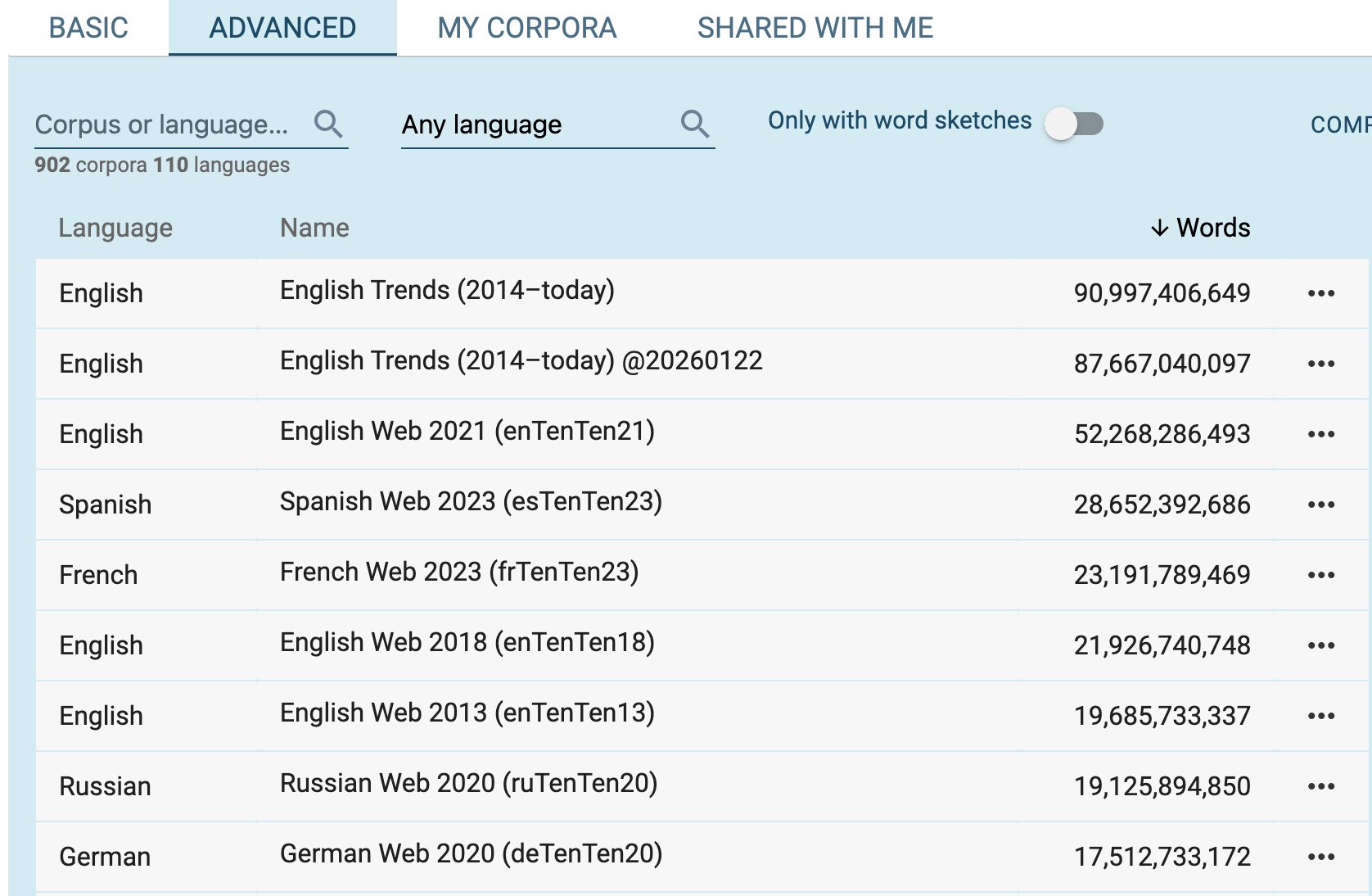
The full list shows the language, name and size in words of each corpus, with categories on the right: web corpora, spoken language, parallel (multilingual), specialized, diachronic, and so on.
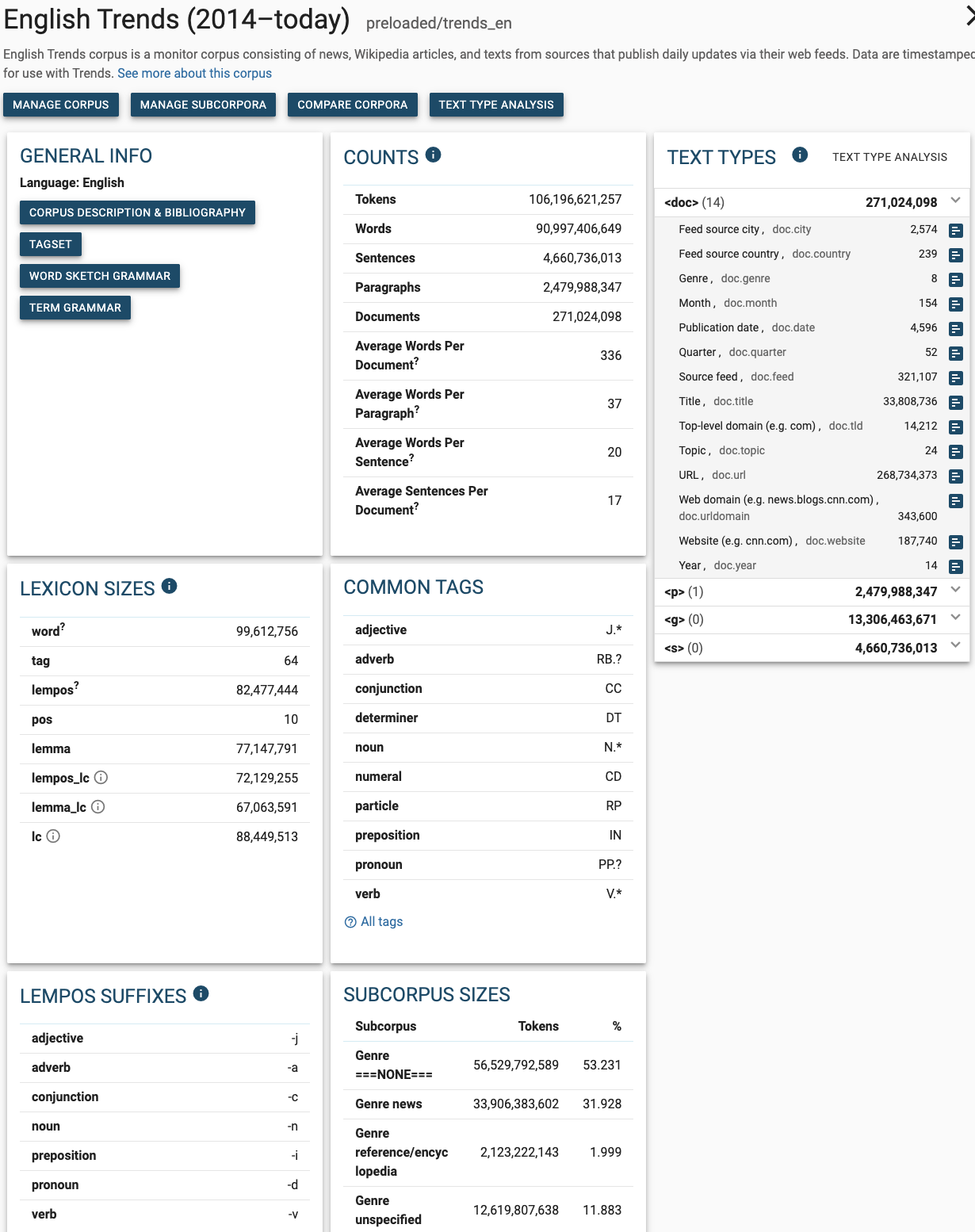
The three dots to the right of a corpus, then “i”, open its detailed record: composition, sources, available annotation data annotationannotation des données datadonnées The process of adding labels or other structured information, such as categories, tags, transcriptions, or marked regions, to data so that it can be used to train or evaluate a machine learning system.Processus consistant à ajouter aux données des étiquettes ou d'autres informations structurées, comme des catégories, des balises, des transcriptions ou des zones marquées, pour qu'elles puissent servir à entraîner ou à évaluer un système d'apprentissage automatique. .
Corpora that come prepared
All these corpora are “prepared” by Sketch Engine: linguistic information is added to them, such as part-of-speech tags part-of-speech tagging (POS tagging)étiquetage morphosyntaxique NLPTAL The task of taking a sequence of tokenized words and a tagset, and assigning to each word one tag naming its grammatical class, such as noun or verb.Tâche qui consiste à prendre une suite de mots segmentés et un jeu d'étiquettes, puis à attribuer à chaque mot une étiquette nommant sa classe grammaticale, par exemple nom ou verbe. and lemmas lemmalemme linguisticslinguistique The base or dictionary form under which the inflected forms of a word are grouped: go, goes, went and gone share the lemma go.Forme de base, ou forme de dictionnaire, sous laquelle sont regroupées les formes fléchies d'un mot : va, allons, allait et allé partagent le lemme aller. . How rich that annotation is varies by language: French and English are very well served, less-resourced languages much less so. The collection covers more than 100 languages and includes enormous, often well-known corpora, such as the TenTen family built from the web (Jakubíček et al., 2013).
Sometimes, though, the corpus you need does not exist yet, and you have to build it.
La page de départ
Après la connexion, vous arrivez sur la page de départ : une barre de recherche et, si vous avez déjà utilisé l’outil, vos corpus récents.
Chercher un corpus
Un clic dans « type to search » propose déjà une sélection de corpus. Pour tout voir, cliquez sur « ADVANCED SEARCH ».
La liste complète affiche la langue, le nom et la taille en mots de chaque corpus, avec des catégories à droite : corpus web, langue parlée, parallèles (multilingues), spécialisés, diachroniques, etc.
Les trois points à droite d’un corpus, puis « i », affichent sa fiche détaillée : composition, sources, annotations data annotationannotation des données datadonnées The process of adding labels or other structured information, such as categories, tags, transcriptions, or marked regions, to data so that it can be used to train or evaluate a machine learning system.Processus consistant à ajouter aux données des étiquettes ou d'autres informations structurées, comme des catégories, des balises, des transcriptions ou des zones marquées, pour qu'elles puissent servir à entraîner ou à évaluer un système d'apprentissage automatique. disponibles.
Des corpus déjà préparés
Tous ces corpus sont « préparés » par Sketch Engine : des informations linguistiques y sont ajoutées, comme les étiquettes morphosyntaxiques part-of-speech tagging (POS tagging)étiquetage morphosyntaxique NLPTAL The task of taking a sequence of tokenized words and a tagset, and assigning to each word one tag naming its grammatical class, such as noun or verb.Tâche qui consiste à prendre une suite de mots segmentés et un jeu d'étiquettes, puis à attribuer à chaque mot une étiquette nommant sa classe grammaticale, par exemple nom ou verbe. et les lemmes lemmalemme linguisticslinguistique The base or dictionary form under which the inflected forms of a word are grouped: go, goes, went and gone share the lemma go.Forme de base, ou forme de dictionnaire, sous laquelle sont regroupées les formes fléchies d'un mot : va, allons, allait et allé partagent le lemme aller. . La richesse de ces annotations varie selon la langue : le français et l’anglais sont très bien dotés, les langues moins dotées le sont moins. La collection couvre plus de 100 langues et inclut des corpus énormes et souvent bien connus, comme la famille TenTen construite à partir du web (Jakubíček et al., 2013).
Parfois, cependant, le corpus dont vous avez besoin n’existe pas encore, et il faut le construire.
Sources
- Jakubíček, M., Kilgarriff, A., Kovář, V., Rychlý, P., & Suchomel, V. (2013). The TenTen Corpus Family. 7th International Corpus Linguistics Conference (CL 2013), Lancaster, 125–127. https://www.sketchengine.eu/wp-content/uploads/The_TenTen_Corpus_2013.pdf
- Kilgarriff, A., Baisa, V., Bušta, J., Jakubíček, M., Kovář, V., Michelfeit, J., Rychlý, P., & Suchomel, V. (2014). The Sketch Engine: ten years on. Lexicography, 1(1), 7–36. https://doi.org/10.1007/s40607-014-0009-9
Sources
- Jakubíček, M., Kilgarriff, A., Kovář, V., Rychlý, P., & Suchomel, V. (2013). The TenTen Corpus Family. 7th International Corpus Linguistics Conference (CL 2013), Lancaster, 125–127. https://www.sketchengine.eu/wp-content/uploads/The_TenTen_Corpus_2013.pdf
- Kilgarriff, A., Baisa, V., Bušta, J., Jakubíček, M., Kovář, V., Michelfeit, J., Rychlý, P., & Suchomel, V. (2014). The Sketch Engine: ten years on. Lexicography, 1(1), 7–36. https://doi.org/10.1007/s40607-014-0009-9