You already use AI every day, mostly without thinking of it that way. The spellchecker that underlines a typo, the search engine that completes your question after three letters, the machine translation machine translation (MT)traduction automatique (TA) translationtraduction The use of a computer system to produce content in a target language that conveys content expressed in a source language.Utilisation d'un système informatique pour produire, dans une langue cible, un contenu qui rend un contenu exprimé dans une langue source. behind a foreign web page and the chatbot you ask to rephrase an email are all built on techniques from the same field.
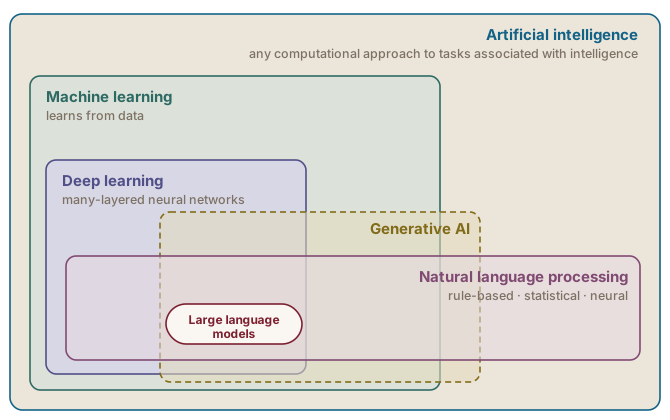
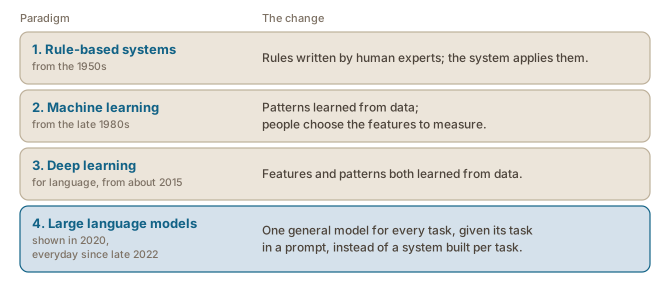
This definition is deliberately broad, and broader than the science-fiction picture of machines that think like humans. It includes any computational approach to tasks associated with intelligence: recognizing patterns, making decisions, using language, solving problems. It says nothing about how the task is performed. A program following a few hundred hand-written rules and a system trained on half the internet both qualify, and the difference between those two ways of qualifying is the subject of the rest of this module.
The boundary of the field also moves. Chess programs were once the showpiece of AI research; today a chess engine on your phone beats any human and nobody calls it AI. Converting a scanned page to editable text was cutting-edge AI in the 1970s; it is now a routine feature of a phone camera. This pattern has a name, the “AI effect” (McCorduck, 2004): once a capability is understood and ordinary, it stops being seen as intelligence. Keep it in mind when you read that a tool “uses AI”. The phrase mostly signals that the capability is recent; it tells you almost nothing about what the tool actually does.
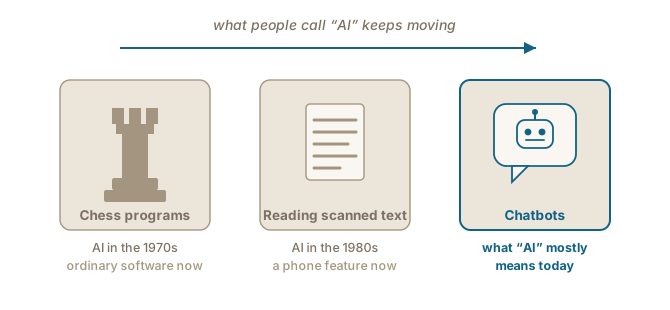
In everyday use today, “AI” refers primarily, though not exclusively, to large language models large language model (LLM)grand modèle de langue (GML) language modelsmodèles de langue A neural-network language model, usually based on the transformer architecture, that is trained on very large amounts of text and contains many learned parameters.Modèle de langue à réseau de neurones, habituellement fondé sur l'architecture des transformeurs, entraîné sur de très grandes quantités de texte et comptant de très nombreux paramètres appris. (LLMs) and to tools with one inside: a chatbot, a writing assistant, a translation feature marketed as intelligent. In this module, I try to consistently use “LLM” when I mean large language models specifically, and “AI” when I mean this type of technology more broadly.
Sources
- Grobelnik, M., Perset, K., & Russell, S. (2024). What is AI? Can you make a clear distinction between AI and non-AI systems?. OECD.AI Policy Observatory. https://oecd.ai/en/wonk/definition
- International Organization for Standardization & International Electrotechnical Commission (2022). Information technology — Artificial intelligence — Artificial intelligence concepts and terminology (ISO/IEC 22989:2022). ISO/IEC. https://www.iso.org/standard/74296.html
- McCorduck, P. (2004). Machines Who Think: A Personal Inquiry into the History and Prospects of Artificial Intelligence. 2nd ed., A K Peters. https://www.routledge.com/Machines-Who-Think-A-Personal-Inquiry-into-the-History-and-Prospects-of-Artificial-Intelligence/McCorduck/p/book/9781568812052
Vous utilisez déjà l’IA tous les jours, le plus souvent sans y penser. Le correcteur orthographique qui souligne une faute de frappe, le moteur de recherche qui complète votre question après trois lettres, la traduction automatique machine translation (MT)traduction automatique (TA) translationtraduction The use of a computer system to produce content in a target language that conveys content expressed in a source language.Utilisation d'un système informatique pour produire, dans une langue cible, un contenu qui rend un contenu exprimé dans une langue source. derrière une page web en langue étrangère et l’agent conversationnel à qui vous demandez de reformuler un courriel reposent tous sur des techniques du même domaine.
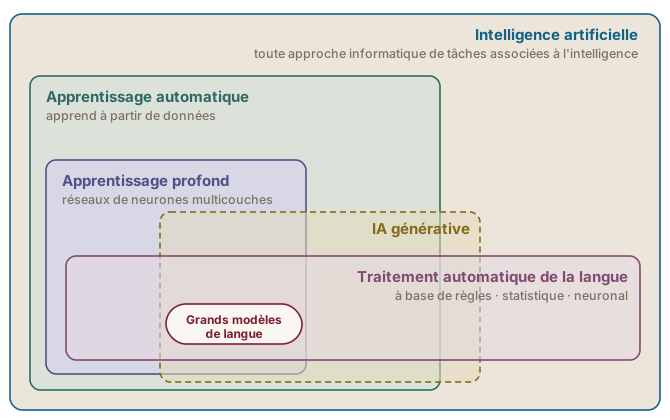
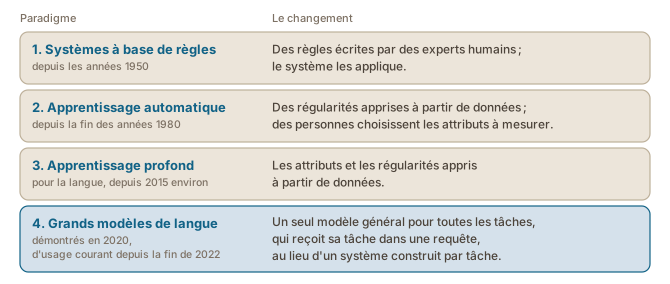
Cette définition est volontairement large, plus large que l’image de science-fiction de machines qui pensent comme des humains. Elle englobe toute approche informatique de tâches associées à l’intelligence : reconnaître des motifs, prendre des décisions, employer la langue, résoudre des problèmes. Elle ne dit rien de la manière dont la tâche est accomplie. Un programme qui suit quelques centaines de règles écrites à la main et un système entraîné sur la moitié d’Internet répondent tous deux à la définition, et la différence entre ces deux façons d’y répondre fait l’objet du reste de ce module.
La frontière du domaine se déplace, elle aussi. Les programmes d’échecs ont été la vitrine de la recherche en IA ; aujourd’hui, un logiciel d’échecs sur votre téléphone bat n’importe quel humain et personne ne parle plus d’IA. Convertir une page numérisée en texte modifiable était de l’IA de pointe dans les années 1970 ; c’est devenu une fonction ordinaire d’un appareil photo de téléphone. Ce phénomène porte un nom, l’« effet IA » (McCorduck, 2004) : dès qu’une capacité est comprise et devenue courante, on cesse d’y voir de l’intelligence. Gardez-le en tête quand vous lisez qu’un outil « utilise l’IA ». L’expression signale surtout que la capacité est récente ; elle ne vous dit à peu près rien de ce que l’outil fait.
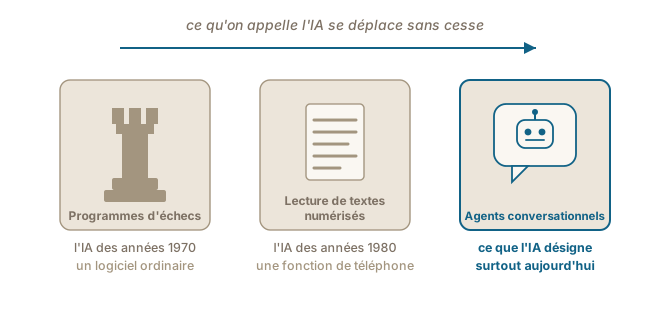
Dans l’usage courant d’aujourd’hui, « IA » renvoie d’abord, sans s’y limiter, aux grands modèles de langue large language model (LLM)grand modèle de langue (GML) language modelsmodèles de langue A neural-network language model, usually based on the transformer architecture, that is trained on very large amounts of text and contains many learned parameters.Modèle de langue à réseau de neurones, habituellement fondé sur l'architecture des transformeurs, entraîné sur de très grandes quantités de texte et comptant de très nombreux paramètres appris. (GML) et aux outils qui en contiennent un : un agent conversationnel, un assistant de rédaction, une fonction de traduction présentée comme intelligente. Dans ce module, j’essaie d’employer systématiquement « GML » quand je parle des grands modèles de langue en particulier, et « IA » quand je parle de ce type de technologie plus largement.
Sources
- Grobelnik, M., Perset, K., & Russell, S. (2024). What is AI? Can you make a clear distinction between AI and non-AI systems?. OECD.AI Policy Observatory. https://oecd.ai/en/wonk/definition
- International Organization for Standardization & International Electrotechnical Commission (2022). Information technology — Artificial intelligence — Artificial intelligence concepts and terminology (ISO/IEC 22989:2022). ISO/IEC. https://www.iso.org/standard/74296.html
- McCorduck, P. (2004). Machines Who Think: A Personal Inquiry into the History and Prospects of Artificial Intelligence. 2nd ed., A K Peters. https://www.routledge.com/Machines-Who-Think-A-Personal-Inquiry-into-the-History-and-Prospects-of-Artificial-Intelligence/McCorduck/p/book/9781568812052