TRA6008 · Bloc 1 · Introduction et GML (séances 1 à 3)TRA6008 · Bloc 1 · Introduction et GML (séances 1 à 3)
Séance 2 · jeudi 10 September 2026Séance 2 · jeudi 10 septembre 2026
PrintedImprimé le·aylart.github.io/learn·
CC BY-NC 4.0
Word embeddingsPlongements lexicaux
Written in English. The French version was automatically generated
and I have not revised it.
Rédigé en anglais. La version française a été
générée automatiquement et je ne l'ai pas révisée.
All words equally differentTous les mots à égale distance
Numbers that say how words relate. So far cat is exactly as far from
dog as it is from democracy.
A representation that stays manageable and still says something.
Giving every word its own slot takes tens of thousands of numbers to say one
thing, and all but one of them are zero.
A representation that can change with the sentence.Bank does not mean
the same thing in every sentence it appears in, and one fixed set of numbers
per word cannot follow that.
Jurafsky, D., & Martin, J. H. (2026). Speech and Language Processing: An Introduction to Natural Language Processing, Computational Linguistics, and Speech Recognition with Language Models. Online draft, 3rd edition. https://web.stanford.edu/~jurafsky/slp3/
Ce que les deux chapitres précédents ont établi
L’idée
Ce qu’elle apporte
Ce qu’elle coûte
Un nombre par mot, par ordre alphabétique
Un identifiant
Un ordre et une arithmétique qui ne veulent rien dire
Des coordonnées dans un espace, donc des distances
Rien encore : l’espace reste à construire
Un vecteur 1 parmi n
Une identité sans faux ordre
Toutes les paires à égale distance ; 99 999 zéros par mot
Ce qui manque encore
Des nombres qui disent comment les mots se rapportent. Jusqu’ici, chat
est exactement aussi loin de chien que de démocratie.
Une représentation qui reste maniable et qui dit quelque chose. Donner à
chaque mot sa propre case demande des dizaines de milliers de nombres pour
dire une seule chose, et tous sauf un valent zéro.
Une représentation qui peut changer avec la phrase.Livres ne veut pas
dire la même chose dans toutes les phrases où le mot apparaît, et un seul jeu
de nombres fixe par mot ne peut pas suivre.
Jurafsky, D., & Martin, J. H. (2026). Speech and Language Processing: An Introduction to Natural Language Processing, Computational Linguistics, and Speech Recognition with Language Models. Online draft, 3rd edition. https://web.stanford.edu/~jurafsky/slp3/
Dimensions with meaningDes dimensions qui veulent dire quelque chose
Words as coordinates
Suppose you want to place words in a two-dimensional space. You give the
horizontal axis one meaning and the vertical axis another, then put each word
where it belongs relative to those two meanings. Every word ends up with
coordinates, which is to say a vectorvectorvecteurmachine learningapprentissage automatiqueAn ordered list of numbers.Liste ordonnée de nombres.: here a list of
two numbers, one per axis. Those numbers do more than locate the word. They say
how it stands on each of the two meanings, and how far it is from every other
word in the same space.
Speed and capacity
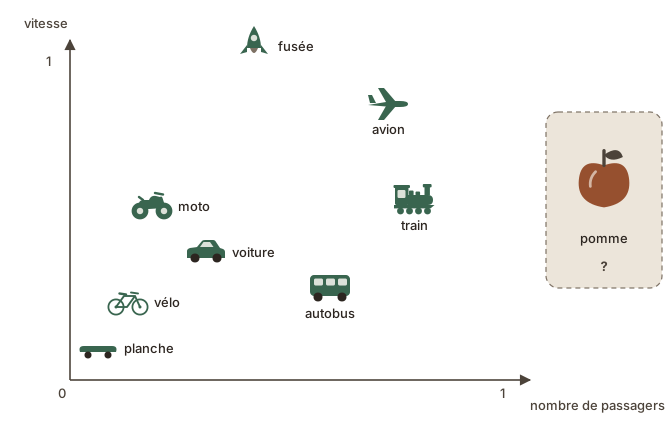
Figure 1. Two hand-picked dimensions, passenger capacity and speed. Every vehicle gets a vector, and groups form that nobody drew.
The idea is worked out for means of transport in
Figure 1figure 1.
The horizontal axis is passenger capacity and the vertical axis is speed, and
most people would agree on roughly where each vehicle goes. A skateboard scores
low on both: it does not travel fast and it carries one person. A rocket has
maximal speed and more moderate capacity, giving it the vector [0.4, 1.0]. Where
a one-hot vector only identified a word, that pair of numbers says something
about the thing named, and it fixes how far the rocket stands from every other
vehicle in the space.
Placing words this way also makes groups form on their own. Personal transport
gathers on the left, public transport on the right, and the rocket sits apart,
which is where it belongs. Nobody drew those groups; they follow from the
coordinates.
Where the apple goes
So far this looks like a promising way to turn words into lists of numbers that
mean something. Then: where would you put an apple in this space? The
question makes no sense, because speed and capacity say nothing about an apple.
Figure 2. The same two axes, and an apple that neither of them measures.
Two things follow. A space that fits a whole vocabulary needs many more than
two dimensions, since it has to suit everything from skateboard to ardour.
And once there are hundreds of dimensions and tens of thousands of words,
neither the axes nor the positions can be chosen by a person.
Which leaves the question: how can numbers like these be found automatically,
for every word in a vocabulary?
Sources
Jurafsky, D., & Martin, J. H. (2026). Speech and Language Processing: An Introduction to Natural Language Processing, Computational Linguistics, and Speech Recognition with Language Models. Online draft, 3rd edition. https://web.stanford.edu/~jurafsky/slp3/
Les mots comme coordonnées
Supposons que vous vouliez placer des mots dans un espace à deux dimensions.
Vous donnez un sens à l’axe horizontal et un autre à l’axe vertical, puis vous
posez chaque mot là où il se situe par rapport à ces deux sens. Chaque mot se
retrouve avec des coordonnées, c’est-à-dire un vecteurvectorvecteurmachine learningapprentissage automatiqueAn ordered list of numbers.Liste ordonnée de nombres. :
ici une liste de deux nombres, un par axe. Ces nombres font plus que localiser
le mot. Ils disent comment il se situe sur chacun des deux sens, et à quelle
distance il se trouve de tous les autres mots du même espace.
La vitesse et le nombre de passagers
Figure 1. Deux dimensions choisies à la main, le nombre de passagers et la vitesse. Chaque véhicule reçoit un vecteur, et des groupes se forment que personne n'a dessinés.
L’idée est développée pour des moyens de transport dans la
Figure 1figure 1.
L’axe horizontal est le nombre de passagers et l’axe vertical la vitesse, et la
plupart des gens s’entendraient sur la place approximative de chaque véhicule.
La planche est basse sur les deux : elle ne va pas vite et elle transporte une
personne. La fusée a une vitesse maximale et une capacité plus modeste, ce qui
lui donne le vecteur [0,4 ; 1,0]. Là où un vecteur 1 parmi n ne faisait
qu’identifier un mot, cette paire de nombres dit quelque chose de la chose
nommée, et elle fixe la distance entre la fusée et tous les autres véhicules de
l’espace.
Placer les mots de cette façon fait aussi apparaître des groupes d’eux-mêmes.
Le transport individuel se rassemble à gauche, le transport collectif à droite,
et la fusée reste à part, là où elle a sa place. Personne n’a dessiné ces
groupes ; ils découlent des coordonnées.
Où placer la pomme
Jusqu’ici, voilà une manière prometteuse de transformer des mots en listes de
nombres qui veulent dire quelque chose. Puis : où placeriez-vous une pomme dans
cet espace ? La question n’a aucun sens, parce que la vitesse et le nombre de
passagers ne disent rien d’une pomme.
Figure 2. Les deux mêmes axes, et une pomme que ni l'un ni l'autre ne mesure.
Deux conséquences. Un espace qui accueille un vocabulaire entier a besoin de
bien plus de deux dimensions, puisqu’il doit convenir à tout, de planche à
ardeur. Et dès qu’il y a des centaines de dimensions et des dizaines de
milliers de mots, ni les axes ni les positions ne peuvent être choisis par une
personne.
Reste la question : comment trouver automatiquement de tels nombres, pour
chaque mot d’un vocabulaire ?
Sources
Jurafsky, D., & Martin, J. H. (2026). Speech and Language Processing: An Introduction to Natural Language Processing, Computational Linguistics, and Speech Recognition with Language Models. Online draft, 3rd edition. https://web.stanford.edu/~jurafsky/slp3/
The company a word keepsLa compagnie que tient un mot
Five blanks
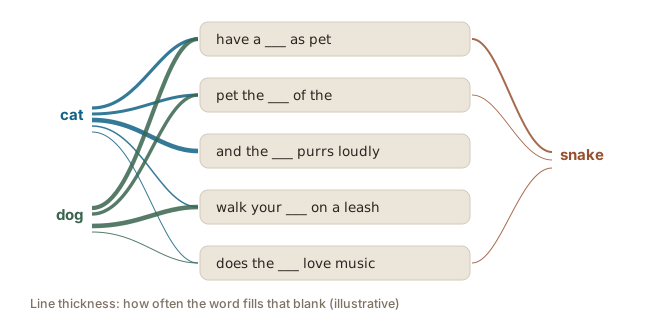
Suppose you are given five fragments of text, each with one word missing:
have a ___ as pet
pet the ___ of the
and the ___ purrs loudly
walk your ___ on a leash
does the ___ love music
Which words could fill the blank? Cat goes into the first three without any
trouble; the leash makes you hesitate. Dog goes into the pet, the petting and
the leash, and fails at the purring. The last fragment takes any of them, which
is why it tells you so little. So the two words share most of their contexts,
and the ones they do not share are exactly the ones you would expect: a cat
purrs, a dog is walked.
Now try snake. It fits have a ___ as pet, and after that it gets harder: a
snake does not purr, and a snake on a leash is a very big stretch. Snake
shares one or two contexts with cat and dog and not the rest. A word like
democracy fits none of the five.
Not only whether a word can fill a blank counts, but how often it does.
Cat turns up before purrs far more often than after walk your, and a
system that counts contexts in a large collection of text sees that difference
directly.
Figure 3. Similar words fill similar blanks, and how often they do is the part that counts. Cat and dog share most of their contexts; snake shares far fewer.
What the blanks show
Words with related meanings turn up in similar contexts, and the more two
words’ contexts overlap, the closer their meanings tend to be. Linguists
formulated this in the 1950s, Joos, Harris and Firth among them (Jurafsky &
Martin, 2026), and Firth put it in one sentence: “You shall know a word by the
company it keeps” (Firth, 1957).
Why this suits a machine
The idea is useful for a machine because of what it does not require:
No definitions. Nobody has to say what cat means.
No labels. Nobody has to mark examples by hand.
No hand-picked axes. Nobody chooses the dimensions of the space, or where
each word goes on them.
It does require text, in quantity. Contexts are observable: any large
collection of text shows directly which words surround which. So a system can
build a workable stand-in for meaning just by reading enough text.
Jurafsky, D., & Martin, J. H. (2026). Speech and Language Processing: An Introduction to Natural Language Processing, Computational Linguistics, and Speech Recognition with Language Models. Online draft, 3rd edition. https://web.stanford.edu/~jurafsky/slp3/
Cinq trous
Supposons qu’on vous donne cinq fragments de texte, chacun avec un mot
manquant :
adopter un ___
caresser le ___ du
et le ___ ronronne fort
promener son ___ en laisse
le ___ aime-t-il la musique
Quels mots pourraient remplir le trou ? Chat entre sans peine dans les trois
premiers ; la laisse fait hésiter. Chien entre dans l’adoption, la caresse et
la laisse, et échoue sur le ronronnement. Le dernier fragment accepte n’importe
lequel des trois, et c’est pourquoi il vous apprend si peu. Les deux mots
partagent donc la plupart de leurs contextes, et ceux qu’ils ne partagent pas
sont exactement ceux qu’on attendrait : un chat ronronne, on promène un chien.
Essayez maintenant serpent. Il va avec adopter un ___, et ensuite, cela se
complique : un serpent ne ronronne pas, et un serpent en laisse, c’est
vraiment tiré par les cheveux. Serpent partage un ou deux contextes avec
chat et chien, et pas le reste. Un mot comme démocratie ne remplit
aucun des cinq.
Il ne suffit pas qu’un mot puisse remplir un trou : la fréquence à laquelle
il le fait compte aussi. Chat précède ronronne bien plus souvent
qu’il ne suit promener son, et un système qui compte les contextes dans un
grand ensemble de textes voit cette différence directement.
Figure 3. Des mots semblables remplissent des trous semblables, et la fréquence est la part qui compte. Chat et chien partagent la plupart de leurs contextes ; serpent en partage bien moins.
Ce que montrent les trous
Les mots dont le sens est apparenté apparaissent dans des contextes semblables,
et plus les contextes de deux mots se recoupent, plus leurs sens ont tendance à
être proches. Des linguistes l’ont formulé dans les années 1950, Joos, Harris
et Firth parmi eux (Jurafsky et Martin, 2026), et Firth l’a résumé en une
phrase : « You shall know a word by the company it keeps » (Firth, 1957).
Pourquoi cela convient à une machine
L’idée est utile à une machine par ce qu’elle n’exige pas :
Aucune définition. Personne n’a à dire ce que chat veut dire.
Aucune annotation. Personne n’a à marquer des exemples à la main.
Aucun axe choisi à la main. Personne ne choisit les dimensions de
l’espace, ni la place de chaque mot sur celles-ci.
Il faut en revanche du texte, en quantité. Les contextes sont observables :
n’importe quel grand ensemble de textes montre directement quels mots
entourent quels autres. Un système peut donc se construire un substitut
utilisable du sens simplement en lisant assez de texte.
Jurafsky, D., & Martin, J. H. (2026). Speech and Language Processing: An Introduction to Natural Language Processing, Computational Linguistics, and Speech Recognition with Language Models. Online draft, 3rd edition. https://web.stanford.edu/~jurafsky/slp3/
Embeddings learned from textDes plongements appris à partir de textes
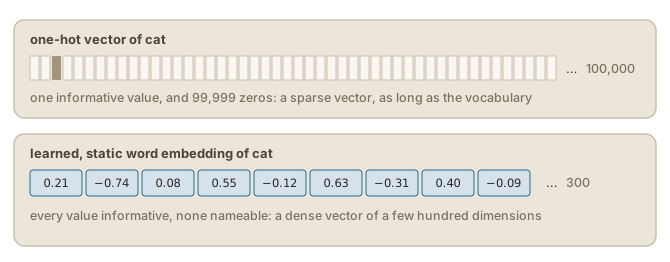
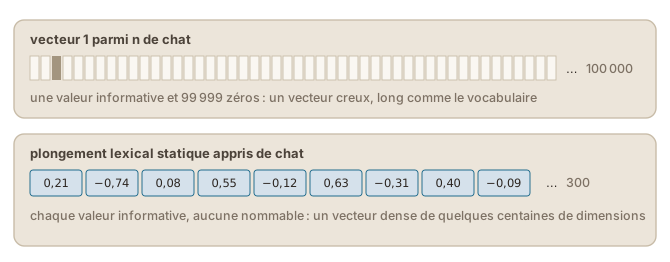
Every property of these vectors contrasts with the one-hot representation:
Short instead of vocabulary-sized. Typically 100 to 300 dimensions rather
than one per word.
Dense instead of sparse. Every position has a meaningful value rather
than a zero.
Distance means something.Cat and dog end up close, snake farther,
democracy elsewhere entirely, because their contexts imposed it
during training.
Figure 4. The same word in the two representations. The learned vector is short and dense, and no single one of its values can be read on its own.
No readable axes
The example with our means of transport showed axes that were interpretable:
speed and capacity. The learned dimensions are not. They do not correspond to
any nameable property, and looking at one value tells you nothing. In this
representation a word’s meaning is the whole pattern of all its values
together, and only comparisons between whole vectors are meaningful.
Sources
Jurafsky, D., & Martin, J. H. (2026). Speech and Language Processing: An Introduction to Natural Language Processing, Computational Linguistics, and Speech Recognition with Language Models. Online draft, 3rd edition. https://web.stanford.edu/~jurafsky/slp3/
Mikolov, T., Chen, K., Corrado, G., & Dean, J. (2013a). Efficient Estimation of Word Representations in Vector Space. arXiv preprint arXiv:1301.3781 (ICLR 2013 Workshop Track). https://arxiv.org/abs/1301.3781
Pennington, J., Socher, R., & Manning, C. (2014). GloVe: Global Vectors for Word Representation. Proceedings of the 2014 Conference on Empirical Methods in Natural Language Processing (EMNLP). https://doi.org/10.3115/v1/D14-1162
Court, dense, et des distances qui veulent dire quelque chose
Chaque propriété de ces vecteurs contraste avec la représentation 1 parmi n :
Court plutôt que long comme le vocabulaire. Typiquement de 100 à 300
dimensions, plutôt qu’une par mot.
Dense plutôt que creux. Chaque position porte une valeur informative
plutôt qu’un zéro.
La distance veut dire quelque chose.Chat et chien se retrouvent
proches, serpent plus loin, démocratie tout à fait ailleurs, parce que
leurs contextes l’ont imposé pendant l’entraînement.
Figure 4. Le même mot dans les deux représentations. Le vecteur appris est court et dense, et aucune de ses valeurs ne se lit isolément.
Des axes illisibles
L’exemple des moyens de transport montrait des axes interprétables : la vitesse
et le nombre de passagers. Les dimensions apprises ne le sont pas. Elles ne
correspondent à aucune propriété nommable, et regarder une seule valeur ne dit
rien. Dans cette représentation, le sens d’un mot est le motif complet de
toutes ses valeurs prises ensemble, et seules les comparaisons entre vecteurs
entiers ont un sens.
Sources
Jurafsky, D., & Martin, J. H. (2026). Speech and Language Processing: An Introduction to Natural Language Processing, Computational Linguistics, and Speech Recognition with Language Models. Online draft, 3rd edition. https://web.stanford.edu/~jurafsky/slp3/
Mikolov, T., Chen, K., Corrado, G., & Dean, J. (2013a). Efficient Estimation of Word Representations in Vector Space. arXiv preprint arXiv:1301.3781 (ICLR 2013 Workshop Track). https://arxiv.org/abs/1301.3781
Pennington, J., Socher, R., & Manning, C. (2014). GloVe: Global Vectors for Word Representation. Proceedings of the 2014 Conference on Empirical Methods in Natural Language Processing (EMNLP). https://doi.org/10.3115/v1/D14-1162
Arithmetic with meaningsDe l'arithmétique avec des sens
Take the vector for king, subtract the vector for man, and add the vector
for woman. The point you land on is nearest the word queen (Mikolov et al.,
2013b). Nothing in the training aimed at this. It falls out of the geometry:
the displacement from man to king encodes something like royalty, and
applying that same displacement to woman arrives near queen.
Click the drawing, or a line below, to build it up stage by stage.Cliquez sur le dessin, ou sur une ligne ci-dessous, pour le construire étape par étape.
Figure 5. Subtracting man from king leaves the crown, and adding woman to the crown arrives at queen.
One direction among many
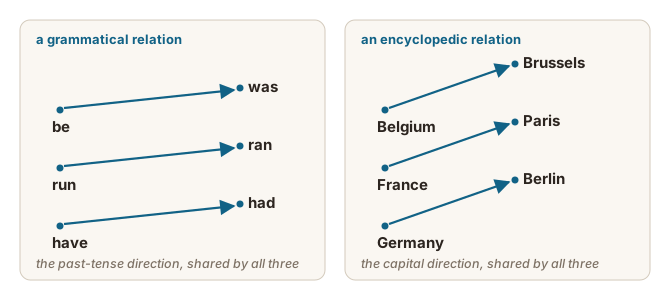
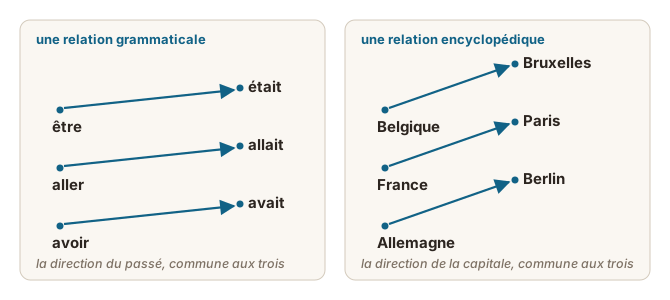
The royalty direction is one of many. Mikolov et al. (2013b) tested the pattern
systematically on grammatical relations, a thousand questions each for
comparatives (good is to better as rough is to rougher), plurals (year
is to years) and verb tense (see is to saw as return is to returned),
and found it there too. Encyclopedic relations behave the
same way, a country and its capital among them (Jurafsky & Martin, 2026). The
axes are still unreadable. The meaning is in the directions between whole
vectors, and those can be looked for after the fact.
Figure 6. A grammatical relation and an encyclopedic one, each a direction that every pair shares.
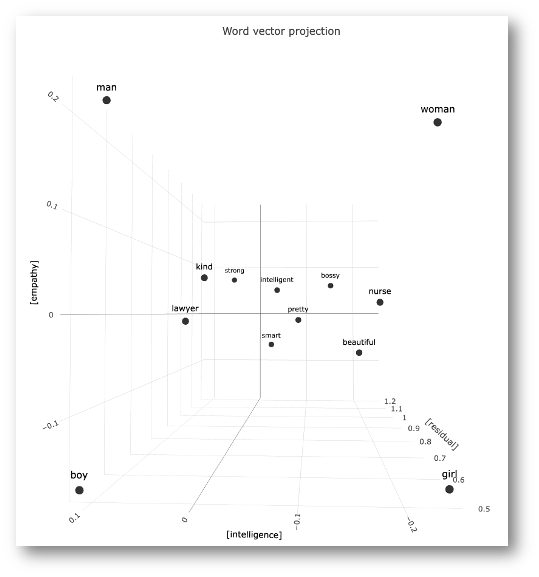
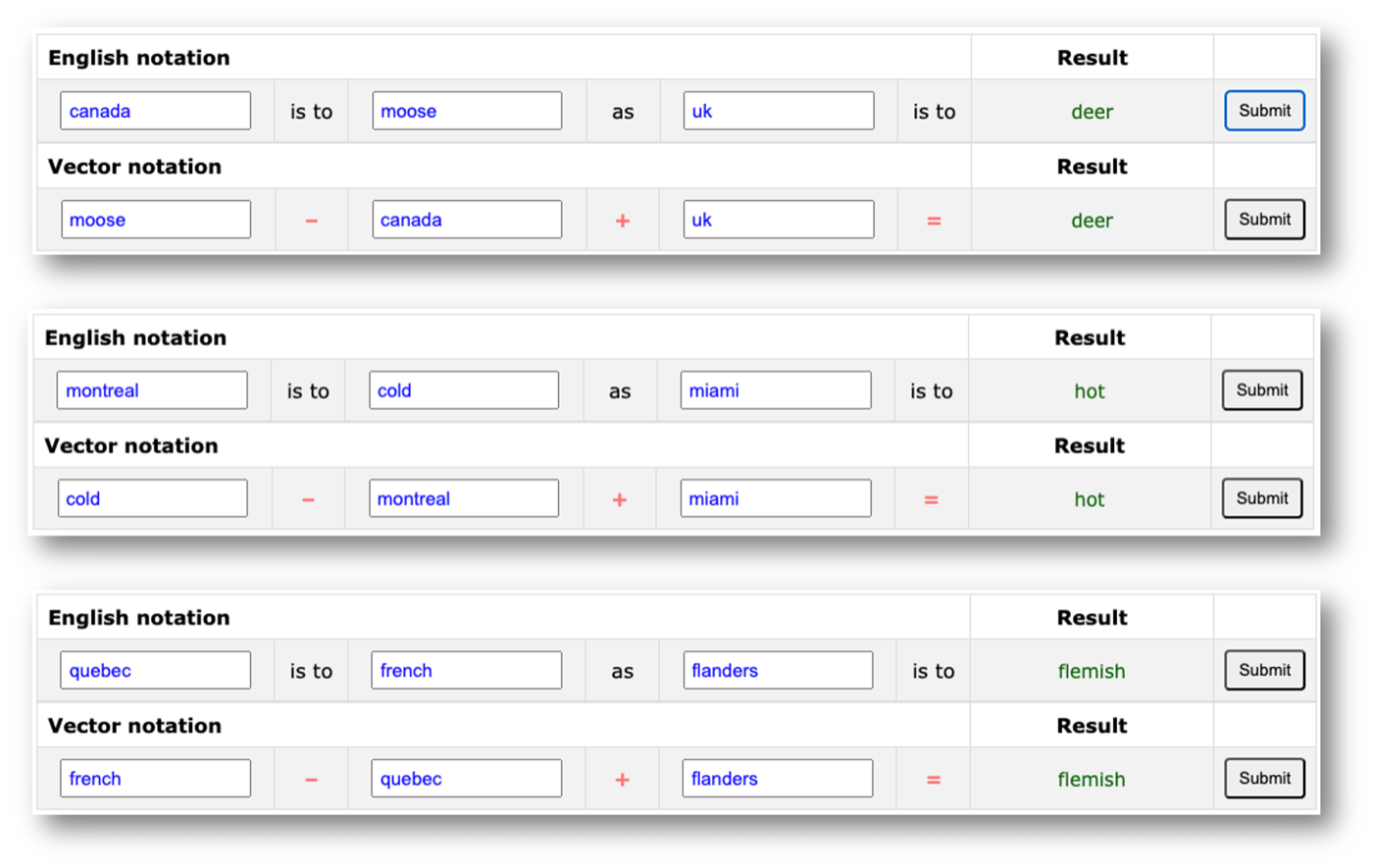
Carnegie Mellon’s browser demo does exactly that. The three screenshots below
were taken from it on 9 September 2026, and the demo can change. They are dense, and
a click opens each one larger.
Figure 7. The space projected onto two directions named by words: intelligence and empathy. The axes were chosen after training, not built into it. Figure 8. Three analogies on the demo's word2vec vectors. Canada is to moose as UK is to deer, Montreal is to cold as Miami is to hot, Quebec is to French as Flanders is to Flemish. Each analogy is typed in words above and as vector arithmetic below, and the two forms return the same word.
The same arithmetic on stereotypes
The arithmetic works on stereotypes too. In embeddings trained on Google News
articles, man is to computer programmer as woman is to homemaker, and
occupation words divide along a gender direction the same way king and
queen divide along a royalty one (Bolukbasi et al., 2016).
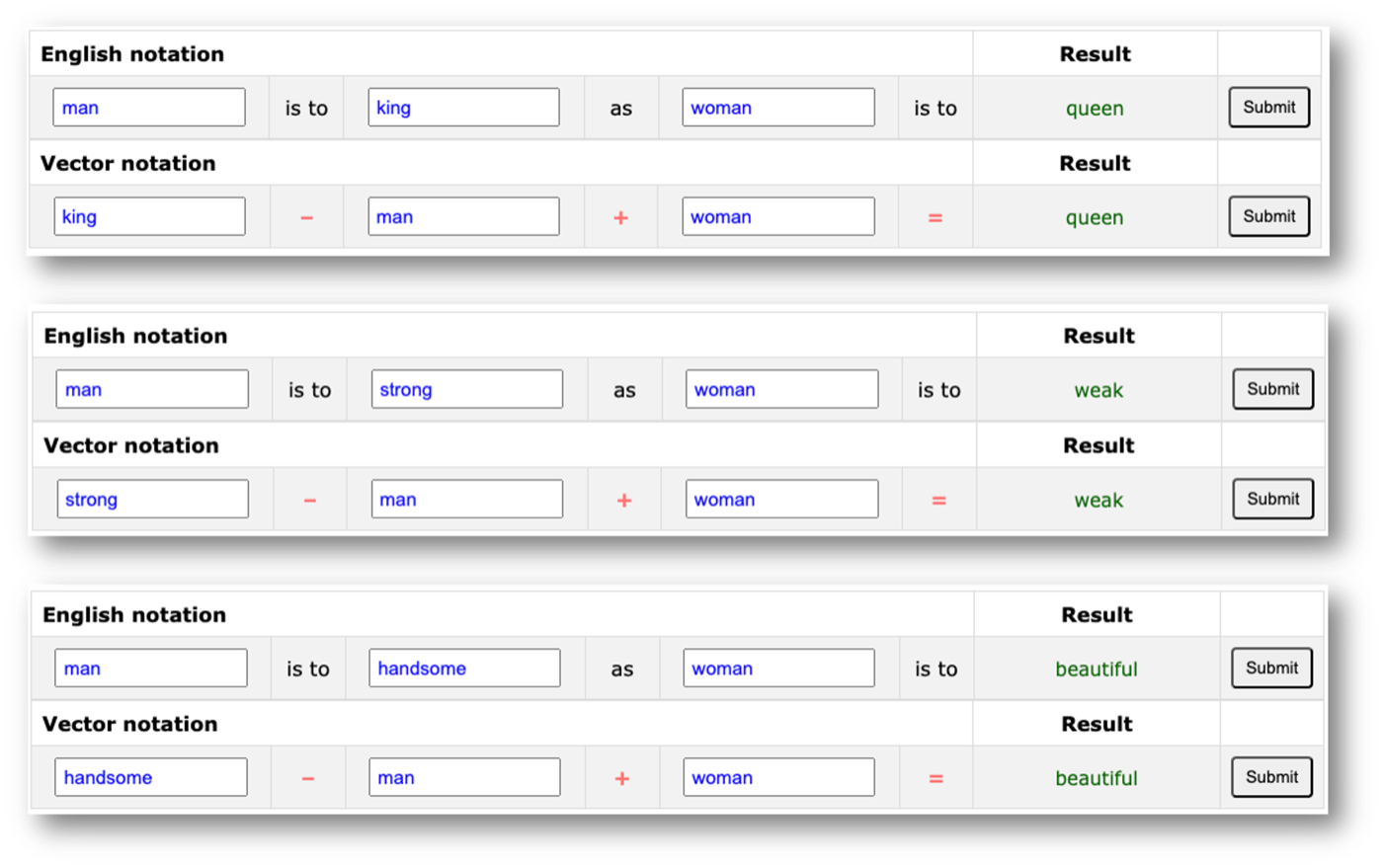
Figure 9. The same demo, on the same word2vec vectors. Man is to king as woman is to queen, the textbook analogy. Then man is to strong as woman is to weak, and man is to handsome as woman is to beautiful.
No programmer decided to put woman further from doctor and closer to
nurse. The bias comes from the text: the vectors record how the words are
used across millions of sentences, and people wrote those sentences. The method
is working as designed. The consequences reach everything built on embeddings
since (see also the Critical issues with LLMs module) (voir aussi le module Enjeux critiques des GML).
Jurafsky, D., & Martin, J. H. (2026). Speech and Language Processing: An Introduction to Natural Language Processing, Computational Linguistics, and Speech Recognition with Language Models. Online draft, 3rd edition. https://web.stanford.edu/~jurafsky/slp3/
Mikolov, T., Yih, W., & Zweig, G. (2013b). Linguistic Regularities in Continuous Space Word Representations. Proceedings of the 2013 Conference of the North American Chapter of the Association for Computational Linguistics: Human Language Technologies. https://aclanthology.org/N13-1090/
Prenez le vecteur de roi, soustrayez le vecteur de homme, puis ajoutez le
vecteur de femme. Le point où vous arrivez a pour plus proche voisin le mot
reine (Mikolov et al., 2013b). Rien dans l’entraînement ne visait ce
résultat. Il découle de la géométrie : le déplacement de homme vers roi
encode quelque chose comme la royauté, et appliquer ce même déplacement à
femme arrive près de reine.
Click the drawing, or a line below, to build it up stage by stage.Cliquez sur le dessin, ou sur une ligne ci-dessous, pour le construire étape par étape.
Figure 5. Soustraire homme de roi laisse la couronne, et ajouter femme à la couronne arrive à reine.
Une direction parmi bien d’autres
La direction de la royauté est l’une parmi bien d’autres. Mikolov et al.
(2013b) ont éprouvé le motif de façon systématique sur des relations
grammaticales, mille questions chacune pour les comparatifs (good est à
better ce que rough est à rougher), les pluriels (year est à years)
et le temps des verbes (see est à saw ce que return est à returned), et
il tenait. Les relations encyclopédiques se comportent
de la même manière, dont celle d’un pays et de sa capitale (Jurafsky et Martin,
2026). Les axes restent illisibles. Le sens est dans les directions entre
vecteurs entiers, et celles-ci peuvent se chercher après coup.
Figure 6. Une relation grammaticale et une relation encyclopédique, chacune une direction que toutes les paires partagent.
La démonstration en ligne de Carnegie Mellon fait exactement cela. Les trois
captures ci-dessous en viennent, prises le 9 septembre 2026, et la démonstration peut
changer. Elles sont denses ; un clic ouvre chacune en plus grand.
Figure 7. L'espace projeté sur deux directions nommées par des mots : l'intelligence et l'empathie. Les axes ont été choisis après l'entraînement, ils n'y étaient pas intégrés. Figure 8. Trois analogies sur les vecteurs word2vec de la démonstration. Canada est à moose ce que UK est à deer, Montreal est à cold ce que Miami est à hot, Quebec est à French ce que Flanders est à Flemish. Chaque analogie est saisie en mots au-dessus et en arithmétique vectorielle au-dessous, et les deux formes renvoient le même mot.
La même arithmétique sur les stéréotypes
L’arithmétique fonctionne aussi sur les stéréotypes. Dans des plongements
entraînés sur des articles de Google News, man est à computer programmer ce
que woman est à homemaker, et les noms de métiers se répartissent selon une
direction de genre exactement comme roi et reine se répartissent selon une
direction de royauté (Bolukbasi et al., 2016).
Figure 9. La même démonstration, sur les mêmes vecteurs word2vec. Man est à king ce que woman est à queen, l'analogie des manuels. Puis man est à strong ce que woman est à weak, et man est à handsome ce que woman est à beautiful.
Aucun programmeur n’a décidé d’éloigner woman de doctor et de la rapprocher
de nurse. Le biais vient des textes : les vecteurs enregistrent la manière
dont les mots sont employés à travers des millions de phrases, et ce sont des
personnes qui ont écrit ces phrases. La méthode fonctionne comme prévu. Les
conséquences touchent tout ce qui a été construit sur des plongements
depuis (see also the Critical issues with LLMs module) (voir aussi le module Enjeux critiques des GML).
Jurafsky, D., & Martin, J. H. (2026). Speech and Language Processing: An Introduction to Natural Language Processing, Computational Linguistics, and Speech Recognition with Language Models. Online draft, 3rd edition. https://web.stanford.edu/~jurafsky/slp3/
Mikolov, T., Yih, W., & Zweig, G. (2013b). Linguistic Regularities in Continuous Space Word Representations. Proceedings of the 2013 Conference of the North American Chapter of the Association for Computational Linguistics: Human Language Technologies. https://aclanthology.org/N13-1090/
The limits of static vectorsLes limites des vecteurs statiques
Three limitations
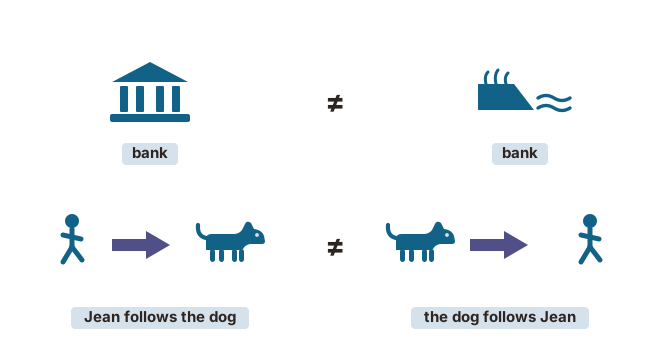
Figure 10. One form carrying two senses, and one set of words in two orders. A fixed vector per word can tell neither pair apart.
New words get nothing
An embedding model has one vector for each word that occurred in its training text, so a word
coined last year, a rare technical term or a typo has no vector and no
representation at all. Morphologically rich languages make this worse, since
their productive compounds and inflections produce forms no training corpus
contains. Modern systems dissolve the problem by working with pieces of words
instead (see also the Tokenization chapter, in the Language as numbers module) (voir aussi le chapitre Jetonisation, dans le module Le langage en nombres).
One vector averages every sense
Bank is a financial institution in I deposited money at the bank and a
strip of riverside in we picnicked on the river bank. A single vector for
bank has to serve both sentences, so it lands somewhere between finance and
geography, a compromise that is wrong everywhere. It is not even a fair
compromise: the vector is an average over occurrences, so it sits nearest
whichever sense is commonest in the training text, and the rarer sense is
served worst. Translation feels this early, since choosing between rive and
banque is exactly a decision about which sense is active.
Order is invisible
The dog follows Jean and Jean follows the dog contain the same words and do
not describe the same walk, so any representation built by combining fixed
word vectors struggles to tell them apart. Meaning depends on arrangement, and
per-word vectors have nowhere to put arrangement.
Sources
Jurafsky, D., & Martin, J. H. (2026). Speech and Language Processing: An Introduction to Natural Language Processing, Computational Linguistics, and Speech Recognition with Language Models. Online draft, 3rd edition. https://web.stanford.edu/~jurafsky/slp3/
Trois limites
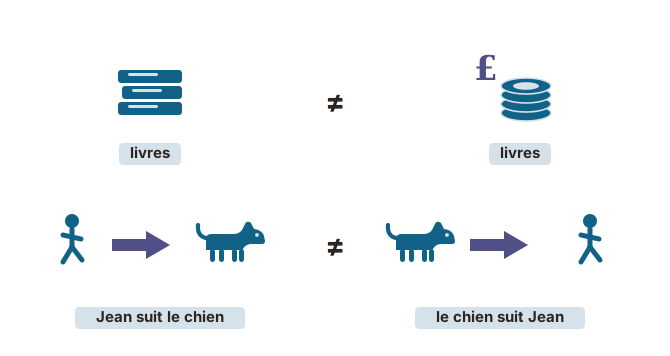
Figure 10. Une forme pour deux sens, et un même ensemble de mots dans deux ordres. Un vecteur fixe par mot ne distingue ni l'une ni l'autre paire.
Les mots nouveaux n’obtiennent rien
Un modèle de plongements a un vecteur pour chaque mot rencontré à
l’entraînement : un mot forgé l’an dernier, un terme technique rare ou une
coquille n’a donc aucun vecteur et aucune représentation. Les langues à
morphologie riche aggravent la situation, puisque leurs composés et leurs
flexions productives produisent des formes qu’aucune base d’apprentissage ne
contient. Les systèmes modernes dissolvent le problème en travaillant sur des
morceaux de mots (see also the Tokenization chapter, in the Language as numbers module) (voir aussi le chapitre Jetonisation, dans le module Le langage en nombres).
Un seul vecteur fait la moyenne de tous les sens
Livres désigne une monnaie dans j’ai changé mille livres et des ouvrages
dans j’ai emprunté trois livres. Un vecteur unique pour livres doit servir
aux deux phrases : il atterrit donc quelque part entre la finance et la
lecture, un compromis qui a tort partout. Ce n’est même pas un compromis
équitable : le vecteur est une moyenne sur les occurrences, il se place donc au
plus près du sens le plus fréquent dans les textes d’entraînement, et c’est le
sens le plus rare qui est le plus mal servi. La traduction s’en aperçoit tôt,
puisque choisir entre pounds et books est exactement une décision sur le
sens actif.
L’ordre est invisible
Jean suit le chien et le chien suit Jean contiennent les mêmes mots et ne
décrivent pas la même promenade ; toute représentation construite en combinant
des vecteurs de mots fixes a donc du mal à les distinguer. Le sens dépend de
l’agencement, et des vecteurs par mot n’ont nulle part où mettre l’agencement.
Sources
Jurafsky, D., & Martin, J. H. (2026). Speech and Language Processing: An Introduction to Natural Language Processing, Computational Linguistics, and Speech Recognition with Language Models. Online draft, 3rd edition. https://web.stanford.edu/~jurafsky/slp3/
Contextual embeddingsPlongements contextuels
Written in English. The French version was automatically generated
and I have not revised it.
Rédigé en anglais. La version française a été
générée automatiquement et je ne l'ai pas révisée.
One word, many vectorsUn mot, plusieurs vecteurs
Three sentences, one word
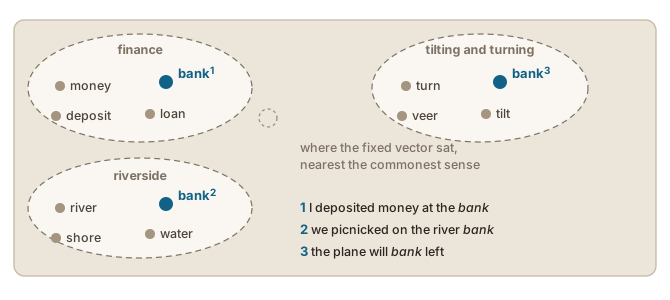
Take three sentences with bank in them:
I deposited money at the bank.
We picnicked on the river bank.
The plane will bank left.
You would translate the word three different ways: banque, rive, virer.
A fixed embedding gives all three the same vector.
Figure 1. One vector per occurrence: the three senses land in three places, and the point where the fixed vector sat is left empty.
A vector per occurrence
A contextual embedding sides with the translator. Instead of storing one
finished vector per word, the model computes a vector for each occurrence, at
the moment of use, from the whole sentence around it:
the bank beside deposited and money comes out near the vocabulary of
finance;
the one beside river and picnicked, near geography;
the one after will, in verb territory.
Same word, three vectors, each shaped by its company. Models that work this
way arrived in the late 2010s, and ELMo was the landmark (Peters et al., 2018).
Nobody lists the senses of bank or writes a rule to pick one. The senses
simply stop being merged, because there is no single vector left for them to
be merged into.
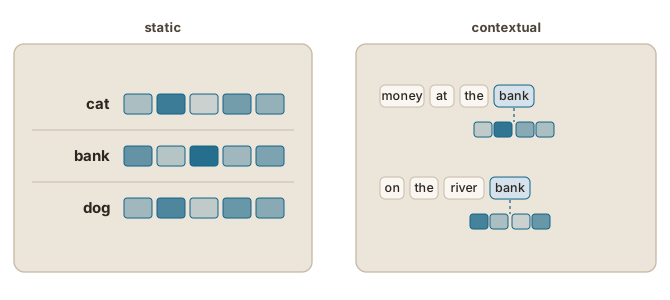
One consequence is easy to miss. A word no longer has “its vector”, the kind
you could print in a table. It has a vector in each sentence, so the question
“what does the model think bank means?” only has answers of the form “here,
in this sentence”. Word meaning in isolation, the thing a dictionary records,
has quietly left the system.
Figure 2. On the left, one row per word, a table you can look up. On the right, no table: each occurrence of bank is given a vector in its own sentence, and the two are not the same.
Sources
Jurafsky, D., & Martin, J. H. (2026). Speech and Language Processing: An Introduction to Natural Language Processing, Computational Linguistics, and Speech Recognition with Language Models. Online draft, 3rd edition. https://web.stanford.edu/~jurafsky/slp3/
Mikolov, T., Chen, K., Corrado, G., & Dean, J. (2013a). Efficient Estimation of Word Representations in Vector Space. arXiv preprint arXiv:1301.3781 (ICLR 2013 Workshop Track). https://arxiv.org/abs/1301.3781
Peters, M. E., Neumann, M., Iyyer, M., Gardner, M., Clark, C., Lee, K., et al. (2018). Deep Contextualized Word Representations. Proceedings of the 2018 Conference of the North American Chapter of the Association for Computational Linguistics: Human Language Technologies, Volume 1 (Long Papers). https://doi.org/10.18653/v1/N18-1202
Trois phrases, un seul mot
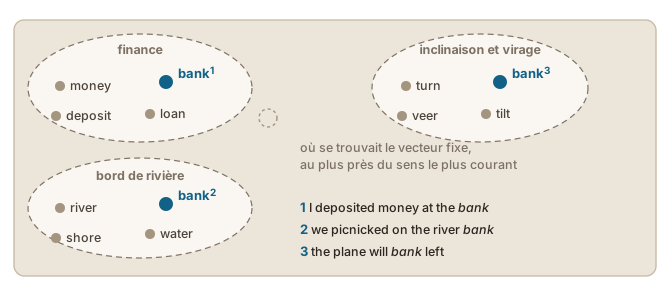
Prenons trois phrases contenant bank :
I deposited money at the bank.
We picnicked on the river bank.
The plane will bank left.
Vous traduiriez le mot de trois façons différentes : banque, rive, virer.
Un plongement fixe donne le même vecteur aux trois.
Figure 1. Un vecteur par occurrence : les trois sens atterrissent en trois endroits, et le point où se trouvait le vecteur fixe reste vide.
Un vecteur par occurrence
Un plongement contextuel donne raison à la traductrice ou au traducteur. Au
lieu de conserver un vecteur tout fait par mot, le modèle calcule un vecteur pour
chaque occurrence, au moment de l’usage, à partir de toute la phrase qui
l’entoure :
le bank voisin de deposited et de money ressort près du vocabulaire de
la finance ;
celui qui voisine avec river et picnicked, près de la géographie ;
celui qui suit will, du côté des verbes.
Même mot, trois vecteurs, chacun façonné par sa compagnie. Les modèles qui
fonctionnent ainsi arrivent à la fin des années 2010, et ELMo en est le jalon
(Peters et al., 2018).
Personne ne dresse la liste des sens de bank ni n’écrit de règle pour en
choisir un. Les sens cessent simplement d’être fusionnés, parce qu’il ne reste
aucun vecteur unique dans lequel les fusionner.
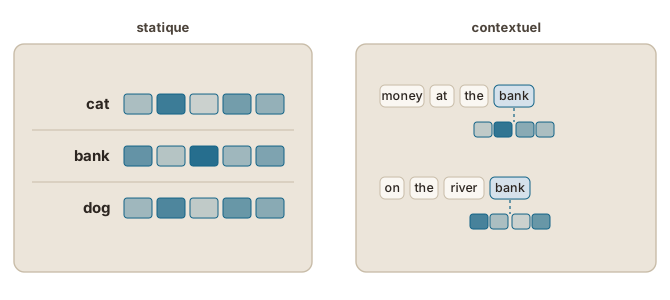
Une conséquence passe facilement inaperçue. Un mot n’a plus « son vecteur »,
celui qu’on pourrait imprimer dans un tableau. Il a un vecteur dans chaque
phrase, si bien que la question « que pense le modèle du sens de bank ? »
n’admet que des réponses de la forme « ici, dans cette phrase ». Le sens d’un
mot hors contexte, ce que consigne un dictionnaire, a discrètement quitté le
système.
Figure 2. À gauche, une rangée par mot, un tableau consultable. À droite, aucun tableau : chaque occurrence de bank reçoit un vecteur dans sa propre phrase, et les deux ne sont pas les mêmes.
Sources
Jurafsky, D., & Martin, J. H. (2026). Speech and Language Processing: An Introduction to Natural Language Processing, Computational Linguistics, and Speech Recognition with Language Models. Online draft, 3rd edition. https://web.stanford.edu/~jurafsky/slp3/
Mikolov, T., Chen, K., Corrado, G., & Dean, J. (2013a). Efficient Estimation of Word Representations in Vector Space. arXiv preprint arXiv:1301.3781 (ICLR 2013 Workshop Track). https://arxiv.org/abs/1301.3781
Peters, M. E., Neumann, M., Iyyer, M., Gardner, M., Clark, C., Lee, K., et al. (2018). Deep Contextualized Word Representations. Proceedings of the 2018 Conference of the North American Chapter of the Association for Computational Linguistics: Human Language Technologies, Volume 1 (Long Papers). https://doi.org/10.18653/v1/N18-1202
Reading in both directionsLire dans les deux sens
Before or after
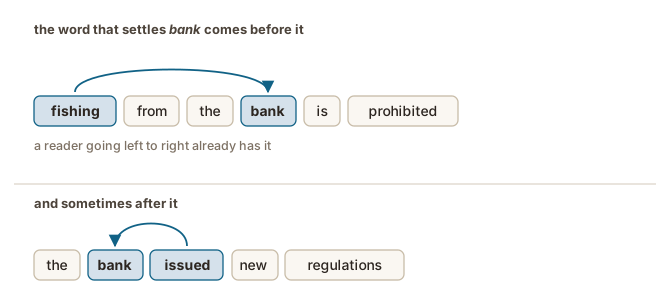
Where does the word that settles the ambiguity sit? Sometimes before the
ambiguous word: in fishing from the bank is prohibited, fishing has settled
the sense by the time bank arrives. Sometimes after it: in the bank issued
new regulations, the deciding word only comes once bank has been read.
Figure 3. The word that settles an ambiguity comes before it in one sentence and after it in the other. A model reading strictly left to right has only half of that context.
Reading both ways
ELMo already used both sides, but shallowly: one model read the sentence left
to right, a second read it right to left, and their outputs were joined at the
end, so the two directions were never combined during training (Devlin et al., 2019).
BERT is the model that put the two together.ELMo and BERT set a
fashion, and the acronyms that followed were bent to land on Sesame Street
characters: ERNIE, Grover, Big Bird.
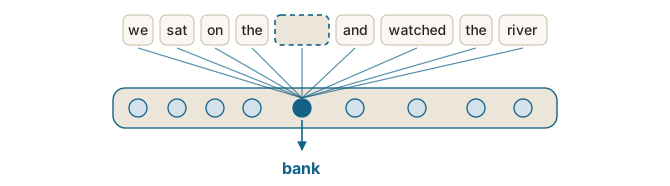
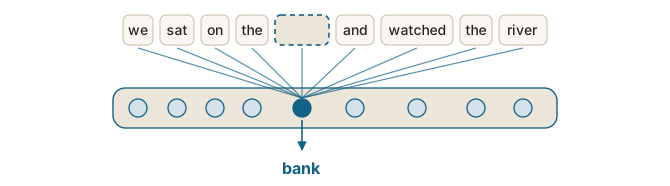
Figure 4. Every token of the sentence, on both sides of the gap, feeds the position where the word is missing, and the model restores it from all of them.
BERT reported new best results on eleven language-processing tasks, and this
methodology became the standard: pretrain one model on raw text, then fine-tune
it for each task. For translation, where the
whole source text is there before any output is produced, reading it in both
directions is the natural design.
What it costs
Two things.
Computation. A fresh vector per occurrence, from the whole sentence, costs
far more than looking up a stored one, so these models need serious hardware.
Devlin, J., Chang, M.-W., Lee, K., & Toutanova, K. (2019). BERT: Pre-training of Deep Bidirectional Transformers for Language Understanding. Proceedings of the 2019 Conference of the North American Chapter of the Association for Computational Linguistics: Human Language Technologies, Volume 1 (Long and Short Papers). https://doi.org/10.18653/v1/N19-1423
Peters, M. E., Neumann, M., Iyyer, M., Gardner, M., Clark, C., Lee, K., et al. (2018). Deep Contextualized Word Representations. Proceedings of the 2018 Conference of the North American Chapter of the Association for Computational Linguistics: Human Language Technologies, Volume 1 (Long Papers). https://doi.org/10.18653/v1/N18-1202
Avant ou après
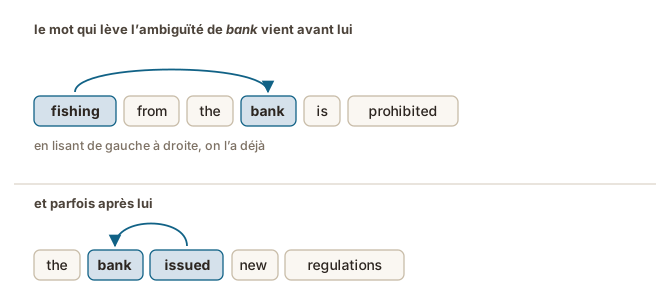
Où se trouve le mot qui lève l’ambiguïté ? Parfois avant le mot ambigu : dans
fishing from the bank is prohibited, fishing a déjà fixé le sens quand
bank arrive. Parfois après lui : dans the bank issued new regulations, le
mot décisif ne vient qu’une fois bank lu.
Figure 3. Le mot qui lève une ambiguïté vient avant elle dans une phrase et après elle dans l'autre. Un modèle qui lit strictement de gauche à droite n'a que la moitié de ce contexte.
Lire dans les deux sens
ELMo utilisait déjà les deux côtés, mais superficiellement : un modèle lisait
la phrase de gauche à droite, un second la lisait de droite à gauche, et leurs
sorties étaient réunies à la fin, si bien que les deux sens ne se rencontraient
jamais pendant l’entraînement (Devlin et al., 2019).
BERT est le modèle qui a réuni les deux.ELMo et BERT ont lancé une
mode, et les acronymes qui ont suivi ont été tordus pour tomber sur des
personnages de Sesame Street : ERNIE, Grover, Big Bird.
BERT a établi de nouveaux records sur onze tâches de traitement
de la langue, et cette méthodologie est devenue la norme : préentraîner un
modèle sur du texte brut, puis l’affiner pour chaque tâche. En traduction, où
tout le texte de départ est là avant qu’aucune sortie ne soit produite, le lire
dans les deux sens est la conception naturelle.
Ce que cela coûte
Deux choses.
Le calcul. Un vecteur neuf par occurrence, à partir de toute la phrase,
coûte bien plus cher que d’en consulter un déjà rangé : ces modèles exigent
donc du matériel sérieux.
Le domaine a jugé que la précision valait les deux.
Sources
Devlin, J., Chang, M.-W., Lee, K., & Toutanova, K. (2019). BERT: Pre-training of Deep Bidirectional Transformers for Language Understanding. Proceedings of the 2019 Conference of the North American Chapter of the Association for Computational Linguistics: Human Language Technologies, Volume 1 (Long and Short Papers). https://doi.org/10.18653/v1/N19-1423
Peters, M. E., Neumann, M., Iyyer, M., Gardner, M., Clark, C., Lee, K., et al. (2018). Deep Contextualized Word Representations. Proceedings of the 2018 Conference of the North American Chapter of the Association for Computational Linguistics: Human Language Technologies, Volume 1 (Long Papers). https://doi.org/10.18653/v1/N18-1202
Using a pretrained modelUtiliser un modèle préentraîné
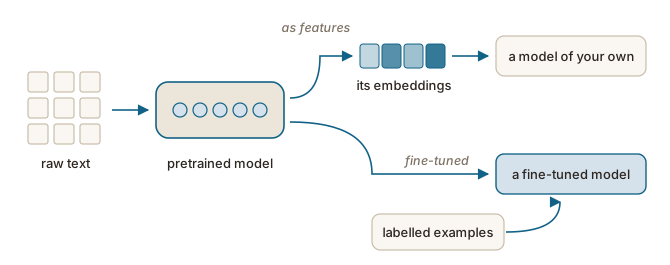
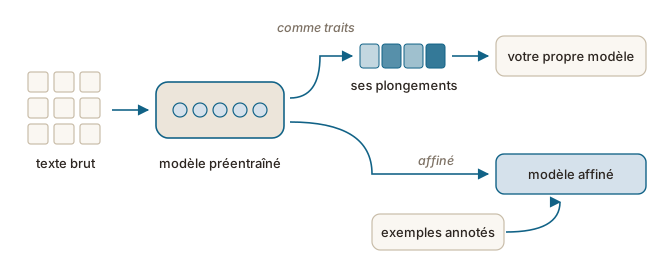
Its embeddings can be taken as they are and fed into a model of your own, which
is how ELMo was used. Or the whole model can be kept and fine-tuned: a small
output layer is added and trained on labelled examples for one task, so that
what the model learned about language carries over to it (Devlin et al.,
2019) (see also the Fine-tuning chapter, in the LLM lifecycle module) (voir aussi le chapitre Affinage, dans le module Cycle de vie des GML). Sentiment analysis,
named-entity recognition and question answering were all built that way, and
the task-specific training is small beside the pretraining.
Devlin, J., Chang, M.-W., Lee, K., & Toutanova, K. (2019). BERT: Pre-training of Deep Bidirectional Transformers for Language Understanding. Proceedings of the 2019 Conference of the North American Chapter of the Association for Computational Linguistics: Human Language Technologies, Volume 1 (Long and Short Papers). https://doi.org/10.18653/v1/N19-1423
Peters, M. E., Neumann, M., Iyyer, M., Gardner, M., Clark, C., Lee, K., et al. (2018). Deep Contextualized Word Representations. Proceedings of the 2018 Conference of the North American Chapter of the Association for Computational Linguistics: Human Language Technologies, Volume 1 (Long Papers). https://doi.org/10.18653/v1/N18-1202
Devlin, J., Chang, M.-W., Lee, K., & Toutanova, K. (2019). BERT: Pre-training of Deep Bidirectional Transformers for Language Understanding. Proceedings of the 2019 Conference of the North American Chapter of the Association for Computational Linguistics: Human Language Technologies, Volume 1 (Long and Short Papers). https://doi.org/10.18653/v1/N19-1423
Peters, M. E., Neumann, M., Iyyer, M., Gardner, M., Clark, C., Lee, K., et al. (2018). Deep Contextualized Word Representations. Proceedings of the 2018 Conference of the North American Chapter of the Association for Computational Linguistics: Human Language Technologies, Volume 1 (Long Papers). https://doi.org/10.18653/v1/N18-1202
Attention & transformersAttention et transformeurs
Written in English. The French version was automatically generated
and I have not revised it.
Rédigé en anglais. La version française a été
générée automatiquement et je ne l'ai pas révisée.
The bottleneckLe goulot d'étranglement
Context matters
Texts are full of context-dependent choices and interpretations, at every
scale:
the word that settles an ambiguity, thirty words earlier in the same sentence;
the latter, referring to something named three sentences ago;
a pronoun pointing back two paragraphs;
a term defined in the introduction and used throughout.
One pass, and no going back
Before the transformer, a model read a sentence the way it arrives: one word at
a time, updating a running summary as it went. ELMo was still built that way in
2018, with two passes over the sentence, each of them one word at a time
(Peters et al., 2018).
That sounds natural, because it is how you read too. You commit as you go, and
a later word sometimes breaks the reading you committed to: the horse raced
past the barn fell sends you back to the beginning. Sentences like that are
called garden-path sentences, tricking you into one reading at the beginning
and making you reconsider at the end. Without the ability to go backwards,
models would not be able to deal with this.
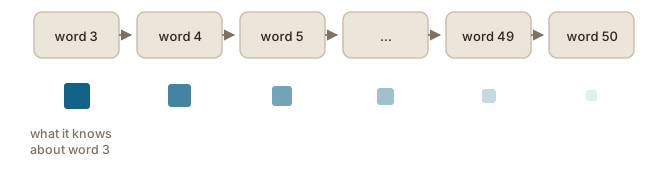
Processing one word at a time in order has a structural weakness as well.
Everything the model knows about word 3 has to survive, inside that running
summary, through the processing of words 4, 5 and 6 to matter at word 50. Each step blurs it a little, like a game of broken
telephone.A party game: one player whispers a phrase to the next
along a line, each passing on what they think they heard, and the last says
aloud what reached them. Over a short span the message arrives; over
a long one what arrives is a paraphrase of a paraphrase.
Figure 1. Word 3 reaching word 50 through every step in between.
Sources
Jurafsky, D., & Martin, J. H. (2026). Speech and Language Processing: An Introduction to Natural Language Processing, Computational Linguistics, and Speech Recognition with Language Models. Online draft, 3rd edition. https://web.stanford.edu/~jurafsky/slp3/
Maruf, S., Saleh, F., & Haffari, G. (2021). A survey on document-level neural machine translation: Methods and evaluation. ACM Computing Surveys, 54(2), article 45. https://doi.org/10.1145/3441691
Peters, M. E., Neumann, M., Iyyer, M., Gardner, M., Clark, C., Lee, K., et al. (2018). Deep Contextualized Word Representations. Proceedings of the 2018 Conference of the North American Chapter of the Association for Computational Linguistics: Human Language Technologies, Volume 1 (Long Papers). https://doi.org/10.18653/v1/N18-1202
Voita, E., Sennrich, R., & Titov, I. (2019). When a good translation is wrong in context: Context-aware machine translation improves on deixis, ellipsis, and lexical cohesion. Proceedings of the 57th Annual Meeting of the ACL, 1198–1212. https://aclanthology.org/P19-1116/
Le contexte compte
Les textes sont pleins de choix et d’interprétations qui dépendent du contexte,
à toutes les échelles :
le mot qui lève une ambiguïté, trente mots plus tôt dans la même phrase ;
ce dernier, qui renvoie à quelque chose nommé trois phrases plus haut ;
un pronom qui renvoie deux paragraphes en arrière ;
un terme défini dans l’introduction et employé partout ensuite.
Un seul passage, sans retour
Avant le transformeur, un modèle lisait une phrase telle qu’elle arrive : un
mot à la fois, en mettant à jour un résumé courant à mesure. ELMo était encore
construit ainsi en 2018, avec deux passages sur la phrase, chacun un mot à la
fois (Peters et al., 2018).
Cela paraît naturel, parce que c’est aussi votre façon de lire. Vous vous
engagez à mesure, et un mot plus loin brise parfois la lecture à laquelle vous
vous étiez engagé : the horse raced past the barn fell vous renvoie au début.
On appelle ces phrases des phrases-pièges : elles vous entraînent vers une
première lecture, puis vous forcent à revenir sur elle à la fin. Sans la
possibilité de revenir en arrière, les modèles ne sauraient pas s’en tirer.
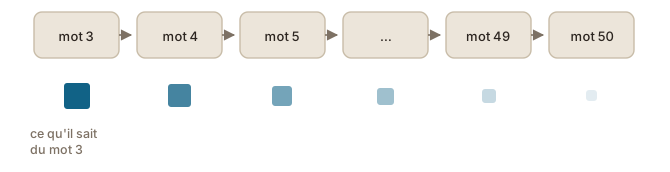
Traiter un mot à la fois, dans l’ordre, a aussi une faiblesse structurelle.
Tout ce que le modèle sait du mot 3 doit survivre, dans ce résumé courant, au
traitement des mots 4, 5 et 6 pour compter encore au mot 50. Chaque étape le
brouille un peu, comme au téléphone
arabe.Un jeu de société : un joueur chuchote une phrase au suivant le
long d’une file, chacun transmet ce qu’il croit avoir entendu, et le dernier
dit à voix haute ce qui lui est parvenu. Sur une courte distance, le
message arrive ; sur une longue, il n’arrive plus que la paraphrase d’une
paraphrase.
Figure 1. Le mot 3 atteignant le mot 50 en passant par toutes les étapes intermédiaires.
Sources
Jurafsky, D., & Martin, J. H. (2026). Speech and Language Processing: An Introduction to Natural Language Processing, Computational Linguistics, and Speech Recognition with Language Models. Online draft, 3rd edition. https://web.stanford.edu/~jurafsky/slp3/
Maruf, S., Saleh, F., & Haffari, G. (2021). A survey on document-level neural machine translation: Methods and evaluation. ACM Computing Surveys, 54(2), article 45. https://doi.org/10.1145/3441691
Peters, M. E., Neumann, M., Iyyer, M., Gardner, M., Clark, C., Lee, K., et al. (2018). Deep Contextualized Word Representations. Proceedings of the 2018 Conference of the North American Chapter of the Association for Computational Linguistics: Human Language Technologies, Volume 1 (Long Papers). https://doi.org/10.18653/v1/N18-1202
Voita, E., Sennrich, R., & Titov, I. (2019). When a good translation is wrong in context: Context-aware machine translation improves on deixis, ellipsis, and lexical cohesion. Proceedings of the 57th Annual Meeting of the ACL, 1198–1212. https://aclanthology.org/P19-1116/
All words at onceTous les mots à la fois
Attention is all you need
The 2017 paper that changed the field has its thesis in its title: “Attention
Is All You Need” (Vaswani et al., 2017). The architecture it introduced, the
transformer, drops reading order entirely. All the words of the input are
processed at the same time, and each word can draw information directly from
any other, whatever the distance between them. The first word of a long sentence no
longer has to survive a relay to reach the last: the two are one connection
apart.
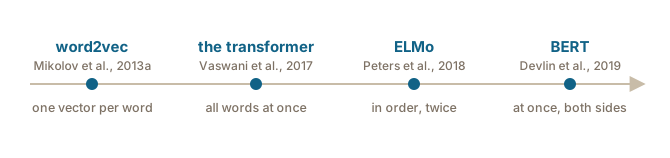
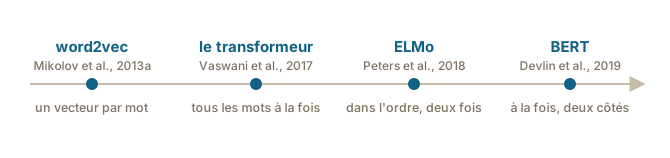
Figure 2. The order they arrived in. ELMo came after the transformer without using it; BERT is built on it, which is how it reads a whole sentence at once.
What about word order?
Dropping sequence creates an obvious problem. If nothing is processed “first”,
how does the model know that the dog follows Jean differs from Jean follows
the dog? The words alone no longer say.
The transformer’s answer is to make position part of each word’s
representation. Before processing starts, every word’s vector is combined with
a numerical encoding of where in the text it sits, like page numbers on a
manuscript that has been taken apart: the pages can then be handled in any
order without the original arrangement being lost.
Click the drawing, or a line below, to build it up stage by stage.Cliquez sur le dessin, ou sur une ligne ci-dessous, pour le construire étape par étape.
Figure 3. The sentence arrives in order, each word is given its position, and from then on the arrangement no longer keeps that order: only the positional encoding remembers it, while the words are processed all at once, each connected to every other.
Sources
Devlin, J., Chang, M.-W., Lee, K., & Toutanova, K. (2019). BERT: Pre-training of Deep Bidirectional Transformers for Language Understanding. Proceedings of the 2019 Conference of the North American Chapter of the Association for Computational Linguistics: Human Language Technologies, Volume 1 (Long and Short Papers). https://doi.org/10.18653/v1/N19-1423
Mikolov, T., Chen, K., Corrado, G., & Dean, J. (2013a). Efficient Estimation of Word Representations in Vector Space. arXiv preprint arXiv:1301.3781 (ICLR 2013 Workshop Track). https://arxiv.org/abs/1301.3781
Peters, M. E., Neumann, M., Iyyer, M., Gardner, M., Clark, C., Lee, K., et al. (2018). Deep Contextualized Word Representations. Proceedings of the 2018 Conference of the North American Chapter of the Association for Computational Linguistics: Human Language Technologies, Volume 1 (Long Papers). https://doi.org/10.18653/v1/N18-1202
L’article de 2017 qui a changé le domaine annonce sa thèse dans son titre :
« Attention Is All You Need » (Vaswani et al., 2017). L’architecture qu’il
présente, le transformeur, abandonne complètement l’ordre de lecture. Tous les
mots de l’entrée sont traités en même temps, et chaque mot peut puiser de
l’information directement dans n’importe quel autre, quelle que soit la
distance. Le premier mot d’une longue phrase n’a plus à survivre à une course
de relais pour atteindre le dernier : les deux sont à une seule connexion l’un
de l’autre.
Figure 2. L'ordre dans lequel ils sont arrivés. ELMo vient après le transformeur sans s'en servir ; BERT est construit sur lui, et c'est ainsi qu'il lit une phrase entière d'un coup.
Et l’ordre des mots ?
Abandonner la séquence crée un problème évident. Si rien n’est traité « en
premier », comment le modèle sait-il que le chien suit Jean diffère de Jean
suit le chien ? Les mots seuls ne le disent plus.
La réponse du transformeur est de faire de la position une partie de la
représentation de chaque mot. Avant que le traitement commence, le vecteur de
chaque mot est combiné à un encodage numérique de sa place dans le texte, comme
des numéros de page sur un manuscrit qu’on a défait : les pages peuvent ensuite
être manipulées dans n’importe quel ordre sans que l’agencement d’origine soit
perdu.
Click the drawing, or a line below, to build it up stage by stage.Cliquez sur le dessin, ou sur une ligne ci-dessous, pour le construire étape par étape.
Figure 3. La phrase arrive dans l'ordre, chaque mot reçoit sa position, et à partir de là l'agencement ne conserve plus cet ordre : seul l'encodage positionnel s'en souvient, tandis que les mots sont traités tous à la fois, chacun relié à tous les autres.
Sources
Devlin, J., Chang, M.-W., Lee, K., & Toutanova, K. (2019). BERT: Pre-training of Deep Bidirectional Transformers for Language Understanding. Proceedings of the 2019 Conference of the North American Chapter of the Association for Computational Linguistics: Human Language Technologies, Volume 1 (Long and Short Papers). https://doi.org/10.18653/v1/N19-1423
Mikolov, T., Chen, K., Corrado, G., & Dean, J. (2013a). Efficient Estimation of Word Representations in Vector Space. arXiv preprint arXiv:1301.3781 (ICLR 2013 Workshop Track). https://arxiv.org/abs/1301.3781
Peters, M. E., Neumann, M., Iyyer, M., Gardner, M., Clark, C., Lee, K., et al. (2018). Deep Contextualized Word Representations. Proceedings of the 2018 Conference of the North American Chapter of the Association for Computational Linguistics: Human Language Technologies, Volume 1 (Long Papers). https://doi.org/10.18653/v1/N18-1202
Reading in both directions settled one question, whether the word that decides
comes before or after (see also the Contextual embeddings chapter, in the Language as numbers module) (voir aussi le chapitre Plongements contextuels, dans le module Le langage en nombres).
It leaves another. Once every word is connected to every other, not all of
those connections are worth the same, and the more context there is, the less
of it counts equally.
Reading the bank was steep, you connect bank with steep and settle on the
riverside sense without noticing you did it. The attention mechanism is the
transformer’s version of that reflex: for each word, attention weights say how
much every other word in the text should influence its representation.
Too tired, too wide
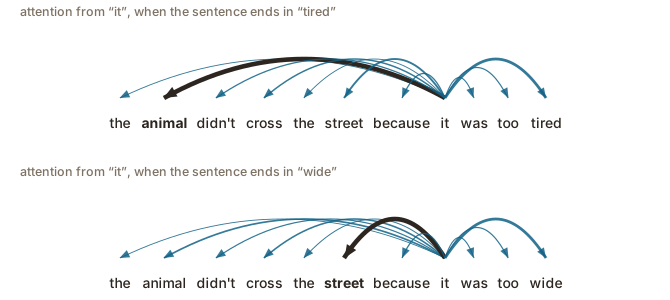
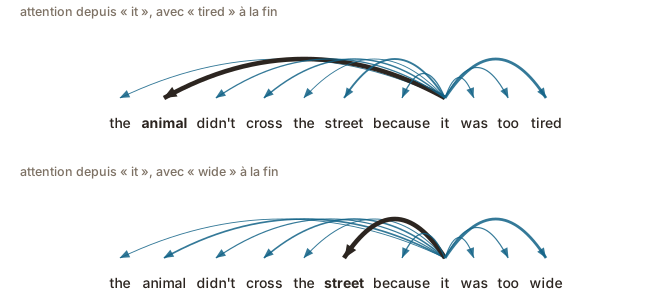
The classic demonstration comes from the transformer paper itself (Vaswani et
al., 2017; visualization by Vig, 2019). Compare:
the animal didn’t cross the street because it was too tired
the animal didn’t cross the street because it was too wide
Changing a single word at the very end changes the meaning of the whole
sentence, by changing which word we link it to: a tired it is the animal, a
wide it is the street. Inside a trained transformer, the attention weights
from it visibly shift between the two sentences, toward animal in the first
and toward street in the second.
Figure 4. Attention from the pronoun to every word of the sentence, thicker where the weight is higher. One changed word at the end moves the heaviest arc from the animal to the street. Drawn after the visualization in Vig (2019).
Nobody programmed the fact that streets are wide and animals get tired. That
came out of patterns across millions of sentences: the distributional idea
again, now applied to relationships inside a sentence rather than to which
words resemble each other.
Learned once, worked out every time
Two different things are called weights here, and they are worth telling
apart.
The attention weights are worked out. They say how much each word of the
text at hand should draw on each other word. The model computes them from
those words, using the weights it learned, and computes them again for the
next text. Nothing about the model changes while it does.
So the arcs in the figure above were not stored anywhere and looked up. They
were computed for that sentence, and the other sentence gives other arcs.
This is the machinery the contextual-embeddings chapter left unexplained: the
vector for this occurrence of bank is assembled from the words its attention
selected, in the proportions it
learned (see also the Contextual embeddings chapter, in the Language as numbers module) (voir aussi le chapitre Plongements contextuels, dans le module Le langage en nombres).
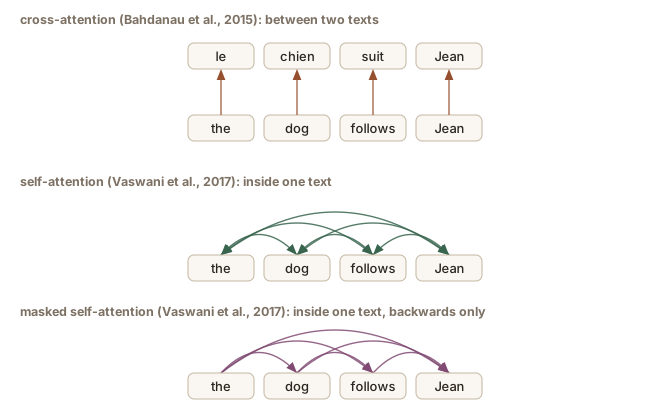
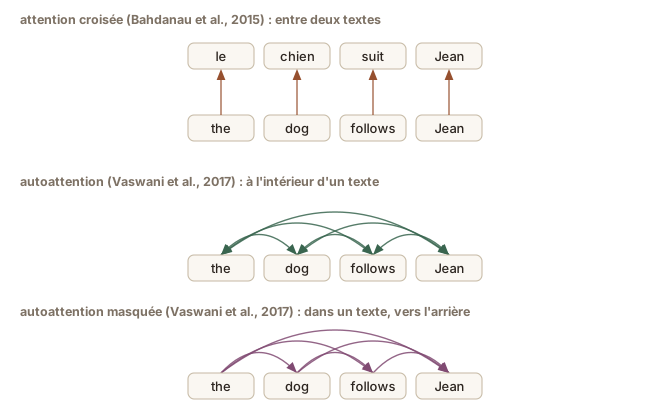
So what is self-attention?
Attention always runs between two sets of words: the ones being given a
representation, and the ones they draw on. Self-attention is the case where
both sets are the same text. That happens everywhere above, each word
of the sentence weighted against the other words of that same sentence.
The other case runs between two different texts, a source and the translation
being written from
it (see also the Encoders and decoders page, in the Language as numbers module) (voir aussi la page Encodeurs et décodeurs, dans le module Le langage en nombres).
That use came first: attention was built for translation (Bahdanau et al.,
2015), and the step taken in 2017 was to use it inside a single text as well
(Vaswani et al., 2017).
Figure 5. The same mechanism in the three configurations a translator is likely to come across, in the order they appeared. Each keeps its colour wherever it turns up again. Others exist and are left aside here.
Bahdanau, D., Cho, K., & Bengio, Y. (2015). Neural Machine Translation by Jointly Learning to Align and Translate. Third International Conference on Learning Representations (ICLR 2015), oral presentation; arXiv:1409.0473. https://arxiv.org/abs/1409.0473
Vig, J. (2019). A Multiscale Visualization of Attention in the Transformer Model. Proceedings of the 57th Annual Meeting of the Association for Computational Linguistics: System Demonstrations, 37–42. https://aclanthology.org/P19-3007/
Mais quel contexte ?
Lire dans les deux sens a réglé une question, celle de savoir si le mot décisif
vient avant ou après (see also the Contextual embeddings chapter, in the Language as numbers module) (voir aussi le chapitre Plongements contextuels, dans le module Le langage en nombres).
Il en reste une autre. Dès que chaque mot est relié à tous les autres, toutes
ces liaisons ne valent pas la même chose, et plus il y a de contexte, moins toutes ses
parties comptent autant.
En lisant the bank was steep, vous rapprochez bank de steep et vous
retenez le sens du bord de rivière sans vous en apercevoir. Le mécanisme
d’attention est la version qu’en donne le transformeur : pour chaque mot, des
poids d’attention disent à quel point chacun des autres mots du texte doit
influencer sa représentation.
Trop fatigué, trop large
La démonstration classique vient de l’article même du transformeur (Vaswani et
al., 2017 ; visualisation de Vig, 2019). Comparez :
the animal didn’t cross the street because it was too tired
the animal didn’t cross the street because it was too wide
Changer un seul mot tout à la fin change le sens de la phrase entière, en
changeant le mot auquel on rattache it : un it fatigué est l’animal, un
it large est la rue. Dans un transformeur entraîné, les poids d’attention
depuis it se déplacent visiblement entre les deux phrases, vers animal dans
la première et vers street dans la seconde.
Figure 4. L'attention depuis le pronom vers chaque mot de la phrase, plus épaisse là où le poids est plus élevé. Un seul mot changé à la fin déplace l'arc le plus épais de l'animal vers la rue. D'après la visualisation de Vig (2019).
Personne n’a programmé le fait que les rues sont larges et que les animaux se
fatiguent. Cela est ressorti de motifs relevés dans des millions de phrases :
l’idée distributionnelle de nouveau, appliquée cette fois aux relations à
l’intérieur d’une phrase plutôt qu’à la ressemblance entre les mots.
Appris une fois, établi chaque fois
Deux choses différentes s’appellent ici des poids, et elles valent la peine
d’être distinguées.
Les poids d’attention sont établis. Ils disent à quel point chaque mot du
texte en cours doit puiser dans chacun des autres. Le modèle les calcule à
partir de ces mots, avec les poids qu’il a appris, et les calcule de nouveau
pour le texte suivant. Rien du modèle ne change pendant ce temps.
Les arcs de la figure ci-dessus n’étaient donc rangés nulle part avant d’être
consultés. Ils ont été calculés pour cette phrase, et l’autre phrase donne
d’autres arcs.
C’est le mécanisme que le chapitre sur les plongements contextuels laissait
inexpliqué : le vecteur de cette occurrence de bank est assemblé à partir des
mots que son attention a retenus, dans les proportions
apprises (see also the Contextual embeddings chapter, in the Language as numbers module) (voir aussi le chapitre Plongements contextuels, dans le module Le langage en nombres).
Alors, qu’est-ce que l’autoattention ?
L’attention s’exerce toujours entre deux ensembles de mots : ceux à qui l’on donne
une représentation, et ceux dans lesquels ils puisent. L’autoattention est le
cas où les deux ensembles sont le même texte. C’est ce qui se passe partout
ci-dessus, chaque mot de la phrase pesé par rapport aux autres mots de cette
même phrase.
Dans l’autre cas, elle s’exerce entre deux textes différents, un texte de départ et la
traduction qu’on en
écrit (see also the Encoders and decoders page, in the Language as numbers module) (voir aussi la page Encodeurs et décodeurs, dans le module Le langage en nombres).
Cet usage est venu le premier : l’attention a été conçue pour la traduction
(Bahdanau et al., 2015), et le pas franchi en 2017 a été de s’en servir aussi à
l’intérieur d’un seul texte (Vaswani et al., 2017).
Figure 5. Le même mécanisme dans les trois configurations qu'une traductrice ou un traducteur est susceptible de rencontrer, dans l'ordre de leur apparition. Chacune garde sa couleur partout où elle réapparaît. D'autres existent et sont laissées de côté ici.
Bahdanau, D., Cho, K., & Bengio, Y. (2015). Neural Machine Translation by Jointly Learning to Align and Translate. Third International Conference on Learning Representations (ICLR 2015), oral presentation; arXiv:1409.0473. https://arxiv.org/abs/1409.0473
Vig, J. (2019). A Multiscale Visualization of Attention in the Transformer Model. Proceedings of the 57th Annual Meeting of the Association for Computational Linguistics: System Demonstrations, 37–42. https://aclanthology.org/P19-3007/
The encoder takes the source and turns it into contextual
representations, all words at the same time.
The decoder writes the target one word at a time, and at each word it
looks in two directions: back over what it has already written, and across at
the encoder’s representations of the source.
Click the drawing, or a line below, to build it up stage by stage.Cliquez sur le dessin, ou sur une ligne ci-dessous, pour le construire étape par étape.
Figure 6. Simplified schematic of an encoder-decoder mechanism, illustrated with a translation task.
Back, with masked self-attention. That same vector also draws on what the
decoder has already written, the and dog. The fourth slot is empty,
because the words after the one being produced do not exist yet, so attention
over the target runs backwards only.
Out of the decoder. The finished vector is mapped back to a word.
Direction belongs to the attention, not to the turning of words into vectors
and back.
Encoder, decoder, or both?
Both halves are made of the same attention layers, so a model can keep one or
keep both. The choice follows from the shape of the task: what goes in,
and what has to come out.
The line is not a wall. A decoder-only model translates perfectly well when
the source and its translation are given to it as one running text, which
happens whenever a translation is asked of a
chatbot (see also the Machine translation module) (voir aussi le module Traduction automatique).
Sources
Devlin, J., Chang, M.-W., Lee, K., & Toutanova, K. (2019). BERT: Pre-training of Deep Bidirectional Transformers for Language Understanding. Proceedings of the 2019 Conference of the North American Chapter of the Association for Computational Linguistics: Human Language Technologies, Volume 1 (Long and Short Papers). https://doi.org/10.18653/v1/N19-1423
Radford, A., Kim, J. W., Xu, T., Brockman, G., McLeavey, C., & Sutskever, I. (2023). Robust speech recognition via large-scale weak supervision. Proceedings of the 40th International Conference on Machine Learning (PMLR 202), 28492–28518. https://proceedings.mlr.press/v202/radford23a.html
L’encodeur prend le texte de départ et le transforme en représentations
contextuelles, tous les mots en même temps.
Le décodeur écrit le texte d’arrivée un mot à la fois, et à chaque mot il
regarde dans deux directions : en arrière sur ce qu’il a déjà écrit, et de
l’autre côté vers les représentations du texte de départ produites par
l’encodeur.
Click the drawing, or a line below, to build it up stage by stage.Cliquez sur le dessin, ou sur une ligne ci-dessous, pour le construire étape par étape.
Figure 6. Schéma simplifié d'un mécanisme encodeur-décodeur, illustré par une tâche de traduction.
En arrière, avec l’autoattention masquée. Ce même vecteur puise aussi
dans ce que le décodeur a déjà écrit, the et dog. La quatrième place est
vide, parce que les mots qui suivent celui qu’on produit n’existent pas
encore : l’attention sur le texte d’arrivée ne va donc que vers l’arrière.
Hors du décodeur. Le vecteur terminé est ramené à un mot.
La direction appartient à l’attention, non au passage des mots aux vecteurs et
des vecteurs aux mots.
Encodeur, décodeur ou les deux ?
Les deux moitiés sont faites des mêmes couches d’attention : un modèle peut
donc n’en garder qu’une, ou garder les deux. Le choix découle de la forme de la
tâche : ce qui entre, et ce qui doit sortir.
La frontière n’est pas un mur. Un modèle à décodeur seul traduit très bien
quand le texte de départ et sa traduction lui sont donnés comme un seul texte
courant, ce qui arrive chaque fois qu’on demande une traduction à un agent
conversationnel (see also the Machine translation module) (voir aussi le module Traduction automatique).
Sources
Devlin, J., Chang, M.-W., Lee, K., & Toutanova, K. (2019). BERT: Pre-training of Deep Bidirectional Transformers for Language Understanding. Proceedings of the 2019 Conference of the North American Chapter of the Association for Computational Linguistics: Human Language Technologies, Volume 1 (Long and Short Papers). https://doi.org/10.18653/v1/N19-1423
Radford, A., Kim, J. W., Xu, T., Brockman, G., McLeavey, C., & Sutskever, I. (2023). Robust speech recognition via large-scale weak supervision. Proceedings of the 40th International Conference on Machine Learning (PMLR 202), 28492–28518. https://proceedings.mlr.press/v202/radford23a.html
Scale and the context windowL'échelle et la fenêtre contextuelle
Why “large” starts here
The transformer improved quality, and the deeper change was economic. A
sequential model processes words like customers in a single queue: one at a
time, however fast each step is. A transformer opens every checkout lane at
once, which is exactly the workload graphics processors are built for.
Click the drawing, or a line below, to build it up stage by stage.Cliquez sur le dessin, ou sur une ligne ci-dessous, pour le construire étape par étape.
Figure 7. Left, each step feeds the next, so the words are worked through in order. Right, nothing waits: every word is worked on in the same step, and every word is connected to every other.
Training on text collections that were unthinkably large in 2016 became
routine within a few years, and model and data sizes grew by orders of
magnitude (Hoffmann et al., 2022). Every system in the LLM lifecycle module is
a transformer at heart (see also the LLM lifecycle module) (voir aussi le module Cycle de vie des GML); without parallel
processing, “large” would have stayed out of reach.
The cost of attention
Attention weighs every pair of words, so doubling the length of a text roughly
quadruples the work. Somewhere, every model has to cap how much text it
processes at once, and that cap is the context window: the
reason a chatbot loses the thread of a long conversation, and the reason
“translate this 200-page document in one go” is not how any of these systems
works (see also the Counting in tokens page, in the Language as numbers module) (voir aussi la page Compter en jetons, dans le module Le langage en nombres).
Le transformeur a amélioré la qualité, et le changement le plus profond a été
économique. Un modèle séquentiel traite les mots comme des clients dans une
seule file : un à la fois, aussi rapide que soit chaque étape. Un transformeur
ouvre toutes les caisses en même temps, ce qui est exactement la charge de
travail pour laquelle les processeurs graphiques sont faits.
Click the drawing, or a line below, to build it up stage by stage.Cliquez sur le dessin, ou sur une ligne ci-dessous, pour le construire étape par étape.
Figure 7. À gauche, chaque étape alimente la suivante : les mots sont donc traités dans l'ordre. À droite, rien n'attend : tous les mots sont traités à la même étape, et chaque mot est relié à tous les autres.
Entraîner sur des ensembles de textes d’une taille inimaginable en 2016 est devenu courant
en quelques années, et la taille des modèles comme celle des données ont
augmenté de plusieurs ordres de grandeur (Hoffmann et al., 2022). Tous les
systèmes du module sur le cycle de vie des GML sont des transformeurs au
fond (see also the LLM lifecycle module) (voir aussi le module Cycle de vie des GML) ; sans le traitement parallèle, le « grand »
serait resté hors de portée.
Le coût de l’attention
L’attention pèse chaque paire de mots : doubler la longueur d’un texte
quadruple donc à peu près le travail. Chaque modèle doit plafonner quelque part
la quantité de texte qu’il traite d’un coup, et ce plafond est la fenêtre
contextuelle : la raison pour laquelle un agent conversationnel perd le fil
d’une longue conversation, et la raison pour laquelle « traduis-moi ce document
de 200 pages d’un coup » n’est pas la façon dont ces systèmes
fonctionnent (see also the Counting in tokens page, in the Language as numbers module) (voir aussi la page Compter en jetons, dans le module Le langage en nombres).
The impact on machine translationL'incidence sur la traduction automatique
Read before you translate
When you translate, you need context before you can commit. You cannot start
rendering a sentence on its first word: you read ahead, a few words at least,
to see where it is going. Consider for instance the English-to-French
translation in Figure 8figure 8.
Click the drawing, or a line below, to build it up stage by stage.Cliquez sur le dessin, ou sur une ligne ci-dessous, pour le construire étape par étape.
Figure 8. Word by word, English on the left and French on the right. Three choices have to be made before the word that settles them arrives.
Nobody gave the model that map. It worked it out from millions of translated
sentence pairs, four and a half million for the English-German system of the
original paper (Vaswani et al., 2017).
Voita, E., Sennrich, R., & Titov, I. (2019). When a good translation is wrong in context: Context-aware machine translation improves on deixis, ellipsis, and lexical cohesion. Proceedings of the 57th Annual Meeting of the ACL, 1198–1212. https://aclanthology.org/P19-1116/
Lire avant de traduire
Quand vous traduisez, il vous faut du contexte avant de pouvoir vous engager.
Vous ne pouvez pas commencer à rendre une phrase dès son premier mot : vous
lisez plus loin, quelques mots au moins, pour voir où elle va. Prenez par
exemple la traduction de l’anglais vers le français de la
Figure 8figure 8.
Click the drawing, or a line below, to build it up stage by stage.Cliquez sur le dessin, ou sur une ligne ci-dessous, pour le construire étape par étape.
Figure 8. Mot à mot, l'anglais à gauche et le français à droite. Trois choix doivent être faits avant que le mot qui les règle arrive.
Personne n’a donné cette carte au modèle. Il l’a établie à partir de millions
de paires de phrases traduites, quatre millions et demi pour le système
anglais-allemand de l’article d’origine (Vaswani et al., 2017).
Voita, E., Sennrich, R., & Titov, I. (2019). When a good translation is wrong in context: Context-aware machine translation improves on deixis, ellipsis, and lexical cohesion. Proceedings of the 57th Annual Meeting of the ACL, 1198–1212. https://aclanthology.org/P19-1116/
TokenizationJetonisation
Written in English. The French version was automatically generated
and I have not revised it.
Rédigé en anglais. La version française a été
générée automatiquement et je ne l'ai pas révisée.
What are tokens?Qu'est-ce qu'un jeton ?
Not words, but tokens
Everything so far has said word: a vector for each word, attention between
words. That is a simplification.
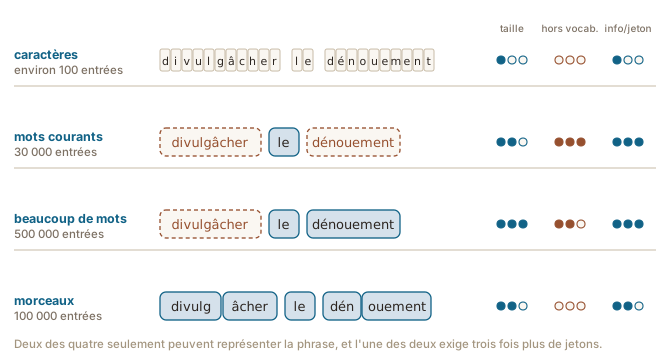
Click the drawing, or a line below, to build it up stage by stage.Cliquez sur le dessin, ou sur une ligne ci-dessous, pour le construire étape par étape.
Figure 1. The same sentence read three ways. The token split and IDs are the real output of OpenAI's o200k_base tokenizer (checked 29 August 2026).
Jurafsky, D., & Martin, J. H. (2026). Speech and Language Processing: An Introduction to Natural Language Processing, Computational Linguistics, and Speech Recognition with Language Models. Online draft, 3rd edition. https://web.stanford.edu/~jurafsky/slp3/
Pas des mots, mais des jetons
Tout ce qui précède a dit mot : un vecteur par mot, de l’attention entre les
mots. C’est une simplification.
Click the drawing, or a line below, to build it up stage by stage.Cliquez sur le dessin, ou sur une ligne ci-dessous, pour le construire étape par étape.
Figure 1. La même phrase lue de trois façons. Le découpage en jetons et les identifiants sont la sortie réelle du segmenteur o200k_base d'OpenAI (vérifiée le 29 août 2026).
Jurafsky, D., & Martin, J. H. (2026). Speech and Language Processing: An Introduction to Natural Language Processing, Computational Linguistics, and Speech Recognition with Language Models. Online draft, 3rd edition. https://web.stanford.edu/~jurafsky/slp3/
Click the drawing, or a line below, to build it up stage by stage.Cliquez sur le dessin, ou sur une ligne ci-dessous, pour le construire étape par étape.
Figure 2. From your sentence to the vectors the model works on. The split shown is real o200k_base output (tiktokenizer.vercel.app, checked 29 August 2026).
Spaces belong to the word that follows
The spaces are inside the tokens. In this tokenizer a space belongs to the word
that follows it, which is why two of the boxes carry one and the first does
not. The same word is therefore a different token at the start of a line and in
the middle of a sentence, and a text already cut on its spaces is counted
differently.
Jurafsky, D., & Martin, J. H. (2026). Speech and Language Processing: An Introduction to Natural Language Processing, Computational Linguistics, and Speech Recognition with Language Models. Online draft, 3rd edition. https://web.stanford.edu/~jurafsky/slp3/
Click the drawing, or a line below, to build it up stage by stage.Cliquez sur le dessin, ou sur une ligne ci-dessous, pour le construire étape par étape.
Figure 2. De votre phrase aux vecteurs sur lesquels le modèle travaille. Le découpage montré est la sortie réelle d'o200k_base (tiktokenizer.vercel.app, vérifiée le 29 août 2026).
Les espaces appartiennent au mot qui suit
Les espaces sont à l’intérieur des jetons. Dans ce segmenteur, une espace
appartient au mot qui la suit, ce qui explique que deux des cases en portent
une et que la première n’en porte pas. Un même mot est donc un jeton différent
au début d’une ligne et au milieu d’une phrase, et un texte déjà découpé sur
ses espaces se compte autrement.
Jurafsky, D., & Martin, J. H. (2026). Speech and Language Processing: An Introduction to Natural Language Processing, Computational Linguistics, and Speech Recognition with Language Models. Online draft, 3rd edition. https://web.stanford.edu/~jurafsky/slp3/
Why not simply use words or characters?Pourquoi ne pas simplement prendre les mots ou les caractères ?
Vocabulary
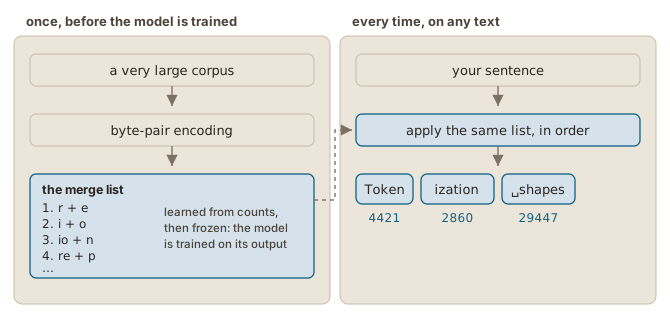
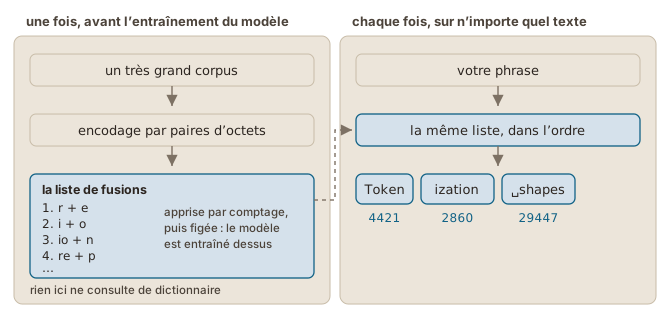
Every model has a fixed list of tokens, chosen before training starts and never
added to afterwards. Every text it will ever read or write has to be expressed
using the tokens in that list, and whatever is not in the list cannot be
represented at all.
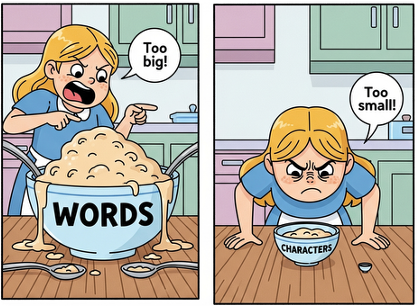
How long that list should be is the question this page turns on, and the two
obvious answers sit at either end.
Figure 3. The two obvious answers, and what is wrong with each. Image generated withImage générée avec Gemini.
One number per word?
Each token would then be a unit that means something. But a list of words runs
into three walls at once.
Rare entries stay poorly learned. A word seen a handful of times in
training gets a vector built from those few occurrences, which is not enough
to place it usefully. Enlarging the list adds entries of exactly that kind.
Every entry costs. The model keeps one row of numbers per entry, and at
every step it scores every entry in the list to decide what comes next. A
longer list means more memory and more computing, for entries that are
mostly rare.
Click the drawing, or a line below, to build it up stage by stage.Cliquez sur le dessin, ou sur une ligne ci-dessous, pour le construire étape par étape.
Figure 4. A vocabulary of whole words: a vector is learned for each word the text contained, and none for the word it never contained.
One number per character?
The list would be tiny, a few hundred entries at most, and nothing would ever
be missing: any text at all can be spelled out, in any language, typos
included. The cost is at the other end. A single character tells you almost
nothing, t on its own means nothing, and a page of text becomes a very
long run of them, as the character row of
Figure 1figure 1 shows.
The model would have to rebuild every word from scratch, every time one occurred.
Pieces in between
New words are mostly made of familiar pieces, and that is the way out. You can
read antibacterial without having seen it before, because anti-, bacteri
and -al are old acquaintances. A vocabulary of pieces, some of them whole
words and some fragments, keeps the common words whole and can still spell out
anything at all, down to single characters in the worst case.
Figure 5. The same phrase represented with four different types of vocabulary, rated for the size of the list, the risk of a word falling outside it, and how much a single token tells you.
Brysbaert, M., Stevens, M., Mandera, P., & Keuleers, E. (2016). How Many Words Do We Know? Practical Estimates of Vocabulary Size Dependent on Word Definition, the Degree of Language Input and the Participant's Age. Frontiers in Psychology, 7, 1116. https://doi.org/10.3389/fpsyg.2016.01116
Jurafsky, D., & Martin, J. H. (2026). Speech and Language Processing: An Introduction to Natural Language Processing, Computational Linguistics, and Speech Recognition with Language Models. Online draft, 3rd edition. https://web.stanford.edu/~jurafsky/slp3/
Le vocabulaire
Chaque modèle a une liste fixe de jetons, choisie avant le début de
l’entraînement et jamais complétée ensuite. Tout texte qu’il lira ou écrira
doit s’exprimer avec les jetons de cette liste, et ce qui n’y figure pas ne
peut pas être représenté du tout.
Quelle doit être la longueur de cette liste ? C’est la question qui occupe cette
page, et les deux réponses évidentes se trouvent aux deux extrémités.
Figure 3. Les deux réponses évidentes, étiquetées en anglais, et ce qui ne va pas avec chacune. Image generated withImage générée avec Gemini.
Un numéro par mot ?
Chaque jeton serait alors une unité qui veut dire quelque chose. Mais une liste
de mots se heurte à trois murs à la fois.
Les entrées rares restent mal apprises. Un mot vu une poignée de fois à
l’entraînement reçoit un vecteur construit sur ces quelques occurrences, ce
qui ne suffit pas à le placer utilement. Agrandir la liste ajoute des entrées
exactement de ce genre.
Chaque entrée coûte. Le modèle garde une rangée de nombres par entrée,
et à chaque étape il attribue un score à chaque entrée de la liste pour
décider de la suite. Une liste plus longue veut dire plus de mémoire et plus
de calcul, pour des entrées le plus souvent rares.
Click the drawing, or a line below, to build it up stage by stage.Cliquez sur le dessin, ou sur une ligne ci-dessous, pour le construire étape par étape.
Figure 4. Un vocabulaire de mots entiers : un vecteur est appris pour chaque mot que le texte contenait, et aucun pour le mot qu'il n'a jamais contenu.
Un numéro par caractère ?
La liste serait minuscule, quelques centaines d’entrées au plus, et rien ne
manquerait jamais : n’importe quel texte peut s’épeler, dans n’importe quelle
langue, coquilles comprises. Le coût est à l’autre bout. Un caractère isolé ne
dit presque rien, t tout seul ne veut rien dire, et une page de texte devient
une très longue suite de caractères, comme le montre la rangée des caractères
de la
Figure 1figure 1. Le
modèle devrait reconstruire chaque mot depuis le début, chaque fois qu’il en
rencontre un.
Des morceaux entre les deux
Les mots nouveaux sont surtout faits de morceaux familiers, et c’est là que se trouve
l’issue. Vous pouvez lire antibactérien sans l’avoir jamais vu, parce que
anti-, bactér et -ien sont de vieilles connaissances. Un vocabulaire de
morceaux, dont certains sont des mots entiers et d’autres des fragments, garde
les mots courants entiers et peut malgré tout épeler n’importe quoi, jusqu’aux caractères
isolés dans le pire des cas.
Figure 5. La même expression représentée avec quatre types de vocabulaire différents, évalués selon la taille de la liste, le risque qu'un mot en sorte, et ce que dit un seul jeton.
Brysbaert, M., Stevens, M., Mandera, P., & Keuleers, E. (2016). How Many Words Do We Know? Practical Estimates of Vocabulary Size Dependent on Word Definition, the Degree of Language Input and the Participant's Age. Frontiers in Psychology, 7, 1116. https://doi.org/10.3389/fpsyg.2016.01116
Jurafsky, D., & Martin, J. H. (2026). Speech and Language Processing: An Introduction to Natural Language Processing, Computational Linguistics, and Speech Recognition with Language Models. Online draft, 3rd edition. https://web.stanford.edu/~jurafsky/slp3/
Split the whole corpus into single characters. These are the first
tokens.
Count every pair of adjacent tokens, and merge the most frequent pair
into one new token, everywhere it occurs.
Repeat step 2 until the vocabulary reaches the size you chose.
Learned once, applied forever
Frequent words quickly get their own token (the is one of the first) and
rarer ones stay in a few pieces. Length counts as well as frequency: every
merge joins two neighbours, so a long word needs many of them before it is
whole again, and a short word of the same frequency gets there sooner.
Frequent endings and stems, -ing, -tion, get a token too, because they
recur across thousands of words.
The counting happens once and produces a list of merges. That
list is then applied unchanged to every text the model ever reads, including
yours.
Figure 6. Byte-pair encoding runs twice over in two different senses: once as learning, on a corpus, and then as a lookup applied unchanged to everything the model reads.
Sources
Jurafsky, D., & Martin, J. H. (2026). Speech and Language Processing: An Introduction to Natural Language Processing, Computational Linguistics, and Speech Recognition with Language Models. Online draft, 3rd edition. https://web.stanford.edu/~jurafsky/slp3/
Sennrich, R., Haddow, B., & Birch, A. (2016). Neural Machine Translation of Rare Words with Subword Units. Proceedings of the 54th Annual Meeting of the Association for Computational Linguistics (Volume 1: Long Papers). https://doi.org/10.18653/v1/P16-1162
Découper tout le corpus en caractères isolés. Ce sont les premiers jetons.
Compter chaque paire de jetons voisins, et fusionner la paire la plus
fréquente en un nouveau jeton, partout où elle apparaît.
Répéter l’étape 2 jusqu’à ce que le vocabulaire atteigne la taille choisie.
Appris une fois, appliqué pour toujours
Les mots fréquents obtiennent vite leur propre jeton (le est l’un des
premiers) et les plus rares restent en quelques morceaux. La longueur compte
aussi, en plus de la fréquence : chaque fusion joint deux voisins, un long mot a donc
besoin de nombreuses fusions avant d’être entier de nouveau, et un mot court de
même fréquence y arrive plus tôt. Les terminaisons et les radicaux fréquents,
-ion, -ment, obtiennent aussi un jeton, parce qu’ils reviennent dans des
milliers de mots.
Le comptage n’a lieu qu’une fois et produit une liste de fusions. Cette liste
est ensuite appliquée sans changement à tous les textes que le modèle lira, y
compris les vôtres.
Figure 6. L'encodage par paires d'octets tourne deux fois en deux sens différents : une fois comme apprentissage, sur un corpus, puis comme consultation appliquée sans changement à tout ce que le modèle lit.
Sources
Jurafsky, D., & Martin, J. H. (2026). Speech and Language Processing: An Introduction to Natural Language Processing, Computational Linguistics, and Speech Recognition with Language Models. Online draft, 3rd edition. https://web.stanford.edu/~jurafsky/slp3/
Sennrich, R., Haddow, B., & Birch, A. (2016). Neural Machine Translation of Rare Words with Subword Units. Proceedings of the 54th Annual Meeting of the Association for Computational Linguistics (Volume 1: Long Papers). https://doi.org/10.18653/v1/P16-1162
BPE by handL'encodage par paires d'octets à la main
Counting pairs, one merge at a time
Here the whole training corpus is three words: representation, retention,
repression. Three steps by hand are enough to see what kind of vocabulary
comes out.
Start by splitting everything into characters, nine distinct ones in all:
r e p r e s e n t a t i o nr e t e n t i o nr e p r e s s i o n
Count adjacent pairs. The pair r e occurs five times (twice in
representation, once in retention, twice in repression), more than any
other, so it becomes the first new token:
re p re s e n t a t i o nre t e n t i o nre p re s s i o n
Recounting and merging seven more times, io then ion, then the three
merges that build repres and the two that make ent, leaves a corpus in
which no pair occurs more than once:
repres ent a t ionre t ent ionrepres s ion
Click the drawing, or a line below, to build it up stage by stage.Cliquez sur le dessin, ou sur une ligne ci-dessous, pour le construire étape par étape.
Figure 7. Every merge is chosen by one number, the count of the pair. No step consults a dictionary or a morphological analysis.
Morphemes by accident
Seven tokens (repres, ent, a, t, ion, re, s) now cover all three
words. Counting pairs and nothing else found ion and ent, real English
morphemes, and repres, a shared stem. It also produced
repres·ent·a·t·ion, which no linguist would propose as a morphological
analysis of representation.
Jurafsky, D., & Martin, J. H. (2026). Speech and Language Processing: An Introduction to Natural Language Processing, Computational Linguistics, and Speech Recognition with Language Models. Online draft, 3rd edition. https://web.stanford.edu/~jurafsky/slp3/
Sennrich, R., Haddow, B., & Birch, A. (2016). Neural Machine Translation of Rare Words with Subword Units. Proceedings of the 54th Annual Meeting of the Association for Computational Linguistics (Volume 1: Long Papers). https://doi.org/10.18653/v1/P16-1162
Compter les paires, une fusion à la fois
Ici, tout le corpus d’entraînement tient en trois mots : representation,
retention, repression. Trois étapes à la main suffisent à voir quel genre
de vocabulaire en sort.
On commence par tout découper en caractères, neuf caractères distincts en
tout :
r e p r e s e n t a t i o nr e t e n t i o nr e p r e s s i o n
On compte les paires voisines. La paire r e apparaît cinq fois (deux fois
dans representation, une fois dans retention, deux fois dans
repression), plus que toute autre ; elle devient donc le premier nouveau
jeton :
re p re s e n t a t i o nre t e n t i o nre p re s s i o n
En recomptant et en fusionnant sept fois de plus, io puis ion, puis les
trois fusions qui construisent repres et les deux qui font ent, on obtient
un corpus où aucune paire n’apparaît plus d’une fois :
repres ent a t ionre t ent ionrepres s ion
Click the drawing, or a line below, to build it up stage by stage.Cliquez sur le dessin, ou sur une ligne ci-dessous, pour le construire étape par étape.
Figure 7. Chaque fusion est choisie par un seul nombre, le compte de la paire. Aucune étape ne consulte de dictionnaire ni d'analyse morphologique.
Des morphèmes par accident
Sept jetons (repres, ent, a, t, ion, re, s) couvrent maintenant
les trois mots. Compter les paires et rien d’autre a trouvé ion et ent, de
vrais morphèmes de l’anglais, et repres, un radical commun. Cela a aussi
produit repres·ent·a·t·ion, qu’aucune linguiste ne proposerait comme analyse
morphologique de representation.
Jurafsky, D., & Martin, J. H. (2026). Speech and Language Processing: An Introduction to Natural Language Processing, Computational Linguistics, and Speech Recognition with Language Models. Online draft, 3rd edition. https://web.stanford.edu/~jurafsky/slp3/
Sennrich, R., Haddow, B., & Birch, A. (2016). Neural Machine Translation of Rare Words with Subword Units. Proceedings of the 54th Annual Meeting of the Association for Computational Linguistics (Volume 1: Long Papers). https://doi.org/10.18653/v1/P16-1162
Try and compare tokenizersEssayer et comparer des segmenteurs
Paste and look
Any text pasted into a tokenizer comes back split, token by token.
The two screenshots below were taken on 8 September 2026 with GPT-4o selected, and
cropped to the panels that matter. Both the interface and the splits change, so
what you see today may not match them.
Figure 8. One paste, five languages, 180 tokens on GPT-4o. English runs almost word by word; the further down the list, the more the colours cut inside words. Figure 9. The same five paragraphs as the model receives them. The colours above are for you; this is the input.
What you should see
Common English words are one token each, because the merges that build
them ran often enough.
Rare words and typos shatter.Tokenization itself comes out in two or
three pieces, and htis in more.
Other languages cost more tokens for the same sentence, and the further
a language is from the training text, the more it costs.
One vocabulary per model
The vocabulary behind the splitting is a design decision, and it has grown.
GPT-2 worked with 50,257 tokens (Radford et al., 2019); the tokenizers OpenAI
has released since, in its open
tiktoken library, reach roughly 200,000.
Much of that growth went to non-English text: a recent tokenizer keeps whole
many French and Dutch words an older one fragmented. The differences between
languages shrink without disappearing, and they can be
measured (see also the Consequences of tokenization chapter, in the Language as numbers module) (voir aussi le chapitre Conséquences de la jetonisation, dans le module Le langage en nombres).
Tiktokenizer offers a choice of models, and the most recent OpenAI one it
lists is GPT-4o. That is the tool lagging rather than anything withheld:
tiktoken maps GPT-5 to the same vocabulary as GPT-4o, so the split above is
the current one. Other companies are less open about this than OpenAI.
Anthropic publishes no tokenizer for Claude, only an
endpoint
that reports how many tokens a text costs, so for those models the count can
be checked and the cuts cannot be seen.
Sennrich, R., Haddow, B., & Birch, A. (2016). Neural Machine Translation of Rare Words with Subword Units. Proceedings of the 54th Annual Meeting of the Association for Computational Linguistics (Volume 1: Long Papers). https://doi.org/10.18653/v1/P16-1162
Coller un texte et regarder
N’importe quel texte collé dans un segmenteur en ressort découpé, jeton par
jeton.
Les deux captures ci-dessous ont été prises le 8 septembre 2026 avec GPT-4o
sélectionné, et rognées sur les panneaux qui comptent. L’interface comme les
découpages changent : ce que vous verrez aujourd’hui peut ne pas y
correspondre.
Figure 8. Un seul collage, cinq langues, 180 jetons sur GPT-4o. L'anglais avance presque mot à mot ; plus on descend dans la liste, plus les couleurs coupent à l'intérieur des mots. Figure 9. Les mêmes cinq paragraphes tels que le modèle les reçoit. Les couleurs au-dessus sont pour vous ; ceci est l'entrée.
Ce que vous devriez voir
Les mots anglais courants font un jeton chacun, parce que les fusions qui
les construisent ont tourné assez souvent.
Les mots rares et les coquilles éclatent.Tokenization lui-même ressort
en deux ou trois morceaux, et htis en davantage.
Les autres langues coûtent plus de jetons pour la même phrase, et plus
une langue est éloignée des textes d’entraînement, plus elle coûte cher.
Un vocabulaire par modèle
Le vocabulaire derrière le découpage est une décision de conception, et il a
grandi. GPT-2 travaillait avec 50 257 jetons (Radford et al., 2019) ; les
segmenteurs qu’OpenAI a publiés depuis, dans sa bibliothèque ouverte
tiktoken, atteignent environ 200 000.
Une bonne part de cette croissance est allée aux textes non anglais : un
segmenteur récent garde entiers de nombreux mots français et néerlandais qu’un
ancien fragmentait. Les écarts entre les langues se réduisent sans disparaître,
et ils se
mesurent (see also the Consequences of tokenization chapter, in the Language as numbers module) (voir aussi le chapitre Conséquences de la jetonisation, dans le module Le langage en nombres).
Tiktokenizer propose un choix de modèles, et le plus récent d’OpenAI qu’il
énumère est GPT-4o. C’est l’outil qui est en retard, non quelque chose qu’on
retiendrait : tiktoken associe GPT-5 au même vocabulaire que GPT-4o, si bien
que le découpage ci-dessus est celui d’aujourd’hui. D’autres entreprises sont
moins ouvertes qu’OpenAI là-dessus. Anthropic ne publie aucun segmenteur pour
Claude, seulement un
point d’accès
qui indique combien de jetons coûte un texte : pour ces modèles, le compte se
vérifie et les coupes ne se voient pas.
Sennrich, R., Haddow, B., & Birch, A. (2016). Neural Machine Translation of Rare Words with Subword Units. Proceedings of the 54th Annual Meeting of the Association for Computational Linguistics (Volume 1: Long Papers). https://doi.org/10.18653/v1/P16-1162
LLMs as next-word predictorsLes GML, prédicteurs du mot suivant
Written in English. The French version was automatically generated
and I have not revised it.
Rédigé en anglais. La version française a été
générée automatiquement et je ne l'ai pas révisée.
Predicting the next wordPrédire le mot suivant
Autocomplete
Type Good into a message on your phone. Your keyboard will suggest the next
words it predicts to be most likely: morning, night, luck.
Add one letter, Good m, and the list narrows to morning. Nothing in the
keyboard understands what you are writing. It is answering a single question:
given the words already typed, which word is likely to come next?
Click Figure 1figure 1 to test the quality of the autocomplete on
my phone.
Figure 1. My own phone, 21 November 2023. One tap of the middle suggestion per stage.
The same question with more behind it
Compare the results from the autocomplete in Figure 1figure 1 with
what we have come to expect from large language models (LLMs) like ChatGPT,
Claude, Gemini, etc.
To understand the difference in quality, consider these important differences:
LLMs are far bigger. The keyboard’s model is around a million adjustable
numbers, small enough to sit on the phone in your hand. LLMs have billions of
them, and they run on hardware you never see.
LLMs learned from far more text, written by other people. Your keyboard
learned from a modest word list and from your own past messages. LLMs are
trained on a very large and varied collection of text. Their vocabulary, their
phrasing and their factual associations all come from there.
LLMs read far more of what you already typed. Where the keyboard uses the
last word or two, they take thousands of tokens of preceding text into
account, so a pronoun twenty sentences back can still affect what they predict
now.
Figure 2. Translation, summary and code come out of the same prediction, asked in different contexts.
Sources
Hard, A., Rao, K., Mathews, R., Ramaswamy, S., Beaufays, F., Augenstein, S., Eichner, H., Kiddon, C., & Ramage, D. (2018). Federated Learning for Mobile Keyboard Prediction. arXiv:1811.03604. https://arxiv.org/abs/1811.03604
Jurafsky, D., & Martin, J. H. (2026). Speech and Language Processing: An Introduction to Natural Language Processing, Computational Linguistics, and Speech Recognition with Language Models. Online draft, 3rd edition. https://web.stanford.edu/~jurafsky/slp3/
La saisie automatique
Tapez Good dans un message sur votre téléphone. Votre clavier vous proposera
les mots qu’il juge les plus probables ensuite : morning, night, luck.
Ajoutez une lettre, Good m, et la liste se réduit à morning. Rien dans le
clavier ne comprend ce que vous écrivez. Il répond à une seule question :
étant donné les mots déjà tapés, quel mot a le plus de chances de suivre ?
Cliquez sur Figure 1figure 1 pour tester la qualité
de la saisie automatique sur mon téléphone.
Figure 1. Mon propre téléphone, 21 novembre 2023. Une touche sur la suggestion du milieu par étape.
La même question, avec bien plus derrière
Comparez les résultats de la saisie automatique de
Figure 1figure 1 avec ce que nous avons pris
l’habitude d’attendre des grands modèles de langue (GML) comme ChatGPT, Claude,
Gemini, etc.
Pour comprendre la différence de qualité, voici les différences importantes :
Les GML sont bien plus gros. Le modèle du clavier compte environ un
million de nombres ajustables, assez peu pour tenir dans le téléphone que vous
avez en main. Les GML en ont des milliards, et ils tournent sur du matériel
que vous ne voyez jamais.
Les GML ont appris sur bien plus de texte, écrit par d’autres. Votre
clavier a appris à partir d’une liste de mots modeste et de vos propres
messages. Les GML sont entraînés sur une collection de textes très vaste et
très variée. Leur vocabulaire, leurs tournures et leurs associations
factuelles viennent tous de là.
Les GML lisent bien plus de ce que vous avez déjà tapé. Là où le clavier
se sert du dernier mot ou des deux derniers, ils prennent en compte des
milliers de jetons de texte précédent, si bien qu’un pronom vingt phrases plus
haut peut encore influer sur ce qu’ils prédisent maintenant.
Figure 2. La traduction, le résumé et le code sortent de la même prédiction, posée dans des contextes différents.
Sources
Hard, A., Rao, K., Mathews, R., Ramaswamy, S., Beaufays, F., Augenstein, S., Eichner, H., Kiddon, C., & Ramage, D. (2018). Federated Learning for Mobile Keyboard Prediction. arXiv:1811.03604. https://arxiv.org/abs/1811.03604
Jurafsky, D., & Martin, J. H. (2026). Speech and Language Processing: An Introduction to Natural Language Processing, Computational Linguistics, and Speech Recognition with Language Models. Online draft, 3rd edition. https://web.stanford.edu/~jurafsky/slp3/
What makes a model largeCe qui rend un modèle grand
Billions of parameters. Every association the model has picked up, between
words, between a country and its capital, between a question and the shape of
an answer, is stored across those numbers and nowhere else.
GPT is short for Generative Pre-trained Transformer, and each of the three
letters names a property of the model. Radford et al. (2018) introduced the
model the name comes from, describing the method as generative pre-training of a
transformer-based language model; the acronym itself came
into use later.
Figure 3. Each letter of GPT names a property of the model.
Sources
Jurafsky, D., & Martin, J. H. (2026). Speech and Language Processing: An Introduction to Natural Language Processing, Computational Linguistics, and Speech Recognition with Language Models. Online draft, 3rd edition. https://web.stanford.edu/~jurafsky/slp3/
Voita, E., Sennrich, R., & Titov, I. (2019). When a good translation is wrong in context: Context-aware machine translation improves on deixis, ellipsis, and lexical cohesion. Proceedings of the 57th Annual Meeting of the ACL, 1198–1212. https://aclanthology.org/P19-1116/
Des milliards de paramètres. Chaque association que le modèle a captée,
entre des mots, entre un pays et sa capitale, entre une question et la forme
d’une réponse, est stockée à travers ces nombres et nulle part ailleurs.
GPT est l’abréviation de Generative Pre-trained Transformer, et chacune des
trois lettres nomme une propriété du modèle. Radford et al. (2018) ont
présenté le modèle dont vient le nom, en décrivant la méthode comme un
préentraînement génératif d’un modèle de langue fondé sur un transformeur ; l’acronyme lui-même s’est répandu plus tard.
Figure 3. Chaque lettre de GPT nomme une propriété du modèle.
Sources
Jurafsky, D., & Martin, J. H. (2026). Speech and Language Processing: An Introduction to Natural Language Processing, Computational Linguistics, and Speech Recognition with Language Models. Online draft, 3rd edition. https://web.stanford.edu/~jurafsky/slp3/
Voita, E., Sennrich, R., & Titov, I. (2019). When a good translation is wrong in context: Context-aware machine translation improves on deixis, ellipsis, and lexical cohesion. Proceedings of the 57th Annual Meeting of the ACL, 1198–1212. https://aclanthology.org/P19-1116/
Why prediction needs knowledgePourquoi la prédiction exige des connaissances
Finishing one sentence
Take an unfinished sentence: The bank was closed because…
Before anything sensible can follow, one thing has to be settled: which bank
this is. The financial sense and the riverside sense lead to entirely different
continuations, and the sentence so far does not say which is meant. This is the
ambiguity a single fixed vector per word could not
resolve (see also the Contextual embeddings chapter, in the Language as numbers module) (voir aussi le chapitre Plongements contextuels, dans le module Le langage en nombres).
Settle it on the financial sense, and the continuation still depends on
knowing how businesses work: a bank closes for a public holiday, for
renovations, at the end of the working day, or permanently because it failed.
And even once you have settled the ambiguity and know enough about the world to
suggest a plausible reason, the continuation still has to be grammatical.
The bank was closed because holiday gives the right reason and is not a
sentence.
What has to be learned
Predicting well across many different texts means having picked up several
kinds of regularity at once:
grammar, syntax and the conventions of a style;
facts about the world, and the relations between the things named in it;
patterns of reasoning, such as cause and effect or the order events happen in;
how people actually use language, including implication and politeness.
None of this is taught separately. Guessing the next word needs all of it, so it
all comes out of practising the guess.
Too much text to remember
The amount of text involved rules out the simplest explanation, that the model
has the training text stored somewhere. Hoffmann et al. (2022) trained a model
of 70 billion parameters on 1.4 trillion tokens. At
roughly four characters a token, keeping that text would take about five
terabytes, more than most laptops can store. The model that came out of it is 70
billion numbers at two bytes each, about 140 gigabytes, which fits on one laptop
with room left over.
Figure 4. The room the training text would take, and the room the model takes, drawn at the ratio between them.
The text itself does not survive that reduction. To predict Paris after the
capital of France is, a model does not need that sentence stored; it needs the
association between France and Paris, which takes far less room and also works in
sentences it has never seen. Karpathy calls the result a lossy compression of
the training text (Karpathy, 2023).
It is a metaphor rather than a technical account, and it makes the right point:
the output stays recognizably derived from text that was never
kept (see also the Pretraining chapter, in the LLM lifecycle module) (voir aussi le chapitre Préentraînement, dans le module Cycle de vie des GML).
Jurafsky, D., & Martin, J. H. (2026). Speech and Language Processing: An Introduction to Natural Language Processing, Computational Linguistics, and Speech Recognition with Language Models. Online draft, 3rd edition. https://web.stanford.edu/~jurafsky/slp3/
Prenez une phrase inachevée : The bank was closed because…
Avant que quoi que ce soit de sensé puisse suivre, une chose doit être réglée :
de quelle bank il s’agit. Le sens financier et le sens de la rive mènent à des
suites entièrement différentes, et la phrase telle quelle ne dit pas lequel est
visé. C’est l’ambiguïté qu’un vecteur unique et fixe par mot ne pouvait pas
lever (see also the Contextual embeddings chapter, in the Language as numbers module) (voir aussi le chapitre Plongements contextuels, dans le module Le langage en nombres).
Réglez-la sur le sens financier, et la suite dépend encore de ce que l’on sait
du fonctionnement des entreprises : une banque ferme pour un jour férié, pour
des rénovations, à la fin de la journée de travail, ou définitivement parce
qu’elle a fait faillite.
Et même une fois l’ambiguïté réglée et le monde assez bien connu pour proposer
une raison plausible, la suite doit encore être grammaticale.
The bank was closed because holiday donne la bonne raison et n’est pas une
phrase.
Ce qu’il faut avoir appris
Bien prédire à travers des textes très divers suppose d’avoir capté plusieurs
sortes de régularités à la fois :
la grammaire, la syntaxe et les conventions d’un style ;
des faits sur le monde, et les relations entre les choses qu’on y nomme ;
des schémas de raisonnement, comme la cause et l’effet ou l’ordre dans lequel
les événements se produisent ;
la façon dont les gens emploient réellement la langue, sous-entendus et
politesse compris.
Rien de tout cela n’est enseigné à part. Prédire le mot suivant exige tout cela,
si bien que tout cela sort de l’exercice répété de la prédiction.
Trop de texte pour s’en souvenir
La quantité de texte en jeu écarte l’explication la plus simple, celle où le
modèle aurait le texte d’entraînement stocké quelque part. Hoffmann et al.
(2022) ont entraîné un modèle de 70 milliards de paramètres sur 1 400
milliards de jetons. À environ quatre caractères par
jeton, conserver ce texte prendrait quelque cinq téraoctets, plus que ne
contiennent la plupart des ordinateurs portables. Le modèle qui en est sorti,
c’est 70 milliards de nombres à deux octets chacun, environ 140 gigaoctets, qui
tiennent sur un seul portable avec de la place en trop.
Figure 4. La place que prendrait le texte d'entraînement, et la place que prend le modèle, dessinées au rapport qui les sépare.
Le texte lui-même ne survit pas à cette réduction. Pour prédire Paris après
the capital of France is, un modèle n’a pas besoin d’avoir cette phrase en
mémoire : il a besoin de l’association entre la France et Paris, qui prend
bien moins de place et vaut aussi dans des phrases qu’il n’a jamais vues.
Karpathy (2023) appelle le résultat une compression avec perte du texte
d’entraînement.
C’est une métaphore plutôt qu’un compte rendu technique, et elle vise
juste : la sortie reste visiblement dérivée d’un texte qui n’a jamais été
conservé (see also the Pretraining chapter, in the LLM lifecycle module) (voir aussi le chapitre Préentraînement, dans le module Cycle de vie des GML).
Jurafsky, D., & Martin, J. H. (2026). Speech and Language Processing: An Introduction to Natural Language Processing, Computational Linguistics, and Speech Recognition with Language Models. Online draft, 3rd edition. https://web.stanford.edu/~jurafsky/slp3/
Each token becomes a vector, and those vectors pass through the network’s layers.
The model produces a score for every token in its vocabulary, turned into a probability.
One token is picked, appended to the text, and the process starts again from step 1.
Figure 5. Each turn of the loop produces one token, and the next turn reads it along with everything before it.
Every token gets a probability
The third step is the one that gets misread. Asked to continue My favourite
colour is, the model does not decide on blue. It produces a number for every
single token it knows, tens of thousands of them, and those numbers add up to
one.
Figure 6. Every token in the vocabulary gets a probability, including the ones that make no sense here. The percentages are illustrative.
Most of them are absurd here and get probabilities near zero, but they are all
scored. Choosing one of them is a separate step, taken after the computation,
and the highest number does not always
win (see also the LLMs are non-deterministic page, in the LLM lifecycle module) (voir aussi la page Les GML ne sont pas déterministes, dans le module Cycle de vie des GML).
Why the text arrives the way it does
From the outside a model looks as though it reads your question once and writes
the answer. Each token in that answer is a separate pass, and every pass reads
the prompt together with everything the model has already added.
Figure 7. Above, generation as it looks from outside. Below, one pass of the model for every token produced.
An answer of five hundred tokens is five hundred of those passes. Two
consequences to consider:
The output appears steadily rather than all at once, because each token
has to wait for the one before it.
The model has no draft. It commits to each token before computing the
next, so it cannot plan a sentence, notice halfway that the ending will not
work, and revise the beginning.
Sources
Jurafsky, D., & Martin, J. H. (2026). Speech and Language Processing: An Introduction to Natural Language Processing, Computational Linguistics, and Speech Recognition with Language Models. Online draft, 3rd edition. https://web.stanford.edu/~jurafsky/slp3/
Ce qui se passe quand vous appuyez sur Entrée
Votre requête passe par les quatre mêmes étapes à chaque fois.
Chaque jeton devient un vecteur, et ces vecteurs traversent les couches du réseau.
Le modèle produit une note pour chaque jeton de son vocabulaire, convertie en probabilité.
Un jeton est choisi, ajouté au texte, et tout reprend à l’étape 1.
Figure 5. Chaque tour de la boucle produit un jeton, et le tour suivant le lit avec tout ce qui le précède.
Chaque jeton reçoit une probabilité
La troisième étape est celle que l’on interprète mal. Quand on lui demande de
continuer My favourite colour is, le modèle ne décide pas blue. Il produit
un nombre pour chacun des jetons qu’il connaît, des dizaines de milliers, et ces
nombres font 1 au total.
Figure 6. Chaque jeton du vocabulaire reçoit une probabilité, y compris ceux qui n'ont aucun sens ici. Les pourcentages sont donnés à titre indicatif.
La plupart sont absurdes ici et reçoivent des probabilités proches de zéro, mais
ils sont tous notés. En choisir un est une étape distincte, qui a lieu après le
calcul, et le nombre le plus élevé ne l’emporte pas
toujours (see also the LLMs are non-deterministic page, in the LLM lifecycle module) (voir aussi la page Les GML ne sont pas déterministes, dans le module Cycle de vie des GML).
Pourquoi le texte arrive comme il arrive
Vu de l’extérieur, un modèle a l’air de lire votre question une fois et d’écrire
la réponse. Chaque jeton de cette réponse est un passage distinct, et chaque
passage lit la requête en même temps que tout ce que le modèle a déjà ajouté.
Figure 7. En haut, la génération telle qu'elle paraît de l'extérieur. En bas, un passage du modèle pour chaque jeton produit.
Une réponse de cinq cents jetons, ce sont cinq cents de ces passages. Deux
conséquences à retenir :
La sortie arrive progressivement plutôt que d’un seul coup, parce que
chaque jeton doit attendre celui qui le précède.
Le modèle n’a pas de brouillon. Il s’engage sur chaque jeton avant de
calculer le suivant, si bien qu’il ne peut pas prévoir une phrase, s’apercevoir
à mi-chemin que la fin ne fonctionnera pas, et revenir sur le début.
Sources
Jurafsky, D., & Martin, J. H. (2026). Speech and Language Processing: An Introduction to Natural Language Processing, Computational Linguistics, and Speech Recognition with Language Models. Online draft, 3rd edition. https://web.stanford.edu/~jurafsky/slp3/
Training dataLes données d'entraînement
Written in English. The French version was automatically generated
and I have not revised it.
Rédigé en anglais. La version française a été
générée automatiquement et je ne l'ai pas révisée.
How much text a model readsQuelle quantité de texte lit un modèle
How much text goes into one model
The dataset assembled to train GPT-3 came to 499 billion tokens, of which the
model saw 300 billion during training (Brown et al., 2020). A few years later,
Chinchilla was trained on 1.4 trillion (Hoffmann et al., 2022). The published
figures have gone on climbing since: 15.6 trillion tokens for Llama 3.1 in 2024
(Grattafiori et al., 2024), 36 trillion for Qwen3 in 2025 (Yang et al.,
2025b).These are the figures that were
published. OpenAI’s report on GPT-4 says it gives “no further details about the
architecture (including model size), hardware, training compute, dataset
construction, training method, or similar” (OpenAI, 2023), and the other large
providers say no more, so the size of the models most people use today is a
matter of estimate rather than record.
Those figures mean very little on their own, so here is a comparison to try to
get a better grasp:
Reading at roughly five tokens a second, without stopping to eat or sleep, 1.4
trillion tokens would take somewhere near nine thousand years. Qwen3’s 36
trillion would take about two hundred and thirty thousand.
Figure 1. The same quantities as time spent reading, which is the only scale most of us have for them. Token counts from Brown et al. (2020), Hoffmann et al. (2022) and Yang et al. (2025b).
How the amounts have grown
Figure 2. Number of adjustable parameters per model, 2018 to 2026, on a logarithmic scale. Kimi K3's 2.8 T is the total it contains; about 104 B of them run for any one token. Figures from Radford et al. (2019), Devlin et al. (2019), Brown et al. (2020), Hoffmann et al. (2022), Chowdhery et al. (2022), Touvron et al. (2023), Grattafiori et al. (2024) and Kimi Team (2026). Figure 3. Number of training tokens per model, 2020 to 2026, on a logarithmic scale. Figures from Brown et al. (2020), Hoffmann et al. (2022), Chowdhery et al. (2022), Touvron et al. (2023), Grattafiori et al. (2024) and Yang et al. (2025b).
The growth went into the text rather than into the model. Chinchilla and Llama 2
are smaller models than GPT-3 and were trained on several times more text, after
Hoffmann et al. (2022) showed that for a given amount of computation a smaller
model trained on more data does better (see also the Pretraining chapter, in the LLM lifecycle module) (voir aussi le chapitre Préentraînement, dans le module Cycle de vie des GML).
Chowdhery, A., Narang, S., Devlin, J., Bosma, M., Mishra, G., Roberts, A., et al. (2023). PaLM: Scaling Language Modeling with Pathways. Journal of Machine Learning Research, 24(240), 1–113. https://jmlr.org/papers/v24/22-1144.html
Devlin, J., Chang, M.-W., Lee, K., & Toutanova, K. (2019). BERT: Pre-training of Deep Bidirectional Transformers for Language Understanding. Proceedings of the 2019 Conference of the North American Chapter of the Association for Computational Linguistics: Human Language Technologies, Volume 1 (Long and Short Papers). https://doi.org/10.18653/v1/N19-1423
Epoch AI (2026). Data on AI models. Online database, CC BY, epoch.ai (retrieved 9 September 2026). https://epoch.ai/data/ai-models
Grattafiori, A., Dubey, A., Jauhri, A., Pandey, A., Kadian, A., et al. (2024). The Llama 3 Herd of Models. arXiv:2407.21783 (preprint). https://arxiv.org/abs/2407.21783
Jurafsky, D., & Martin, J. H. (2026). Speech and Language Processing: An Introduction to Natural Language Processing, Computational Linguistics, and Speech Recognition with Language Models. Online draft, 3rd edition. https://web.stanford.edu/~jurafsky/slp3/
Touvron, H., Martin, L., Stone, K., Albert, P., Almahairi, A., Babaei, Y., et al. (2023). Llama 2: Open Foundation and Fine-Tuned Chat Models. arXiv:2307.09288 (preprint). https://arxiv.org/abs/2307.09288
Yang, A., Li, A., Yang, B., et al. (Qwen Team) (2025b). Qwen3 Technical Report. arXiv:2505.09388 (preprint). https://arxiv.org/abs/2505.09388
Quelle quantité de texte entre dans un modèle
Le jeu de données réuni pour entraîner GPT-3 comptait 499 milliards de jetons,
dont le modèle a vu 300 milliards pendant l’entraînement (Brown et al., 2020).
Quelques années plus tard, Chinchilla était entraîné sur 1 400 milliards
(Hoffmann et al., 2022). Les chiffres publiés n’ont cessé de grimper depuis :
15 600 milliards de jetons pour Llama 3.1 en 2024 (Grattafiori et al., 2024),
36 000 milliards pour Qwen3 en 2025 (Yang et al.,
2025b).Ce sont là les chiffres qui ont été publiés. Le rapport d’OpenAI
sur GPT-4 précise qu’il ne donne « aucun détail supplémentaire sur
l’architecture (y compris la taille du modèle), le matériel, le calcul
d’entraînement, la construction du jeu de données, la méthode d’entraînement ou
autre » (OpenAI, 2023), et les autres grands fournisseurs n’en disent pas
davantage. La taille des modèles que la plupart des gens utilisent aujourd’hui
relève donc de l’estimation plutôt que du fait établi.
Ces chiffres ne veulent pas dire grand-chose en eux-mêmes ; voici donc une
comparaison pour tenter de mieux les saisir :
À raison d’environ cinq jetons par seconde, sans s’arrêter pour manger ni pour
dormir, 1 400 milliards de jetons prendraient près de neuf mille ans. Les 36 000
milliards de Qwen3 en prendraient environ deux cent trente mille.
Figure 1. Les mêmes quantités exprimées en temps de lecture, la seule échelle dont la plupart d'entre nous disposent pour elles. Nombres de jetons tirés de Brown et al. (2020), Hoffmann et al. (2022) et Yang et al. (2025).
Comment les quantités ont augmenté
Figure 2. Nombre de paramètres ajustables par modèle, de 2018 à 2026, sur une échelle logarithmique. Les 2 800 milliards de Kimi K3 sont le total qu'il contient ; environ 104 milliards servent pour un jeton donné. Chiffres tirés de Radford et al. (2019), Devlin et al. (2019), Brown et al. (2020), Hoffmann et al. (2022), Chowdhery et al. (2022), Touvron et al. (2023), Grattafiori et al. (2024) et Kimi Team (2026). Figure 3. Nombre de jetons d'entraînement par modèle, de 2020 à 2026, sur une échelle logarithmique. Chiffres tirés de Brown et al. (2020), Hoffmann et al. (2022), Chowdhery et al. (2022), Touvron et al. (2023), Grattafiori et al. (2024) et Yang et al. (2025).
La croissance est allée au texte plutôt qu’au modèle. Chinchilla et Llama 2 sont
des modèles plus petits que GPT-3 et ont été entraînés sur plusieurs fois plus de
texte, après que Hoffmann et al. (2022) ont montré qu’à quantité de calcul
donnée, un modèle plus petit entraîné sur plus de données fait
mieux (see also the Pretraining chapter, in the LLM lifecycle module) (voir aussi le chapitre Préentraînement, dans le module Cycle de vie des GML).
Chowdhery, A., Narang, S., Devlin, J., Bosma, M., Mishra, G., Roberts, A., et al. (2023). PaLM: Scaling Language Modeling with Pathways. Journal of Machine Learning Research, 24(240), 1–113. https://jmlr.org/papers/v24/22-1144.html
Devlin, J., Chang, M.-W., Lee, K., & Toutanova, K. (2019). BERT: Pre-training of Deep Bidirectional Transformers for Language Understanding. Proceedings of the 2019 Conference of the North American Chapter of the Association for Computational Linguistics: Human Language Technologies, Volume 1 (Long and Short Papers). https://doi.org/10.18653/v1/N19-1423
Epoch AI (2026). Data on AI models. Online database, CC BY, epoch.ai (retrieved 9 septembre 2026). https://epoch.ai/data/ai-models
Grattafiori, A., Dubey, A., Jauhri, A., Pandey, A., Kadian, A., et al. (2024). The Llama 3 Herd of Models. arXiv:2407.21783 (preprint). https://arxiv.org/abs/2407.21783
Jurafsky, D., & Martin, J. H. (2026). Speech and Language Processing: An Introduction to Natural Language Processing, Computational Linguistics, and Speech Recognition with Language Models. Online draft, 3rd edition. https://web.stanford.edu/~jurafsky/slp3/
Touvron, H., Martin, L., Stone, K., Albert, P., Almahairi, A., Babaei, Y., et al. (2023). Llama 2: Open Foundation and Fine-Tuned Chat Models. arXiv:2307.09288 (preprint). https://arxiv.org/abs/2307.09288
Yang, A., Li, A., Yang, B., et al. (Qwen Team) (2025b). Qwen3 Technical Report. arXiv:2505.09388 (preprint). https://arxiv.org/abs/2505.09388
Where the text comes fromD'où vient le texte
Crawling the web
The largest single source for most models is a crawl of the public web.
A downloaded page comes with navigation menus, cookie banners, advertisements, boilerplate footers and the
HTML that structures all of it, so the running text has to be pulled out of the
markup first, and that extraction is itself imperfect.
What went into one published model
GPT-3 is a useful case because its composition was published, which is unusual
(Brown et al., 2020).
Source
Tokens
Share of training
Common Crawl (filtered)
410 billion
60 %
WebText2
19 billion
22 %
Books1
12 billion
8 %
Books2
55 billion
8 %
Wikipedia
3 billion
3 %
The table names sources it does not describe. Brown et al. (2020) account for
Books1 and Books2 in a single phrase, “two internet-based books corpora”, and
say nothing about what is in them or where they came from, although the two
together come to 67 billion tokens and Books2 alone is the second largest source
in the list.
Figure 4. How much of the corpus each source is, and how much of the training it accounts for. Figures from Brown et al. (2020).
A source’s share of the words is the amount of text it contributed. Its share of
the training is the number of times the model read that text, and the two come
apart: Common Crawl is 82 % of the words and 60 % of the training, while
Wikipedia is well under 1 % of the words and 3 % of the training. So the model
went through Wikipedia several times over while seeing much of the crawl once or
not at all.
Sampling weights manage quality without anyone editing the text.
Sources trusted to be clean and well written are read repeatedly; the messy bulk
is read thinly.
Jurafsky, D., & Martin, J. H. (2026). Speech and Language Processing: An Introduction to Natural Language Processing, Computational Linguistics, and Speech Recognition with Language Models. Online draft, 3rd edition. https://web.stanford.edu/~jurafsky/slp3/
L’exploration du Web
La principale source, pour la plupart des modèles, est une exploration du
Web public.
Une page téléchargée arrive avec ses menus de navigation, ses bandeaux de témoins,
ses publicités, ses pieds de page standardisés et le HTML qui structure le tout ;
il faut donc d’abord extraire le texte courant du balisage, et cette extraction
est elle-même imparfaite.
Ce qui est entré dans un modèle publié
GPT-3 est un cas utile parce que sa composition a été publiée, ce qui est rare
(Brown et al., 2020).
Source
Jetons
Part de l’entraînement
Common Crawl (filtré)
410 milliards
60 %
WebText2
19 milliards
22 %
Books1
12 milliards
8 %
Books2
55 milliards
8 %
Wikipédia
3 milliards
3 %
Le tableau nomme des sources qu’il ne décrit pas. Brown et al. (2020) rendent
compte de Books1 et de Books2 en une seule expression, « deux corpus de livres
tirés d’Internet », et ne disent rien de leur contenu ni de leur provenance,
alors que les deux réunis font 67 milliards de jetons et que Books2 est à lui
seul la deuxième source en importance de la liste.
Figure 4. La part du corpus que représente chaque source, et la part de l'entraînement qu'elle occupe. Chiffres tirés de Brown et al. (2020).
La part des mots d’une source est la quantité de texte qu’elle a fournie. Sa part
de l’entraînement est le nombre de fois que le modèle a lu ce texte, et les deux
se dissocient : Common Crawl représente 82 % des mots et 60 % de
l’entraînement, tandis que Wikipédia est bien en dessous de 1 % des mots et
compte pour 3 % de l’entraînement. Le modèle a donc parcouru Wikipédia
plusieurs fois, alors qu’il n’a vu qu’une fois, ou pas du tout, une bonne partie
de l’exploration.
Les poids d’échantillonnage gèrent la qualité sans que personne ne modifie le
texte. Les sources jugées propres et bien écrites sont lues à répétition ; la
masse brouillonne n’est lue que superficiellement.
Jurafsky, D., & Martin, J. H. (2026). Speech and Language Processing: An Introduction to Natural Language Processing, Computational Linguistics, and Speech Recognition with Language Models. Online draft, 3rd edition. https://web.stanford.edu/~jurafsky/slp3/
![A two-dimensional graph with passenger capacity on the horizontal axis and speed on the vertical axis. Skateboard, bicycle, motorcycle and car are circled together on the left as personal transport; bus, train and plane are circled on the right as public transport; the rocket sits alone at the top left, labelled with the vector [0.4, 1.0].](../../../../../figures/language-as-numbers/word-embeddings/transport-space-en.svg)
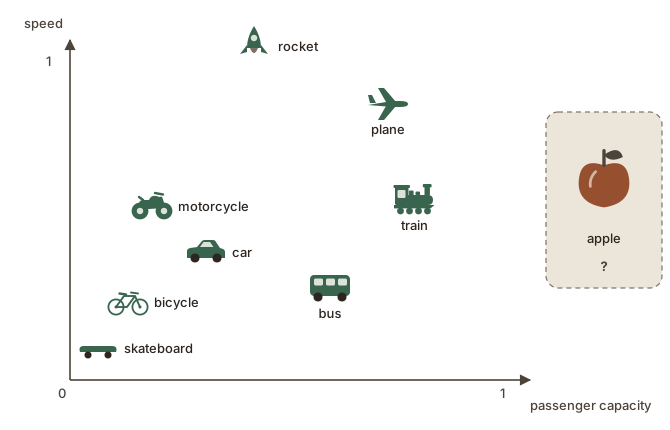
![Un graphique à deux dimensions avec le nombre de passagers en abscisse et la vitesse en ordonnée. La planche, le vélo, la moto et la voiture sont entourés à gauche comme transport individuel ; l'autobus, le train et l'avion sont entourés à droite comme transport collectif ; la fusée est seule en haut à gauche, avec le vecteur [0,4 ; 1,0].](../../../../../figures/language-as-numbers/word-embeddings/transport-space.svg)