Accents and UnicodeAccents et Unicode
You saw it on the ranges page: [a-zA-Z] ignores “é”, “ç” and “û”. The same
goes for \w, which is exactly [a-zA-Z0-9_]. Both stop at ASCII.
For French this is a real problem: an expression that looks as though it finds every word silently misses a good share of them. Unicode properties solve it:
\p{L}→ any letter, accents included;\p{Lu}→ an uppercase letter;\p{Ll}→ a lowercase letter.
To use \p{...}, the u (Unicode) flag has to be on: it is in every exercise
in the module, and in the gmu setting recommended for regex101.
On y va ensemble. Elle a fini. Il ira à Montréal en mai. J'ai vu 5 pommes.On y va ensemble. Elle a fini. Il ira à Montréal en mai. J'ai vu 5 pommes. ␣y␣ ␣a␣ ␣à␣ ␣ space · ⇥ tab · ⏎ line break · ◆ empty match␣ espace · ⇥ tabulation · ⏎ retour à la ligne · ◆ correspondance vide ␣y␣ ␣a␣ ␣à␣ ␣ space · ⇥ tab · ⏎ line break · ◆ empty match␣ espace · ⇥ tabulation · ⏎ retour à la ligne · ◆ correspondance vide 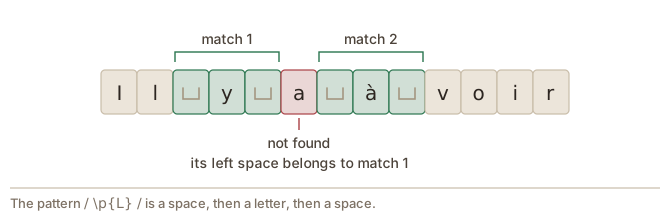
Vous l’avez vu dès la page sur les plages : [a-zA-Z] ignore « é », « ç » ou
« û ». Il en va de même pour \w, qui est exactement [a-zA-Z0-9_]. Les deux
s’arrêtent à l’ASCII.
Pour le français, c’est un vrai problème : une expression qui a l’air de trouver tous les mots en manque silencieusement une bonne partie. Les propriétés Unicode le résolvent :
\p{L}→ n’importe quelle lettre, accents compris ;\p{Lu}→ une lettre majuscule ;\p{Ll}→ une lettre minuscule.
Pour utiliser \p{...}, le drapeau u (Unicode) doit être actif : c’est le
cas dans tous les exercices du module et dans le réglage gmu recommandé pour
regex101.
On y va ensemble. Elle a fini. Il ira à Montréal en mai. J'ai vu 5 pommes.On y va ensemble. Elle a fini. Il ira à Montréal en mai. J'ai vu 5 pommes. ␣y␣ ␣a␣ ␣à␣ ␣ space · ⇥ tab · ⏎ line break · ◆ empty match␣ espace · ⇥ tabulation · ⏎ retour à la ligne · ◆ correspondance vide ␣y␣ ␣a␣ ␣à␣ ␣ space · ⇥ tab · ⏎ line break · ◆ empty match␣ espace · ⇥ tabulation · ⏎ retour à la ligne · ◆ correspondance vide 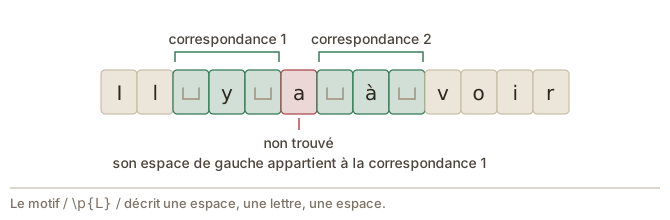
Sources
- MDN Web Docs (n.d.). Regular expressions. MDN JavaScript Guide, Mozilla. https://developer.mozilla.org/en-US/docs/Web/JavaScript/Guide/Regular_expressions
Sources
- MDN Web Docs (n.d.). Regular expressions. MDN JavaScript Guide, Mozilla. https://developer.mozilla.org/en-US/docs/Web/JavaScript/Guide/Regular_expressions